

Many families assume that adult day care is a step toward giving up — a sign that an aging parent can no longer manage. In reality, it's often the opposite. Adult day care is one of the most practical tools available for keeping your parent at home longer, reducing isolation, and giving you the breathing room you need as a caregiver. This guide walks you through what adult day care actually is, who benefits most, how to choose a quality program, and what most families overlook when making this decision.
Table of Contents
- What is adult day care? Core features and benefits
- Who benefits most? Identifying good candidates for adult day care
- How adult day care supports both seniors and families
- Choosing quality care: Key factors and pitfalls
- Our take: What most families miss about adult day care
- Next steps: Compassionate support and resources for your family
- Frequently asked questions
Key Takeaways
| Point | Details |
|---|---|
| Adult day care explained | Supervised daytime programs help older adults live at home longer with structured support and socialization. |
| Who benefits most | Adult day care is ideal for those needing daytime supervision, companionship, or help with routine care—not only dementia patients. |
| Dual-family impact | These programs relieve caregiver stress and promote mental, emotional, and social wellbeing for both seniors and their families. |
| Quality matters | Look for strong staff training and programming variety—avoid centers with high turnover or minimal activities. |
| Proactive support | Starting adult day care before a crisis can greatly improve independence and family harmony. |
What is adult day care? Core features and benefits
Adult day care might sound unfamiliar, but the concept is straightforward. Adult day services is a supervised, daytime community program that supports adults who can't safely be alone for extended periods, helping them stay in their own homes longer. Programs typically run weekdays during business hours, so your parent attends during the day and comes home each evening.
This makes adult day care very different from other care options. Here's a quick comparison to help you see where it fits:
| Care type | Location | Hours | Level of care |
|---|---|---|---|
| Adult day care | Community center | Daytime only | Supervised, social, activity-based |
| Home health aide | Parent's home | Scheduled hours | Medical or personal care at home |
| Assisted living | Residential facility | Around the clock | Full-time supervised living |
| Memory care | Specialized facility | Around the clock | Intensive dementia-specific support |
Adult day care fills a gap that many families don't realize exists. Your parent doesn't need full-time residential care, but they also shouldn't be alone all day. This is where adult day care steps in, offering structure, companionship, and supervision without uprooting your parent from their home.
Most programs offer a reliable daily routine that includes:
- Structured activities such as crafts, music, gentle movement, and games
- Social interaction with peers in a group setting
- Nutritious meals and snacks prepared on-site
- Health monitoring by trained staff, sometimes including nursing support
- Transportation to and from the center for those who need it
- Personal care assistance such as help with grooming or mobility
The structure matters more than it might seem. For aging adults, a predictable routine supports cognitive function, emotional stability, and physical health. Many participants actually look forward to their days at the center because it gives them something to do, people to see, and a sense of purpose.

For practical caregiving resources and tools to help you organize your parent's care, it helps to understand all the options on the table before making any decisions. Adult day care is often underutilized simply because families don't know enough about it to consider it.
It's also worth knowing that adult day care is not one-size-fits-all. Some centers specialize in dementia care. Others focus on social programming for seniors who are relatively independent but lonely or at risk. Costs vary by region, and many programs accept Medicaid or offer sliding scale fees, so financial barriers may be smaller than you expect.
Who benefits most? Identifying good candidates for adult day care
Once you know what adult day care offers, the next step is deciding whether it's right for your loved one. Not every senior needs it, but for those who do, it can make a meaningful difference.
Here are common profiles of older adults who tend to benefit most:
| Situation | Why adult day care helps |
|---|---|
| Mild to moderate cognitive decline | Provides safe supervision and mental stimulation |
| Social isolation or loneliness | Offers daily peer interaction and community |
| Mobility challenges | Staff support reduces fall risk and encourages safe movement |
| Caregiver working full time | Fills supervision gap during work hours |
| Early to mid-stage dementia | Structured routine supports memory and reduces anxiety |
Research supports the value for people living with dementia in particular. Person-centered outcomes in adult day centers show that participants with dementia reported feeling included and supported, with many developing a "second home" attachment to their day center. That kind of emotional connection is hard to replicate at home, especially when family caregivers are managing their own work and responsibilities.
Here is a practical way to assess whether your parent might be a good fit:
- Can they be safely alone for six or more hours? If not, some form of daytime support is needed.
- Are they showing signs of isolation or withdrawal? Social engagement is a genuine health factor, not just a comfort.
- Do you notice early signs of memory changes? Our early dementia signs resource can help you assess what you're observing.
- Are you, as the caregiver, struggling to maintain balance? Your wellbeing is part of the equation too.
- Does your parent resist staying home alone? Some older adults are more comfortable in a group setting than family members realize.
Pro Tip: Don't wait for a crisis to explore adult day care. Many families find it easiest to introduce the idea as a social opportunity rather than a care intervention. "They have a great art program you might enjoy" lands very differently than "We're worried you're not safe alone."
Adult day care is not appropriate for everyone. If your parent requires constant medical monitoring, is in hospice care, or has behavioral challenges that could be disruptive in a group setting, a different level of care may be more suitable. Consulting with your parent's doctor and reviewing our dementia care guide can help you think through those situations with more clarity.
The goal is always to match your parent's actual needs with the right level of support, not to find a solution that just ticks a box.
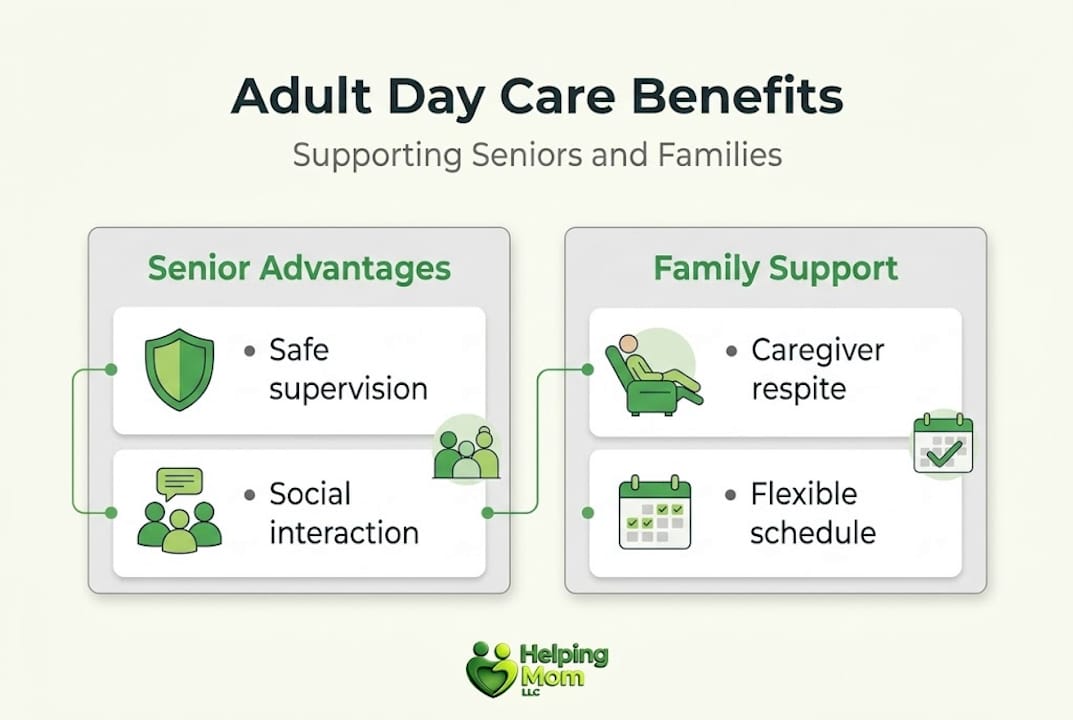
How adult day care supports both seniors and families
Knowing who benefits is only part of the picture. Let's explore how adult day care tangibly improves wellbeing for both seniors and their families.
For your aging parent, the benefits go deeper than filling the hours. Community, belonging, and purposeful activity are not small things. They are tied to physical health, cognitive function, and emotional resilience. Seniors who attend adult day care regularly often report:
- Reduced feelings of loneliness and isolation
- Greater sense of routine and predictability
- Improved mood and engagement
- Maintained or improved physical function through activity programming
- A sense of identity outside the home, something that can quietly erode for older adults who are housebound
"When my mother started going to her day center three times a week, she came home with stories. She had opinions about who won the card game. That person — curious, social, engaged — had been fading. The center brought her back a little."
This is the kind of shift that's hard to quantify but very real for families who experience it.
For family caregivers, the impact is equally significant. Caregiving without any respite is a well-documented path toward burnout. Evidence-based supports in adult day services can succeed when programs adapt their approach, align goals with families, and address staff capacity alongside caregiver needs. In other words, good programs think about you, not just your parent.
What does that mean in practical terms? It means:
- You can work a full day without worry, knowing your parent is supervised and engaged
- You get mental space to rest, which makes you a more patient and present caregiver when your parent is home
- Your stress levels decrease when a trained team is sharing the responsibility
- You maintain your own identity outside the role of caregiver
Exploring caregiver well-being resources alongside adult day care planning can help you approach this as a whole-family decision, not just a logistical fix. The most sustainable caregiving arrangements are ones that account for everyone involved.
You can also find additional support, practical advice, and real-world guidance on our caregiving tips blog, where we regularly cover the emotional and practical sides of caring for an aging parent.
Choosing quality care: Key factors and pitfalls
You understand the benefits and impacts. Now let's help you sort out which adult day care is a good fit and help you avoid some common mistakes.
Not all adult day care programs are created equal. Program quality depends heavily on staffing, training, and safety considerations. Research on physical activity programming in adult day services specifically found systemic constraints like staffing shortages and a fear of falls, which can lead programs toward more conservative, often seated-only activity choices. That's a limitation worth knowing about before you enroll.
Here's what to look for when you visit or call a center:
- Staff-to-participant ratio: Lower ratios mean more individual attention. Ask specifically what the ratio is during peak hours.
- Staff training and credentials: Are there licensed nurses or social workers on staff? What training do care aides receive?
- Turnover rate: High staff turnover often signals deeper organizational problems and affects the consistency your parent needs.
- Activity variety: Does the program offer both seated and active options? Is there flexibility for different ability levels?
- Safety protocols: What happens if a participant falls or has a medical concern? What is the emergency plan?
- Transportation quality: Is it reliable, accessible, and staffed by trained drivers?
- Licensing and oversight: Is the center licensed by your state? Are inspection records available?
Pro Tip: Visit the center unannounced if you can. Scheduled tours show you the best version of a program. A drop-in visit during a regular session shows you the reality.
Watch for these yellow and red flags:
- Staff seem disengaged, distracted, or unfamiliar with participants by name
- Activities are limited to television or very passive options every day
- The space feels crowded or understaffed during your visit
- Management is reluctant to share licensing information or inspection history
- Participants look bored, disengaged, or unattended
You can use our care planning template to organize your notes from multiple center visits, which makes it much easier to compare options side by side. If you're also thinking about broader safety considerations at home, our aging parents at home resource covers practical ways to support your parent's safety between center days.
Choosing the right program takes a little time, but the effort is well worth it. A quality adult day care center becomes a genuine partner in your parent's care.
Our take: What most families miss about adult day care
Here's something we've noticed after years of supporting families through caregiving decisions: adult day care is almost always considered too late.
Families tend to wait until there's a crisis. A fall. A concerning incident at home. A moment where continuing the current arrangement clearly isn't working. By that point, the transition is harder, the options feel more urgent, and everyone is already exhausted.
But adult day care works best as an early, proactive tool. Not a last resort. When your parent starts attending before things become difficult, they have more time to adjust, more energy to engage, and a better chance of genuinely enjoying the program. It becomes a positive part of their week rather than a sign that something has gone wrong.
The other thing families often miss is the stigma piece. Some older adults push back hard against the idea, seeing it as a step toward losing their independence. The reframe that tends to work is simple: adult day care is one of the things that makes staying home possible. It's a support structure, not a replacement for home life. Families who approach it that way, calmly and without pressure, often find their parent warms up to the idea faster than expected.
If you're feeling the early edges of caregiver fatigue, please don't wait. Looking into caregiver well-being advice now, before you hit a wall, is one of the most practical things you can do for both yourself and your parent.
Next steps: Compassionate support and resources for your family
If this article has helped clarify what adult day care is and whether it might be right for your family, the next step is simply gathering more information at a pace that feels manageable. Our caregiving guide is a good starting point for families navigating these early decisions. When you're ready to think about your own needs as a caregiver, our well-being support resources are there for you. And if you're thinking about broader safety and comfort at home, explore our aging in place guide for practical, calming guidance. You don't have to figure this all out at once.
Frequently asked questions
Is adult day care only for people with dementia?
No, adult day care serves anyone who needs supervised daytime care and socialization, not just those with dementia. It supports a wide range of older adults, including those dealing with loneliness, mobility challenges, or mild health needs.
How does adult day care improve caregiver well-being?
It provides caregivers with needed respite and reduces daily stress. Evidence-based supports in adult day services work best when programs adapt to meet both the senior's and the caregiver's needs together.
What should I look for when selecting an adult day care center?
Focus on staff training, activity variety, safety protocols, and staff-to-participant ratios. Program quality depends heavily on staffing and safety practices, so ask detailed questions and visit in person before committing.
Does adult day care help maintain independence?
Yes. By providing structured, supervised daytime support, it allows older adults to stay in their homes longer rather than transitioning to residential facilities prematurely.
Are there options for transportation to adult day care centers?
Most programs include transportation as part of their daily support structure, making attendance possible even for seniors who no longer drive. Always confirm transportation details when you first contact a center.