

There's a particular kind of worry that settles in somewhere around your 40s or 50s. It isn't dramatic or sudden. It's more like a quiet hum in the background of your daily life, a subtle sense that something has shifted with your mom or dad. Maybe they've had a health scare. Maybe you've noticed small changes during your last visit. You're juggling your own family, your job, and now this growing sense of responsibility for someone who once took care of you. This experience has a name: aging parent anxiety. And if you've been feeling it, you're far from alone.
Table of Contents
- What is aging parent anxiety?
- Causes and triggers: Why anxiety peaks for adult children
- How aging parent anxiety affects your life and health
- Practical strategies and support resources
- Why embracing imperfection is the antidote to aging parent anxiety
- Take the next step: Resources that make caregiving easier
- Frequently asked questions
Key Takeaways
| Point | Details |
|---|---|
| Aging parent anxiety defined | It's the persistent stress and worry about caring for or supporting an aging parent. |
| High-risk triggers identified | Transitions, complex diagnoses, and family dynamics sharply increase anxiety for caregivers. |
| Impact on your health | Chronic anxiety from caregiving can cause physical, emotional, and relationship strain. |
| Support strategies work | Self-care, therapy, support groups, and honest conversation can greatly reduce anxiety. |
| Resources are available | You can access checklists, guides, and emotional support tailored for adult children and caregivers. |
What is aging parent anxiety?
Aging parent anxiety is persistent worry about a parent's health, safety, finances, or care. It isn't a clinical diagnosis. It's a very human response to watching your parent age and realizing that the roles between you are slowly, and sometimes painfully, beginning to shift.
This type of anxiety tends to build gradually. One day you're calling to check in. The next, you're analyzing every cough or forgotten word. You begin mentally rehearsing difficult scenarios, wondering if your parent is safe at home alone, whether they're eating properly, or what happens if they need more care than you can provide.
The emotions that come with this are layered and sometimes contradictory:
- Love and concern that fuel constant vigilance
- Guilt about not doing enough, or not being close enough geographically
- Helplessness when you can't fix what's happening
- Fear of making the wrong decisions on their behalf
- Obligation that can make you feel trapped between competing responsibilities
These feelings are completely valid. If you're also navigating coping with caregiver guilt, you'll recognize how tightly these emotions are woven together.
Research confirms that caregiving stress is widespread and serious. Dementia and cancer caregiving are associated with significantly higher anxiety levels, and women in the sandwich generation (those caring for both children and aging parents simultaneously) report greater emotional distress than their peers. Chronic caregiving stress can eventually cause health anxiety in caregivers themselves, meaning you start worrying about your own health in addition to your parent's.
"Caring for a parent isn't something most of us were trained for. It's something we figure out as we go, usually while managing everything else in our lives."
If you're already thinking about caring for a parent with dementia, the emotional weight can feel especially heavy. Understanding what's happening inside you is the first step toward managing it.
Causes and triggers: Why anxiety peaks for adult children
Understanding why this anxiety surfaces is the first step toward regaining some sense of control. Let's look at what drives these worries and who's particularly at risk.
Aging parent anxiety doesn't arrive without a reason. It tends to spike during specific transitions or circumstances. Here are the most common triggers:
- A health crisis or diagnosis. A hospitalization, a fall, or a new diagnosis like cancer or cognitive decline can immediately shift your perspective. Suddenly, your parent's vulnerability becomes impossible to ignore.
- Noticeable cognitive changes. When you start seeing early signs of dementia, like repeated questions, confusion about time, or getting lost on familiar routes, your concern understandably intensifies.
- Role reversal. There's a profound emotional adjustment that happens when you realize you're now the one looking after your parent rather than the other way around. This shift can bring grief, discomfort, and a sense of lost identity.
- Family conflict. Disagreements with siblings about care decisions, finances, or who does what are extremely common. These conflicts amplify anxiety by adding interpersonal stress on top of an already difficult situation.
- Geographic distance. Not being physically present creates a different but equally real kind of worry. You fill in the gaps with your imagination, and it's rarely reassuring.
- Financial concerns. Uncertainty about how to fund care, whether a parent has enough savings, or what happens when money runs out is a major source of ongoing stress.
Certain groups face compounded challenges. Women in the sandwich generation report more distress from caregiving compared to men or those without dependent children at home. Those providing care for parents with dementia or serious illnesses like cancer carry a higher burden of chronic anxiety.
Here's a quick look at how different caregiving situations compare in terms of anxiety intensity:
| Caregiving situation | Anxiety level | Key contributing factor |
|---|---|---|
| Healthy parent, some monitoring | Low to moderate | General aging concerns |
| Parent with mobility limitations | Moderate | Home safety, fall risk |
| Sandwich generation caregiving | High | Competing demands |
| Parent with cancer diagnosis | High | Uncertainty, medical complexity |
| Parent with dementia | Very high | Unpredictability, behavioral changes |
Accessing caregiver emotional support early, before burnout sets in, makes a measurable difference in your ability to sustain care over the long term.
Pro Tip: If anxiety spikes every time you get off the phone with a parent, that's a signal worth paying attention to. Write down what specifically worries you most. Named fears are easier to address than vague dread.
How aging parent anxiety affects your life and health
Anxiety isn't just a feeling. It alters your everyday life and even your physical health. Here's what every adult child navigating this should understand.

When worry becomes chronic, it stops being a background hum and starts being a real burden. The effects touch nearly every part of your life.
Physical effects are often the first to appear:
- Disrupted sleep, often from nighttime worry spirals
- Fatigue and low energy that don't resolve with rest
- Increased susceptibility to illness when your immune system is under strain
- Tension headaches or digestive problems linked to chronic stress
- Risk of burnout, where you feel completely depleted and unable to function as a caregiver
Emotional symptoms build over time:
- Irritability and short-temperedness with people you love
- Difficulty concentrating at work or home
- A persistent sense of guilt, even when you're doing a great deal
- Feeling like nothing you do is ever quite enough
- Emotional numbness as a way of coping with ongoing stress
Relationship friction is real and often underacknowledged:
| Area of life | Common impact |
|---|---|
| Marriage or partnership | Reduced quality time, increased tension |
| Parenting | Distraction, reduced patience |
| Friendships | Social withdrawal, isolation |
| Work performance | Missed deadlines, difficulty focusing |
| Personal health | Skipped medical appointments, poor nutrition |
If these effects are already present in your life, you're not failing. You're experiencing a predictable response to an objectively difficult situation. The important thing is not to let it continue unchecked. Chronic caregiving stress has been shown to produce health anxiety in caregivers themselves, creating a cycle that's genuinely hard to break without intentional intervention.
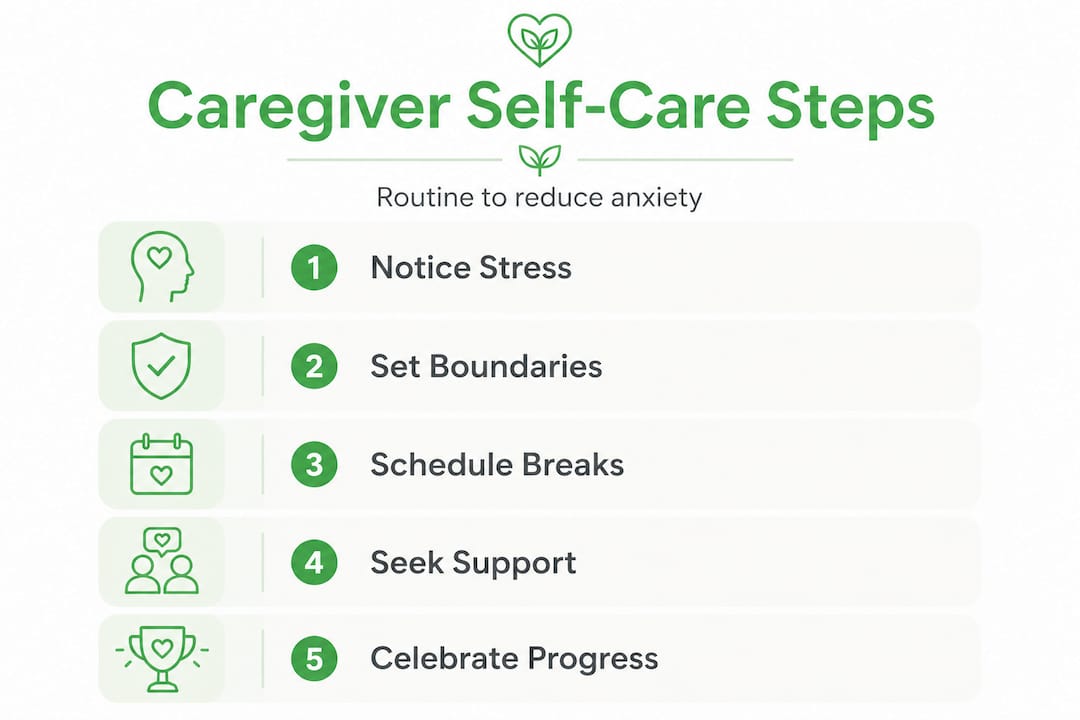
Pro Tip: Block 15 minutes per week on your calendar specifically for your own wellbeing. It could be a walk, a phone call with a friend, or simply sitting quietly. Consistency matters more than duration.
The earlier you start supporting your own wellbeing as a caregiver, the better equipped you'll be to show up for your parent over time. Self-care isn't a luxury in this context. It's a functional necessity.
Practical strategies and support resources
Awareness is only useful when it leads to action. Here's how you can start feeling better and access real support.
You don't need to overhaul your entire life to reduce caregiver anxiety. Small, consistent steps build real momentum. Here's where to begin:
- Prioritize self-care as non-negotiable. Sleep, nutrition, and movement aren't extras. They form the foundation from which everything else is managed. Even modest improvements in these areas can shift your baseline.
- Delegate and ask for help. Many caregivers carry far more than their share simply because they haven't asked others to step in. Talk to siblings, other family members, or trusted friends about specific tasks they can take on. Be concrete in your requests.
- Use your Employee Assistance Program (EAP). Many employers offer free counseling sessions through an EAP. These are confidential, often available quickly, and specifically designed for personal and family stress. Check your HR materials or employee portal.
- Join a support group. Organizations like the American Psychological Association (APA), Mental Health America (MHA), AARP, and Care.com all offer resources for caregivers. Support groups, whether in person or online, can reduce isolation and provide practical perspective from people who genuinely understand.
- Consider therapy. A therapist who works with family systems or caregiver issues can help you navigate guilt, boundary struggles, and the role reversal that comes with this stage of life. Coping with guilt tips can be a starting point, but professional support often goes deeper.
- Have open conversations about finances. Financial uncertainty is one of the biggest drivers of caregiver anxiety. Research shows that open financial discussions reduce worry for 60 to 84 percent of caregivers surveyed. You don't need to have all the answers. Simply beginning the conversation with your parent or siblings significantly lowers the emotional charge.
- Build a communication rhythm. Regular, structured conversations with aging parents about their wishes, needs, and daily experiences reduce guesswork and anxiety on both sides.
If you're in the sandwich generation or caring for a parent with dementia or cancer, standard advice often falls short. You may need more targeted support:
- Connect with a geriatric care manager who can coordinate complex care needs
- Access memory care resources specific to dementia caregiving
- Explore respite care options so you have genuine time to recover
- Look into local caregiver coalitions or hospital social worker referrals
"You cannot pour from an empty cup. Asking for help isn't weakness; it's the most practical thing you can do for your parent and for yourself."
Finding emotional support resources that fit your specific situation is worth the time it takes. Not every resource is designed for every caregiver, and the right fit can make a meaningful difference.
Why embracing imperfection is the antidote to aging parent anxiety
Here's something most caregiving guides won't say directly: the pursuit of doing everything perfectly is one of the fastest paths to complete burnout.
It's understandable. You love your parent. You want to get this right. So you research every option, attend every appointment, respond to every call, and feel personally responsible for every outcome. And then, when something goes wrong anyway, and something always does eventually, you take it as evidence that you weren't enough.
This is a painful and very common trap. The truth is that caregiving is inherently uncertain. You are not a medical professional, a social worker, or a miracle worker. You are a person doing something incredibly hard while also managing your own life. That is already more than enough.
What actually matters isn't perfection. It's presence. It's the phone call you make even when you're tired. It's the conversation you initiate even when it feels awkward. It's showing up imperfectly and consistently, which is something no amount of guilt or anxiety can replicate.
Reframing your role this way doesn't mean lowering your standards. It means recognizing that caregiver guilt and self-care are deeply connected. When you release the expectation of flawlessness, you actually have more emotional capacity to be genuinely present for your parent.
Most families stumble through this stage. They have hard conversations that don't go perfectly. They make decisions with incomplete information. They argue, apologize, and try again. What unites the families who come through it with their relationships intact isn't that they got everything right. It's that they kept going, kept communicating, and kept asking for help when they needed it.
Progress in caregiving happens one conversation at a time. One phone call. One form filled out. One boundary set. Give yourself credit for every step, not just the ones that feel significant.
Take the next step: Resources that make caregiving easier
You don't have to navigate this alone. At Helping Mom, we've built practical, compassionate guides specifically for adult children like you, covering everything from home safety to emotional wellbeing.
If you're thinking about whether your parent can safely stay at home, our aging in place guide walks you through the key considerations in plain language. For a room-by-room assessment of potential hazards, our home safety checklist is a simple tool you can use on your next visit. And when the emotional weight of caregiving feels like too much, our caregiver well-being resources offer grounded, realistic guidance for protecting your own health while caring for someone you love. Each resource is designed to reduce overwhelm, not add to it.
Frequently asked questions
What are the signs of aging parent anxiety?
Common signs include persistent worry, sleep trouble, irritability, and feeling overwhelmed about your parent's health or care decisions. Over time, chronic caregiving stress can lead caregivers to develop health anxiety about their own wellbeing as well.
How is anxiety different for those caring for parents with dementia?
Caregivers supporting parents with dementia have a much higher risk of chronic anxiety and distress due to unpredictable changes and challenging behaviors. Research confirms that dementia caregiving is among the highest-stress caregiving situations a person can face.
What resources can help with caregiver anxiety?
Support groups, therapy, self-care routines, and open family communication all help reduce caregiver anxiety. Groups through the APA, MHA, and AARP, combined with practical caregiver support tools, can provide meaningful, sustained relief.
Does talking about caregiving finances reduce anxiety?
Yes. Open financial discussions reduce worry for 60 to 84 percent of caregivers surveyed, making it one of the most impactful steps you can take to lower your overall stress level.
Is it common to feel guilty when supporting aging parents?
Feeling guilty is extremely common among caregivers. Setting clear boundaries and accessing therapy for guilt or peer support are two of the most effective ways to reduce guilt and prevent long-term burnout.