

TL;DR:
- Most resistance from aging parents stems from fears of losing independence, not stubbornness or rejection.
- Effective communication requires patience, gentle conversations, and involving healthcare professionals when needed.
An aging parent refusing help is one of the most common and emotionally exhausting challenges adult children face. According to the Elder Care Alliance, 77% of adult children report that their aging parents show resistance when offered assistance. That number is worth sitting with. It means you are not alone, and it means this resistance is not a personal rejection. It is a deeply human response to a difficult transition. Understanding why your parent says no, and how to respond with patience and respect, is the real starting point for making progress.
Why is my aging parent refusing help?
The most direct answer is this: fear drives refusal, not stubbornness. Your parent is not trying to make your life harder. They are trying to hold onto something they feel slipping away.
Here are the most common fears behind the resistance you are seeing:
- Fear of losing independence. For your parent's generation, self-sufficiency is tied to identity and dignity. Accepting help can feel like admitting defeat.
- Shame about needing assistance. Many older adults grew up in households where asking for help was seen as weakness. That belief does not disappear with age.
- Fear of burdening family. Your parent may be refusing precisely because they love you and do not want to become a source of stress or financial strain.
- Distrust of outsiders. The idea of a stranger coming into the home to provide care can feel threatening, even when the intention is kind.
- Denial as a coping mechanism. Denial is a psychological defense. It protects your parent from confronting a reality that feels overwhelming.
"Resistance often stems from fears, not actual stubbornness. Framing help as a way to preserve independence, rather than replace it, lowers defenses significantly."
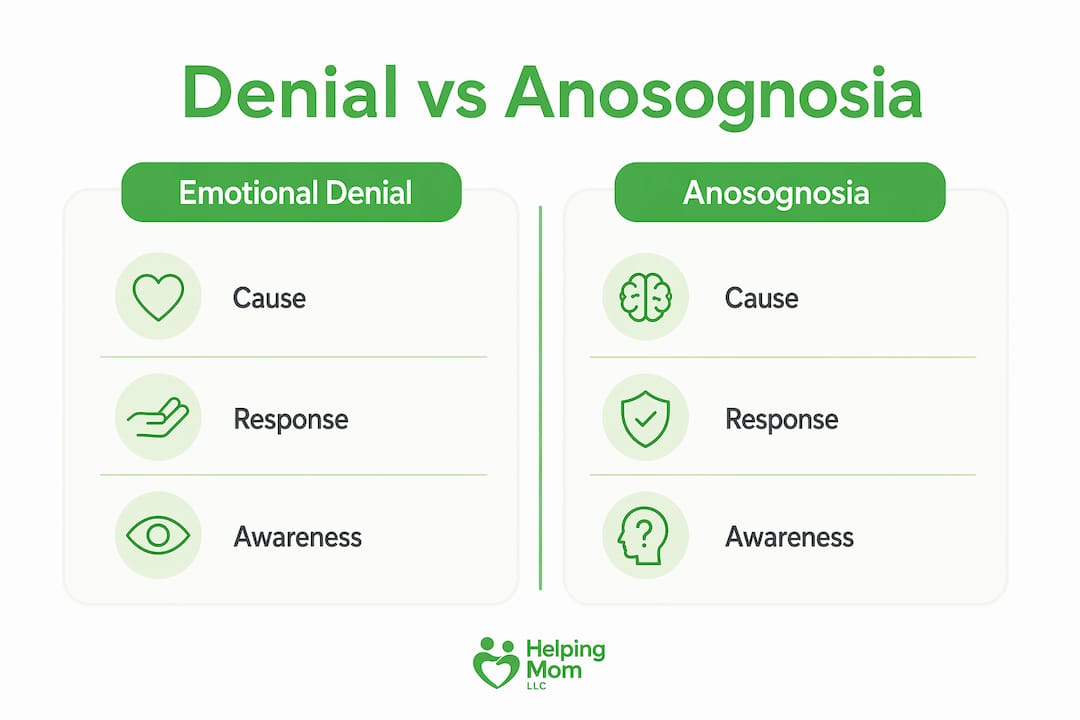
There is also a neurological dimension worth understanding. Anosognosia is a condition, common in dementia, where a person genuinely lacks awareness of their own deficits. This is not denial in the psychological sense. It is a symptom of the disease itself. The difference between denial and anosognosia matters enormously because the strategies that work for one will not work for the other.
Pro Tip: Before your next conversation, ask yourself whether your parent's resistance feels emotional and defensive, or whether they seem genuinely unaware of the problem. That distinction will shape everything about how you respond.
How do you talk to an aging parent who refuses help?
Effective communication with aging parents starts with one principle: lead with their values, not your concerns. When you open a conversation by listing everything that worries you, your parent hears criticism, not care. Start instead by asking what matters most to them.
Here is a practical sequence that works better than a single "big talk":
- Choose a calm, low-pressure moment. Avoid bringing up care needs during a stressful visit or right after an incident. A relaxed Sunday afternoon works better than a rushed phone call.
- Ask open-ended questions. Try "What would make you feel most comfortable at home?" rather than "I'm worried you're going to fall." Open questions invite dialogue instead of defensiveness.
- Validate their feelings first. Say "I understand you want to stay independent" before you say anything about what you think needs to change.
- Avoid ultimatums. Presenting a list of demands or issuing warnings tends to harden resistance. Your parent needs to feel like a partner in the conversation, not a problem being managed.
- Involve their physician. Doctors carry real weight in these conversations. A physician raising a safety concern lands differently than a worried adult child raising the same concern. Ask the doctor to address it directly during a scheduled visit.
- Stop if the conversation shuts down. Revisit the topic later rather than pushing through resistance. Forcing the conversation rarely produces agreement. It usually produces withdrawal.
One of the most consistent findings in elder care communication is that multiple gentle conversations spaced over months produce better outcomes than a single high-stakes discussion. Think of it as a slow, steady process rather than a problem to solve in one afternoon.
Pro Tip: If your parent shuts down, say "I hear you. We don't have to figure this out today." Then genuinely let it go for a few weeks. That kind of patience builds more trust than any argument.

You can find more guidance on talking with aging parents about care on the Helping-mom resource library.
What practical steps help when a parent resists care?
When communicating feels stuck, shifting your focus to small, concrete actions often opens a door that conversation alone cannot. The goal is not to solve everything at once. It is to build trust through low-stakes moments.
Start here:
- Offer one thing at a time. Presenting a full care plan overwhelms most people. Offer to help with one specific task, like picking up groceries or setting up a medication reminder app, and let that become normal before adding anything else.
- Give choices, not directives. "Would you prefer I come on Tuesday or Thursday?" preserves your parent's sense of control far better than "I'm coming over to help."
- Start with small, non-intrusive help. Medication reminders, minor household tasks, or driving to appointments are low-barrier entry points. They build a habit of receiving help without triggering the deeper fears around independence.
- Document safety incidents. If your parent falls, gets lost, or misses medications, write it down with dates and details. Clear documentation is critical if you ever need to involve a geriatrician, Adult Protective Services, or a legal professional.
- Request a geriatric assessment. A geriatrician can evaluate cognitive and physical function in a way that feels medical rather than familial. This removes the emotional charge from the conversation and puts the focus on health.
On the legal side, age 75 is widely recommended as the time to begin formal discussions about power of attorney, healthcare directives, and future care planning. Starting these conversations before a crisis makes them far less fraught.
| Situation | Recommended approach |
|---|---|
| Parent resists all offers of help | Start with one small, practical task and build from there |
| Parent denies any safety concerns | Involve their physician to raise concerns in a medical context |
| Parent shows signs of cognitive decline | Request a geriatric assessment and begin documenting incidents |
| Legal decisions are needed | Consult an elder law attorney, especially if capacity is in question |
Denial vs. dementia-related unawareness: why the difference matters
Understanding whether your parent's refusal comes from emotional denial or neurological unawareness changes everything about your approach. These two causes look similar from the outside but require very different responses.
| Factor | Emotional denial | Anosognosia |
|---|---|---|
| Cause | Psychological defense mechanism | Neurological symptom of dementia or brain injury |
| Awareness of deficits | Present but avoided | Genuinely absent |
| Response to gentle persuasion | Often improves over time | Rarely effective |
| Response to logical evidence | Can shift with trust and patience | Does not respond to logic or facts |
| Best approach | Long-term dialogue, emotional validation | Safety-focused interventions, caregiver support |
Emotional denial responds to patience, empathy, and repeated gentle conversations. Your parent knows on some level that things are changing. They need time and reassurance to accept that reality. Differentiating denial from anosognosia is the foundation for setting realistic expectations as a caregiver.
Anosognosia is different. When a parent with dementia insists they are fine, they are not being stubborn or deceptive. They genuinely cannot perceive the problem. Logic and evidence do not work in these cases. The focus shifts from persuasion to safety planning, environmental adjustments, and working with medical professionals to put protective structures in place.
Recognizing which situation you are in helps you stop blaming yourself when a conversation does not go the way you hoped. It also helps you direct your energy toward what will actually make a difference.
Key takeaways
Respecting your aging parent's autonomy while gently building their acceptance of help is the most effective long-term strategy for reducing resistance.
| Point | Details |
|---|---|
| Fear drives refusal | Most resistance comes from fear of losing independence, not stubbornness or personal rejection. |
| Communication takes time | Multiple gentle conversations over months work better than a single high-stakes discussion. |
| Small steps build trust | Starting with one low-barrier offer of help reduces resistance more than presenting a full care plan. |
| Denial and anosognosia differ | Emotional denial responds to patience; anosognosia requires safety-focused interventions instead. |
| Documentation matters | Recording safety incidents supports medical and legal professionals if intervention becomes necessary. |
What I've learned from watching families navigate this
I have seen a lot of families come to Helping-mom after months of frustration, feeling like they have tried everything. The most common thing I notice is that they have been trying to solve the problem in one conversation. They have been presenting evidence, making arguments, and waiting for their parent to see reason. And it has not worked.
What actually moves things forward is almost always quieter than that. It is the adult child who stops arguing and starts listening. It is the daughter who asks her father what he is most afraid of, and then actually sits with the answer. It is the son who offers to drive his mother to one appointment, without any agenda attached, and lets that small act of care speak for itself.
The other thing I want to say clearly is this: your parent's refusal is not a measure of your love or your effort. Helping reluctant seniors accept care is genuinely hard, and it takes longer than most people expect. That is not a failure. It is just the reality of this kind of work.
Take care of yourself in the process. Caregiver exhaustion is real, and you cannot sustain this kind of patience if you are running on empty. The work of supporting an aging parent is a long one. Pace yourself accordingly.
— Mike
How Helping-mom can support you from here
If you are dealing with an aging parent who resists help, Helping-mom has practical resources built specifically for this stage of caregiving. The home safety guide for seniors walks you through concrete ways to reduce fall risks and improve safety at home, even when your parent is not fully on board yet. There are also guides on accepting help conversations that give you word-for-word approaches for reducing conflict and building cooperation. If you are feeling the weight of caregiving yourself, the caregiver well-being resources offer support for managing stress and staying grounded. You do not have to figure this out alone.
FAQ
Why does my aging parent refuse help even when they clearly need it?
Fear of losing independence is the most common reason. Your parent may also feel shame about needing assistance or worry about burdening you, which can make refusal feel safer than acceptance.
How do I talk to a stubborn elderly parent about accepting care?
Lead with empathy and ask open-ended questions about what they value most. Multiple gentle conversations over time are more effective than one direct confrontation, and involving their physician can make a significant difference.
What is the difference between denial and anosognosia in aging parents?
Denial is a psychological defense where your parent avoids accepting a difficult reality. Anosognosia is a neurological symptom of dementia where they genuinely cannot perceive their own deficits. The two require very different approaches.
When should I involve a doctor or legal professional?
Involve a physician when safety concerns are not being addressed through family conversation alone. For legal matters, age 75 is recommended as the time to begin formal planning around power of attorney and healthcare directives.
What is the best first step when a parent refuses all help?
Start with one small, low-pressure offer rather than a full care plan. Entry-level assistance like medication reminders or help with a single errand builds trust gradually and reduces the resistance that comes with larger asks.