

Starting a beginner caregiver workflow doesn't have to feel like climbing a mountain. The most effective approach is a seven-step plan you can begin today: (1) identify your role and priorities, (2) gather and organize essential information, (3) build a daily and weekly schedule, (4) set up medication and appointment management, (5) do a quick home safety check, (6) ask for help and build a support team, and (7) protect your own health with a short nightly review. Trusted resources like the National Institute on Aging, the Caregiver Action Network, and Helping-mom all point to the same starting place: write it down, share it, and adjust as you go.
- Identify your caregiving role and top priorities
- Gather medical records, contacts, and legal documents
- Build a daily and weekly schedule you can share
- Set up medication tracking and appointment reminders
- Walk through the home and fix the easiest safety hazards
- Ask for help with a concrete task menu
- Do a 5–10 minute nightly review to protect your own health
Your 10-minute next action: Call your parent's primary care doctor today and ask for a current medication list and the name of any specialists involved in their care. That one call gives you the foundation for steps 2 through 4.
Pro Tip: Keep a small notebook or a notes app open during that first call. You'll collect more useful information in 10 minutes than you'd gather in a week of trying to remember details.
Key Takeaways
A sustainable beginner caregiver workflow starts with one centralized record, a shared schedule, and a short nightly review that keeps the plan current without adding hours to your day.
| Point | Details |
|---|---|
| Start with one source of truth | Collect meds, contacts, and legal docs into a single binder or shared folder in your first week. |
| Build a shareable schedule | A daily routine and weekly task grid prevent tasks from falling through the cracks during handoffs. |
| Medication systems prevent errors | One pharmacy, a weekly pill organizer, and phone alarms are the simplest reliable setup. |
| Ask with a task menu | Concrete, time-limited requests get real help; vague offers rarely do. |
| Nightly review prevents burnout | A 5–10 minute check-in each evening shifts caregiving from reactive to proactive over time. |
| Helping-mom provides ready tools | Printable templates, Zoom consultations, and in-person assessments support each step of the workflow. |
Table of Contents
- What does a beginner caregiver workflow look like day to day?
- Step 1: How do you figure out your caregiving role and priorities?
- Step 2: What essential information do you need to gather first?
- Step 3: How do you build a daily schedule you can actually share?
- Step 4: How do you keep medications and appointments from slipping through the cracks?
- Step 5: What are the quickest home safety fixes to make right now?
- Step 6: How do you actually ask for help without it feeling awkward?
- Step 7: How do you protect your own health while caregiving?
- What should you expect in the first 30, 60, and 90 days?
- Where can you find trustworthy resources and short training?
- A calm note on what to realistically expect
- Helping-mom supports your workflow with practical tools and real guidance
- Sources
- FAQ
What does a beginner caregiver workflow look like day to day?
The table below gives you an at-a-glance view of all seven steps, with realistic time estimates and a daily/weekly/one-time label so you can plan your schedule without guessing.
| Step | Action | Time Estimate | Frequency | Who to Loop In |
|---|---|---|---|---|
| 1. Identify role & priorities | List what you must handle vs. what others can do | 30–60 min | One-time (revisit monthly) | Family members, employer if needed |
| 2. Gather essential info | Collect meds, contacts, insurance, legal docs into one binder or folder | 1–2 hours | One-time (update as needed) | Doctor's office, pharmacy, attorney |
| 3. Build a schedule | Write a daily routine and weekly task grid | 60 minutes | One-time setup; adjust weekly | Family helpers, paid aides |
| 4. Medication & appointments | Create a med list; set reminders; sync pharmacy | 30 min setup | Daily check; weekly refill review | Pharmacy, doctor's office |
| 5. Home safety check | Walk each room; fix trip hazards; add grab bars or night-lights | 1–2 hours | One-time; revisit every 3 months | Occupational therapist if needed |
| 6. Ask for help | Share a task menu with family and friends; contact local programs | 30 min | Weekly | Family, Area Agency on Aging |
| 7. Nightly review | 5–10 min check-in: what worked, what to adjust | 5–10 min | Daily | Just you (or a co-caregiver) |
The Caregiver Action Network recommends weekly schedules, shared calendars, and delegation as the core time-management tactics that prevent burnout. Starting with this grid gives you a realistic picture of where your hours are actually going.
Step 1: How do you figure out your caregiving role and priorities?
Before you can organize anything, you need to know what you're actually responsible for. Many new caregivers try to do everything, and that's where the trouble starts.
Primary vs. supporting caregiver. A primary caregiver handles daily tasks: medications, meals, transportation, and personal care. A supporting caregiver fills in, runs errands, or manages finances. Neither role is lesser. What matters is that someone owns each task clearly, so nothing falls through the cracks.
A simple prioritization framework helps you decide where to focus first:
- Safety first. Is your parent at risk of falling, wandering, or missing critical medications? These come before anything else.
- Medications second. Missed or doubled doses cause real harm. Get this system right early.
- Appointments third. Specialist visits, lab work, and follow-ups need to stay on track.
- Daily living tasks fourth. Meals, hygiene, and household chores matter, but they're also the easiest to delegate.
Scripts that actually work:
When calling a doctor's office: "Hi, I'm [name], the adult child of [parent's name]. I'm now helping coordinate their care. Can you add me to their file as an authorized contact, and can you send me their current medication list?"
When asking a sibling to help: "I need someone to handle grocery runs on Tuesdays. Could you take that on for the next month? I'll handle the doctor appointments."
When telling an employer: "I'm managing some family caregiving responsibilities. I may occasionally need flexibility for a morning appointment. I wanted to give you a heads-up and talk through how we can make this work."
Clarity about your role from the start prevents the resentment that builds when one person silently carries everything.
Step 2: What essential information do you need to gather first?
The single most common mistake new caregivers make is relying on memory. One centralized record, whether a physical binder or a shared online folder, reduces errors and makes handoffs far safer when another family member steps in.

The National Institute on Aging provides checklists for exactly what to collect. Here are the core fields to capture:
| Category | What to Record |
|---|---|
| Medical diagnoses | Current conditions, date of diagnosis |
| Medications | Name, dose, frequency, reason, prescribing doctor |
| Allergies | Medications, foods, environmental triggers |
| Primary care doctor | Name, phone, fax, patient portal login |
| Specialists | Name, specialty, phone, next appointment date |
| Insurance | Medicare/Medicaid numbers, supplemental plan, pharmacy benefit card |
| Emergency contacts | Family members with phone numbers and relationship |
| Legal documents | Location of healthcare proxy, power of attorney, living will |
| Daily routines | Wake time, meal preferences, sleep schedule, mobility notes |
Storage options and trade-offs:
A physical binder is reliable during power outages and easy for any helper to grab in an emergency. The downside is that it can get outdated if you forget to update it.
A shared online folder (Google Drive, iCloud, or a HIPAA-aware app like CaringBridge) lets multiple family members access the same document from anywhere. Updates are instant, but it requires everyone to have a device and know how to use it.
A combination of both tends to work best: keep a one-page care summary printed and posted somewhere visible (inside a kitchen cabinet door, for example), and maintain the full record digitally.
Pro Tip: Take a photo of the one-page care summary with your phone right now. If your parent has a medical emergency and you're not home, you can read it to the 911 dispatcher or ER nurse in seconds.
Practitioners consistently find that the most successful caregiving workflows use one centralized source of truth rather than fragmented notes and verbal updates. Build yours in the first week. You'll refer to it constantly.
Step 3: How do you build a daily schedule you can actually share?
A schedule turns caregiving from a series of interruptions into a predictable routine. Predictability reduces anxiety for both you and your parent.
Sample daily schedule:
- 7:00 AM Wake-up routine: help with getting up, bathroom, and dressing if needed
- 7:30 AM Morning medications with breakfast
- 8:00 AM Breakfast and brief check-in conversation
- 12:00 PM Lunch; check for any midday medications
- 1:00 PM Activity or rest period (walk, reading, TV, hobby)
- 3:00 PM Afternoon snack; hydration reminder
- 5:30 PM Dinner preparation and meal
- 7:00 PM Evening medications; personal care if needed
- 8:30 PM Wind-down routine; lights out
- 9:00 PM Your 5–10 minute nightly review (Step 7)
Weekly task grid for handoffs:
- Monday: Grocery run (assign to sibling or volunteer)
- Tuesday: Laundry and light housekeeping
- Wednesday: Any standing appointments; pharmacy pickup if needed
- Thursday: Social activity or phone call with a friend or family member
- Friday: Weekly medication organizer refill; review next week's appointments
- Saturday/Sunday: Flexible; ideal for family visits or respite time for you
Making it shareable:
- Calendar invites work well when helpers are tech-comfortable. Google Calendar lets you share a single calendar with the whole family.
- A printed schedule posted on the refrigerator is the most reliable option for helpers who aren't checking their phones.
- A shared document (Google Docs or a simple Word file in a shared folder) lets anyone update it when something changes.
The Caregiver Action Network's time management guidance specifically recommends routines and shared calendars as the most effective tools for managing caregiver responsibilities without burning out. For dementia caregivers, Alzheimer's.gov notes that consistent daily routines reduce agitation and help preserve independence. A printable caregiver schedule from Helping-mom can save you the setup time if you'd rather start from a template.
Step 4: How do you keep medications and appointments from slipping through the cracks?
Medication errors are one of the most common and preventable problems in home caregiving. A simple system handles this before it becomes a crisis.
Your medication list template:
- Medication name (brand and generic)
- Dose (e.g., 10 mg)
- Time(s) taken (e.g., 8:00 AM, 8:00 PM)
- Reason (e.g., blood pressure, cholesterol)
- Prescribing doctor
- Pharmacy name and phone number
- Refill date (when to call or auto-refill triggers)
Keep this list in your care summary binder and share a copy with the pharmacy. When every prescription runs through one pharmacy, the pharmacist can flag dangerous interactions automatically.
Reminder options that work:
- Pill organizers (weekly, AM/PM) are low-tech and reliable. Fill them every Sunday.
- Phone alarms labeled with the medication name ("Mom's blood pressure pill") are free and effective.
- Automated pharmacy sync lets the pharmacy fill all medications on the same day each month. Ask specifically about this service.
- 90-day fills reduce the number of trips and the risk of running out.
- Caregiver apps like Medisafe send reminders and track whether doses were taken.
For appointments: Add every appointment to a shared calendar the moment it's scheduled. Include the doctor's name, address, and phone number in the calendar event so you're not searching for it the morning of the visit.
Pro Tip: Ask the pharmacist about medication synchronization. Most major pharmacy chains offer it at no extra cost, and it can cut your monthly pharmacy trips in half while reducing the chance of a missed refill.
Step 5: What are the quickest home safety fixes to make right now?
A room-by-room walk-through takes about an hour and can prevent a fall that would change everything. The CDC/NIOSH Homecare Safety Handbook identifies simple transfer tools and trip-hazard removal as the most effective low-cost safety steps available to family caregivers.
Quick room-by-room checklist:
- Entry/hallway: Remove loose rugs; add a grab bar near the front door; make sure the path is well-lit
- Living room: Clear cords and clutter from walking paths; check that chairs have firm armrests for getting up
- Bathroom: Install grab bars near the toilet and in the shower; add a nonslip mat inside the tub; consider a shower chair or raised toilet seat
- Kitchen: Move frequently used items to counter height; check that the stove controls are easy to read; keep a clear path to the refrigerator
- Bedroom: Add a night-light between the bed and bathroom; check that the bed height allows your parent to stand up easily; keep a phone within reach of the bed
- Stairs: Confirm handrails are secure on both sides; add non-slip treads if the stairs are smooth
Low-cost items worth buying first: grab bars ($15–$40 each), nonslip bath mat ($10–$20), plug-in night-lights ($5–$15 each), and a raised toilet seat ($25–$60). Most of these are available at any hardware or home goods store.
When to call a professional: If your parent has fallen more than once in the past six months, uses a walker or wheelchair, or has had a rapid decline in mobility, a professional home safety assessment is worth scheduling. An occupational therapist or a certified aging-in-place specialist can spot hazards you'd miss. Helping-mom's home safety guide for seniors walks through this process in plain language, and local in-person assessments are available in Central Florida.
Red flags that mean act now: a fall in the past 30 days, visible confusion near the stove or stairs, or difficulty getting up from a seated position without assistance.
Step 6: How do you actually ask for help without it feeling awkward?
Asking for help is a skill, not a personality trait. The reason most people say no isn't unwillingness; it's that the request is too vague. "Let me know if you need anything" almost never leads to real help. A concrete task menu does.
Sample task menu to share with family and friends:
- Bring one dinner (Tuesday evenings work best)
- Drive to a doctor's appointment (usually Wednesday mornings)
- Pick up prescriptions from the pharmacy
- Sit with Mom for two hours on Saturday afternoon so I can rest
- Make one phone call to check in during the week
- Help with grocery shopping (a list will be ready)
When you give people a specific, time-limited task, they're far more likely to say yes. Mayo Clinic's guidance on caregiver stress makes this point directly: concrete requests produce concrete help.
Sample scripts:
Text to a sibling: "Hey, I'm putting together a list of ways people can help with Dad. Would you be able to bring dinner on Tuesday evenings for the next month? It would make a real difference."
Email to a friend: "I'm coordinating care for my mom and could use some backup. Would you be up for a two-hour visit on Saturday afternoons once or twice a month? It gives me a break and she'd love the company."
Local support options to check first:
- Your local Area Agency on Aging (find yours through the Eldercare Locator) connects you to meal delivery, transportation, and respite programs at little or no cost.
- Adult day programs offer structured daytime activities for your parent while you work or rest.
- Volunteer caregiver programs through local nonprofits or faith communities often provide companionship visits and errand help.
A family meeting guide from Helping-mom can help you structure that first conversation with siblings so it stays productive rather than tense.
Step 7: How do you protect your own health while caregiving?
Caregiver burnout is real, and it usually builds slowly. The most sustainable protection is a tiny daily habit: a 5–10 minute nightly review that keeps you from carrying the weight of the day into the next one.
Nightly review template:
- What went well today? Name one thing, even if it's small.
- What was hard? Identify the specific friction point, not a general feeling.
- One adjustment for tomorrow. Change one thing: a different time for a task, a call to make, a helper to ask.
- How are you feeling physically? Did you eat, move, and sleep reasonably well?
- One thing you're grateful for. This isn't forced positivity; it's a neurological reset.
Practitioners recommend this 5–10 minute nightly check-in specifically because it shifts caregiving from reactive to proactive. You stop putting out fires and start anticipating them.
15-minute self-care options that actually fit a caregiver's day:
- A short walk around the block after dinner
- A phone call with a friend (not about caregiving)
- Ten minutes of stretching or light yoga
- A cup of tea and a book, with your phone in another room
- A healthy snack you actually enjoy, eaten sitting down
The NIA's self-care guidance emphasizes sleep, physical activity, and accepting help as the three most practical levers for caregiver resilience. Mayo Clinic adds that the perfectionist trap is one of the most common causes of caregiver burnout: the belief that you must do everything perfectly and alone. You don't. Good enough, done consistently, is far better than perfect, done exhausted.
For deeper support on the emotional side of caregiving, the caregiver well-being resources at Helping-mom and mental health support guidance from Nortex Psychiatry are both worth bookmarking.
Pro Tip: Set a recurring phone alarm for 9:00 PM labeled "5-min review." The first week it will feel unnecessary. By week three, you'll notice you're sleeping better.
What should you expect in the first 30, 60, and 90 days?
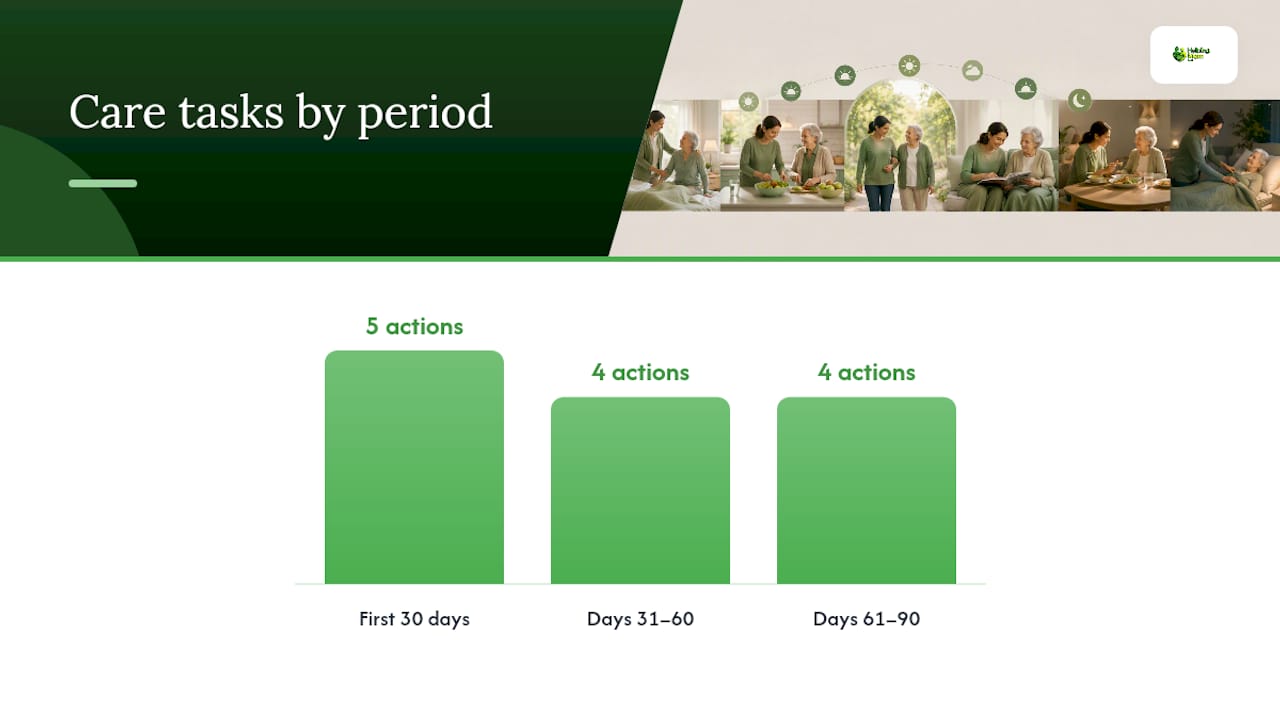
The first three months of caregiving have a predictable shape. Knowing what's coming makes it less disorienting.
First 30 days:
- Complete your one-page care summary and share it with at least one other family member
- Set up the medication system and confirm the pharmacy sync
- Do the home safety walk-through and fix the easiest hazards
- Attend at least one doctor's appointment with your parent to introduce yourself as an authorized contact
- Identify one person who can give you a break
Days 31–60:
- Refine the daily schedule based on what's actually working
- Research local support programs through your Area Agency on Aging
- Review legal documents: does your parent have a healthcare proxy and power of attorney in place? If not, this is the time to address it
- Check in on finances: are bills being paid, and is there a plan for care costs?
Days 61–90:
- Assess whether the current care level is sustainable or whether additional help is needed
- Consider a professional home safety assessment if mobility has declined
- Revisit the task menu and confirm helpers are still engaged
- Schedule your own medical appointment if you've been putting it off
Cost areas to plan for:
- Medications: costs vary widely depending on insurance coverage; Medicare Part D plans differ significantly, so a free review through your State Health Insurance Assistance Program (SHIP) is worth requesting
- Minor home modifications: grab bars, nonslip mats, and night-lights typically run $100–$300 for a basic setup; a full bathroom modification (walk-in shower, wider doorways) is a larger investment
- Paid respite or aides: home health aides typically range from $20–$35 per hour depending on location and agency; adult day programs often cost less and may be partially covered by Medicaid
Red flags that mean it's time to reassess:
- Your parent has fallen more than once, or had a near-miss
- You're missing your own medical appointments or sleeping fewer than six hours regularly
- Medications are being missed despite a reminder system
- Your parent is showing signs of confusion, wandering, or unsafe behavior near the stove or stairs
Where can you find trustworthy resources and short training?
You don't need a certification to be a good caregiver. But a few hours of free training in the first month can prevent a lot of avoidable mistakes.
- National Institute on Aging (nia.nih.gov): Free, plain-language guides on getting started, managing medications, and caregiver self-care. One of the most reliable starting points available.
- AARP Caregiving Resource Center (aarp.org/caregiving): Practical articles, a caregiver help desk, and a local resource finder. Particularly useful for navigating Medicare and insurance questions.
- Caregiver Action Network (caregiveraction.org): Free tip sheets, a peer support community, and time-management resources written specifically for family caregivers.
- Alzheimer's.gov: Dementia-specific guidance on routines, communication, and daily care. Relevant even if your parent hasn't been diagnosed, since cognitive changes often precede a formal diagnosis.
- Eldercare Locator (eldercare.acl.gov): The fastest way to find local services, from meal delivery to transportation to respite care. Enter a zip code and it returns vetted local programs.
- Your local Area Agency on Aging: Most offer free caregiver training workshops, in-person or online. Call 211 or use the Eldercare Locator to find yours.
- Helping-mom (helping-mom.com): Practical guides, printable templates, and a caring for aging parents checklist designed specifically for adult children in the early stages of caregiving. Less clinical than government sites, and built around the real questions families ask.
A calm note on what to realistically expect
Caregiving rarely goes exactly as planned, and that's not a sign you're doing it wrong. The workflow in this guide gives you a structure to return to when things get complicated, not a standard you have to meet perfectly every day.
What most new caregivers discover around the 60-day mark is that the hardest part isn't the tasks. It's the emotional weight of watching a parent need help. That's normal, and it deserves acknowledgment. The nightly review isn't just a productivity tool; it's a small act of self-respect that says your experience matters too.
The guidance here is practical and non-medical. For any medical decisions, medication changes, or health concerns, please work directly with your parent's healthcare providers. This is general caregiving support, not clinical advice.
Helping-mom supports your workflow with practical tools and real guidance
The seven steps in this guide are easier to maintain when you have the right tools in hand. Helping-mom offers a set of resources that map directly to this workflow: a printable one-page care summary template, a shareable daily and weekly schedule, and a home safety checklist that walks you through every room without the clinical jargon.
For caregivers who want more than a template, paid Zoom consultations give you a one-on-one session with a caregiving specialist who can help you work through your specific situation, whether that's a difficult family conversation, a safety concern, or a plan for the next six months. In-person home safety assessments are available locally in Central Florida. These aren't generic checklists; they're tailored walkthroughs of your parent's actual home.
Start with the home safety guide for seniors or browse the full caregiving guides library to find the resource that fits where you are right now.
Sources
- Getting Started With Caregiving | National Institute on Aging
- Caregiver stress: Tips for taking care of yourself - Mayo Clinic
- NIOSH Homecare Safety Handbook (2015) - CDC/NIOSH
- Effective Time Management Tips for Caregivers - Caregiver Action Network
- Tips for caregivers | Alzheimer's.gov
- Eldercare Locator - ACL
This article is general information, not a substitute for advice from a qualified doctor. Consult a qualified healthcare professional about your own circumstances before acting on anything here.
FAQ
What should a caregiver do first?
Start by identifying your role and collecting essential documents: a current medication list, the names and phone numbers of all healthcare providers, insurance information, and any legal documents like a healthcare proxy or power of attorney. The National Institute on Aging provides a clear checklist of what to gather and how to store it.
What are some common daily tasks for a new caregiver?
Daily caregiving tasks typically include medication administration, meal preparation, personal care assistance (bathing, dressing), transportation or appointment coordination, and a brief check-in conversation. A written daily schedule, even a simple one, keeps these tasks consistent and makes it easier for another helper to step in.
How do you prevent caregiver burnout from the start?
A short nightly review of 5–10 minutes, combined with at least one concrete self-care habit each day, is the most practical early defense against burnout. Mayo Clinic specifically identifies the perfectionist trap as a leading cause of caregiver exhaustion, and recommends delegating tasks and accepting help as the sustainable path forward.
How do you find local caregiving support in the U.S.?
The Eldercare Locator is the fastest starting point: enter your parent's zip code and it returns local Area Agencies on Aging, meal programs, transportation services, and respite options. Most of these programs are free or low-cost and are specifically designed for family caregivers.
What is the most important thing to set up in the first week?
A one-page care summary, a single document with your parent's medications, diagnoses, emergency contacts, and insurance information, is the highest-priority task in week one. It reduces errors, speeds up every future interaction with healthcare providers, and gives any helper an immediate picture of what's needed.
Recommended
- Printable Caregiver Schedule | Free Daily & Weekly Care Planning Template - Helping Mom LLC
- Caregiver Schedule Template | Free Downloadable Templates for Family Caregivers
- Complete Caregiving Guides | Helping Mom LLC - Resources for Caring for Aging Parents
- Caring for Aging Parents Checklist - Helping Mom LLC