

TL;DR:
- Adult children need clear boundaries to protect their well-being while caring for parents effectively. Setting specific limits in time, emotion, and communication reduces burnout and improves relationship quality. Repeating boundaries consistently and managing guilt help sustain caregiving without damage or exhaustion.
Caregiver boundaries with parents are clear, specific limits that adult children set to protect their own wellbeing while providing sustainable care. These limits are not walls. They are the internal operating instructions that define how much you can give without depleting yourself. Healthy caregiving boundaries generally fall into five categories: time, emotional labor, communication, financial limits, and information sharing. Without them, caregiving shifts from a choice to an obligation, and that shift is where burnout begins. This guide gives you practical, calm guidance on how to set those limits, hold them with confidence, and keep your relationship with your parent intact.
What are the most effective types of caregiver boundaries with aging parents?
Boundaries work best when they are specific, not vague. Telling your parent "I can't always be available" is far less effective than saying "I'm available by phone on weekday evenings after 6:00 PM." Setting specific, clear limits is 3–4 times more effective at reducing burnout than vague requests. That gap matters because vague limits invite negotiation, while specific ones close it.
The five boundary categories each address a different pressure point in the caregiving relationship:
- Time boundaries define when you visit, how long you stay, and when you are reachable by phone. A simple example: visits on Tuesday and Saturday afternoons, not daily drop-ins.
- Emotional labor limits mean you are not responsible for managing your parent's mood, anxiety, or loneliness every hour of the day. You can listen with care without absorbing every worry as your own problem to solve.
- Communication boundaries protect both of you from conversations that consistently go sideways. If certain topics, such as old family conflicts or medical decisions you cannot control, reliably end in distress, it is reasonable to redirect them.
- Financial limits define what you will and will not contribute, whether that is money, time, or unpaid tasks. Delegating care tasks to professional help or other family members reduces burnout and keeps your own finances stable.
- Information sharing boundaries cover what you share about your personal life, your children, or your finances. You do not owe your parent access to every detail of your life simply because you are their caregiver.
Pro Tip: Use a shared digital calendar, such as Google Calendar, to make your availability visible. Shared calendars can prevent 80–90% of daily scheduling conflicts by turning your limits into something your parent can see, not just hear.
Boundaries also include deciding which tasks you take on and which you hand off. You do not have to be the only person managing medications, driving to appointments, and handling finances. Distributing those responsibilities is not abandonment. It is good care planning.
How can adult children communicate limits clearly and calmly?
The most common mistake caregivers make when setting boundaries with parents is over-explaining. The more you justify a limit, the more room you create for negotiation. State the boundary briefly, offer a short reason if it helps, and then stop talking.
Effective communication follows a simple structure:
- State the limit clearly. "I can visit on Tuesdays and Saturdays" is a complete sentence. It does not need a paragraph of explanation behind it.
- Acknowledge your parent's feelings without reversing the limit. "I know you'd love to see me more often, and I'll be there on Tuesday" keeps warmth in the conversation without backing down.
- Prepare a calm response to pushback. Your parent may say "You never have time for me anymore." A steady reply: "I understand that feels that way. I'll see you Tuesday."
- Repeat the same words if pressed. Repetition signals that the limit is real. Changing your language under pressure signals that it is negotiable.
- Follow through every time. Inconsistent enforcement teaches your parent that limits are flexible, which increases stress for both of you over time.
Scripts like "I can visit on Tuesdays and Saturdays" set clearer expectations than open-ended promises. The specificity removes ambiguity and reduces the emotional energy spent on repeated renegotiation.
Pro Tip: Have boundary conversations when you are calm, not in the middle of a conflict. Planning what you will say in advance, and even practicing it out loud, helps you stay steady when your parent pushes back.

Separating the boundary from the relationship is the key skill here. You can hold a firm limit and still be warm, present, and loving. The two are not in conflict. In fact, limits protect the relationship by keeping resentment from building quietly underneath it.
Why do caregivers feel guilt when setting limits, and how do you manage it?
Guilt after setting a boundary is normal. It does not mean you have done something wrong. Feeling guilty reflects the discomfort of breaking long-held family patterns, not evidence of actual harm. That distinction matters because guilt, left unexamined, will erode limits that took real courage to set.
Family systems theory explains why pushback from your parent, or from siblings, feels so destabilizing. Family systems pushback is structural, not personal. When one person in a family changes their behavior, the system applies pressure to return to the old pattern. That pressure is predictable. Anticipating it helps you stay firm without interpreting resistance as failure.
"The hardest part about boundary-setting is maintaining limits through family pushback without interpreting resistance as failure. Resistance signals adjustment, not that your boundary is wrong."
Guilt also fades with practice. Guilt is often learned and diminishes with repeated boundary practice. Each time you hold a limit and the relationship survives, you build evidence that the limit is safe. That evidence accumulates.
Self-care for caregivers plays a direct role here. Daily mindfulness, even ten minutes of quiet, helps regulate the emotional reactivity that makes guilt feel urgent. When you are depleted, every push from your parent feels like a crisis. When you are rested, you can respond rather than react. If guilt or family conflict feels unmanageable, a therapist who understands caregiver burnout can help you separate what is yours to carry from what is not.
How do boundaries support sustainable caregiving and your own well-being?
Boundaries do not reduce the care you give. They improve the quality of it. Caregivers who implement clear limits report better relationship quality and less emotional reactivity with their parents. That improvement happens because you are showing up by choice, not by exhaustion.
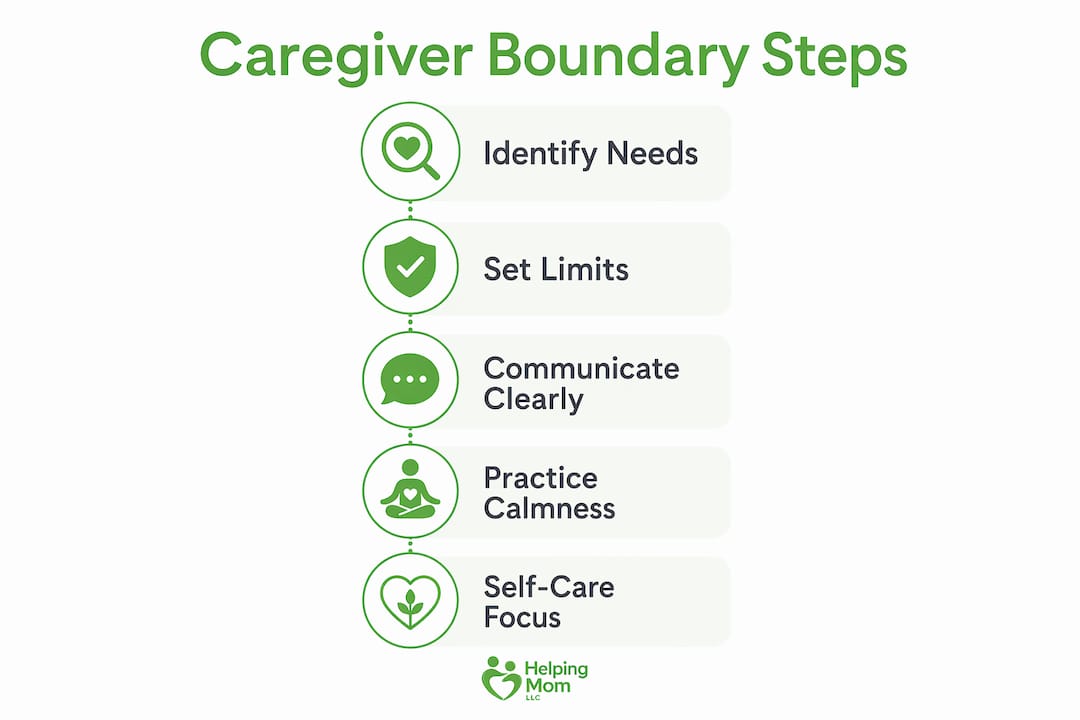
Caregivers without clear limits experience 20–30% more irritability and mood swings than those who protect their time and energy. That irritability does not stay contained. It spills into every interaction, including the ones with your parent that you want to be good.
The table below shows how each boundary type connects to a specific wellbeing outcome:
| Boundary type | Wellbeing outcome |
|---|---|
| Time boundaries | Reduced exhaustion; more energy for quality visits |
| Emotional labor limits | Lower irritability; calmer interactions with your parent |
| Communication boundaries | Fewer conflicts; more positive conversations |
| Financial limits | Reduced financial stress; clearer family expectations |
| Task delegation | Shared responsibility; lower risk of long-term burnout |
Sustainable caregiving also protects your own family and personal life. When caregiving expands to fill every available hour, your relationships with your spouse, children, and friends quietly erode. Limits preserve those relationships, which in turn give you the support you need to keep caring for your parent well. You can find practical guidance on balancing caregiving roles without losing yourself in the process.
Boundaries also make it possible to plan ahead. When you know what you can realistically provide, you can identify gaps and fill them with professional support, community resources, or family help before a crisis forces the decision. That kind of intentional care is better for your parent and far more sustainable for you.
Key Takeaways
Caregiver boundaries with parents are the most reliable tool adult children have for sustaining both their own wellbeing and the quality of care they provide.
| Point | Details |
|---|---|
| Five boundary categories | Time, emotional labor, communication, financial limits, and information sharing each address a distinct pressure point. |
| Specificity reduces burnout | Clear, specific limits are 3–4 times more effective at reducing burnout than vague requests. |
| Scripts over explanations | Short, repeated scripts signal that limits are real and prevent ongoing renegotiation. |
| Guilt is normal, not a verdict | Guilt reflects breaking old family patterns and fades with consistent practice. |
| Boundaries improve care quality | Caregivers with clear limits report less irritability and better relationship quality with their parents. |
What I've learned about boundaries after years in caregiving conversations
I want to be honest with you about something most articles skip: setting a boundary with your parent will feel wrong the first several times you do it. Not because it is wrong. Because it is new. You have spent decades in a particular role with this person, and changing that role feels like a betrayal even when it is the most caring thing you can do.
The caregivers I hear from most often are not struggling because they don't know what a boundary is. They are struggling because they know exactly what limit they need to set and they cannot bring themselves to hold it when their parent looks hurt or says something that triggers old guilt. That is the real work. It is not intellectual. It is emotional.
What I have found actually helps is this: stop trying to set the boundary perfectly and start trying to set it consistently. A limit that is imperfect but held is worth far more than a perfectly worded one that collapses under pressure. Your parent will adjust. The relationship will not break. And the version of you that shows up after six months of holding your limits will be calmer, more present, and genuinely glad you started.
If you are dealing with a parent who is particularly resistant, Helping-mom's guide on dealing with difficult elderly parents offers grounded, practical support for exactly that situation.
— Mike C.
Practical resources from Helping-mom to support your caregiving
Boundaries are one piece of sustainable caregiving. The physical environment your parent lives in is another. Helping-mom offers a practical home safety checklist for caregivers that helps you identify fall risks, accessibility gaps, and safety improvements without a clinical assessment. For caregivers thinking about the longer picture, the caregiver well-being resources at Helping-mom address emotional health, role clarity, and the kind of sustainable support that keeps you in this role for the long term. Both are free, clear, and written for adult children who are figuring this out as they go.
FAQ
What are caregiver boundaries with parents?
Caregiver boundaries with parents are specific limits that adult children set around their time, emotional energy, finances, and communication to protect their wellbeing while providing care. They define what you will and will not take on, not what your parent is allowed to feel.
How do I set limits without damaging my relationship with my parent?
State limits briefly, acknowledge your parent's feelings without reversing the limit, and follow through consistently. Setting boundaries is not rejection. Caregivers who hold clear limits report better relationship quality, not worse.
Why do I feel guilty after setting a boundary?
Guilt reflects the discomfort of changing long-held family patterns, not evidence of wrongdoing. It is a normal reaction that fades with repeated practice as you build evidence that the relationship survives the limit.
What should I do when my parent pushes back against my limits?
Repeat your boundary using the same calm words without adding new justifications. Family systems theory predicts this pushback as a structural response to change, not a personal rejection. Anticipating it helps you stay steady.
How do caregiver limits reduce burnout?
Caregivers without clear limits experience significantly more irritability and emotional exhaustion than those who protect their time and energy. Specific limits reduce the chronic stress that accumulates when caregiving expands without constraint.
Recommended
- How to Support Aging Parents: Practical Steps for Families | Helping Mom LLC
- Compassionate Guide on Dealing with Difficult Elderly Parents | Helping Mom LLC
- The Role of Caregivers: Practical Support for Adult Children Caring for Aging Parents | Helping Mom LLC
- Setting Boundaries with Aging Parents | Helping Mom LLC