

There is no federal "caregiver tax credit" you can check a box for in 2026. What exists instead is a set of overlapping federal tools, mainly the Child and Dependent Care Credit, the Credit for Other Dependents, and the medical expense deduction, plus a handful of state-level credits. A federal bill called the Credit for Caring Act would create something closer to a true caregiver credit, but it remains stuck in Congress. Your first move is figuring out which existing federal option fits your situation, then checking whether your state offers anything on top of it.
TL;DR:
- The Child and Dependent Care Credit is the main federal caregiver benefit available now, but it depends on qualified expenses, caregiver location, and income limitations.
- The proposed federal Credit for Caring Act is unlikely to impact 2026 taxes unless it passes; current recordkeeping and documentation remain essential.
- About 15 states have introduced caregiver tax credits, with roughly five enacted, but eligibility, refundability, and application procedures vary significantly by state.
- To qualify, caregivers must document expenses, caregiver incapacity, and support payments properly, avoiding ineligible relatives and medical-only costs.
- Higher household income reduces the percentage of qualifying expenses claimable through the child and dependent care credit, but it does not disqualify eligibility entirely.
Table of Contents
- Federal Caregiver Tax Benefits You Can Use Right Now
- Is a Federal Caregiver Credit Actually Coming?
- Which States Offer Their Own Caregiver Tax Credit
- Who Counts as Your Dependent for Tax Purposes
- Filing Step by Step: Form 2441 and Common Mistakes
- Your Pre-Filing Checklist for Caregiver Tax Breaks
- What Caregiving Expenses Actually Qualify
- Recordkeeping That Actually Holds Up Under Scrutiny
- How Income Level Affects Your Credit Amount
- Do Caregiver Credits Affect Your Child Tax Credit or EITC?
- What I Tell Caregivers About Getting Ahead of Tax Season
- Get Your Financial and Safety Records Organized With Helping-mom
- Sources
- FAQ
Federal Caregiver Tax Benefits You Can Use Right Now
The Child and Dependent Care Credit (CDCC) is the closest thing to a working caregiver tax deduction most families can actually use today, and it comes with real dollar ceilings you need to know before you get your hopes up. You can count qualifying care expenses for dependents up to specified dollar limits, and the credit percentage varies based on your adjusted gross income, according to IRS Publication 503.
That credit only applies if the care allows you (and your spouse, if you're married) to work or actively look for work. A parent who stays home all day watching your mother while you're also home doesn't create a qualifying expense; a paid aide who frees you up to keep your job does.
A few mechanics determine whether you qualify at all:
- Your parent (or other relative) must be physically or mentally incapable of self-care and must have lived with you more than half the year.
- If your parent doesn't meet the incapacity test but still qualifies as your dependent, you may instead claim the Credit for Other Dependents, worth up to $500, though it works differently than the CDCC.
- If your employer offers a dependent care flexible spending account (FSA), money you set aside there (generally up to $5,000) reduces the dollar limit you can also claim under the CDCC.
That last point trips up more families than any other rule in this section. You cannot fully double dip between an FSA and the credit, so the math depends on your specific numbers.
Is a Federal Caregiver Credit Actually Coming?
The Credit for Caring Act, introduced in recent sessions as H.R.7165, would let eligible working caregivers claim a credit equal to a percentage of qualified expenses above a threshold, with a capped maximum amount. It targets people caring for a spouse, parent, or other relative with long-term care needs, not just dependents who live with you, which is a meaningfully broader definition than the CDCC uses.
The bill also includes inflation indexing, so the cap would rise over time rather than staying frozen the way many tax provisions do. It has been reintroduced across multiple sessions without passing, and nothing in current bill text is retroactive or usable for a 2026 return.
Treat this as something to watch, not something to plan around. Keep good records regardless. If the bill passes with retroactive language down the road, families with documented expenses will be positioned to benefit; families without records won't be.
Which States Offer Their Own Caregiver Tax Credit
State activity has picked up noticeably. As of April 2025, roughly 15 states had introduced caregiver tax credit bills and about 5 states had enacted programs, according to an ASPE review of federal and state caregiver tax credit laws. That number moves every legislative session, so treat any state list, including this one, as a starting point rather than the final word.
Nebraska is a useful example of how these programs actually work. Its Caregiver Tax Credit Act calculates the credit as a percentage of eligible caregiving expenditures, up to a set maximum, with its own application process separate from the federal return.
State programs vary in ways that matter to your bottom line:
- Some are refundable (you get money back even if you owe no state tax); others are nonrefundable and only offset tax you already owe.
- Income caps and expense caps differ widely from state to state.
- Some require a separate application before the tax year ends, rather than simply claiming the credit when you file.
Because enacted programs and pending bills both keep shifting, check your state revenue department's website directly before assuming last year's rules still apply. A caregiver tax credit that existed in one state's proposal stage last year might be law this year, or might have died in committee.
Who Counts as Your Dependent for Tax Purposes
The IRS applies two separate tests, and caregivers often confuse them. The support test asks whether you provided more than half of your parent's total financial support during the year. The gross-income test asks whether your parent's taxable income stayed under the IRS threshold for the year (Social Security benefits usually don't count toward this).
For the Child and Dependent Care Credit specifically, the standard is stricter: your parent generally must have lived with you for more than half the year and be incapable of self-care, per IRS guidance on the credit. A parent who lives independently across town, even if you pay most of their bills, typically won't qualify you for the CDCC, though they may still qualify as a dependent for other purposes.
Documentation is what turns a claim into a defensible claim. Gather these before you sit down to file:
- Invoices or receipts from every paid caregiver or care facility, dated and itemized.
- The provider's name, address, and Taxpayer Identification Number or Social Security number, which the IRS requires you to report on your return.
- Your W-2, Box 10, if your employer provided dependent care benefits during the year.
- A doctor's letter confirming incapacity, if your parent's condition isn't self-evident from a diagnosis already on file.
- Proof of payment, bank statements or canceled checks work fine, showing the money actually left your account.
Pro Tip: Ask your parent's care provider for an itemized annual statement in January, before tax season gets busy. Most agencies will generate one automatically if you ask, and it saves you from reconstructing months of receipts in April.
One more wrinkle: payments to certain relatives, like your spouse or your own minor child, generally don't count as qualifying expenses, even if they're providing genuine care.
Filing Step by Step: Form 2441 and Common Mistakes
You claim the Child and Dependent Care Credit on Form 2441, which then feeds into Schedule 3 and ultimately your Form 1040. Part II of the form calculates the credit itself; Part III only applies if you received dependent care benefits through your employer, and skipping it when you should have filled it out is one of the most common reasons returns get flagged.
Watch for these errors:
- Missing provider TIN or SSN. The IRS routinely rejects or delays credits when this field is blank or wrong.
- Double-dipping between an FSA and the credit. If you excluded $5,000 through a dependent care FSA, your CDCC dollar limit drops by that same amount, you can't claim both on the full expense amount.
- Claiming payments to ineligible relatives. Paying your spouse or your teenager to babysit doesn't qualify, even with a receipt.
- Forgetting to amend prior returns. If new legislation ever changes eligibility retroactively, you may need to file an amended return to capture credits you missed.
Most tax software walks you through Form 2441 automatically once you enter dependent care expenses, but the software can't catch a missing TIN you never gathered in the first place.
Your Pre-Filing Checklist for Caregiver Tax Breaks
Before tax season hits, work through this short list so nothing catches you off guard:
- Confirm you (and your spouse, if applicable) had earned income during the year the care was provided.
- Pull your W-2 and check Box 10 for any employer dependent care benefits.
- Get your care provider's TIN or SSN in writing, don't wait until April.
- Request a doctor's note if your parent's incapacity isn't already documented elsewhere.
- Total your qualifying expenses against the $3,000 or $6,000 limit before you assume you've hit the cap.
Here's a rough way to think about FSA versus credit: if you're in a higher tax bracket and you're already maxing out a dependent care FSA through work, the FSA usually saves you more than the CDCC would on the same dollars. If you don't have FSA access, or your employer doesn't offer one, the credit is often your better (and only) option. Borderline cases, especially if you're close to income phase-out thresholds, are worth a conversation with a tax preparer rather than a guess. Helping-mom's financial planning guide for caregivers walks through this kind of decision in more detail.
Pro Tip: If you hire an in-home caregiver directly rather than through an agency, you may become a household employer under IRS rules, which means Schedule H and payroll tax withholding. Getting this wrong doesn't just create a tax headache, it can invalidate credits you thought you'd locked in.
What Caregiving Expenses Actually Qualify
Not every dollar you spend on your parent's care counts toward these credits, and the distinction matters more than most families realize until they're staring at a rejected claim. In-home care, whether it's a home health aide, a companion caregiver, or a licensed nurse providing custodial (not medical) care, generally qualifies as long as it enables you to work.
Adult day care programs qualify too, and they're often the most straightforward category because the provider typically issues a clear invoice with their TIN already listed. Respite care, the short-term relief care that gives you a break from caregiving duties, can qualify when it's the mechanism that allows you to work, though purely medical respite billed through insurance won't count toward the CDCC.
What generally doesn't qualify: expenses that are primarily medical treatment rather than custodial supervision (those may belong on Schedule A as a medical expense deduction instead), and payments for care that doesn't enable you or your spouse to work or look for work. A private nurse administering medication after surgery is a medical expense. A companion who keeps your mother safe and engaged while you're at your job is a dependent care expense. The line isn't always crisp, but the "does this let me work" test is the one the IRS actually applies.
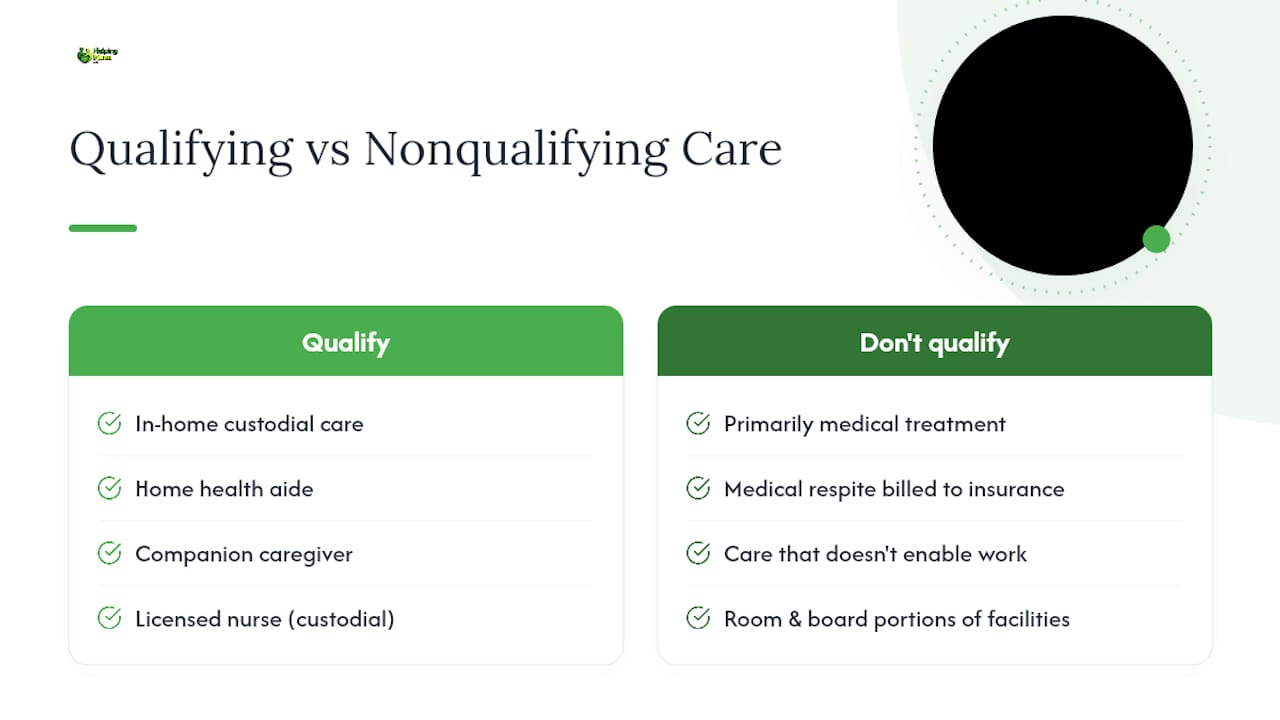
Overnight care and full-time facility stays complicate things further since you can typically only count the portion allocable to care, not room and board, unless the facility is primarily custodial in nature.
Recordkeeping That Actually Holds Up Under Scrutiny
Basic recordkeeping means saving receipts. Audit-ready recordkeeping means building a system that reconstructs your entire year of care spending in minutes, not hours, if the IRS ever asks.
Start a dedicated folder, physical or digital, the day you begin paying for care, not the week before you file. Inside it, keep monthly statements from every provider (not just annual summaries, since annual totals sometimes get disputed if a provider changes their invoicing format mid year). Save the actual bank or credit card statement showing each payment cleared, not just the invoice showing what was owed. An invoice proves a bill existed; a cleared payment proves you actually paid it, and the IRS wants the second one.
If your parent's incapacity is central to your claim, get the doctor's letter early and keep it in the same folder, dated, on letterhead, and specific about the nature and expected duration of the condition. A vague note is far weaker evidence than one that states plainly why your parent cannot be left alone.
Log any cash payments the same day you make them, with the provider's name and TIN attached, since cash is the single easiest category to lose track of and the hardest to substantiate later. If you switch providers mid-year, keep both providers' complete records rather than assuming the new provider's invoice covers the transition period.
Set a calendar reminder each January to request a fresh, itemized annual statement from every provider you used the previous year while the information is still fresh for them to pull.
How Income Level Affects Your Credit Amount
The Child and Dependent Care Credit isn't an all-or-nothing benefit; it phases down as your income rises. From there, the percentage steps down gradually as income increases, bottoming out at 20% for most higher-income households, per IRS Publication 503.
That means a family earning $20,000 and a family earning $150,000 could both claim the same $3,000 in qualifying expenses for one dependent, but the family with lower income receives a meaningfully larger credit. This isn't a hard cutoff where you suddenly lose eligibility above a certain income, unlike some other tax provisions; it's a gradual slide that affects the size of the benefit rather than whether you qualify at all.
Proposed federal legislation like the Credit for Caring Act includes its own separate earned-income thresholds and phase-out structure, distinct from the CDCC's rules, so don't assume the two would work identically if the bill ever becomes law. If you're filing jointly and one spouse has little or no earned income, remember that the CDCC generally requires both spouses to have earned income (with narrow exceptions for students or people who are themselves incapable of self-care), which can eliminate the credit entirely regardless of your household's total income.
Do Caregiver Credits Affect Your Child Tax Credit or EITC?
Claiming the Child and Dependent Care Credit for your parent doesn't reduce your Child Tax Credit or your Earned Income Tax Credit (EITC), since these are calculated independently on separate parts of your return. You can claim all three in the same tax year if you qualify for each on its own terms.
Where things get more complicated is with the Earned Income Tax Credit specifically, because EITC eligibility depends heavily on your total earned income and adjusted gross income, and claiming an elderly parent as a dependent can shift which EITC bracket and phase-out range applies to your household. If adding your parent as a dependent changes your filing status or the number of dependents you claim, run the numbers both ways rather than assuming the change only helps you.
The Credit for Other Dependents, which many caregivers claim for a parent who doesn't meet the CDCC's stricter incapacity and residency tests, also phases out at higher income levels, starting around $200,000 for most filers. None of these credits require you to choose one over another; the real risk is missing one because you assumed claiming a parent as a dependent would complicate credits you already understood, like the Child Tax Credit for your own kids.
What I Tell Caregivers About Getting Ahead of Tax Season
The families I've watched navigate this well didn't have better tax knowledge than everyone else. They just started a folder for receipts in January instead of scrambling in March. That one habit, more than any credit or deduction, determines whether tax season feels manageable.
Small paperwork steps preserve real money. Use the pre-filing checklist above, and when your situation gets complicated, a tax professional is worth the conversation.
— Mike C.
Get Your Financial and Safety Records Organized With Helping-mom
Sorting through provider invoices, W-2 boxes, and doctor's letters is a lot easier when it's part of a bigger system rather than a once-a-year scramble. Helping-mom builds that system for Central Florida families and caregivers nationwide through practical guides and templates that organize the financial and safety side of caregiving together, since the two are more connected than most families realize. A parent whose home has been assessed for fall risks and mobility needs often has clearer documentation of the incapacity that supports a dependent care claim in the first place.
The Aging Parent Finances guide walks you through budgeting for care costs alongside the records you'll want come tax time, and Helping-mom's paid Zoom consultations give you a focused hour to review your specific documents with someone who has walked other families through the same process. Book a session before tax season peaks, and you'll walk into filing season with your paperwork already sorted.
This article is general information, not a substitute for advice from a qualified financial advisor. Consult a qualified financial professional about your own circumstances before acting on anything here.
Sources
- Publication 503 (2025), Child and Dependent Care Expenses | Internal Revenue Service
- Review of Federal and State Caregiver Tax Credit Laws and Bills | ASPE
- Congress
FAQ
Do you get a tax credit for being a caregiver?
Not a dedicated federal "caregiver credit" in 2026, but you may qualify for the Child and Dependent Care Credit, the Credit for Other Dependents, or a state-level caregiver credit depending on where you live.
Who gets the $6,000 tax break for the elderly?
Caregivers with two or more qualifying dependents who received care enabling them to work can count up to $6,000 in qualifying expenses toward the Child and Dependent Care Credit, per IRS Publication 503.
Can I get paid to be a family caregiver in the US?
Some states offer paid family caregiver programs through Medicaid waivers, which is separate from tax credits; check your state's Medicaid or aging services agency for eligibility, since this varies significantly by state.
How much do you get for claiming an elderly parent as a dependent?
Claiming a parent as a dependent alone doesn't produce a fixed dollar amount; it may qualify you for the Credit for Other Dependents (up to $500) or, if stricter tests are met, the larger Child and Dependent Care Credit.
How do I know if my state has its own caregiver tax credit?
Check your state's department of revenue website directly, since roughly 15 states had introduced caregiver credit bills and about 5 had enacted programs as of the most recent ASPE review, and that number continues to change.
Recommended
- Types of Caregiver Support: Practical Options for Your Family
- The Sandwich Generation Financial Survival Guide: 7 Things to Do Before Caregiving Costs Overwhelm You
- Caregiver Support - Helping Mom LLC | Resources & Support for Family Caregivers
- How to Find Caregiver Support: Practical Steps for Adult Children