

What does a parent support team actually look like?
Creating a support team for parents means assembling a coordinated group of people, including family members, close friends, neighbors, and professionals, who share caregiving responsibilities in an organized, intentional way. The goal is not to do everything yourself. It is to build a network that can carry the load together, so no single person burns out and your parent receives consistent, attentive care.
The core steps look like this:
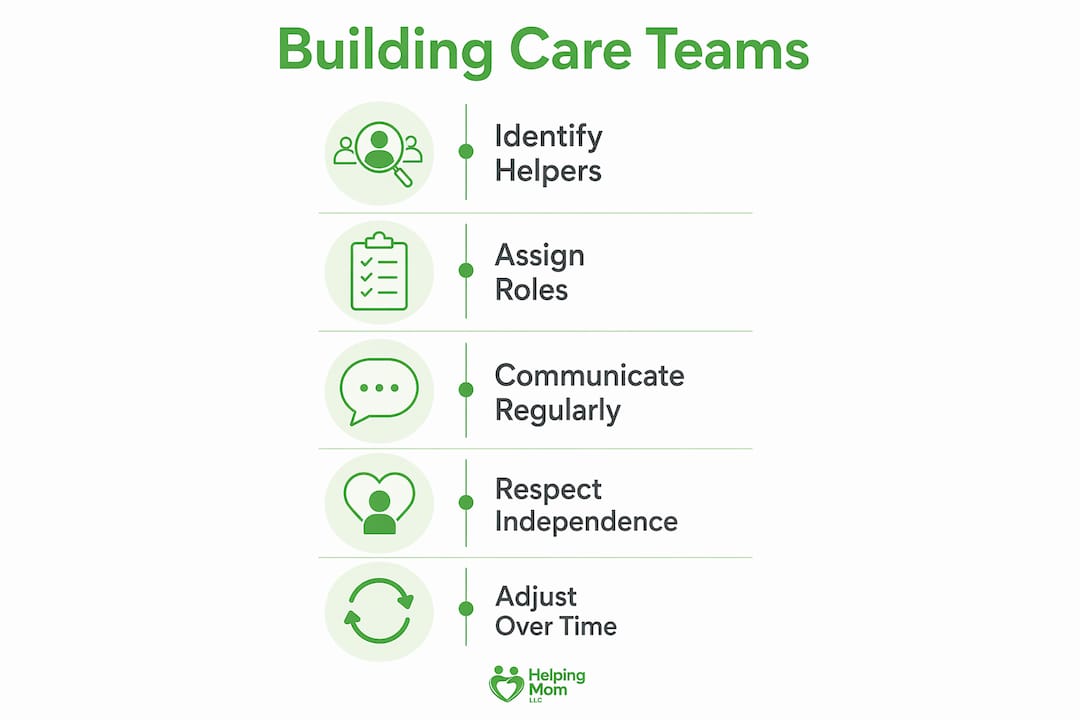
- List your helpers. Think beyond siblings. Neighbors, church friends, a cousin who lives nearby, and a parent's longtime friend all count.
- Assess skills and availability. Who can drive? Who is good with paperwork? Who lives closest?
- Talk with your parent first. Their preferences shape the whole plan.
- Assign clear roles. Ambiguity is where things fall apart.
- Bring in professionals when family capacity reaches its limit. This is not a failure; it is good planning.
Starting with this structure, even loosely, makes every step that follows easier to manage.
Table of Contents
- How to build your parent's care team, step by step
- Keeping the team working well over time
- How do you respect your parent's independence while building a care plan?
- When and how to bring professional caregivers onto the team
- Key Takeaways
- FAQ
How to build your parent's care team, step by step
Building a care team follows a clear sequence. Skipping steps usually means doubling back later, often during a stressful moment.
- Write down every potential helper. Include family members regardless of distance, friends your parent trusts, neighbors who already check in, and any community contacts like a faith community or senior center volunteer.
- Assess each person honestly. Consider time availability, physical proximity, emotional bandwidth, and specific strengths. Someone three states away can still manage insurance calls or online bill pay.
- Have a real conversation with your parent. Ask what kind of help feels comfortable and what feels intrusive. Their answers will surprise you, and they matter more than any plan you make without them.
- Hold a team meeting, virtual or in person. Bring the key helpers together, share what you know about your parent's needs, and let people volunteer for tasks that fit their lives.
- Assign roles in writing. A shared document or even a group text thread with clear task ownership prevents the "I thought you were handling that" problem.
- Revisit the plan regularly. Needs change. A plan that worked six months ago may need adjusting now.
- Add professional help before you hit a wall. A geriatric care manager can assess needs and coordinate services when family capacity is stretched.
Pro Tip: Designate a team leader before you recruit widely. A designated team leader prevents communication breakdown and overlapping responsibilities. This person does not have to do the most work; they just need to be the central point of contact.
Keeping the team working well over time
A care team that starts strong can quietly fall apart without some structure holding it together. The multidisciplinary team (MDT) approach, used in professional senior care settings, offers a useful model for families. It means each person has a defined role, everyone works from the same shared plan, and communication happens on a regular schedule rather than only during crises.

Research on senior care teams shows that teamwork improves care outcomes significantly, with most care professionals agreeing that coordinated teamwork leads to better results; furthermore, MDT models have been shown to increase staff engagement.
What keeps a family care team sustainable:
- Scheduled check-ins. A monthly call or video chat keeps everyone informed and prevents small issues from becoming big ones.
- Shared documentation. A simple shared folder, Google Doc, or caregiving app gives everyone access to the same information: medications, appointments, contacts, and recent changes.
- A clear communication lead. One person filters updates and sends them out. Without this, people get different versions of the same information.
- Conflict resolution before conflict happens. Agree early on how disagreements will be handled. Written care plans and neutral facilitators can ease family tension when it arises.
- Trust and adaptability. The team that lasts is the one that can adjust when circumstances shift, without blame.
Regular team meetings and shared documentation are not administrative overhead. They are what prevent role fragmentation and reduce errors over time.
How do you respect your parent's independence while building a care plan?
This is where many families struggle. You can see that your parent needs more support. Your parent may not see it the same way, or may feel that accepting help means losing control of their own life. Both things can be true at once, and neither cancels the other out.
Respecting autonomy means involving your parent in every decision, listening actively, and framing support as collaboration rather than control. In practice, that sounds like asking "What would make this easier for you?" instead of "We've decided you need help with X."
Strategies that actually work:
- Ask, don't announce. Questions open conversations; declarations close them.
- Start with what your parent identifies as a problem. If they mention forgetting medications, that is your entry point.
- Document their preferences in the care plan. When everyone on the team knows what your parent wants, there is less room for well-meaning overreach.
- Bring in a neutral third party when needed. A social worker, geriatric care manager, or family mediator can help when conversations stall or family members disagree.
- Revisit preferences regularly. What your parent wants at 78 may differ from what they want at 83.
Pro Tip: Build a caregiver binder together with your parent, not for them. Work through it in short sessions, one cluster at a time: daily contacts, medical information, finances, and legal documents. Doing it together builds trust and gives your parent a sense of ownership over their own care.
Caregiving is a role expansion, not a reversal. Feeling frustrated or uncertain along the way is normal. Sharing tasks across a team, rather than carrying them alone, is what makes the long haul manageable. You can find more guidance on supporting aging parents through Helping-mom's practical resources.
When and how to bring professional caregivers onto the team
Family love and good intentions have real limits. Recognizing when to add professional help is one of the most important decisions a care team makes, and doing it early is almost always better than waiting for a crisis.
Signs it is time to bring in professional support:
- A family caregiver is showing signs of burnout: exhaustion, resentment, or declining health
- Daily care demands, such as bathing, medication management, or mobility assistance, exceed what family members can safely provide
- Medical complexity has increased and requires clinical oversight
- Your parent is frequently alone and at risk
Types of professionals and when to add them:
| Professional Role | Primary Responsibilities | When to Bring Them In |
|---|---|---|
| Geriatric care manager | Needs assessment, care coordination, referrals | Early, especially if family is geographically scattered |
| In-home care aide | Personal care, meals, companionship, light housekeeping | When daily tasks exceed family capacity |
| Home health nurse | Medication management, wound care, health monitoring | After a hospitalization or with complex medical needs |
| Physical or occupational therapist | Mobility, fall prevention, home safety assessment | After a fall or significant decline in function |
| Social worker | Community resources, benefits navigation, family support | When financial or emotional strain is high |
Legal and financial considerations matter here. If you hire an independent caregiver rather than through an agency, you may take on employer responsibilities including payroll taxes. Agencies handle this, though at a higher hourly cost. Review your parent's long-term care insurance policy, if they have one, before committing to a care arrangement. A financial guide for aging parents can help you understand what coverage may already be in place.
Introduce professional help gradually when possible. Starting with a few hours a week gives your parent time to adjust and builds trust with the new caregiver before more hours are added. Technology can also help bridge gaps between in-person visits; tools that reduce elderly isolation through video calls and remote check-ins are worth exploring for families spread across distances.
Key Takeaways
A sustainable care team for an aging parent requires clear roles, consistent communication, and your parent's active participation from the start.
| Point | Details |
|---|---|
| Start with a helper inventory | List family, friends, and neighbors before assigning any roles or tasks. |
| Designate a team leader early | One communication hub prevents overlapping responsibilities and dropped tasks. |
| Include your parent in every decision | Framing support as collaboration, not control, protects their autonomy and your relationship. |
| Use shared documentation | A single care plan everyone can access reduces errors and keeps the team aligned. |
| Add professional help proactively | Bring in a geriatric care manager or home aide before burnout forces the decision. |
FAQ
How many people should be on a parent's care team?
There is no fixed number. A functional team typically includes two to five family members or close contacts with defined roles, plus one or more professionals as needs grow. What matters is clarity of roles, not team size.
What if siblings disagree about how to care for a parent?
Written care plans and neutral facilitators, such as a social worker or geriatric care manager, can help align family members when disagreements arise. Focusing conversations on your parent's stated preferences, rather than individual opinions, usually moves things forward.
When should a family hire a geriatric care manager?
A geriatric care manager is worth contacting when family members are geographically spread out, when care needs are complex, or when the family is unsure how to assess what level of support is needed. Early involvement prevents reactive decision-making during a health crisis.
How do you prevent caregiver burnout within the team?
Distribute tasks deliberately so no single person carries the bulk of hands-on care. Schedule regular check-ins to catch overload early, and use respite care when a primary caregiver needs a break. Recognizing the early signs of burnout matters as much as the team structure itself.
What documents should a parent care team have in place?
At minimum: a power of attorney, advance directive, HIPAA release, and a current list of medications and emergency contacts. Organizing these before a crisis, ideally in a shared caregiver binder, saves significant stress later.