

When you're talking with a parent who has dementia, connection comes before correction: calm tone, short sentences, one simple choice at a time, and validation of what they're feeling. That single shift changes almost every hard conversation. The specific words and tools change as the disease moves through stages, but the foundation stays the same.
TL;DR:
- Using one-step instructions, visual cues, and routine helps manage confusion and repetitive questions in middle and late stages of dementia.
- Validating feelings before facts reduces distress and prevents agitation, especially when addressing emotional needs behind repeated questions.
- Environmental adjustments like good lighting, labeled photos, and quiet rooms consistently improve communication and reduce misdirection.
- Caregivers' emotional state greatly influences interactions, making self-care, patience, and scheduled breaks essential for sustained support.
- Sudden or severe changes in behavior or cognition, such as rapid decline or new aggression, require prompt medical evaluation rather than communication adjustments.
Table of Contents
- Quick Dementia Communication Strategies You Can Try Today
- How Should Communication Change By Dementia Stage?
- What Should You Do About Repeated Questions and Agitation?
- Why Do Tone, Touch, and Music Matter More Than Words Sometimes?
- What Low-Cost Tools Actually Reduce Confusion?
- How Does Your Own Behavior Shape These Conversations?
- When Do Communication Changes Need Medical Attention?
- What Does the Research Actually Support?
- A Caregiver's Perspective on What Actually Helps
- Sources
- FAQ
Quick Dementia Communication Strategies You Can Try Today
You don't need a manual to start improving conversations with your parent this afternoon. A handful of small adjustments, practiced consistently, do more good than any single "perfect" script. These are the moves worth trying on your very next visit or phone call.
- Speak slowly and stick to one idea per sentence. "Let's go for a walk" lands better than "Do you want to go for a walk after we finish lunch, or would you rather rest first?"
- Get to eye level and face them directly before you start talking, especially if they're seated. Standing over someone while speaking can feel confrontational even when your tone is gentle.
- Offer two choices instead of open-ended questions. "Do you want the blue sweater or the green one?" works. "What do you want to wear?" often doesn't, because it asks the brain to generate options it may no longer organize easily.
- Validate the feeling before you address the fact. If your mother insists she needs to pick up her (long-deceased) sister from school, try "That sounds important to you, tell me about her" rather than "She's been gone for years, Mom."
- Give them time. Simple, direct language and patient pauses matter more than filling silence. Count to ten in your head before repeating or rephrasing.
- Don't quiz or correct. Skip "Do you remember what day it is?" Skip "No, that's wrong, it's Tuesday." Neither helps, and both can trigger shame or frustration.
- For repeated questions, answer once, add a visual cue, then redirect. "Yes, I locked the door, see the note by the light switch, want to help me fold these towels?"
Pro Tip: Keep a small notecard in your pocket with three go to phrases you know work for your parent. When you're tired or rattled, you won't have to think of the right words. You'll just read the card.
How Should Communication Change By Dementia Stage?
The biggest mistake caregivers make isn't tone or vocabulary. It's using the same approach across the entire disease course. What works beautifully in year one can feel patronizing or confusing by year four, and what's gentle and appropriate in the middle stage can be overwhelming by the late stage. Communication needs shift as dementia progresses, and matching your approach to the current stage is the single biggest lever you have.
Early stage: keep the conversation two-way
In the early stage, your parent is still largely themselves. They can follow conversations, express opinions, and want to be included, not managed. This is the time to lean into real dialogue rather than simplified instructions.
- Ask open but simple questions: "How are you feeling about the doctor's appointment?" rather than a checklist of yes/no items.
- Involve them directly in decisions about their own care. "Would you rather try the pill organizer or a phone reminder?" respects their autonomy while still moving toward a solution.
- Give them room to finish their own sentences, even when word-finding gets slow. Jumping in to supply words too quickly can feel diminishing.
A sample exchange: "Mom, the doctor mentioned trying a new medication for your blood pressure. What do you think about that?" She might take thirty seconds to respond, and that's fine. The goal is to let her stay a participant in her own life for as long as that's genuinely possible.
Middle stage: shrink instructions to one step
The middle stage tends to last the longest, often stretching across several years, and it's where most caregivers feel the most friction. Multi-step instructions and abstract questions stop working reliably. One-step directions, choice prompts, and visual reinforcement start doing the heavy lifting.
- Break every task into a single action: "Let's brush your teeth" now, "Let's put on your shoes" later, not both at once.
- Replace "What do you want for breakfast?" with "Eggs or cereal?" while holding up both options if possible.
- Use routine aggressively. The same sequence, same time, same words each day reduces the number of decisions your parent has to make from scratch.
Sample dialogue: "Time to get dressed. Here's your shirt." (Hand it directly to them rather than pointing across the room.) "Arm in first." Short, sequential, physical.
Late stage: prioritize comfort over conversation
By the late stage, verbal language often becomes limited or absent, and nonverbal connection, touch, facial expression, a soothing tone, carries most of the message. This is not a failure of communication. It's a different kind of communication.
- Keep interactions brief. A few minutes of calm, sensory-based connection beats a longer visit that overwhelms.
- Use touch when welcomed: a hand on the shoulder, holding hands, gentle brushing of hair.
- Play familiar music. Recognition of a favorite song often persists long after words fade.
A note on timing: Progression through these stages varies enormously by person and by underlying condition. The middle stage alone can last many years, which is exactly why a single fixed script never works for the whole journey.
What Should You Do About Repeated Questions and Agitation?
Repetitive questions aren't a sign your parent is being difficult on purpose, and they're rarely really about the fact being asked. Repetitive questioning is usually a signal of an unmet emotional need or a memory limitation, most often anxiety, disorientation, or a search for reassurance. "When is Dad picking me up?" asked for the fifteenth time isn't really about a schedule. It's often about feeling unmoored.
A simple four-step approach helps you respond consistently instead of reacting in the moment:
- Recognize the pattern. Notice when and where the repetition happens most. Is it always before dinner? Always when a certain visitor leaves?
- Check the root cause. Are they hungry, in pain, overtired, or reacting to noise and clutter in the room? A treatable discomfort often hides behind a repeated question.
- Respond with validation plus a cue. Answer the question once, honestly and calmly, then point to something visual: a whiteboard note, a photo, a sign taped to the door. Combining a verbal answer with a visible cue reduces the need for constant repetition far more than repeating the answer over and over.
- Refine the routine. If the same question keeps surfacing at the same time each day, build a small ritual around it, a snack, a short walk, a specific chair, so the underlying need gets met before the question even arises.
For agitation specifically, distraction tasks often work better than argument. Handing over a photo album, a soft blanket to fold, or a simple sorting task (buttons, playing cards) gives restless hands something to do and shifts attention away from the source of distress. Layering auditory, visual, and tactile cues together tends to land better than words alone, especially when attention is already strained.
Pro Tip: If agitation escalates and you feel your own frustration rising, it's okay to step away for sixty seconds, take three slow breaths, and return. A brief pause almost never makes things worse, and it often prevents you from saying something you'll regret.

If a situation ever turns physically unsafe, for you or for your parent, disengage and give space before re-approaching. Safety always comes before finishing the conversation.
Why Do Tone, Touch, and Music Matter More Than Words Sometimes?
Your body language often gets "heard" before your words do. A caregiver's calm posture and tone frequently register more clearly than the actual sentence being spoken, which means your parent may respond to your anxiety long before they process what you actually said. If you walk in rushed and tense, expect a tense response, even if your words are perfectly gentle.
- Model the mood you want back. Relaxed shoulders, a soft voice, an unhurried pace, these signal safety in a way that vocabulary can't override.
- Use touch thoughtfully and watch for consent. A hand offered palm up, rather than grabbed, lets your parent choose to take it. If they pull away, respect that and try again later rather than pushing through.
- Build a short playlist of familiar songs. Music and photos often provide steadier access to memory and comfort than extended verbal conversation, particularly once word-finding becomes difficult.
- Keep a few tactile objects on hand. A soft scarf, a smooth stone, a familiar sweater to hold. Simple textures can be genuinely calming during anxious moments.
- Check hearing and vision before assuming confusion. A hearing aid with a dead battery or glasses left in another room can look exactly like cognitive decline. Rule out the simple fix first.
- Adjust lighting in the evening. Softer lighting during evening hours reduces the shadows and glare that can trigger confusion or fear as daylight fades.
What Low-Cost Tools Actually Reduce Confusion?
You don't need anything expensive to cut down on repeated questions and daily friction. A few dollars of supplies, used consistently, does most of the work.
- A visible daily schedule. A simple whiteboard listing the day's events in large print, breakfast, doctor visit, walk, dinner, gives your parent something to check instead of asking you repeatedly.
- Labeled photos on key doors and drawers. A picture of a toothbrush on the bathroom door, a photo of clothes on the dresser drawer, these cut down on wandering searches and frustrated calls for help.
- Choice cards. Two laminated index cards with pictures (tea vs. coffee, walk vs. TV) let your parent point rather than search for words.
- A large analog clock paired with a written note of the day and date. Digital displays can be harder to parse; a big analog face with "Today is Tuesday" written beside it anchors time more reliably.
- A locked-door sign paired with a verbal answer. Showing the physical action, pointing to the lock, then to a written note that says "Doors locked" reinforces the message through more than one sense at once.
- A quieter room setup. Turn off the television during conversations, lower background music, and clear visual clutter from the main sitting area. Fewer competing signals means an easier time following what you're saying.
If you want a head start on building these tools rather than assembling them piece by piece, our guide to making a home safer for seniors includes communication templates alongside the safety checklists.
How Does Your Own Behavior Shape These Conversations?
Your mood is contagious in ways that matter more with dementia, not less. When you walk in stressed from traffic or a rough day at work, that tension often transfers directly into how your parent responds, sometimes before you've said a single word. Protecting your own steadiness isn't a luxury item on the caregiving list. It's part of the actual technique.
- Protect your sleep and hydration. Exhausted, dehydrated caregivers are shorter-tempered, and shorter tempers show up instantly in tone of voice.
- Take planned breaks, not just emergency ones. Even fifteen minutes to sit outside or call a friend resets your patience for the next hour.
- Rotate duties with siblings or other family when possible. No single person should carry every difficult conversation alone, week after week.
- Have a personal de-escalation move ready. Step into another room, run cold water over your hands, or take three slow breaths before responding to something frustrating.
- Lean on outside support. Peer support groups and brief respite periods measurably improve caregiver coping and, in turn, the quality of everyday communication.
Pro Tip: Put one recurring break on your actual calendar this week, even just twenty minutes, and treat it with the same seriousness as a doctor's appointment. Caregivers who schedule rest tend to keep it; caregivers who wait for a "good moment" often never take it.
If burnout is creeping in, our guide on managing caregiver stress walks through practical, non-clinical ways to protect your own capacity for the long haul.
When Do Communication Changes Need Medical Attention?
Most day-to-day confusion and repetition are simply part of how dementia progresses, and the strategies above are built for that ordinary, expected friction. But a few signs are worth a call to the doctor rather than another home adjustment.
- A sudden or sharp decline, confusion that appears over hours or days rather than gradually, deserves prompt attention.
- New pain, agitation, or aggression that wasn't there before can point to an infection, medication side effect, or another treatable issue.
- Signs resembling delirium, sudden disorientation, hallucinations, or extreme drowsiness, need same-day medical evaluation.
- Changes tied closely to a new medication are worth flagging for a review, since acute or out-of-pattern declines often have a treatable cause rather than being a permanent step in the disease.
Before you call, jot down when the change started, what it looks like, and anything new (medication, illness, a fall) in the days before. That short timeline helps a clinician far more than "she's just been different lately." A call to your parent's primary care provider is the right first step; the Alzheimer's Association helpline is also a solid resource if you're not sure whether what you're seeing warrants a visit.
What Does the Research Actually Support?
The strategies in this guide aren't guesswork. They're drawn from a consistent body of practical guidance, not a single trendy technique. The National Institute on Aging's guidance on Alzheimer's communication, Harvard Health's practical communication tips, the Alzheimer's Association's stage-based framework, and a case-based review on repetitive behavior published in PMC all converge on the same core moves: reduce noise, get to eye level, keep sentences short, allow time to respond, and validate feelings before facts.
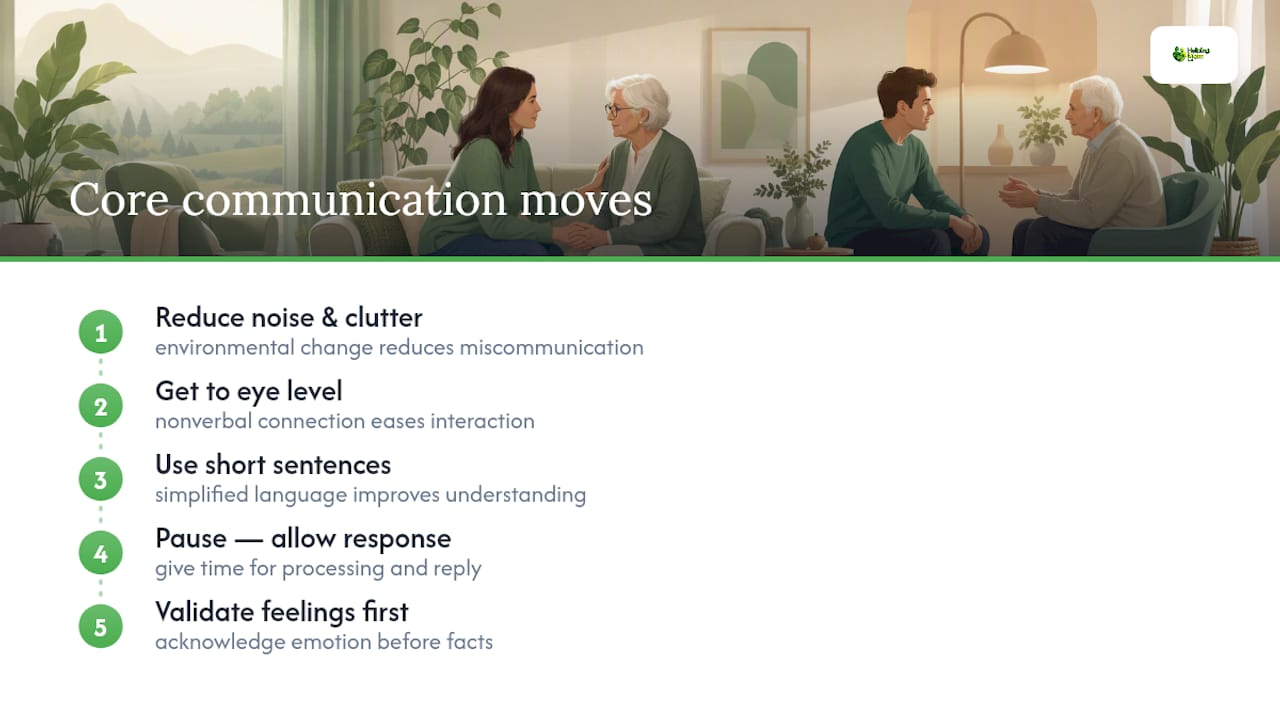
Where the evidence is strongest: environmental adjustments (lighting, noise, eye level) and simplified language consistently reduce miscommunication across nearly every source. Where more clinical nuance applies: sudden behavioral changes, new aggression, or rapid decline. Those situations call for a medical review rather than a communication tweak, since an underlying medical cause can look identical to ordinary disease progression at first glance.
If you want to go deeper on any single piece of this, our guides on caring for a parent with dementia and talking with aging parents about care both build on these same fundamentals with more scenario-specific detail.
For readers navigating memory changes from causes other than dementia, our partners at the Safety Behind the Wheel Foundation cover memory loss after brain injury, a useful comparison if you're trying to understand how different conditions affect communication differently.
Once your parent's communication needs are clearer, the next practical step for many families is making sure the home itself supports those changes, better lighting, reduced clutter, visible cues in the right places. Our home safety guide for aging parents walks through exactly where to start, and if you'd rather talk it through with someone directly, Helping-mom offers paid one-on-one Zoom consultations to help you build a communication and safety plan specific to your parent's stage and home.
A Caregiver's Perspective on What Actually Helps
Here's what surprises most people once they start applying these ideas: the "right words" matter far less than most caregivers assume. A daughter I heard about through caregiving networks spent months trying to reason her mother out of asking about a sister who'd passed away years earlier, correcting the timeline every single time, and every single time it ended in tears. The shift came when she stopped correcting and started validating: "You miss her, don't you? Tell me about her." The question didn't disappear, but the distress around it did, almost immediately.
That's the part conventional advice tends to underplay. Caregivers are told to be patient, be calm, use short sentences, all true, but the deeper skill is letting go of the need to be factually right in every exchange. Dementia doesn't require you to win the conversation. It asks you to meet the person where they are, again and again, sometimes dozens of times a day.
If you're in the thick of this right now, exhausted and unsure whether you're doing it right, that uncertainty is normal, not a sign of failure. Asking for help, from a sibling, a support group, or a guided consultation, is part of doing this well, not a departure from it. Helping-mom's guides on helping a parent with memory loss exist for exactly this moment when you want a clear plan instead of another list of generic tips.
— Mike C.
This article is general information, not a substitute for advice from a qualified doctor. Consult a qualified healthcare professional about your own circumstances before acting on anything here.
Sources
- Communication and Alzheimer's — Alzheimer’s Association
- Bridging the gap: Dementia communication strategies — Harvard Health
- Repetitive behavior and dementia — PMC (case-based strategies)
- Communicating with someone who has Alzheimer’s disease — National Institute on Aging (NIA)
FAQ
What Are the 3 R's of Communication for Dementia?
Definitions vary across sources, but a common version emphasizes reassure, respond, and redirect: acknowledge the person's feeling, answer their concern simply, then guide attention toward a calming activity or task.
Why Do People With Dementia Wander at Night?
Nighttime wandering is often linked to disorientation, disrupted sleep patterns, or a search for something familiar, and it tends to respond well to consistent evening routines, clear visual cues, and softer lighting that reduces confusing shadows.
What Is the 90 Second Rule for Dementia Patients?
This isn't a term drawn from the research reviewed here, so rather than guess at a specific rule, the safer guidance is the well-supported principle behind it: give a person extra time, often well beyond what feels natural, to process a question and respond before repeating or rephrasing it.
What Are Five Effective Communication Strategies?
Minimizing background noise, keeping eye contact at eye level, using short direct sentences, practicing active listening, and validating emotions over facts form a strong, evidence-backed starting set for most conversations.
How Do You Handle the Same Question Asked Repeatedly?
Answer the question once, calmly and honestly, then add a visual cue like a whiteboard note or a labeled sign, and redirect attention to a simple task or activity rather than repeating the verbal answer over and over.
Does Tone of Voice Matter More Than the Words You Use?
Often, yes. A calm tone and relaxed body language tend to register with a person who has dementia even when the specific words don't fully land, which is why staying visibly calm matters as much as choosing the right sentence.