

TL;DR:
- Early signs of dementia include persistent changes in memory, behavior, and daily function that go beyond normal aging. Recognizing patterns like repeated questions, hygiene decline, or personality shifts helps families seek timely evaluation and plan care. Early diagnosis allows for better management and preparation before the condition progresses.
Early signs of dementia in parents are specific, persistent changes in memory, behavior, and daily function that go beyond normal aging and signal progressive cognitive decline. Dementia is not a single disease but a group of symptoms caused by conditions like Alzheimer's disease, vascular dementia, or Lewy body dementia. Recognizing these changes early gives your family time to seek evaluation, plan ahead, and support your parent's independence with dignity. This guide walks you through what to watch for, how to tell the difference from typical aging, and what practical steps you can take right now.
What are the classic early warning signs of dementia in aging parents?
Early warning signs of dementia are observable changes in how your parent thinks, communicates, and manages daily life. They are not occasional slip-ups. They are patterns that repeat and gradually worsen over time.
The most common signs adult children notice first include:
- Memory loss affecting daily life. Your parent forgets appointments, asks the same question several times in one conversation, or cannot recall recent events. Forgetting where they put their keys occasionally is normal. Forgetting what keys are for is not.
- Difficulty with familiar tasks. Cooking a recipe they have made for decades, managing a checkbook, or following a TV program becomes confusing or impossible.
- Confusion about time or place. Your parent loses track of the day, month, or year. They may not know where they are, even in their own neighborhood.
- Word-finding trouble. They stop mid-sentence, substitute odd words, or struggle to follow a conversation. This goes beyond occasionally forgetting a name.
- Mood and personality changes. Increased anxiety, suspicion, irritability, or withdrawal from social activities can all be early indicators.
- Poor judgment. Giving large sums of money to strangers, ignoring personal hygiene, or making unsafe decisions around the stove or car are red flags.
Observing two or more of these signs should prompt a visit to a primary care doctor for a cognitive screening. Doctors use tools like the Mini-Cog, MMSE (Mini-Mental State Examination), or MoCA (Montreal Cognitive Assessment) alongside blood work to rule out reversible causes.
Pro Tip: Keep a simple written log of specific incidents with dates. When you bring your parent to the doctor, this record is far more useful than a general sense that "something seems off."

How do early signs of dementia differ from normal aging?
Not every memory lapse signals dementia. Understanding the difference helps you respond calmly and appropriately rather than either dismissing real concerns or panicking over normal changes.
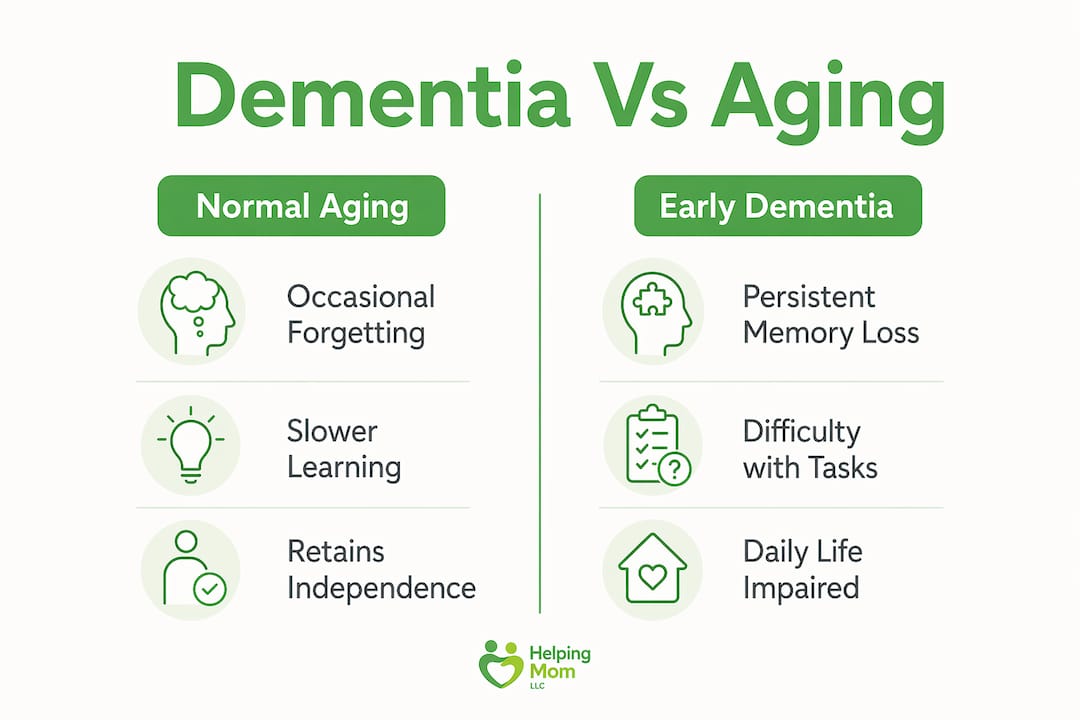
Normal aging includes slower processing speed, occasional forgetfulness, and taking longer to learn new things. These changes are mild and do not interfere with daily independence. Your parent may forget a neighbor's name but remember it later. They may take longer to balance their checkbook but still get it right.
Dementia symptoms are persistent, progressive, and disruptive to daily life. Your parent does not remember the conversation later. They cannot complete the checkbook at all. The difference is not just frequency. It is whether the change affects their ability to function independently.
| Normal Aging | Early Dementia |
|---|---|
| Occasionally forgets a name but recalls it later | Forgets familiar people and does not recall them |
| Misplaces items but retraces steps to find them | Puts items in unusual places and cannot retrace steps |
| Slower to learn new technology | Cannot follow simple instructions at all |
| Occasionally misses a bill payment | Repeatedly misses payments or forgets bills exist |
| Takes longer to make decisions | Shows consistently poor or unsafe judgment |
One of the earliest and most overlooked clues is a decline in executive function. Neglecting personal hygiene, such as skipping nail care or dental hygiene, signals that the brain is struggling to initiate and sequence daily tasks. This often appears before obvious memory loss.
Pro Tip: If you are unsure whether what you are seeing is normal aging or something more, Helping-mom's guide on normal vs. dementia changes offers a calm, clear comparison you can review before the doctor's appointment.
What subtle non-memory symptoms can signal early dementia?
Some of the earliest dementia indicators have nothing to do with forgetting names or losing keys. These non-memory symptoms often appear years before a formal diagnosis and are frequently mistaken for depression, stress, or personality changes that come with aging.
Behavioral changes are a significant early signal. Apathy, impulsivity, irritability, and depression can all precede memory loss by years. Families often assume their parent is going through a rough patch emotionally. In reality, these shifts may reflect early changes in the brain's frontal lobe, which governs personality and behavior.
Financial patterns are another telling sign. Missed bill payments can appear up to 6 years before a dementia diagnosis. That is not a typo. Managing finances requires planning, sequencing, and memory. When those abilities begin to erode, bills get overlooked long before anyone notices a memory problem.
Physical changes also carry weight. Unexplained weight loss can begin as far as 10 years before diagnosis. Changes in speech complexity, such as shorter sentences and simpler vocabulary, have been identified by researchers as early markers as well.
Families often mistake early dementia mood and behavioral changes for new depression or anxiety. These are frequently signs of cognitive decline that require sensitive care and a proper evaluation, not just reassurance.
Watching for these subtle shifts gives you a meaningful head start. You do not need to diagnose your parent. You need to notice the pattern and bring it to a doctor's attention.
How can adult children practically recognize early dementia signs at home?
Recognizing cognitive decline in a parent requires calm, consistent observation over time. You are not looking for one dramatic moment. You are looking for a pattern of small changes that add up.
Here are practical steps to take:
- Watch daily hygiene habits. Declining self-care tasks like brushing teeth, trimming nails, or changing clothes are early signs of executive dysfunction. These are easy to observe during regular visits.
- Track repeated questions and missed appointments. Write down specific examples with dates. Note whether your parent asks the same question multiple times in one visit or forgets plans you made together recently.
- Monitor driving and safety. New dents on the car, getting lost on familiar routes, or running red lights are serious warning signs that require prompt attention.
- Request read-only financial account access. Monitoring financial accounts early allows you to catch missed payments without conflict. Frame it as helping with organization, not taking over.
- Keep a symptom diary. A simple notebook or phone note with dates, behaviors, and context gives the doctor a clear picture. Vague concerns are easy to dismiss. Specific documented patterns are not.
- Schedule a cognitive screening. When you have documented two or more consistent changes, call your parent's primary care doctor. Ask specifically about a cognitive evaluation. Doctors use the Mini-Cog, MMSE, or MoCA to assess memory, attention, and reasoning.
Approach all of this with your parent's dignity in mind. You are not investigating them. You are paying attention because you care. Frame your observations that way in every conversation.
Pro Tip: If your parent resists a doctor's visit, try framing it as a routine checkup rather than a memory evaluation. Many people are more willing to go when it does not feel like a test.
What happens after early signs appear: dementia stages and caregiving
Dementia typically progresses over 2 to 10 years from the first mild symptoms to the late stage. Knowing what to expect helps you plan ahead rather than react in a crisis.
| Stage | Common Symptoms | Caregiving Focus |
|---|---|---|
| Early | Mild memory lapses, word-finding trouble, mood changes | Observation, doctor evaluation, legal and financial planning |
| Middle | Increasing confusion, safety risks, help needed with daily tasks | Home safety modifications, supervision, daily routines |
| Late | Loss of recognition, limited mobility, full care needed | Personal care support, comfort, and family coordination |
The early stage is the most important window for planning. Your parent can still participate in decisions about their care, finances, and living arrangements. This is the time to talk about legal documents like a power of attorney, review financial accounts, and assess home safety for aging in place.
The middle stage brings increasing dependence. Your parent may need reminders for medications, help with bathing, and supervision around the stove or car. Home modifications like grab bars, door alarms, and simplified routines make a real difference at this stage.
Key caregiving priorities to address early:
- Talk with siblings and family members about shared responsibilities before a crisis forces the conversation.
- Connect with your parent's doctor to understand the diagnosis and what to expect.
- Look into local support groups and respite care options for yourself as a caregiver.
- Review the home environment for fall risks and safety hazards.
Planning in the early stage protects both your parent and you.
Key Takeaways
Recognizing early signs of dementia in parents requires consistent observation of memory, behavior, and daily function changes that persist, worsen, and disrupt independence.
| Point | Details |
|---|---|
| Early signs are patterns, not moments | Look for repeated behaviors over time, not single incidents. |
| Non-memory symptoms appear first | Apathy, missed bills, and hygiene decline can precede memory loss by years. |
| Normal aging differs from dementia | Normal aging slows function; dementia disrupts it entirely. |
| Documentation supports diagnosis | A written symptom log with dates helps doctors assess cognitive change accurately. |
| Early planning protects everyone | The early stage is the best time to address legal, financial, and home safety needs. |
What I have learned from watching families navigate this
One thing I have seen repeatedly is that adult children wait too long. Not because they do not care. Because they do not want to be wrong. There is a real fear of alarming a parent unnecessarily, or of damaging the relationship by raising concerns. So families watch and wait, sometimes for years, while the window for early planning quietly closes.
The shift I would encourage is this: you do not need certainty to take action. You need a pattern. If you have noticed three or four of the signs described here over the past few months, that is enough to schedule a doctor's visit. You are not diagnosing your parent. You are asking a professional to take a look.
The other thing worth saying plainly is that the emotional weight of this falls unevenly on families. Often one adult child carries most of the observation, the worry, and the logistics. If that is you, please do not do it alone. A family meeting for aging parents is one of the most practical things you can do early on. Getting everyone on the same page before a crisis is far easier than trying to coordinate during one.
Finally, remember that an early diagnosis is not a sentence. It is information. And information gives you choices.
— Mike
Practical resources for families noticing early changes
If you are starting to notice changes in your parent and want to take calm, practical steps, Helping-mom has guides built specifically for this moment. The home safety guide for seniors walks you through the most common risks in the home environment and how to address them before they become urgent. The aging in place resource hub covers everything from daily routines to longer-term planning. These resources are designed for adult children who want to act thoughtfully and early, not reactively. You do not need to have all the answers right now. You just need a place to start.
FAQ
What are the first signs of dementia in a parent?
The first signs are usually repeated memory lapses affecting daily life, difficulty with familiar tasks, and subtle personality or mood changes. Missed bill payments and declining hygiene can appear years before more obvious memory loss.
Can dementia symptoms look like depression?
Yes. Apathy, withdrawal, and irritability are common early dementia signs that are frequently mistaken for depression. A doctor's evaluation is the only way to distinguish between the two conditions accurately.
What tests do doctors use to screen for dementia?
Doctors use cognitive tools like the Mini-Cog, MMSE, or MoCA along with blood work to rule out reversible causes such as infections, thyroid problems, or medication interactions.
How is dementia different from normal aging?
Normal aging causes occasional forgetfulness and slower processing but does not disrupt daily independence. Dementia impairs daily function in ways that are persistent, progressive, and not explained by normal aging alone.
When should I take my parent to the doctor for memory concerns?
Schedule a visit when you have observed two or more consistent changes in memory, behavior, or daily function over several weeks or months. Bringing a written log of specific incidents with dates will help the doctor assess the situation clearly.