

Start with two quick safety checks: is the bathroom floor dry and clear, and has the water heater been turned down to a safe temperature? If your elderly parent refuses to bathe, skip the debate and offer a smaller, lower-pressure option instead, like a seated wash-up at the sink or a warm washcloth session with a towel over their lap. That single shift, from insisting on a full shower to offering a gentler alternative, often lowers resistance immediately. The sections below walk through why this happens and exactly what to say and do next.
TL;DR:
- Most bathing resistance in older adults stems from fear of falling, embarrassment, pain, or cognitive challenges, not stubbornness or defiance.
- Urgent issues such as recent falls, unsteadiness, dizziness, or sudden behavioral changes require immediate medical evaluation and environmental safety adjustments.
- Using choice-based language, timing routines for mornings, and incorporating sensory comforts can significantly reduce resistance and increase cooperation.
- Implementing bathroom safety modifications like grab bars, non-slip mats, and safer fixtures can lower the risk of falls and alleviate fear.
- When resistance escalates or health concerns arise, professional assessments and home safety evaluations can provide tailored solutions and support.
Table of Contents
- Why Older Adults Resist Bathing
- Quick Safety Check: Red Flags That Need Attention Now
- What to Say: Scripts and Timing That Lower Resistance
- Bathing Alternatives You Can Try Today
- Bathroom Changes That Reduce Fear and Risk
- When to Call In Healthcare or Paid Help
- Keeping Dignity Intact While Protecting Yourself
- Why Calm, Dignity-First Approaches Work
- How Helping Mom Can Help You Build a Plan
- Sources
- FAQ
Why Older Adults Resist Bathing
Bathing resistance almost never comes from stubbornness. It comes from something specific, and once you name it, you can respond to the actual problem instead of pushing harder against an invisible wall.
Fear of falling tops the list for many older adults, especially those who have slipped in a tub before or feel unsteady standing on wet tile. Embarrassment runs a close second: undressing in front of an adult child, even one you raised, can feel humiliating, particularly for a parent who spent decades being the one in charge. Dementia and other cognitive changes add another layer entirely. A parent with memory loss may genuinely not remember when they last bathed, or they may not understand the sequence of steps well enough to start on their own. Depression can flatten motivation for hygiene the same way it flattens motivation for anything else. Sensory sensitivities matter too. Water that feels merely cool to you can feel painfully cold to aging skin, and the sound of running water or a loud bathroom fan can be genuinely distressing for someone with dementia.
Physical pain is often the quiet culprit. Arthritis in the shoulders makes hair washing agonizing. Sore knees or hips make the step over a tub edge feel like a real risk rather than a minor inconvenience. And medications can play a role too. A new prescription or a dosage change can cause dizziness, fatigue, or skin sensitivity that makes bathing suddenly unappealing when it wasn't before.
The National Institute on Aging notes that refusal often reflects embarrassment, fear, physical discomfort, or trouble following the steps rather than simple defiance, and that watching for the specific trigger matters more than repeating the request.
To find the real cause, pay attention to timing and pattern:
- Does resistance happen every time, or only on certain days or times of day?
- Does your parent refuse the whole process, or just one part, like hair washing or undressing?
- Did the resistance start suddenly, or has it built gradually over months?
- Does it get worse in the evening, which can point to sundowning in someone with dementia?
Matching your approach to the actual cause changes everything. A parent who is afraid of falling needs a grab bar and a shower seat, not a pep talk. A parent who feels embarrassed needs privacy and a towel, not a cheerful audience. Guessing wrong wastes energy and can deepen the standoff.
Quick Safety Check: Red Flags That Need Attention Now
Before you focus on encouragement or routine, rule out anything urgent. Some causes of bathing refusal are simply preferences to work around. Others are signals your body is sending that something has changed.
Run through this list the next time bathing comes up:
- Has your parent fallen recently, or seemed unsteady getting in or out of a chair?
- Do they hesitate, wobble, or grab furniture during transfers, like standing up from the toilet or bed?
- Have they mentioned dizziness, or do they seem lightheaded after standing?
- Is there new incontinence paired with redness, rash, or broken skin?
- Did the refusal start abruptly, alongside any other sudden change in mood or behavior?
- Has a doctor changed a medication or dosage in the past few weeks?
If you check even one of these boxes, treat it as information, not an emergency in itself, but a signal to pause and look closer.
Falls are the leading cause of injury among older adults, and the CDC's STEADI program recommends screening for fall risk specifically so caregivers and clinicians can catch modifiable factors, like poor balance or unsafe footwear, before an injury happens rather than after.
Take these steps right away if you spot a red flag: clear anything on the bathroom floor that could cause a slip, stop any transfer that looks unsafe rather than pushing through it, and call the primary care provider if the change came on suddenly. A gradual shift over weeks can usually wait for a scheduled appointment. A sudden one, especially paired with confusion or a fall, deserves a same-week call, and anything involving chest pain, slurred speech, or a head injury needs urgent care right away.
What to Say: Scripts and Timing That Lower Resistance
The words you choose matter almost as much as the plan behind them. A direct command like "You need to take a shower now" invites a power struggle, because it removes your parent's sense of control over their own body. Offering a choice does the opposite.
Try phrasing like this instead:
- "Would you like to wash up before or after breakfast today?"
- "I brought warm towels. Do you want to start with your hands and face, or your hair?"
- "Let's get you freshened up before your favorite show comes on."
- "You can wear whichever robe you'd like after. Which one sounds good?"
Notice that none of these ask permission for the whole event. They ask for a small decision within an event that's already happening. That distinction matters, because a parent who feels like they're choosing is far less likely to resist than one who feels like they're being managed.
Timing helps too. Morning tends to work better than evening for most older adults, and it's especially important for anyone with dementia, since confusion and agitation often build later in the day, a pattern often called sundowning. If your parent has always been a night owl, adjust around their actual rhythm rather than a generic rule, but avoid the final hour before bed if agitation has been a pattern.
Small sensory touches go a long way. A warm towel draped over the shoulders while you wash elsewhere on the body reduces the shock of exposure. Playing a favorite song softly in the background can ease anxiety, and a towel or robe kept over the lap preserves modesty during the parts of the process that feel most exposing. Person-centered approaches like these have shown promising reductions in agitation and anxiety during personal care, according to research summarized by the Alzheimer's Association, even if larger studies are still needed to confirm the size of the effect.

Giving your parent a small role also helps enormously. Let them hold the washcloth and wash their own arm while you handle their back. Let them choose the soap or pick which towel to use after. These moments of control add up to real cooperation over time.
Pro Tip: Narrate what you're doing before you do it, every single time, even if it feels repetitive. "I'm going to check the water temperature now" or "I'm going to help you stand up" gives your parent a beat to prepare instead of feeling surprised or handled.
If your parent pushes back mid-process, pause rather than push through. Step back, lower your voice, and offer a smaller version of the task, like just washing hands and face today. You can return to the rest tomorrow.
Bathing Alternatives You Can Try Today
A full shower or bath isn't the only path to good hygiene, and treating it as the only option is often what creates the standoff in the first place. Several lower-friction alternatives can keep your parent clean and comfortable on days when a full bath feels like too much.
Consider rotating through these depending on the day:
- A seated wash-up at the bathroom sink or with a basin at bedside
- Hair washing at the kitchen or bathroom sink using a handheld sprayer, separate from the rest of bathing
- No-rinse cleansing wipes for a quick, low-stress refresh
- Dry shampoo between full washes to manage odor and oil
- A bed sponge bath for days when mobility or mood makes standing difficult
- A towel draped over the lap or shoulders throughout, to preserve modesty and warmth
For a calm, seated wash-up or chair-based shower, a simple sequence keeps things predictable for both of you:
- Gather everything before you start: washcloths, towels, soap, a robe, and any equipment, so you're not leaving the room mid-task.
- Warm the bathroom ahead of time with a space heater or by running the shower briefly to take the chill off.
- Check water temperature on your own wrist first, since aging skin can be less sensitive to heat and more prone to burns.
- Start with the face and hands, areas that feel least exposing, before moving to the body.
- Work top to bottom, keeping a towel over areas not currently being washed.
- Dry thoroughly, especially skin folds and between toes, to prevent irritation or fungal issues.
- Dress in the outfit your parent chose ahead of time, so that decision isn't left for the moment they're cold and tired.
On frequency, don't aim for daily. The National Institute on Aging suggests two to three baths or showers a week as a reasonable baseline for someone with dementia, with sponge baths or sink hair washes filling the gaps on harder days. That flexible rhythm keeps hygiene manageable without turning every single day into a negotiation.
Bathroom Changes That Reduce Fear and Risk
Some resistance disappears the moment the physical environment stops feeling dangerous. If your parent hesitates near the tub, grips the sink too hard, or refuses to lift a leg over the tub wall, the problem may be the bathroom itself rather than bathing in general.
Start with the fixes that match the specific problem you've observed:
- If unsteady transfers are the issue, install grab bars near the toilet and inside the shower or tub, positioned where your parent actually reaches, not just where they look tidy.
- If slipping is the concern, add non-slip mats both inside the tub and on the floor just outside it, since that transition point is where many falls happen.
- If standing for a shower feels risky, add a tub bench or shower seat so your parent can sit through the entire process.
- If water pressure or aim feels unpleasant, switch to a handheld showerhead, which also gives you far more control when you're assisting.
- If temperature is unpredictable, install a thermostatic mixing valve or simply test the water with your own hand before your parent steps in.
- If getting up from the toilet is a struggle, a raised toilet seat with armrests can help before and after bathing.
Basic home fixes like grab bars, non-slip mats, and better lighting are among the most effective first steps for reducing fall risk, since most injurious falls among older adults happen at home, often in the bathroom specifically.
If you're not sure which fixes to prioritize, an occupational therapist can walk through the home and flag the highest-risk spots. Ask your parent's doctor for a referral, or start with a grab bar and bathroom safety guide to understand what to look for before you buy anything. A physical therapist referral makes sense if balance or gait, rather than the environment alone, seems to be driving the fear.
When to Call In Healthcare or Paid Help
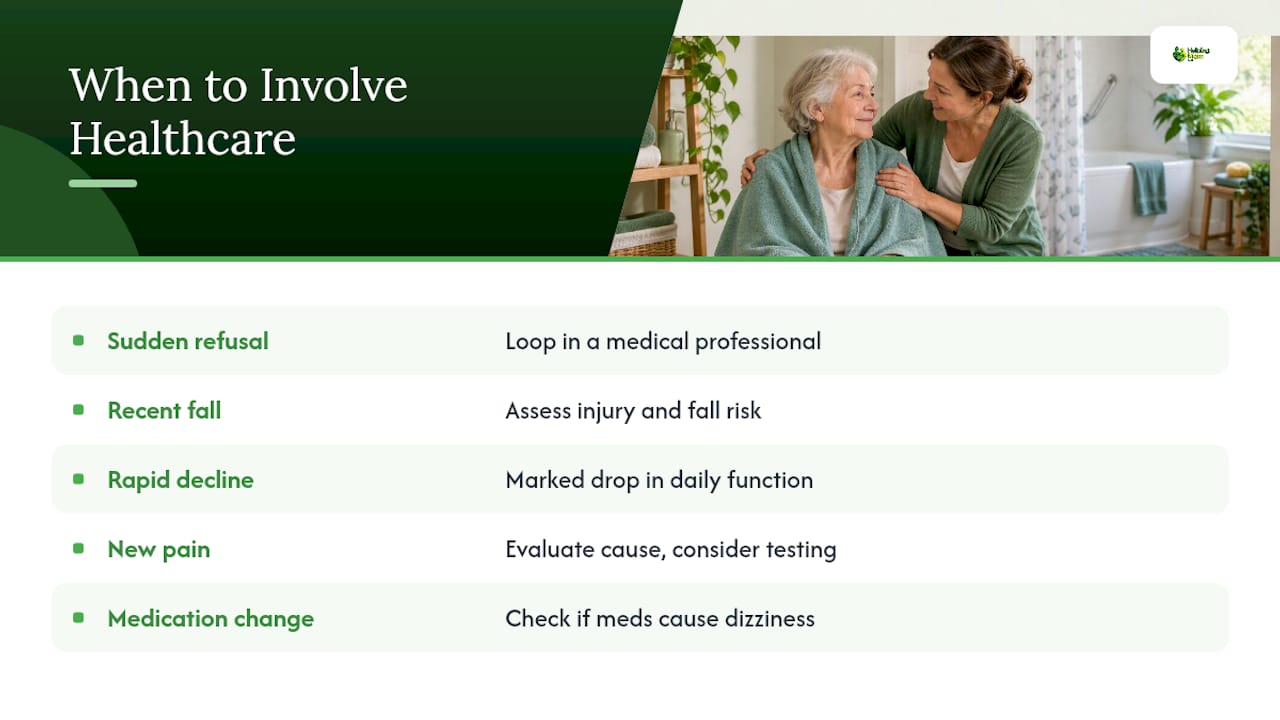
Some situations call for more than a communication script or a grab bar. Sudden refusal, a recent fall, rapid decline in daily function, new pain, or a recent medication change are all reasons to loop in a medical professional rather than handling it alone.
Before a visit to the primary care provider, jot down a few things: the dates of any falls, exactly when the refusal started, a current medication list, and specific examples of what your parent can and can't do on their own right now. During the appointment, ask directly: could a medication be causing dizziness or skin sensitivity? Should we screen for depression? Is a referral to physical therapy or occupational therapy appropriate?
Home health services, when ordered by a physician, can include a physical therapist to work on balance and transfers, an occupational therapist to assess the home and recommend equipment, and sometimes a home health aide to assist with bathing directly a few times a week. Referrals to PT for balance work and OT for a home safety evaluation are standard recommendations once a fall risk has been identified, and Medicare covers an OT home-safety evaluation when a doctor orders it as medically necessary, so it's worth asking specifically for that referral by name.
If daily hygiene has become a consistent struggle rather than an occasional one, a professional bathing aide or home health aide can take pressure off the relationship, letting you stay in the role of loving adult child rather than the person your parent battles every time water is involved.
Keeping Dignity Intact While Protecting Yourself
Good hygiene care rests on a handful of small, repeatable habits. Keep a towel over your parent's lap or shoulders throughout the process, not just at the start. Narrate each step before you do it, even the ones that seem obvious to you. Offer real choices, like which washcloth or which song, and let your parent hold the washcloth or soap themselves whenever they're able to.
Your own safety matters just as much. Never improvise a transfer you're not confident about, and don't try to catch a falling adult on your own. If a task requires more strength or stability than you have, get help, whether that's a gait belt, a second person, or professional support. Attempting an unsafe transfer solo risks injury to both of you.
A workable bathing routine is rarely perfect. It's a mix of small technique choices, a safer environment, and scripts that reduce friction, aimed at something repeatable rather than flawless. If you want a starting point, the elderly home safety checklist covers the basics room by room, and a Caregiving Clarity Session can help if you need a plan built around your parent's specific situation rather than general guidance.
Why Calm, Dignity-First Approaches Work
Small, consistent changes tend to produce far more cooperation than any single conversation ever will, no matter how carefully you plan that conversation. One family I've seen described in caregiving circles made exactly one change: switching from "It's time for your shower" to "Do you want to wash your hair before or after lunch?" Resistance dropped almost immediately, not because the underlying fear disappeared, but because the sense of being controlled did. If today's attempt doesn't go well, that's not a failure. It's information. The Helping Mom resources are built around exactly this kind of steady, practical adjustment, one small shift at a time.
— Mike C.
How Helping Mom Can Help You Build a Plan
Reading through causes, scripts, and equipment lists is useful, but a plan built around your parent's specific fears, home layout, and routine gets you further, faster. The Caregiving Clarity Session offers a focused conversation where you walk through what's actually happening with your parent's bathing resistance and leave with a concrete, prioritized plan, including scripts you can use that same week.
If safety concerns are part of the picture, the In-Home Age-Safe Home Safety Assessment sends someone into the actual bathroom to flag risks and recommend fixes in the order that matters most, which tends to suit families who want hands-on guidance rather than a checklist to interpret alone. If you're outside the local service area, the Virtual Home Safety Consultation covers similar ground remotely.
To be clear: if the tips above are already working and your parent is safe, you may not need any of this. But if resistance keeps escalating or you're unsure whether what you're seeing is normal, book a Caregiving Clarity Session and get a plan built around your actual situation.
Sources
For deeper guidance beyond this article, the NIA's bathing, dressing, and grooming guide covers dementia-specific hygiene approaches, the Alzheimer's Association bathing page offers step-by-step safety tips, and the CDC STEADI caregiver brochure walks through home fall-prevention basics.
- Alzheimer's caregiving: Bathing, dressing, and grooming | National Institute on Aging
- CDC STEADI: Best practices for developing an inpatient program to prevent older adult falls after discharge
FAQ
How long can an elderly person go without bathing?
There's no universal number, but the NIA's baseline of two to three baths a week is a reasonable target, filled in with sponge baths or sink washes on other days. Going a few extra days rarely causes harm as long as basic spot cleaning continues in between.
What are the signs that an elderly person is deteriorating?
Watch for sudden changes rather than slow, expected ones: new unsteadiness or falls, confusion that wasn't there before, rapid weight change, withdrawal from routines they used to enjoy, or a sudden inability to manage tasks they handled fine last month. Any sharp, sudden shift is worth a call to their doctor.
What should I do if my elderly parent refuses help?
Start by identifying the specific fear or discomfort behind the refusal rather than repeating the request. Offer smaller choices, adjust timing, and bring in a professional evaluation if refusal is sudden or paired with other changes. The Helping Mom guide on parents who refuse help walks through this conversation in more depth, and calming techniques like the ones described in this anxiety coping guide can ease tension in the moment.
What stage of dementia is refusing to bathe?
Bathing resistance can appear at nearly any stage of dementia, though it often becomes more noticeable in the middle stages as confusion about the steps and increased fear of unfamiliar sensations grow. It's a common symptom rather than a marker of one specific stage, so pair the observation with other changes in memory and daily function before drawing conclusions.