

Help your parent by validating first, offering small reversible choices, and sharing responsibility through a family plan. That approach keeps you genuinely useful without quietly taking control.
Start here, right now:
- Say something that shows you heard them before you offer any suggestion or fix.
- Do one small, reversible thing today — drop off a meal, pick up a grab bar to show them, or clear a tripping hazard with their permission.
- Call a professional if safety is immediately at risk — your parent's doctor, a local Area Agency on Aging, or book a home safety consultation through Helping-mom.
Table of Contents
- Why do good-intentioned adult children end up taking charge?
- How do you open conversations without being controlling?
- What are small, respectful ways to help at home?
- What is supported decision-making, and how does it differ from control?
- How do you cope with the discomfort of stepping back?
- How do you run a family meeting that actually works?
- Phrases you can use right now
- Key Takeaways
- Walking alongside, not in front
- Helping-mom resources for your next step
- Useful sources
- FAQ
Why do good-intentioned adult children end up taking charge?
The shift from helper to controller usually happens quietly. You notice something that worries you, and the urge to fix it kicks in before you have even asked your parent how they feel about it. A few common drivers push this pattern:
- Anxiety about risk — a fall, a missed medication, a stove left on. The fear is real, but the response is often faster than the situation requires.
- Role reversal discomfort — watching a parent slow down triggers grief, and action feels better than sitting with that feeling.
- Time pressure — you have a job, kids, and a two-hour drive. It is easier to just handle it than to negotiate.
- Sibling dynamics — if no one else is stepping up, you fill the gap, sometimes too completely.
Therapists point out that the urge to fix is often an anxiety-management response for the helper, not a solution to the parent's actual need. Before you act, it helps to ask yourself: Is this for them, or to calm me down?
Pro Tip: Before your next visit or call, pause for 60 seconds and name what you are feeling. Anxious? Guilty? Rushed? Naming it gives you a moment of choice before you react.
How do you open conversations without being controlling?
Validation comes first. Offering advice before someone feels understood makes that advice land poorly, regardless of how good it is. Therapist Alli Spotts-De Lazzer recommends short phrases that signal you are listening before you say anything else.
Validation-first openers:
- "That sounds really hard."
- "I can see why you'd feel that way."
- "I'm not here to tell you what to do. I just want to understand."
Two short example conversations:
When your parent resists help: You: "I noticed the steps looked a little slippery last time I was over. How are you feeling about them?" Parent: "I've been fine for 30 years." You: "That makes sense. Would it be okay if I just looked at them with you? No pressure to change anything."
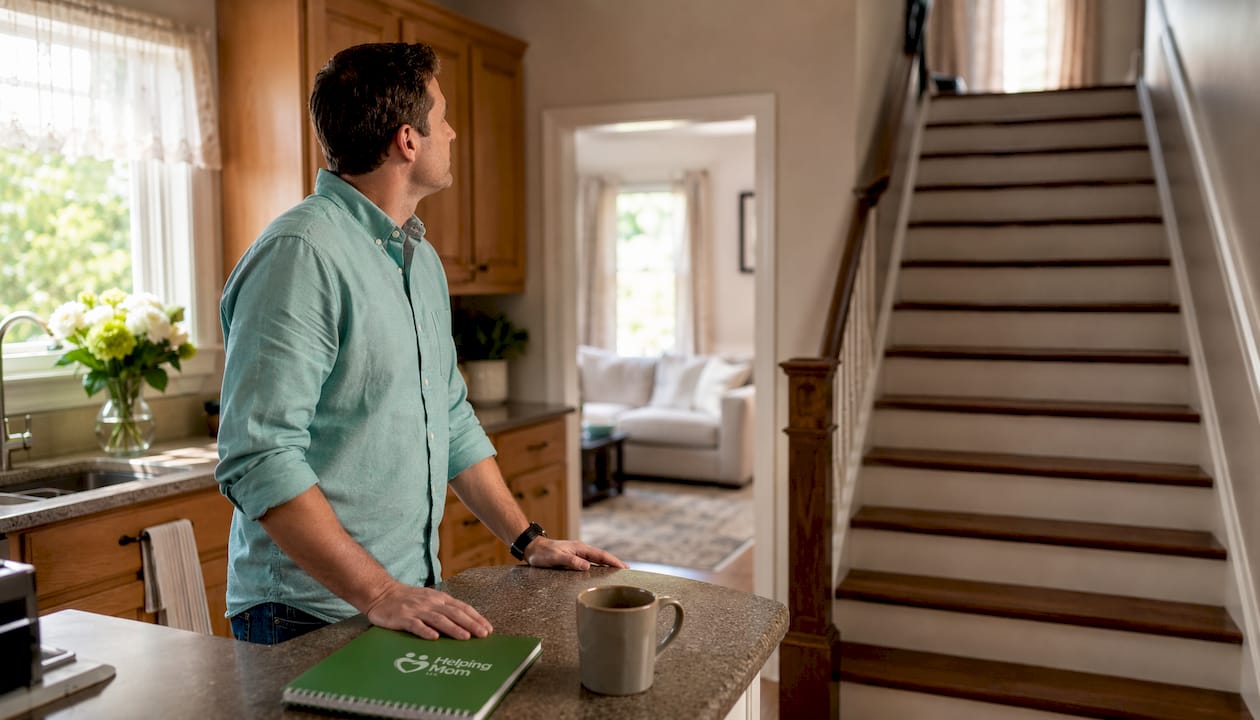
When a safety concern is real but your parent is still independent: You: "I worry sometimes, and I know that can feel like I don't trust you. Can I share one thing I noticed, and then you tell me what you think?"
Replace directives with curiosity. The "And what else?" technique, used up to three times in a row, helps your parent explore their own options rather than waiting for yours. Try: "What would help you feel more comfortable?" and then, "And what else?"
Pro Tip: Advice lands better after someone feels understood. Spend at least two minutes listening before you suggest anything. The conversation will go differently.
What are small, respectful ways to help at home?
Practical gestures — dropping off a meal, running an errand, being present — often communicate care more clearly than unsolicited advice. The goal is to increase your parent's capability so they feel more able, not more managed.
Low-control help options to offer now:
- Bring a meal and eat together, no strings attached.
- Offer to drive to one appointment and let them decide which one.
- Ask if they'd like company while they sort through mail or manage a task they've mentioned.
- Suggest a grab bar as a 30-day trial — frame it as removable and reversible.
Safety checklist items to present as options, not requirements:
- Better lighting in hallways and stairwells ("Want me to pick up a brighter bulb and try it?")
- A non-slip bath mat ("I found one that's easy to remove if you don't like it.")
- A grab bar near the toilet or shower ("We could put it up for a month and see if it feels useful.")
- Clearing a rug that slides ("Can I move this one for now, just to see how the floor feels?")
For professional help at home, arranging in-home care works best when your parent is part of the decision from the start, not handed a schedule after the fact.
What is supported decision-making, and how does it differ from control?
Supported decision-making means your parent stays the decision-maker. Your role is to give them information, options, and time, not to make the call for them. It is the practical alternative to guardianship, and it works in everyday caregiving long before legal questions arise.
Practical boundary rules:
- Ask before acting. Always.
- Keep your actions reversible wherever possible.
- Never assume authority over finances or legal matters without explicit, documented agreement.
- If you handle a task on their behalf, tell them what you did and why.
Signs that a legal conversation may be needed include repeated safety incidents your parent cannot recall, or clear difficulty understanding financial decisions. At that point, consult an elder law attorney or a certified financial planner who works with aging adults. That is a professional conversation, not one to navigate alone.
Quick actions that preserve autonomy:
- Present two or three options and let your parent choose.
- Offer information without a recommendation attached: "Here's what I found. What do you think?"
- When handling home or health changes, use trial periods with a set check-in date.
Letting go is not withdrawing care. It is removing control from care so you stay connected without directing outcomes.
Pro Tip: Before you take any action on your parent's behalf, ask: "Did they ask me to do this, or did I decide they needed it?" That one question changes a lot.
How do you cope with the discomfort of stepping back?
Watching your parent struggle with something you could easily fix is genuinely hard. The discomfort is real, and it often drives caregivers to act too quickly or too completely.
A simple self-check before you intervene:
- Pause. Take a breath.
- Name the feeling: worried, guilty, frustrated, helpless.
- Ask: Is this action for them, or to relieve my discomfort?
Signs of caregiver burnout to watch for:
- Resentment toward your parent or siblings
- Difficulty sleeping or concentrating
- Feeling like nothing you do is enough
- Withdrawing from your own relationships
If several of these feel familiar, caregiver well-being resources can help you reset before you hit empty. Knowing when to step in is also part of protecting yourself.
Pro Tip: Schedule one 15-minute check-in with yourself each week. Write down what went well and what felt hard. Patterns become visible quickly, and visibility gives you options.
When to escalate immediately: If your parent is in immediate physical danger, call 911 or their primary care provider. That is not taking over. That is keeping them safe.
How do you run a family meeting that actually works?
A structured meeting with a short agenda reduces tension and increases the chance that decisions stick. Starting with validation and clear roles makes the difference between a productive conversation and a family argument.
Step-by-step meeting template:
- State the purpose (2 minutes): "We're here to talk about how we can support Mom together, not to make decisions for her."
- Invite your parent to speak first (5 minutes): Ask what they want, what's working, and what feels hard.
- Present the top three concerns (10 minutes): Safety, daily tasks, and upcoming needs. Frame each as a question, not a conclusion.
- Agree on a trial period (5 minutes): Pick one change to try for 30 days, then schedule a check-in.
- Assign one task per person (5 minutes): Specific, small, and time-bound.
- Set the next meeting date before you leave.
If disagreement comes up mid-meeting:
- "Let's hear what Mom thinks before we decide."
- "Can we agree to try this for 30 days and revisit it?"
- "I hear you. Can we write down both options and let Dad choose?"
Helping-mom's family meeting agenda template gives you a printable version of this structure so you can walk in prepared.
Phrases you can use right now
Keep these close. They work in real conversations, not just in theory.
Validation-first phrases:
- "That sounds exhausting. I'm glad you told me."
- "I can see this has been on your mind."
- "You've handled a lot. I just want to help where I can."
Permission-to-help and limited-offer phrases:
- "Would it be okay if I helped with just this one thing?"
- "I don't want to take over. Can I offer one idea and you tell me what you think?"
- "What would feel like the right amount of help to you?"
Safety-framed, reversible-trial language:
- "What if we tried this for a month? If it doesn't feel right, we take it out."
- "I found something that might make the bathroom feel safer. Want to look at it together?"
- "This isn't permanent. We can always change it back."
Key Takeaways
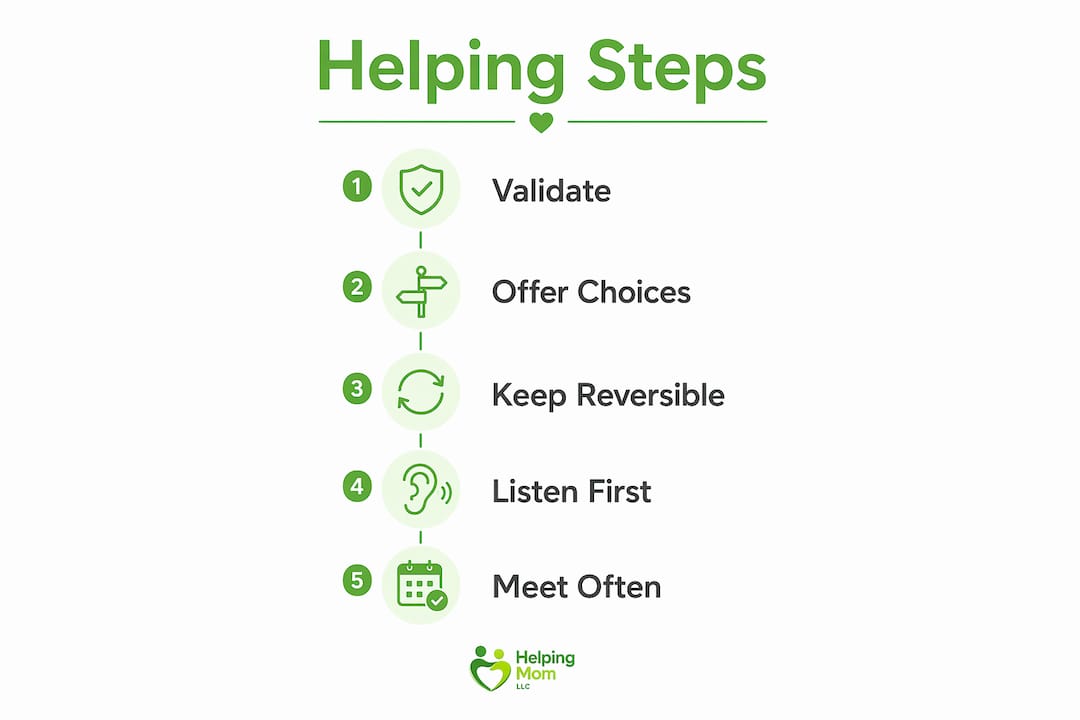
Supporting an aging parent without taking over means validating first, offering choices, keeping actions reversible, and sharing responsibility through a family plan.
| Point | Details |
|---|---|
| Validate before advising | Short phrases like "That sounds hard" increase receptiveness before any suggestion lands. |
| Keep help reversible | Frame safety changes as 30-day trials so your parent stays in control of the outcome. |
| Use the "And what else?" technique | Ask up to three times to help your parent explore their own options without you supplying the answer. |
| Run a structured family meeting | Start with your parent's voice, agree on one trial change, and set a check-in date before you leave. |
| Helping-mom resources | Use Helping-mom's family meeting templates, home safety checklists, and caregiver well-being guides to stay organized and supported. |
Walking alongside, not in front
The hardest part of this work is not the logistics. It is tolerating the discomfort of watching someone you love move more slowly than you'd like, make a choice you wouldn't make, or decline help you know would serve them. Every instinct says fix it. But the most effective caregivers I've seen are the ones who learned to walk beside their parent rather than in front of them.
The practical steps in this article are not complicated. Validate first. Offer choices. Keep things reversible. Meet as a family with a real agenda. These are small moves, and they compound. A parent who feels heard is far more likely to accept help when it genuinely matters. A caregiver who checks their own emotional state before acting stays in the role longer without burning out.
Helping-mom exists to give you the tools for exactly this: calm, clear guidance that respects your parent's independence and your own limits. The home safety checklist, the family meeting template, and the caregiver well-being resources are all there when you're ready.
Helping-mom resources for your next step
If you're ready to move from reading to doing, Helping-mom has practical tools built for this exact situation:
- Elderly home safety checklist — a printable, room-by-room guide to low-control safety fixes you can offer as reversible options.
- Family meeting agenda template — a ready-to-use structure so your next family conversation has a clear purpose and a real outcome.
- Caregiver well-being guide — practical support for managing your own energy so you can stay in this role for the long haul.
For a more personalized approach, Helping-mom offers paid one-on-one Zoom consultations and in-person home safety assessments for families in Central Florida. You get calm, non-alarmist guidance tailored to your parent's actual home and situation. Book a consultation at helping-mom.com when you're ready to take the next step.
Useful sources
- How to Support Someone Without Giving Advice — Time article featuring therapist Alli Spotts-De Lazzer on validation-first communication and practical gestures over advice.
- Helping vs. Control in Relationships — Authentic Living Therapy's guide to recognizing when helping crosses into control, with self-check tools for caregivers.
- Support Is Not Control — Psychology Today piece on supported decision-making as an alternative to guardianship.
- How to Guide People Without Giving Advice — Psychology Today on the "And What Else?" technique for helping someone explore their own options.
- True Support: Helping Someone Grow Without Taking Over — Creativity Chronicles on shifting from "How do I fix this?" to "How do I help them feel more capable?"
- Family Meeting for Aging Parents: A Practical Guide — Helping-mom's step-by-step guide to structured family meetings with validation-first agendas.
- Practical Guide: How to Make Home Safer for Seniors — Helping-mom's room-by-room home safety resource, including how to present modifications as reversible trials.
FAQ
What does "helping without taking over" actually mean in caregiving?
It means your parent stays the decision-maker while you provide information, options, and practical support. You offer choices rather than conclusions, and you keep any changes reversible so your parent can say no.
How do I bring up a safety concern without starting an argument?
Validate first, then ask a question rather than making a statement. Try: "I noticed the steps looked slippery. How are you feeling about them?" This opens a conversation instead of triggering a defense.
What is supported decision-making for aging parents?
Supported decision-making is an approach where the parent remains the decision-maker and the caregiver's role is to provide information and options, not to decide on their behalf. It is a practical alternative to guardianship for parents who still have capacity.
How do I know when I need to step in more firmly?
Watch for immediate safety risks: repeated falls, inability to manage medications, or signs that your parent cannot recall recent events. Helping-mom's guide on when to step in outlines specific red flags and next steps.
What if my parent refuses all help?
Start smaller. Offer one specific, low-stakes thing rather than a general offer to help. The phrase "Would it be okay if I just did this one thing?" is less threatening than "I want to help more." Helping-mom's resource on when parents refuse help walks through this in more detail.