

TL;DR:
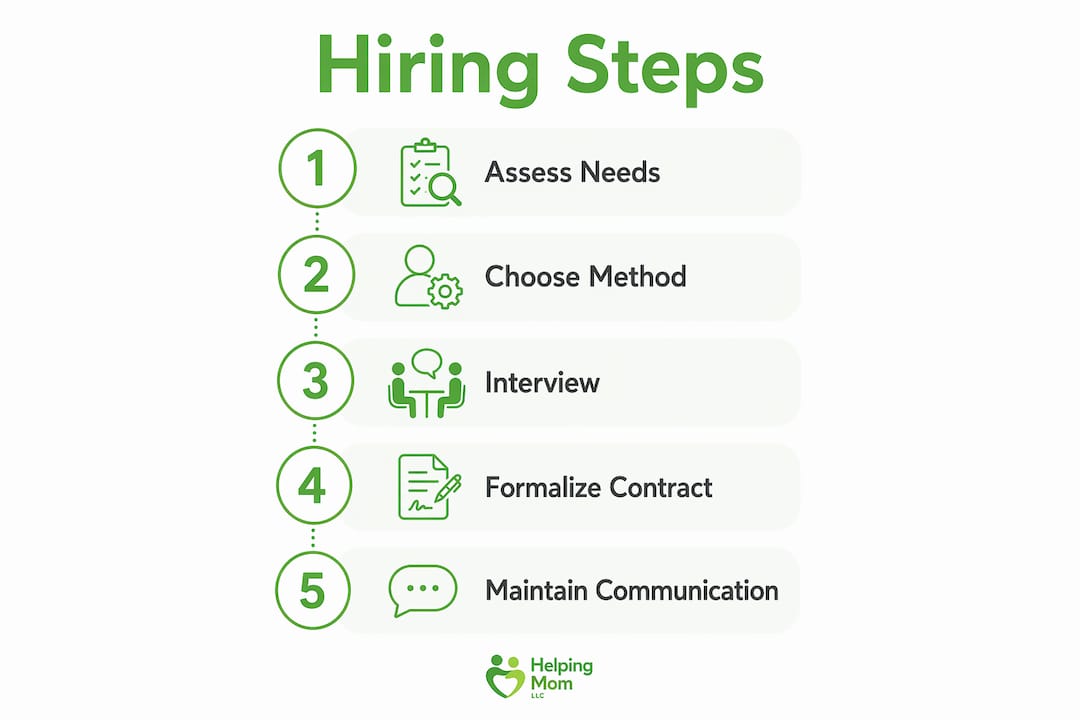
- Hiring in-home help involves a four-step process of assessing needs, choosing a hiring method, interviewing with the parent present, and formalizing a care plan. Families should start with a small number of hours, consider the pros and cons of agency versus independent hires, and involve the parent in interviews to ensure compatibility. Clear communication, written agreements, and designated family contacts help maintain effective care and boundaries over time.
Hiring in-home help is defined as the process of identifying, screening, and formally engaging a caregiver to support an aging parent's daily needs at home. The industry term for this role is "home care aide," though families also encounter titles like personal care aide, home health aide, and in-home support worker. Getting the basics right matters because a poor hire affects your parent's safety, comfort, and dignity. A structured approach, one that covers needs assessment, hiring method, interviewing, and a written care plan, protects everyone involved. This guide walks you through each step with calm, practical clarity so you can move forward with confidence.
What are the hiring in-home help basics you need to know?
A 4-step hiring process forms the foundation of safe, quality in-home care: assess needs and budget, choose your hiring method, interview with your parent present, and formalize a care plan and contract. Skipping any step creates gaps that show up later as mismatched expectations, legal exposure, or a caregiver who simply is not the right fit.
The need for in-home help often builds gradually. Harvard Health notes that early warning signs include difficulty cooking, managing household tasks, or driving safely. Recognizing these signs early gives your family time to plan thoughtfully rather than react in a crisis. Helping-mom's guide on signs your parent needs help can help you identify those early signals before they become urgent.
How to assess your aging parent's care needs and budget
Start by listing the specific tasks your parent struggles with. Caregiving professionals organize these around activities of daily living, commonly called ADLs. The core ADLs include:
- Bathing and personal hygiene
- Dressing and grooming
- Meal preparation and feeding
- Medication reminders (non-medical prompting only)
- Mobility and transfers (moving from bed to chair, for example)
- Light housekeeping and laundry
- Transportation to appointments
Beyond physical tasks, consider emotional and social needs. Does your parent spend long stretches alone? Do they seem withdrawn or anxious? A caregiver who provides companionship alongside practical help delivers meaningfully better outcomes than one who only completes tasks.
Budget is the next honest conversation. The 2025 CareScout Cost of Care Survey reports the national median hourly rate for a non-medical in-home caregiver at $35, with annual costs reaching roughly $80,080 at 44 hours per week. That figure reflects full-time care. Many families start with far fewer hours and adjust as needs grow.
Pro Tip: Start with 10–15 hours per week. This lets you test the fit, observe your parent's response, and refine the care plan before committing to a larger schedule or higher cost.
Geographic location, level of care required, and caregiver certification all affect the final rate. Build a realistic, flexible budget that accounts for possible increases over time.
What are your hiring method options and how to choose?
Two primary paths exist: hiring through a licensed agency or hiring an independent caregiver directly. Each has real trade-offs.

| Factor | Licensed agency | Independent hire |
|---|---|---|
| Background checks | Agency handles | Family's responsibility |
| Payroll and taxes | Agency handles | Family's responsibility |
| Backup coverage | Agency provides substitute | Family arranges |
| Cost | Generally higher | Generally lower |
| Flexibility | Less customizable | More customizable |
| Management burden | Low for family | High for family |
Agency hiring costs more per hour, but the agency manages payroll, insurance, screening, and backup care when a caregiver calls in sick. That administrative relief is significant for adult children who are already managing full-time jobs and their own households.
Independent hiring costs less per hour, but your family takes on legal and financial responsibilities. These include running background checks, verifying certifications, handling payroll taxes, and carrying household employer insurance. If you go this route, consult an accountant or elder law attorney before your first paycheck.
When verifying any candidate, confirm the following:
- State-issued caregiver certification (where required)
- Criminal background check from a reputable screening service
- Professional references from at least two prior employers
- Driving record if transportation is part of the role
- First aid or CPR certification for added safety
Pro Tip: Honestly assess how much time your family has to manage an independent hire. If the answer is "not much," an agency is the safer choice, even at a higher hourly rate.
How to interview, vet, and select the right in-home caregiver
Preparation makes interviews productive. Write your questions before the first candidate arrives. Strong interview questions cover both practical skills and personal qualities.
Good questions to ask include:
- What experience do you have helping seniors with bathing, dressing, or mobility?
- How do you handle a situation where a client refuses care?
- Describe a time you noticed a change in a client's condition. What did you do?
- How do you spend time with a client who is having a difficult day?
- Are you comfortable with our specific schedule and any driving requirements?
Involving your parent in the interview improves caregiver compatibility and satisfaction. Your parent will spend far more time with this person than you will. Their comfort and sense of connection matter as much as the candidate's resume.
After the interview, follow a structured screening checklist:
- Verify all credentials and certifications directly with issuing bodies
- Call every reference and ask specific questions about reliability and judgment
- Run a criminal background check through a reputable third-party service
- Confirm the candidate's legal right to work in the United States
Watch for red flags: vague answers about past employment, reluctance to provide references, or any pressure to skip formal paperwork. Trustworthy candidates welcome transparency.
Pro Tip: Arrange a paid trial shift before making a final offer. A two-hour visit with your parent present tells you more than any interview.
Good footwear is one small but practical detail worth noting. Caregivers who are on their feet for long hours benefit from supportive shoes, and senior-appropriate footwear also reduces fall risk for your parent during assisted walks or transfers.
How to formalize the arrangement with a care plan and contract
A written care plan defines exactly what the caregiver does, when, and how. It protects your parent, the caregiver, and your family. A solid care plan includes:
- Daily schedule with specific tasks and timing
- Medication reminders (list medications by name, dose, and time)
- Emergency contacts and protocols
- Dietary preferences and restrictions
- Mobility assistance notes (equipment used, transfer techniques)
- Personal preferences (how your parent likes to be addressed, favorite activities)
The contract is a separate document covering the employment relationship. Include compensation rate, payment schedule, overtime policy, notice period for termination, confidentiality expectations, and a clear description of duties. For independent hires, consult your state's household employer rules. The IRS classifies most in-home caregivers as household employees, which triggers specific tax obligations.
A common pitfall is having multiple family members give the caregiver different instructions. Conflicting directions from multiple family members cause confusion and erode the caregiver's confidence. Designate one or two family members as the primary contacts for all caregiver communication.
Pro Tip: Review and update the care plan every 60–90 days, or any time your parent's needs change significantly. A care plan that reflects current reality is far more useful than one written at hire.
How to maintain successful communication and boundaries with caregivers
Treating caregivers as partners, not just hired help, directly improves care quality. A caregiver who feels respected and heard is more likely to notice subtle changes in your parent's condition and communicate them to you promptly.
Set up regular check-ins, whether weekly phone calls or brief in-person conversations. These create a natural space to address small concerns before they grow. Professional boundaries between family and caregivers help manage performance issues without emotional complications. Warmth and professionalism are not opposites. You can be kind and still be clear about expectations.
Privacy is a real adjustment for families. Loss of privacy is the most common friction when a caregiver enters the home. Creating a private room or space where family members can decompress without the caregiver present helps maintain a sense of home. If your family uses safety monitoring devices, know that families retain control over those devices and can adjust or pause them during private family time.
For guidance on setting healthy boundaries in caregiving relationships, Helping-mom offers a practical resource that many families find useful when navigating this adjustment.
Pro Tip: Designate one family member as the primary caregiver contact. This single change reduces confusion, builds trust with the caregiver, and keeps everyone on the same page.
Key Takeaways
Successful in-home care hiring requires a structured four-step process: assess needs, choose a hiring method, interview with your parent present, and formalize everything in writing.
| Point | Details |
|---|---|
| Assess needs first | List specific ADLs and emotional needs before contacting any agency or candidate. |
| Budget realistically | The 2025 national median rate is $35 per hour; start with fewer hours and scale up. |
| Choose your hiring method carefully | Agencies cost more but handle payroll, screening, and backup; independent hires require family management. |
| Involve your parent | Including your parent in interviews improves compatibility and long-term satisfaction. |
| Designate one family contact | One primary communicator reduces caregiver confusion and keeps care consistent. |
What I've learned from watching families hire caregivers
Most families I've seen go through this process make the same early mistake. They focus almost entirely on finding the right caregiver and almost none of their energy on preparing the home and the family for what comes next. The caregiver arrives, and suddenly there are three siblings texting different instructions, no written schedule, and a parent who was never really part of the conversation.
The hiring part is actually the easier half. The harder work is agreeing as a family on who manages what, how you'll handle disagreements, and how you'll treat the caregiver as a professional rather than a family friend or a servant. Both extremes cause problems. Too casual, and boundaries blur. Too cold, and the caregiver feels undervalued and leaves.
One thing I've come to believe strongly: the families who do this well are the ones who write things down. Not because they're more organized by nature, but because writing things down forces clarity. When you have to put the care plan on paper, you realize what you haven't agreed on yet. That friction, before the caregiver starts, is far easier to resolve than after.
Give yourself permission to start small. A few hours a week, a simple written plan, one family member handling communication. You can build from there. The goal is not a perfect system on day one. The goal is a safe, respectful arrangement that you can refine over time.
— Mike C.
Practical resources from Helping-mom for families hiring help
Hiring a caregiver is one piece of a larger picture. Your parent's home environment matters just as much as who is in it. Helping-mom's guide to making home safer for seniors walks you through practical safety upgrades that complement any in-home care arrangement, from bathroom grab bars to lighting improvements. For a broader view of what aging at home can look like with the right support in place, the aging in place guide covers the full picture. Both resources are written for adult children who want clear, non-clinical guidance they can actually use.
FAQ
What does a home care aide typically help with?
A home care aide assists with non-medical daily tasks including bathing, dressing, meal preparation, medication reminders, light housekeeping, and companionship. They do not provide medical treatment or diagnosis.
How much does in-home care cost on average?
The 2025 CareScout Cost of Care Survey reports a national median rate of $35 per hour for non-medical in-home care. Annual costs reach approximately $80,080 for full-time care at 44 hours per week, though most families start with far fewer hours.
Should I hire through an agency or independently?
Agencies cost more per hour but handle background checks, payroll, taxes, and backup coverage. Independent hires cost less but require the family to manage all legal and administrative responsibilities.
What qualifications should I look for in a caregiver?
Look for state-issued certification where required, a clean criminal background check, verifiable professional references, and current first aid or CPR training. Driving record verification is necessary if transportation is part of the role.
How do I handle disagreements between family members and the caregiver?
Designate one or two family members as the primary caregiver contacts. Conflicting instructions from multiple family members cause confusion and undermine care quality. A single communication point keeps expectations clear for everyone.