

TL;DR:
- The hospital to home transition involves careful discharge planning, home safety setup, medication review, and ongoing family involvement. Families play a critical role in preventing readmissions by actively coordinating care and preparing the home environment. Effective communication and early engagement throughout the 30-day recovery period improve safety and health outcomes for seniors.
The hospital to home transition is the coordinated process of safely moving an aging parent from inpatient care back to a supported home environment. It covers discharge planning, medication management, home safety preparation, and ongoing caregiver involvement. Nearly 1 in 5 Medicare patients is readmitted within 30 days. That statistic reflects a system where discharge is treated as an ending rather than a beginning. As an adult child, your role in this process is not optional. You are the most consistent person in your parent's care, and your involvement directly shapes what happens next.
What does discharge planning actually involve?
Discharge planning is the structured process hospitals use to prepare a patient for safe care after leaving. Federal regulation 42 CFR § 482.43 requires hospitals to begin this process at the time of admission, not the day before discharge. That means you can ask about it on day one.
The hospital's discharge planning team typically includes a social worker, a nurse, and sometimes a physical therapist or pharmacist. Together, they assess your parent's mobility, cognitive status, medication needs, and home environment. The goal is to identify what support will be needed before the patient leaves the building.
Your job is to be present in those conversations. Ask for a written discharge plan and a full medication list early in the stay. Request a formal meeting with the care team if one has not been scheduled. Families who request early team meetings catch errors and gaps that staff may miss.
Key things to ask the discharge team before your parent leaves:
- What are the specific care needs at home, and who will provide them?
- Has a home health agency been ordered, and when will they make their first visit?
- What medications have changed, and what were stopped or added?
- What symptoms should prompt a call to the doctor or a return to the ER?
- Is a follow-up appointment already scheduled?
Pro Tip: Ask the nurse or social worker to walk you through the discharge summary before your parent is discharged. If anything is unclear, say so. You are not being difficult. You are doing exactly what good caregivers do.
How to prepare the home before your parent arrives
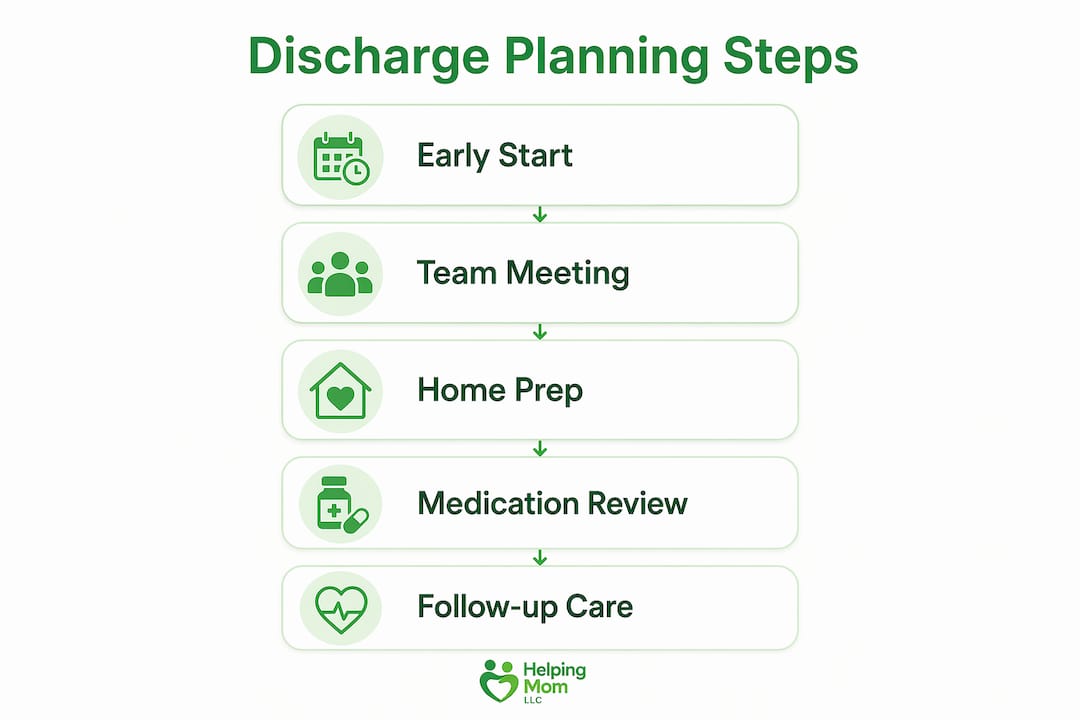
Home preparation is not about perfection. It is about removing the most likely hazards before your parent walks through the door. Falls are the leading cause of hospital readmission for older adults, and most fall risks are fixable with a few hours of focused attention.
Start with a room-by-room home safety assessment before discharge day. Focus on the areas your parent uses most: the bedroom, bathroom, and any main walking paths.
- Clear walking paths. Remove loose rugs, electrical cords, and any furniture that narrows hallways or doorways.
- Add grab bars. Install them in the shower, beside the toilet, and at any steps your parent regularly uses.
- Improve lighting. Add nightlights in the bedroom, hallway, and bathroom. Poor lighting at night is a major fall trigger.
- Set up the bedroom for easy access. Move the bed to a height that allows your parent to sit and stand without straining. Keep frequently needed items within reach.
- Arrange durable medical equipment. If the hospital ordered a walker, wheelchair, or hospital bed, confirm delivery before discharge day, not after.
Beyond the physical space, arrange the human support. Confirm who will be present during the first 48 hours at home. This window is the most vulnerable period. Delays of more than 48 hours in home care initiation significantly increase the risk of complications and readmission. Call the home health agency the day before discharge to confirm the exact time of their first visit.
- Confirm the agency has received the physician's orders.
- Ask for the name of the nurse or therapist who will visit first.
- Have a list of your parent's medications and current symptoms ready for that visit.
Pro Tip: Use the aging in place checklist from Helping-mom to walk through your parent's home systematically. It takes less than an hour and gives you a clear picture of what needs attention before discharge day.
How to manage medications and follow-up care
Medication errors contribute to 25% of hospital readmissions. That number reflects how often something goes wrong in the handoff between hospital prescribers and home care. The first home health nurse visit is the right time to go through every medication carefully.

During that first visit, ask the nurse to compare the hospital discharge medication list against what your parent was taking before admission. Discrepancies are common. A medication may have been stopped, a dose changed, or a new drug added that interacts with an existing one. Report any discrepancy to the prescribing physician the same day. Helpful medication management guidance from Helping-mom walks through how to organize and track prescriptions safely at home.
Follow-up appointments matter just as much as medications. Schedule a visit with the primary care physician within 7 days of discharge. For parents with heart failure, pneumonia, or a recent surgery, that window is especially critical. Many readmissions happen because warning signs appear between discharge and the first follow-up, and no one is watching closely enough.
Watch for these red flag symptoms that require immediate contact with the care team:
- Sudden confusion or significant change in alertness
- Shortness of breath or chest pain
- Fever above 101°F
- Wound drainage, redness, or swelling at a surgical site
- A fall, even one with no apparent injury
- Refusal to eat or drink for more than 24 hours
Use the teach-back method to confirm your parent understands their medications and warning signs. Ask them to explain back to you what each medication is for and what to do if they feel worse. This simple check catches misunderstandings before they become emergencies.
What pitfalls should you watch for during the transition?
The post-hospital period is a 30-day process, not a single event. Most families treat discharge day as the finish line. It is actually the starting line for a month of careful monitoring and coordination.
The most common pitfalls fall into four categories:
- Communication gaps. Information shared in the hospital does not always reach the home health agency or the primary care physician. You may need to be the one who connects those dots by sharing the discharge summary with every provider involved.
- Delayed home care. If the agency does not arrive within 48 hours, call them and the physician's office. Do not wait to see if they show up.
- Insurance misunderstandings. Medicare Part A covers skilled home health care for homebound patients with a documented skilled need, such as wound care or physical therapy. It does not cover non-skilled help like bathing assistance or meal preparation. Knowing this distinction prevents unexpected bills.
- Passive reliance on the system. The hospital team did their part. The home health agency will do theirs. But neither has the full picture that you have as a family member. Active involvement is not interference. It is what keeps people safe.
"Most medical errors during post-hospital recovery happen not because of bad care, but because of broken handoffs. The family caregiver is the one person present across every handoff. That role is not a burden. It is a protective factor."
Patient-Oriented Discharge Summaries, known as PODS, improve patient understanding of discharge instructions. They work best when paired with active family engagement, not as a substitute for it.
Pro Tip: Keep a simple notebook or notes app dedicated to your parent's recovery. Log every medication, every symptom, every provider visit, and every question. When you call the doctor's office, you will have exactly the information they need.
Key Takeaways
A safe hospital to home transition depends on early discharge planning, a prepared home environment, careful medication review, and consistent family advocacy throughout the full 30-day recovery window.
| Point | Details |
|---|---|
| Start discharge planning early | Federal law requires hospitals to begin planning at admission; ask for a written plan on day one. |
| Prepare the home before arrival | Remove fall hazards, confirm equipment delivery, and arrange support for the first 48 hours. |
| Review all medications at the first home visit | Medication errors cause 25% of readmissions; compare hospital and pre-admission lists immediately. |
| Schedule follow-up within 7 days | A primary care visit within one week catches warning signs before they become emergencies. |
| Stay actively involved for 30 days | The transition is a month-long process; passive reliance on the system leaves critical gaps. |
What I've learned about the caregiver's role in this process
I have seen families walk out of hospitals with a folder of paperwork and a vague sense that everything is handled. It rarely is. The discharge summary is a starting point, not a finished plan. The home health agency is skilled, but they visit for an hour or two and then leave. The physician's office is reachable by phone, but only if you call.
The families who see the best outcomes are the ones who treat themselves as part of the care team. They ask questions. They write things down. They call when something feels off. Structured transition workflows cut 30-day readmissions from 35.8% to 7.7% in clinical settings. That kind of result does not happen by accident. It happens when communication is deliberate and consistent.
What I tell adult children is this: you do not need a medical background to do this well. You need to be present, organized, and willing to ask the same question twice if the first answer was unclear. Your parent's recovery is not a solo effort by the hospital or the home health nurse. It is a team effort, and you are a critical member of that team. Helping-mom exists to give you the practical tools to fill that role with confidence, not anxiety.
— Mike C.
Practical home safety resources from Helping-mom
Helping-mom provides calm, practical guidance for adult children preparing a parent's home for safe recovery. The home safety guide for seniors walks through every room with specific, non-technical steps you can take before discharge day. For families working through the full picture of aging in place, the helping parents age in place resource covers home modifications, care coordination, and what to prioritize first. These guides are written for real families, not medical professionals, and they give you a clear starting point when the situation feels like a lot to manage.
FAQ
What is a hospital to home transition?
A hospital to home transition is the coordinated process of moving a patient from inpatient hospital care to a supported home environment, including discharge planning, home health services, and family caregiver involvement.
When should discharge planning begin?
Federal regulation 42 CFR § 482.43 requires hospitals to begin discharge planning at the time of admission. Families can and should ask about the discharge plan within the first day or two of any hospital stay.
Does Medicare cover home health care after a hospital stay?
Medicare Part A covers skilled home health care for patients who are homebound and have a documented skilled need, such as nursing care or physical therapy. It does not cover non-skilled assistance like help with bathing or housekeeping.
What is the "first 48-hour gap" in home care?
The first 48-hour gap refers to the period between hospital discharge and the first home health agency visit. Delays beyond 48 hours significantly increase the risk of complications and readmission. Confirm the agency's arrival time before your parent leaves the hospital.
How can I reduce the risk of my parent being readmitted?
Schedule a follow-up with the primary care physician within 7 days of discharge, review all medications during the first home health visit, and stay actively involved in monitoring symptoms and coordinating care throughout the full 30-day recovery period.