

Figuring out how to coordinate care for an aging parent is one of the most meaningful things you can do for someone you love. It's also one of the most complicated. You're balancing your own work, family, and life while trying to stay on top of your parent's health needs, appointments, finances, and safety. Without a real system in place, things slip through the cracks, family tensions rise, and caregivers burn out quickly. This guide walks you through a practical, step-by-step approach to organizing care so that nothing falls through and everyone knows their role.
Table of Contents
- Key takeaways
- How to coordinate care for an aging parent
- Assessing your parent's needs before you plan
- Building a dynamic care coordination system
- Navigating family dynamics and hard conversations
- Practical safety and daily care at home
- My honest take on coordinating care
- Resources to help you get started
- FAQ
Key takeaways
| Point | Details |
|---|---|
| Coordination beats helping alone | A shared system for roles and information prevents burnout and reduces family conflict. |
| Start with a needs assessment | Score daily living areas objectively before deciding which support is most urgent. |
| Build a living care plan | Update your care document after every major health change, not just at the start. |
| Assign roles clearly | Map out who handles which tasks to prevent overlap, gaps, and resentment. |
| Talk to your parent first | Framing added support around maintaining independence leads to much better cooperation. |
How to coordinate care for an aging parent
There's a meaningful difference between helping your parent and coordinating their care. Helping is reactive. You step in when something goes wrong, drive them to an appointment, pick up groceries when they call. Coordinating is proactive. It means having a system that organizes who does what, keeps information current, and manages appointments and communications before a crisis hits.
Without coordination, common problems include:
- Siblings doing duplicate tasks while other things go unaddressed
- Important medical details scattered across sticky notes and old emails
- Your parent being asked the same questions by three different family members
- No clear person to call when something unexpected happens
The benefits of good coordination go beyond logistics. Seniors who have a structured plan around them tend to maintain independence longer, stay safer at home, and feel less anxious about the future. For family members, it means less guessing, less guilt, and much less tension.
Pro Tip: Don't wait for a fall or a diagnosis to start coordinating. The families who feel most calm and prepared are almost always the ones who started before things got urgent.
Assessing your parent's needs before you plan
Before you can build any kind of care system, you need an honest picture of where your parent stands right now. This isn't about making judgments. It's about gathering facts so you can prioritize thoughtfully.
A helpful method is a 0-2 scoring system applied across 10 daily living areas such as bathing, meal preparation, medication management, mobility, and finances. A score of 0 means no support needed, 1 means occasional help, and 2 means consistent assistance required. Total scores of 0 to 5 suggest low needs, 6 to 12 moderate, and 13 to 20 indicate high needs that call for prompt action.
Once you have a baseline assessment, organize your findings across these five areas:
- Legal. Does your parent have a power of attorney, a healthcare proxy, and an advance directive in place? Note that many standard POAs aren't recognized by all financial institutions, so it's worth verifying early.
- Medical. Gather a current medication list, primary care provider details, specialist contacts, and insurance information.
- Financial. Identify accounts, income sources, recurring bills, and any existing financial legal authority.
- Housing. Assess whether the current home is safe for aging in place, and whether modifications may be needed.
- Caretaking. Who is currently providing hands-on care? What is sustainable long-term?
A good elder care plan addresses all five pillars before a crisis forces rushed decisions.
| Area | What to gather | Why it matters |
|---|---|---|
| Legal | POA, healthcare proxy, advance directive | Enables family to act legally on parent's behalf |
| Medical | Medication list, provider contacts, insurance | Prevents gaps in coordinating medical care for seniors |
| Financial | Accounts, bills, income, authority documents | Reduces tension and supports early planning |
| Housing | Safety assessment, modification needs | Supports aging in place safely |
| Caretaking | Current helpers, sustainable roles | Prevents burnout and defines responsibility |

Pro Tip: Keep all gathered documents in one physical binder AND a shared digital folder. Make sure at least two people in the family know exactly where both are.
Building a dynamic care coordination system
Once you know what your parent needs, the next step is building a system that actually gets used. The best systems are simple, shared, and updated regularly. Here's how to set one up:
- Create a people map. List every person involved in your parent's care: family members, doctors, pharmacist, neighbors who check in, any paid helpers. For each person, note their role, the best way to reach them, and what they're responsible for. This single step eliminates enormous amounts of confusion.
- Choose one source of truth. Whether it's a shared Google Doc, a printed binder, or a dedicated digital family tool, the format matters less than everyone agreeing to use the same one. Multiple scattered sources are almost as bad as no source at all.
- Schedule weekly care admin blocks. Set aside 20 to 30 minutes each week to review upcoming appointments, update any notes, and handle small tasks before they pile up. This habit alone prevents most of the chaos that derails families.
- Log visits and observations. After each visit or call with your parent, make a brief note. Changes in mood, appetite, mobility, or memory are often gradual. Written notes help you spot patterns that would otherwise be invisible.
- Trigger a full review after key changes. A hospitalization, a new diagnosis, a medication change, or a significant shift in your parent's condition should prompt a full update of the care plan. A living document updated at these moments is far more useful than a form completed once and filed away.
| Approach | Works well when... | Struggles when... |
|---|---|---|
| Shared digital document | Family members are comfortable online | Not everyone has reliable tech access |
| Printed binder at parent's home | Parent is hands-on and wants to see their plan | Binder isn't updated consistently |
| Caregiving app | Multiple siblings need real-time updates | Family doesn't agree on a single platform |
Pro Tip: Assign one person as the "care coordinator" for a set period, say three months, then rotate if needed. This person owns updates and keeps everyone informed. It doesn't mean doing more physical care. It means owning the information flow.
Navigating family dynamics and hard conversations
This is the part most articles skip over. The practical steps are manageable. The family conversations are where things actually get hard.
Managing elder care with siblings means dealing with different opinions, guilt, geography, and old family dynamics that never really went away. A few things that genuinely help:
- Start with facts, not feelings. Instead of "you never help," try "Mom's been to four appointments this month and I've taken her to all of them. I need us to share that going forward." Specific observations open conversations that accusations close.
- Make specific asks. Saying "I need more help" rarely works. Saying "Can you take Dad to his cardiology appointment on the 14th?" gives someone something concrete to say yes to. Caregiver responsibilities fall into clear buckets: health and safety, appointments, daily care, home logistics, finances, and communication. Assign from those buckets deliberately.
- Address conflicts early. Disagreements about care decisions get harder the longer they're avoided. A brief, calm conversation at the first sign of friction is almost always easier than a full family confrontation six months later.
- Involve a neutral third party if needed. Geriatric care managers can serve as neutral advocates who help families work through disagreements and assess needs objectively. This option is underused and genuinely helpful.
When it comes to talking with your parent, the approach matters as much as what you say. Framing added support as a way to help them stay independent at home is far more effective than presenting it as taking over. You can learn more about starting these conversations in a way that respects your parent's autonomy.
Pro Tip: If finances are part of the conversation, start early and keep it light. Financial planner Carolyn McClanahan recommends a "low-key" approach to understand your parent's financial system before you ever need legal authority over it.
Practical safety and daily care at home
Even with a strong coordination system, the day-to-day details of keeping your parent safe require ongoing attention. A few areas worth reviewing regularly:
- Home safety. Check for trip hazards, adequate lighting, bathroom grab bars, and clear pathways. These are among the most common and preventable causes of injury for seniors at home. Helping-mom's home safety guide walks through the most important modifications room by room.
- Medication management. Use a pill organizer, a medication list posted in a visible spot, and pharmacy blister packs if needed. Medication errors are one of the most preventable risks for older adults living at home.
- Daily routine support. Help with activities like meals, bathing, and mobility in ways that support your parent doing as much as they can themselves. Doing everything for them, even with good intentions, can reduce their confidence and physical function over time.
- Community resources. The Eldercare Locator at 1-800-677-1116 connects families with local services including meal delivery, transportation, and in-home support. It's free and available nationwide.
- Knowing when to reassess. Watch for increasing forgetfulness, unexplained weight loss, withdrawal from usual activities, or physical changes like new bruising or unsteady walking. These are signals that the current care plan may need adjusting.
The caring for aging parents checklist from Helping-mom is a practical tool to keep these daily and safety considerations organized across your whole family.
My honest take on coordinating care
I've talked with a lot of families who waited until a crisis to start planning, and I've talked with families who started early. The difference in how they experience caregiving is significant. Not because the early planners avoided hard moments. They didn't. But they had the structure and the shared language to handle those moments without falling apart.
What I've found is that care coordination is only about 40% logistics. The rest is managing your own emotions, navigating family roles that were established decades ago, and learning to let go of the idea that you have to do everything yourself. The adult child who takes everything on alone is not winning. They're burning out quietly, and that doesn't serve anyone, least of all their parent.
The best thing I can encourage you to do is start small and start now. You don't need a perfect system. You need a shared document, a list of who's doing what, and one honest conversation with your siblings and your parent. Build from there. Ask for help. Use the caregiver resources available to you. And give yourself genuine credit for showing up. This work matters.
— Mike
Resources to help you get started
Helping-mom exists to make this part of life feel more manageable, not more overwhelming. If you're ready to take the next step, the home safety guide covers every room in your parent's home with practical, specific modifications that support aging in place. For the emotional side of caregiving, the caregiver well-being resources offer real, grounded support for the person doing the caring. You can also explore the full aging in place hub for guidance on long-term planning, family communication, and keeping your parent safe and comfortable at home. You don't have to figure this out alone.
FAQ
What does care coordination for aging parents actually mean?
Care coordination means organizing who does what, keeping health and legal information current, and managing your parent's appointments and daily needs through a shared system rather than informal, reactive helping.
How do I start a care plan for my aging parent?
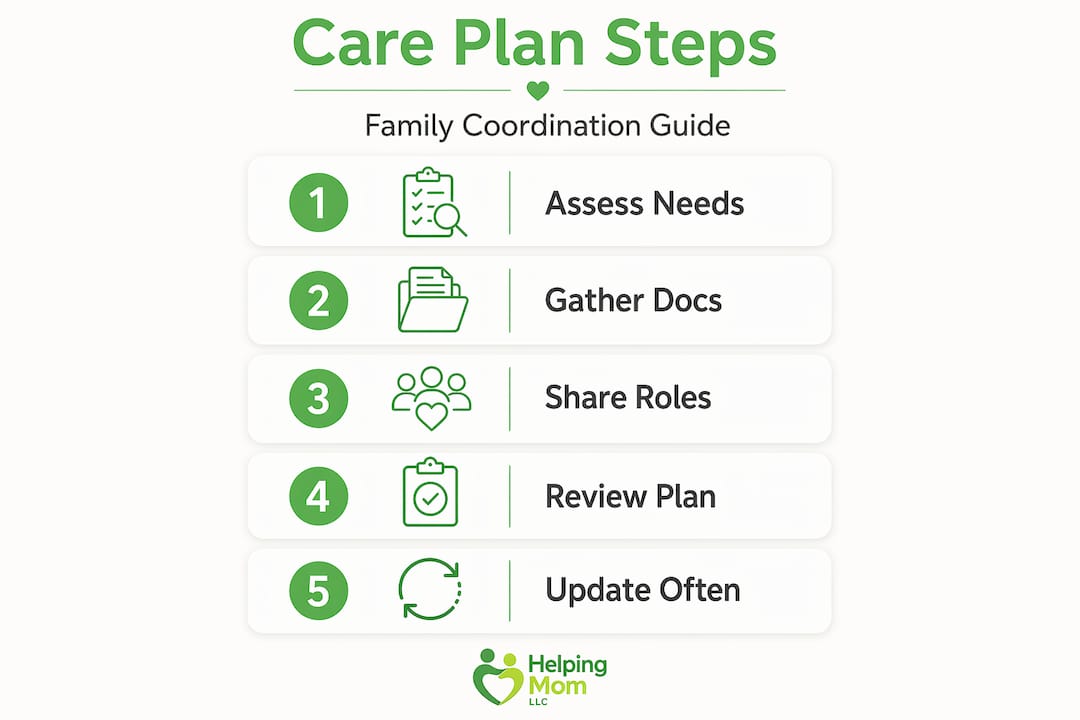
Begin with a needs assessment across daily living areas, then gather legal, medical, financial, housing, and caretaking documents. From there, assign clear family roles and create one shared place to store all information.
How do I talk to siblings about sharing caregiving responsibilities?
Use specific facts rather than general complaints, and make concrete requests tied to clear tasks. Assigning responsibilities from defined categories like appointments, finances, and daily care reduces conflict and prevents overlap.
When should a care plan be updated?
A care plan should be reviewed after any major health change, hospitalization, new diagnosis, or shift in your parent's living situation. Treating it as a living document rather than a one-time form keeps it genuinely useful.
Where can families find local support for elderly parents?
The Eldercare Locator at 1-800-677-1116 or eldercare.acl.gov connects families with local services including transportation, meals, and in-home assistance at no cost.