

Helping an aging parent without upsetting them means offering support in ways that respect their autonomy, preserve their dignity, and invite their participation rather than override it. This is what caregiving specialists call person-centered care, and it is the most effective framework for adult children who want to help without triggering resistance or conflict. The difference between help that lands well and help that causes hurt usually comes down to timing, tone, and whether your parent feels like a partner in the conversation or a problem being managed. This guide walks you through the communication strategies, practical tools, and family coordination approaches that make that difference real.
How to help an aging parent without upsetting them: the mindset shift that changes everything
The most common reason adult children accidentally upset aging parents is not bad intentions. It is the instinct to fix things quickly. When you see a safety risk or a health concern, the urge to act fast feels responsible. But to your parent, a sudden push for change can feel like a loss of control over their own life.
Geriatric care specialists, including Dr. Karen Halpert, consistently point out that resistance from aging parents is rarely stubbornness for its own sake. It almost always reflects something deeper: fear of losing independence, grief over physical decline, or a sense that their identity is being taken from them. Understanding that emotional layer changes how you approach every conversation.
A few mindset shifts make a real difference:
- Stop framing help as a solution to a problem. Your parent is not a problem. Frame your offers as additions to their life, not corrections to it.
- Expect the conversation to take time. One talk rarely changes anything. Repeated, patient conversations over weeks or months are far more effective than a single push.
- Avoid accusatory language. Phrases like "You can't manage this anymore" or "We're worried you'll fall" put parents on the defensive immediately.
- Give them the lead. Ask what they want, not what you think they need. This small shift preserves dignity and opens doors.
Pro Tip: Before any care conversation, ask yourself: "Am I trying to help my parent, or am I trying to relieve my own anxiety?" Both are valid, but they require different approaches.
The goal is not to take control. It is to walk alongside your parent as they adjust to a new chapter.

What communication techniques actually work with aging parents
Effective communication with aging parents is less about what you say and more about how and when you say it. Starting these conversations early, before a crisis forces the issue, gives everyone more room to think clearly and respond calmly. A fall, a hospital stay, or a car accident is the worst possible moment to introduce major changes.
Here is a practical sequence that works well for most families:
- Choose a calm, unhurried moment. Avoid bringing up care concerns during holidays, family gatherings, or right after a stressful event. A quiet afternoon visit is better than a rushed phone call.
- Open with curiosity, not conclusions. Instead of "We think you need help," try "How are you feeling about managing the house these days?" Open-ended questions invite your parent to lead.
- Use "I" statements. "I worry when I don't hear from you for a few days" lands very differently than "You never call." One expresses care; the other sounds like blame.
- Invite their input on solutions. Ask "What would make you feel safer at home?" rather than presenting a pre-decided plan. Parents who help shape the solution are far more likely to accept it.
- Bring in a trusted third party when needed. A family doctor, a social worker, or a trusted family friend can sometimes say the same thing you have been saying, and it lands completely differently. This is not a failure on your part. It is just how human psychology works.
For parents showing signs of cognitive decline, the approach shifts significantly. Harvard Health research confirms that correcting dementia misstatements increases distress without improving understanding. Instead, agree with their emotional reality, use short and simple sentences, and rely on nonverbal reassurance like a calm tone and gentle touch. Logic does not work when memory is impaired. Emotional alignment does.
Pro Tip: If a conversation starts to escalate, say "Let's come back to this" and genuinely do so within a week. Pausing is not giving up. It is giving your parent time to process.
You can find more specific language and conversation frameworks in Helping-mom's guide on talking with aging parents about care.
Practical tools and steps to support aging parents without overwhelming them
Practical support works best when it is introduced gradually, one small step at a time. Presenting a full care plan all at once can feel overwhelming and controlling. Introducing one change, letting it settle, then suggesting the next one respects your parent's pace and reduces pushback.
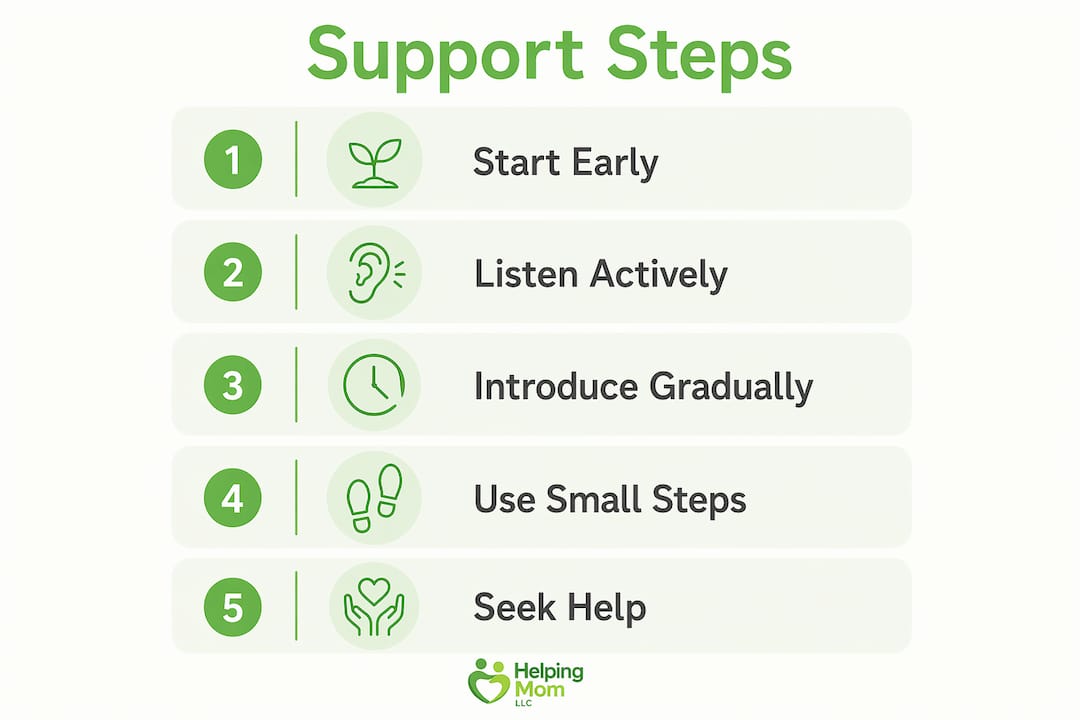
Start with the lowest-stakes changes first. Medication management is a good entry point because it is concrete, easy to frame as helpful rather than intrusive, and directly reduces a real risk. Pill organizers, medication alarms, and phone reminder apps like Medisafe are simple tools that most parents accept readily once they see the benefit.
Home safety modifications follow a similar logic. The table below shows how to sequence common changes from least to most significant:
| Modification | Why it works | Best time to introduce |
|---|---|---|
| Better lighting in hallways and stairs | Low cost, easy to frame as comfort | Early, before any falls occur |
| Grab bars in bathroom | Directly reduces fall risk | After any near-miss or balance concern |
| Clutter removal in walkways | Reduces trip hazards without major change | Framed as a "refresh," not a safety intervention |
| Medical alert device | Provides independence, not surveillance | After parent expresses concern about being alone |
| In-home aide for specific tasks | Preserves independence in other areas | After trust is established with smaller changes |
A professional home safety evaluation, often available through occupational therapists or local Area Agencies on Aging, gives you an objective third-party assessment. This takes the pressure off you to be the one identifying every problem, and parents often respond better to recommendations from a professional than from an adult child.
The key principle across all of these tools is that conversations about care are not one-time events. They are ongoing processes that evolve as your parent's needs change. Revisit them regularly, not just when something goes wrong.
How to handle resistance and refusals without losing your patience
Even with the best approach, some parents will refuse help. That refusal is not the end of the conversation. It is information about where your parent is emotionally right now.
Resistance often reflects deeper feelings about loss, fear, or a sense that their life is slipping out of their hands. When you understand that, you can respond with empathy instead of frustration.
Practical de-escalation strategies that work:
- Pause and return. If a conversation becomes heated, stop it. Say "I hear you. Let's talk about this again soon." Then follow through.
- Use curiosity instead of conclusions. Planting a question like "What would need to be true for you to feel comfortable with some help around the house?" and then letting it sit for a week gives your parent time to arrive at their own answer.
- Acknowledge what they are protecting. Say "I know how much your independence means to you, and I want to help you keep it." This reframes your offer as support for their goal, not opposition to it.
- Accept that some things are not yours to control. You can offer, advocate, and support. You cannot force. Accepting that limit reduces your own stress and keeps the relationship intact.
"The goal isn't to win the argument. It's to stay in the relationship long enough to be trusted."
When refusals persist and safety is a genuine concern, involving a social worker or geriatric care manager gives you a professional ally who can assess the situation without the emotional weight of a family dynamic.
How to involve family and professional resources without creating more conflict
Caregiving shared across a family is more sustainable and less contentious than one person carrying it alone. The challenge is that siblings often have different levels of involvement, different opinions, and different relationships with the parent. Without structure, family conversations about care can become as difficult as the parent conversations themselves.
A few approaches that help:
- Hold a family meeting before talking to your parent. Agree on the core message, divide responsibilities, and identify who will take the lead in conversations. A united front reduces the chance of your parent playing siblings against each other.
- Use a shared document or app. Tools like Google Docs or CaringBridge let family members track appointments, medications, and concerns without relying on one person to relay everything. This reduces miscommunication and resentment.
- Assign roles based on geography and capacity, not guilt. The sibling who lives closest is not automatically responsible for everything. Financial management, research, and emotional support can all be handled remotely.
- Bring in a professional when the family is stuck. A geriatric care manager, social worker, or elder law attorney can provide objective guidance that takes the burden off family members to be the experts on everything.
- Plan for caregiver respite. Shared family support and respite care are not luxuries. They are what allows you to show up consistently and patiently over the long term.
Helping-mom's resource on difficult conversations with aging parents covers family meeting structures in more detail if you need a starting point.
Key takeaways
Supporting an aging parent without causing upset requires respecting their autonomy, pacing your conversations, and treating care as an ongoing partnership rather than a one-time intervention.
| Point | Details |
|---|---|
| Start early and stay calm | Begin care conversations before a crisis, during relaxed moments, not emergencies. |
| Use curiosity, not conclusions | Open-ended questions preserve dignity and invite parents to lead their own decisions. |
| Introduce changes gradually | Start with low-stakes tools like pill organizers before moving to bigger modifications. |
| Handle resistance with empathy | Refusals reflect fear, not stubbornness. Pause, return, and reframe your offer. |
| Share the load | Family coordination and professional support reduce caregiver burnout and conflict. |
What I've learned about helping parents without pushing them away
I have talked with a lot of families going through this, and the pattern I see most often is not a lack of love. It is a mismatch in timing. An adult child sees a real risk and wants to act now. The parent sees a child who is suddenly treating them like they cannot manage their own life. Both reactions make complete sense. They just collide badly.
The families who navigate this well are not the ones with the most resources or the most organized care plans. They are the ones who slow down enough to ask their parent what they actually want. Sometimes the answer is surprising. A parent who refuses a grab bar in the bathroom might be completely open to a medical alert device because it gives them more confidence to live alone, not less.
The other thing I have seen consistently is that caregivers who try to do everything themselves burn out faster and become less patient over time. That is not a character flaw. It is just what happens when one person carries too much. Seeking help, whether from siblings, a social worker, or a respite care program, is not giving up. It is what makes it possible to keep showing up with warmth and patience, which is ultimately what your parent needs most from you.
If you are feeling stuck in a particular conversation or situation, Helping-mom's guide on convincing a parent to accept help offers specific language and approaches worth reading.
— Mike
Make your parent's home safer, one step at a time
If you are ready to move from conversation to action, Helping-mom's senior home safety guide is a practical starting point. It covers grab bars, lighting, fall prevention, and room-by-room modifications you can introduce gradually without overwhelming your parent. For the emotional side of caregiving, the caregiver well-being resources at Helping-mom address burnout, stress, and how to sustain your own health while supporting someone you love. Both resources are designed for adult children who want clear, calm guidance they can actually use today.
FAQ
How do I bring up care concerns without starting a fight?
Start the conversation early, during a calm moment rather than a crisis, and use open-ended questions that invite your parent to share their perspective first. Framing your concern as care rather than criticism makes a significant difference in how it is received.
What do I do if my parent refuses all help?
Resistance often reflects fear rather than a final decision, so pause the conversation and return to it over several weeks using curiosity-based questions. Involving a trusted third party, such as a doctor or social worker, can also shift the dynamic when direct conversations stall.
How do I communicate with a parent who has dementia?
Avoid correcting misstatements and instead align with their emotional reality using short sentences, calm tone, and nonverbal reassurance. Logic-based arguments increase distress in people with cognitive decline; emotional connection is far more effective.
What are the easiest first steps to make a parent's home safer?
Improved lighting, grab bars in the bathroom, and clutter removal in walkways are low-cost, low-resistance starting points that reduce fall risk without feeling like a major intervention. Introducing these one at a time, framed as comfort upgrades rather than safety measures, increases the chance your parent will accept them.
How do I get my siblings to share the caregiving responsibility?
Hold a family meeting before approaching your parent, agree on a shared message, and divide tasks based on each person's capacity and location rather than proximity alone. Using a shared tracking tool like Google Docs or CaringBridge keeps everyone informed and reduces the burden on any one person.