

The fastest way to get siblings reliably involved is a written plan that assigns domain-based roles, a shared document, and a scheduled weekly check-in. Start by sending one message today.
Your 24–48 hour quick-start checklist:
- Text or email each sibling: "I'd like to schedule a 45-minute call this week to talk about Mom/Dad's care. Can you do [date/time]?"
- Attach or paste a short list of current tasks you're handling alone.
- Open with this sentence on the call: "I'm not asking anyone to do more than they can — I just need us to look at the full picture together and decide who owns what."
That's it for now. The sections below give you everything else you need to make it stick. For a broader look at getting siblings on board, Helping-mom offers a companion guide worth bookmarking.
Table of Contents
- What does the full scope of caregiving actually look like?
- How do you run a family meeting that actually produces commitments?
- How do domain-based roles prevent one sibling from carrying everything?
- What shared systems keep everyone accountable without constant reminders?
- What can a long-distance sibling realistically contribute?
- What do you do when a sibling refuses or keeps dropping the ball?
- What does caregiving actually cost in time and money?
- Copy-ready templates you can use today
- Key Takeaways
- The part most caregiving guides leave out
- How Helping-mom can help you put this into action
- Useful sources and further reading
- FAQ
What does the full scope of caregiving actually look like?
Before you ask anyone for help, you need a clear picture of what "help" means. Most siblings underestimate how much is already happening, and that gap is where resentment grows.
Map every caregiving task across these seven domains, then estimate the weekly hours each one takes:
| Domain | Sample tasks | Current owner | Frequency | Est. weekly hours |
|---|---|---|---|---|
| Medical coordination | Doctor calls, medication tracking, records | Weekly | ||
| Money & paperwork | Bills, insurance, benefits | Monthly | ||
| Appointments & transport | Driving, scheduling, follow-up | Weekly | ||
| Home maintenance & safety | Repairs, safety checks, yard | As needed | ||
| Personal care | Bathing, meals, dressing support | Daily | ||
| Social & companionship | Visits, calls, activities | Weekly | ||
| Planning & legal | Advance directives, POA, estate | Quarterly |
Copy this table into a shared Google Doc or a printed binder. Once every sibling can see the full load, the conversation shifts from "you're being controlling" to "this is a lot — let's divide it."
Translate the inventory into one meeting goal: "Make care sustainable by assigning a domain owner for each area and scheduling a weekly 20-minute check-in." That sentence goes at the top of your meeting agenda.
Pro Tip: Treat your first assignment split as a 60–90 day trial with a scheduled review. It lowers resistance because no one feels locked in permanently.
How do you run a family meeting that actually produces commitments?
A dedicated, scheduled meeting where the full task inventory is visible transforms emotional accusations into shared problem-solving. Sending the agenda in advance is the single step most families skip, and it's the one that matters most.
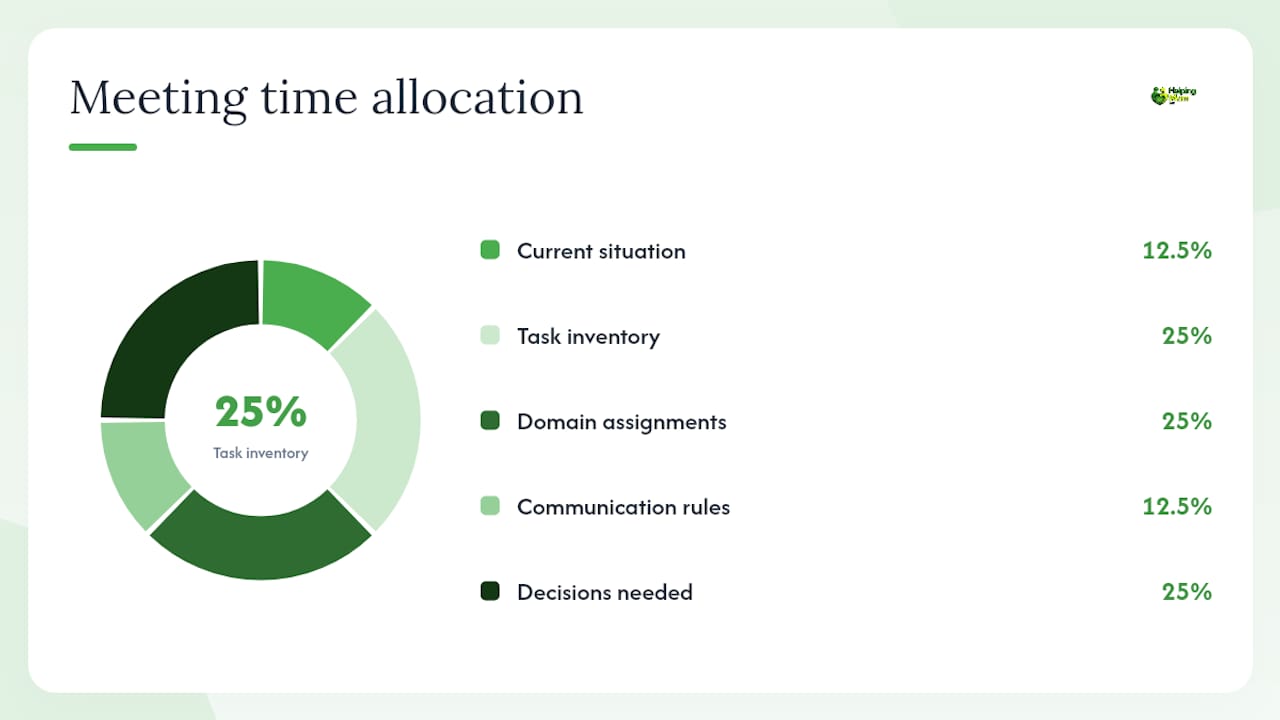
Agenda to send 48 hours before the meeting:
- Current situation: what care looks like right now (5 min)
- Full task inventory review: domains, hours, gaps (10 min)
- Proposed domain assignments: who owns what (10 min)
- Communication rules: how we'll stay coordinated (5 min)
- Decisions needed today: commitments, backups, review date (10 min)
Ground rules to state at the start:
- Facts only. No rehashing old grievances.
- Each person speaks once before anyone speaks twice.
- Decisions are made by consensus; unresolved items go to a neutral third party.
- The meeting ends on time.
Scripts that work:
Direct ask: "I need someone to own the medical coordination domain — that means being the main contact for doctors and tracking medications. Can you take that on for the next 90 days?"
Response to "I don't have time": "I hear you. What could you realistically do — even one task that takes less than two hours a week?"
Closing commitment: "Let's confirm: [Name] owns [domain], starting [date], and we'll check in on [date]. I'll add it to the shared doc today."
A family meeting guide from Helping-mom walks through facilitation tips if you'd like more support running the session.
How do domain-based roles prevent one sibling from carrying everything?
Asking for favors one at a time keeps you in a constant manager role. Assigning ownership of an entire domain shifts that. The National Institute on Aging specifically recommends domain-based assignments to prevent the primary caregiver from becoming the default coordinator for every task.
| Domain role | What it includes | Best fit |
|---|---|---|
| Medical coordinator | Doctor calls, records, medication list | Organized sibling, any distance |
| Financial lead | Bills, insurance, benefits, tax docs | Detail-oriented, comfortable with numbers |
| Transportation captain | Driving, scheduling rides, appointment follow-up | Local sibling with flexible schedule |
| Home & safety lead | Repairs, safety modifications, contractor calls | Handy sibling or one with local contractor contacts |
| Social connector | Regular visits, calls, activities, companionship | Sibling with emotional bandwidth and proximity |
| Planning & legal lead | POA, advance directives, estate coordination | Sibling with legal/financial background or time to research |
Match domains to distance, schedule, skills, and emotional capacity, not to birth order or guilt. Set a backup for each domain and a review date every 60–90 days.
Pro Tip: When in-person tasks are uneven, a financial contribution plan keeps things fair. A sibling who can't drive to appointments can fund a rideshare account or contribute to an in-home aide's hours instead.
What shared systems keep everyone accountable without constant reminders?
A visible shared system is the most reliable safeguard against failed sibling collaboration, according to NIA guidance on sharing caregiving responsibilities. The goal is one place where everyone can see what's happening without texting the primary caregiver.
Your care hub should contain:
- Legal documents: power of attorney, advance directive, insurance cards
- Medication list with dosages and prescribing doctors
- Provider contact list (primary care, specialists, pharmacy)
- Domain assignment map with owner names
- Shared calendar with appointments and check-in slots
- Shared expense log
For the weekly check-in, pick a recurring 15–20 minute slot and protect it. Cover four things: what happened this week, what's coming up, any concerns, and one task to hand off. A Google Doc, a shared Notes folder, or even a printed binder works. Low-tech options are fine. The habit matters more than the platform.
For more on coordinating care as a family, Helping-mom's coordination guide covers ongoing systems in depth.
What can a long-distance sibling realistically contribute?
Distance is not an excuse to be uninvolved. It's a reason to own a different set of tasks.
| Remote-friendly role | Specific tasks | Suggested cadence |
|---|---|---|
| Financial lead | Pay bills, manage insurance claims, track expenses | Weekly |
| Research coordinator | Compare providers, find local resources, vet facilities | As needed |
| Scheduler | Book appointments, arrange transportation, coordinate services | Weekly |
| Supply manager | Order medications, groceries, medical supplies online | Weekly |
| Respite funder | Contribute financially to in-home aide or adult day program | Monthly |
| Emotional check-in | Regular calls or video chats with the parent | 2–3x per week |
Set a clear handoff rule: the long-distance sibling sends a weekly update email to the shared doc by Sunday evening, and the local sibling flags anything that needs in-person attention by Monday morning. When physical presence is genuinely required, the long-distance sibling funds a paid aide or covers travel costs rather than leaving the gap unfilled.
What do you do when a sibling refuses or keeps dropping the ball?
Treat a pattern of missed commitments as planning data, not a personal failure. The NIA advises reassigning the work or creating redundancy rather than repeated confrontation.
| Situation | Practical response |
|---|---|
| Sibling agrees but consistently misses tasks | Reassign to a reliable sibling or hire paid help; document the gap |
| Sibling refuses outright | Accept it, adjust the plan, and protect your own capacity |
| Sibling contributes inconsistently | Assign them a low-stakes backup role; don't build critical tasks around them |
| Sibling disputes decisions | Bring in a neutral professional; document all decisions in the shared doc |
Keep a simple care journal: date, what happened, who was responsible, what was done. This protects care continuity and matters if legal or estate questions arise later.
Re-invite script: "I know this has been hard to fit in. I'm not asking for more than you can give. Is there one specific thing you could own reliably, even something small?"
Boundary script: "If [task] isn't covered by [date], I'll need to hire someone. I wanted you to know before I do."
For more on working through sibling conflict without damaging relationships, Helping-mom's conflict guide covers this in detail.
What does caregiving actually cost in time and money?
Setting realistic expectations prevents resentment. Here's a rough picture of weekly time commitments by care level:
| Domain | Low needs (hrs/wk) | Moderate needs (hrs/wk) | High needs (hrs/wk) |
|---|---|---|---|
| Medical coordination | 1 | 2–3 | 4–5 |
| Money & paperwork | 1 | 1–2 | 2–3 |
| Appointments & transport | 1–2 | 3–4 | 5 |
| Personal care | 1 | 5–10 | 15–20+ |
| Social & companionship | 2–3 | 3–5 | 5 |
For paid supports, common ballpark ranges include:
- In-home aide: $20–$30/hour in most U.S. markets (rates vary by region and agency)
- Meals on Wheels: Fees are income-based and often low or free; contact your local program directly
- Geriatric care manager assessment: Varies by region; ask for a written estimate before committing
Subsidies are available. Contact your local Area Agency on Aging to find programs in your area. Veterans may qualify for VA caregiver support benefits.
Budgeting steps for siblings:
- Total the estimated monthly cost of paid supports.
- Decide whether to split costs equally or proportionally to income.
- Document contributions in the shared expense log.
- Revisit at the 60–90 day review.
Copy-ready templates you can use today
You don't need to write anything from scratch. Use these directly.
Family meeting agenda (paste into an email):
- Welcome and ground rules (2 min)
- Task inventory review (10 min)
- Proposed domain assignments (10 min)
- Communication system setup (5 min)
- Commitments and next review date (5 min)
Ask script: "I need someone to own [domain]. It takes about [X hours/week]. Can you commit to that for the next 90 days?"
Objection response: "I understand. What's one thing you could do consistently? Even two hours a week helps."
To turn these into a shared care hub, paste the task inventory table and domain map into a Google Doc, share it with all siblings, and bookmark it as the single source of truth. Helping-mom's family meeting agenda template gives you a printable, fillable version ready to send.
Key Takeaways
A written domain-based plan, a shared document, and a scheduled weekly check-in are the three things that most reliably turn sibling intentions into consistent caregiving contributions.
| Point | Details |
|---|---|
| Map tasks first | Build a seven-domain task inventory before any meeting so asks are concrete and fair. |
| Use domain ownership | Assign whole domains, not one-off favors, to prevent the primary caregiver from managing everything. |
| Trial periods reduce resistance | Treat the first assignment split as a 60–90 day trial with a scheduled review date. |
| Neutral professionals help | A geriatric care manager or social worker can break family deadlocks when dynamics stall. |
| Helping-mom supports the plan | Helping-mom's templates, 1:1 Zoom consults, and home safety assessments give you ready-made tools to start this week. |
The part most caregiving guides leave out
Most articles tell you to "have a family meeting" as if scheduling a call is the hard part. The hard part is that you're asking people to change their lives, and some of them won't. That's worth saying plainly.
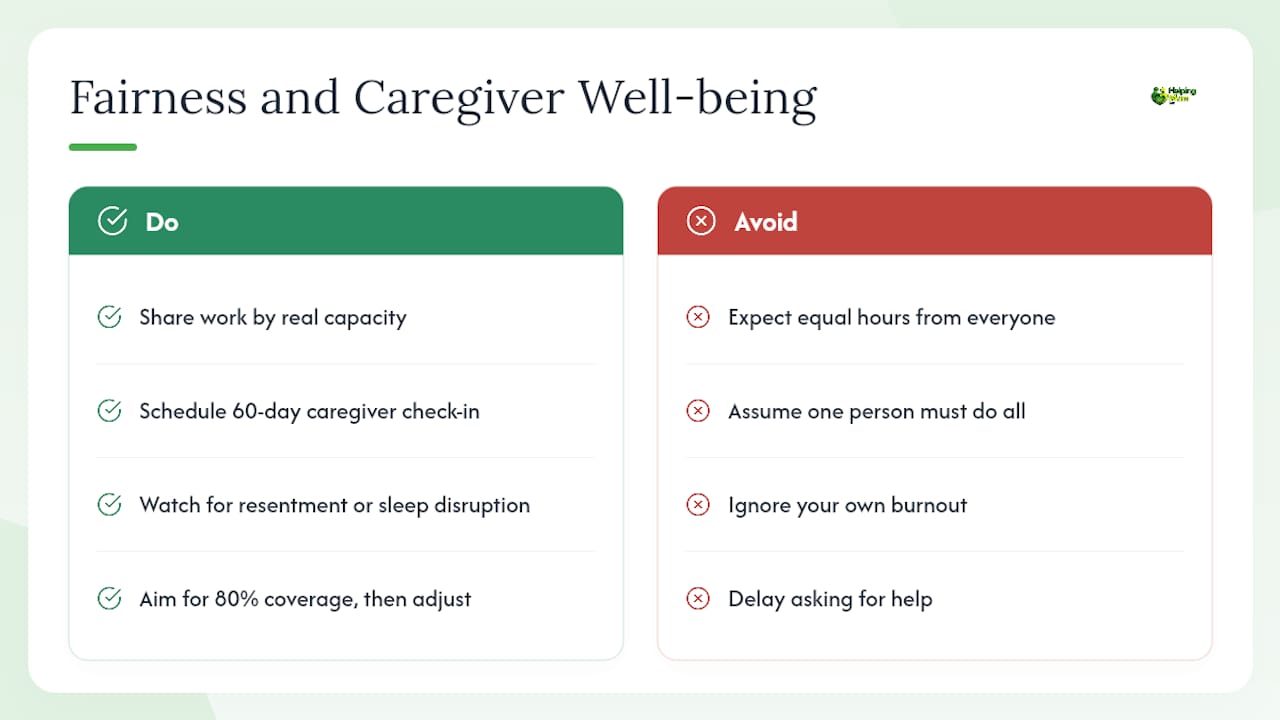
Fairness in caregiving doesn't mean equal hours. It means each sibling contributing according to their real capacity, as Illinois Extension research on sibling caregiving confirms. A sibling with three kids and a demanding job contributing $300/month toward an aide is doing their part. A sibling who lives nearby and has more flexibility taking on transportation is doing their part. Neither is more or less valuable.
What I'd encourage you to watch for is your own burnout, not just your parent's needs. The primary caregiver is often the last person to ask for help. Schedule a caregiver well-being check-in for yourself at the same 60-day mark you set for the domain review. Signs worth noticing: resentment that doesn't lift, sleep disruption, or a growing sense that you're invisible in your own life.
Imperfect arrangements are normal. A plan that covers 80% of the need with three reliable siblings is better than a perfect plan that only one person executes. Revisit, adjust, and keep going.
How Helping-mom can help you put this into action
Pulling a family together around a parent's care is one of the most practical things you can do, and you don't have to figure out the logistics alone. Helping-mom offers three resources that fit directly into the plan above.
The downloadable template pack includes a fillable family meeting agenda, a task inventory sheet, and a domain assignment map you can share with siblings before the first call. The 1:1 Zoom consultation gives you 60 minutes with a caregiving advisor to work through your specific family situation, assign domains, and set up your shared system. For families in Central Florida, an in-person home safety assessment adds a physical walkthrough to identify safety gaps that belong in the home maintenance domain.
All resources are non-medical, private, and focused on practical next steps. To book a consultation or download the template pack, visit Helping-mom's caregiver well-being resources and choose the option that fits where you are right now.
Useful sources and further reading
- Sharing caregiving responsibilities | National Institute on Aging (NIA)
- Caregiver Action Network
- Siblings working together as caregivers | Family Files | Illinois Extension
- How to divide caregiving responsibilities fairly with siblings | MySageBeam
- What is a care review? A guide for families | Care Managers
When hiring a care manager or elder law attorney, look for written credentials, verifiable references, and a clear written scope of services before any money changes hands. Keep links to all these resources in your shared care hub so every sibling can access them.
FAQ
How do you start involving siblings in caregiving?
Send a short message today asking for a 45-minute call, attach a list of current tasks, and open the call with a specific ask tied to one domain. Starting with a visible task inventory makes the conversation concrete rather than emotional.
What if a sibling refuses to help with a parent's care?
Treat refusal as planning data: reassign the work, document the gap, and hire paid support if needed. A re-invite script that asks for one small, specific commitment often works better than a broader appeal.
How much does a geriatric care manager cost?
Fees vary by region and scope of service; ask for a written estimate before hiring. Your local Area Agency on Aging can connect you to lower-cost social workers and community resources if a private care manager is out of budget.
What can a long-distance sibling realistically do?
Remote siblings can own financial management, research, scheduling, supply ordering, and regular emotional check-in calls with the parent. These roles are documented, scheduled, and just as valuable as in-person tasks.
When should you involve a neutral third party?
Bring in a geriatric care manager, social worker, or family mediator when siblings cannot reach decisions based on facts alone, or when old family dynamics are blocking practical planning.
Recommended
- How to Get Siblings to Help with an Aging Parent Without Creating Family Conflict | Helping Mom LLC
- Caregiver Sibling Conflict: How to Work as a Team | Helping Mom LLC
- Adult Sibling Conflict During Parent Care | Helping Mom LLC
- How to Coordinate Care for an Aging Parent: A Family Guide | Helping Mom LLC