
TL;DR:
- Monitoring physical health, daily skills, and home conditions helps determine if a parent can safely live alone. Consistent observation, layered communication, and home modifications reduce risk while respecting independence. Regular, gentle conversations and community support enable better safety management for aging parents.
Knowing if your parent is safe living alone means looking at three things together: their physical health, their ability to manage daily tasks, and the condition of their home. This is what aging-in-place professionals call a functional safety assessment. You do not need a medical degree to do it. You need to know what to look for, how to observe it over time, and when to act. This article walks you through the key warning signs, practical monitoring strategies, home modifications, and how to have the conversation with your parent without damaging trust.
How to know if your parent is safe living alone: the core signs
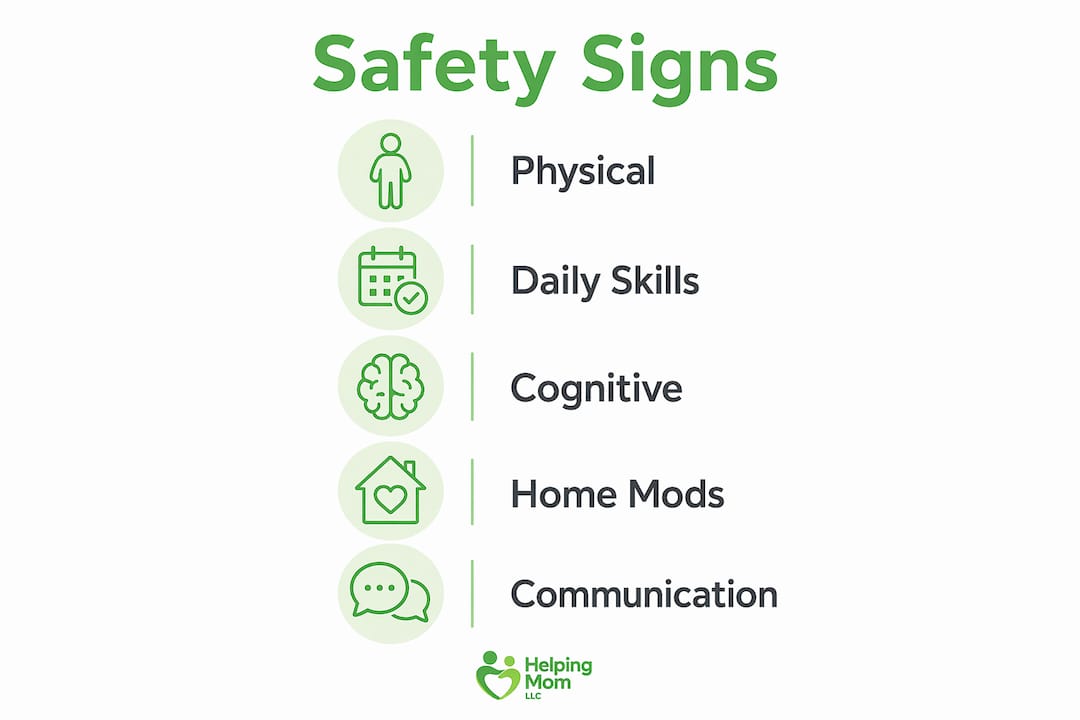
The clearest indicators of safety fall into three categories: physical stability, daily living skills, and cognitive function. A single bad day does not tell you much. A pattern of difficulty tells you everything.
Physical stability starts with falls. Falls are the leading cause of injury for adults aged 65 and older. What makes this especially serious is that falling once doubles a senior's risk of falling again. One fall is a signal. Two falls in the same spot, or near-falls your parent mentions casually, are a pattern that demands attention.
Watch for these physical warning signs:
- Unexplained bruises or cuts your parent cannot account for
- Avoiding certain rooms or areas of the home, like the stairs or the bathroom
- Moving more slowly, holding onto walls, or shuffling instead of walking
- Complaining of dizziness or feeling unsteady after standing up
Daily living skills, known clinically as Activities of Daily Living (ADLs), are equally telling. Persistent challenges with ADLs like cooking, bathing, dressing, or managing medications are direct indicators of safety risk. If your parent is skipping meals, wearing the same clothes for days, or leaving medications untouched in the pill organizer, those are concrete signs worth noting.
Cognitive changes are often the hardest to spot because they can appear gradually. Watch for missed appointments, confusion about the day or time, forgetting recent conversations, or withdrawing from hobbies and social activities. These are not just memory quirks. They signal that your parent may be losing the ability to manage their environment safely.
Pro Tip: Keep a simple log on your phone. When you notice something, write down the date and what you observed. Patterns become much clearer when you can see them in writing over several weeks.
How to assess your parent's safety from a distance
Distance makes observation harder, but it does not make it impossible. The key is building a layered monitoring system that gives you multiple sources of information without making your parent feel watched.
-
Set up daily check-ins. A brief morning text or a short phone call at a consistent time gives you a daily baseline. If your parent misses a check-in, you have a clear signal to follow up. Multi-layered monitoring that combines texts, video calls, and neighbor contacts forms an effective early-warning system for adult children who live far away.
-
Use video calls intentionally. A video call lets you see your parent's appearance, their home environment, and their energy level. Look at what is visible in the background. Is the kitchen clean? Are there dishes piling up? Does your parent look rested and well-groomed?
-
Build a local network. A neighbor who checks in twice a week, a friend from church, or a regular delivery person can all serve as informal eyes on the ground. Local support networks act as the eyes and ears that prevent adult children from carrying the full weight of long-distance caregiving alone.
-
Introduce technology gradually. Smart sensors that detect movement, medication reminder apps, and personal emergency response systems (PERS) can all extend your awareness without requiring constant calls. The right technology for aging parents works best when it is framed as a tool that protects your parent's lifestyle, not one that limits it.
-
Create an escalation plan. Decide in advance who contacts whom if a check-in is missed. Clear escalation protocols prevent panic and unnecessary emergency responses. Write it down and share it with everyone in the network.
Pro Tip: Ask your parent's neighbor if they would be willing to text you once a week with a simple "all good." Most neighbors are happy to help when asked directly. It costs them almost nothing and gives you real peace of mind.
How to evaluate and adapt the home environment for safety
The home itself is either a safety asset or a risk factor. A practical home safety evaluation does not require a professional on the first pass. You can do a solid walk-through yourself during a visit.
Focus on these areas first:
- Floors and pathways. Remove loose rugs, extension cords across walkways, and any clutter that narrows a path. These are the most common trip hazards in older homes.
- Bathroom. Install grab bars next to the toilet and inside the shower or tub. Add a non-slip mat on the floor outside the tub. A shower chair is worth considering if your parent takes long showers or has balance concerns.
- Lighting. Poor lighting is a major fall risk, especially at night. Add nightlights in the hallway, bathroom, and bedroom. Motion-activated lights are a practical upgrade.
- Kitchen. Move frequently used items to lower shelves so your parent does not need to climb or stretch. Check that the stove knobs are easy to read and turn.
- Stairways. Confirm that handrails are secure on both sides. If your parent avoids the stairs, that avoidance is itself a warning sign worth addressing.
Home safety adaptations like grab bars, improved lighting, and non-slip mats reduce accident risk while preserving independence. A periodic professional home safety evaluation can identify hazards that are easy to miss during a casual visit.
| Area | Key modification | Purpose |
|---|---|---|
| Bathroom | Grab bars, non-slip mat | Prevent falls during bathing and toileting |
| Hallways and stairs | Motion-activated lighting | Improve visibility at night |
| Kitchen | Lowered item storage | Reduce reaching and climbing |
| Living areas | Remove loose rugs | Eliminate trip hazards |
| Entryways | Lever door handles | Easier to use with reduced grip strength |
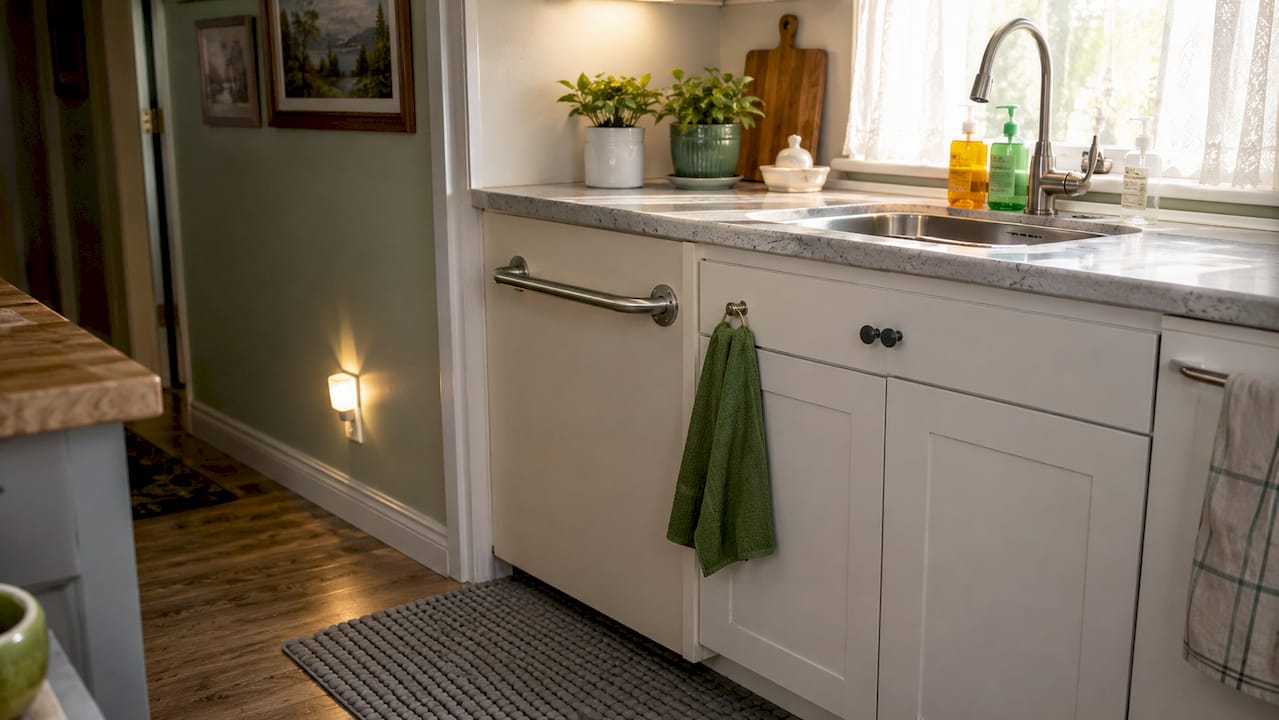
The goal is not to turn your parent's home into a medical facility. The goal is to remove the most likely causes of injury while keeping the space familiar and comfortable.
When and how to talk to your parent about safety concerns
This conversation is often the hardest part. Your parent may feel that raising safety concerns is an attack on their independence. Approached with care, it does not have to be.
Start with what you have observed, not with conclusions. Saying "I noticed you mentioned feeling dizzy a few times this month" lands very differently than "I'm worried you're not safe." Concrete observations are harder to dismiss than general concerns.
- Focus on support, not control. Frame every suggestion as something that helps your parent stay in their home longer. Safety devices are better adopted when framed as tools that sustain independence rather than limit it. That framing applies to conversations too.
- Involve their doctor when possible. A recommendation from a physician carries weight that a family member's concern sometimes does not. Ask your parent's doctor to address fall risk or medication management at the next appointment.
- Propose small changes first. Suggesting a grab bar in the bathroom is a much easier conversation than suggesting a move. Start with the least disruptive change and build from there.
- Expect some resistance. Resistance is normal and does not mean the conversation failed. Recognizing subtle declines early can prevent a crisis, but it requires patience and repeated, gentle conversations over time.
Pro Tip: Bring a sibling or trusted family member into the conversation when possible. A consistent message from more than one person feels less like pressure and more like genuine concern.
For a structured way to approach these discussions as a family, a family meeting guide can help you organize the conversation before it happens.
Key Takeaways
Knowing whether your parent is safe living alone requires observing physical, cognitive, and environmental indicators together over time, not reacting to a single incident.
| Point | Details |
|---|---|
| Falls signal immediate risk | One fall doubles the chance of another; treat any fall as a prompt for a full safety review. |
| ADL difficulties are concrete indicators | Missed medications, poor hygiene, and skipped meals show declining ability to manage daily life. |
| Layered monitoring works best | Combine daily check-ins, video calls, local contacts, and technology for reliable awareness. |
| Home modifications reduce risk | Grab bars, better lighting, and cleared pathways address the most common causes of injury. |
| Conversations require patience | Frame safety changes as support for independence, and expect the discussion to happen more than once. |
What I have learned from watching this up close
I have talked with a lot of families who came to Helping-mom after a crisis. A fall in the middle of the night. A medication mix-up that landed a parent in the ER. What strikes me every time is that the signs were there weeks or months earlier. They just did not know what to look for, or they noticed something and told themselves it was a one-off.
The hardest thing to accept is that families often wait for a catastrophic incident before acting, when the real opportunity lies in catching the slow, quiet changes. A parent who stops cooking. A parent who avoids the stairs. A parent who seems a little more withdrawn on calls. These are not dramatic warning signs. They are easy to rationalize away. But they add up.
The other thing I have seen is how much it helps to stop thinking of this as your responsibility alone. Building a local network around your parent, even a small one, changes the dynamic completely. You go from being the sole person trying to monitor everything from a distance to being the coordinator of a small team. That shift matters for your parent's safety and for your own wellbeing.
Technology helps, but it does not replace the human layer. A sensor that detects no movement after 10 a.m. is useful. A neighbor who notices your parent's curtains are still closed at noon is equally useful. Use both.
Finally, respect for your parent's independence is not in conflict with keeping them safe. The two things work together when you approach the conversation right. Your parent wants to stay in their home. You want them to be safe. Those goals are the same goal.
— Mike
Practical resources from Helping-mom for home safety
Helping-mom has built a set of practical, non-clinical resources specifically for adult children navigating these questions. The practical guide to making home safer for seniors walks you through room-by-room modifications with clear, specific steps. The elderly home safety checklist gives you a printable tool you can use during your next visit to assess your parent's home systematically. Both resources are designed to help you take small, confident steps without needing to figure everything out at once. If you are also thinking about the longer picture, the aging in place guide covers how to plan for your parent's evolving needs over time.
FAQ
What are the first signs a parent may not be safe alone?
The earliest signs are usually falls or near-falls, missed medications, and difficulty with basic daily tasks like cooking or bathing. A pattern of these issues is more significant than any single incident.
How often should I check on an aging parent living alone?
A daily check-in by text or phone call is a practical baseline. Video calls two to three times a week add a visual layer that helps you spot changes in appearance, energy, or home condition.
Can technology replace in-person visits for monitoring safety?
Technology extends your awareness between visits but does not replace them. Smart sensors and emergency alert systems are useful tools, but in-person observation remains the most reliable way to assess your parent's actual condition.
When should I consider alternatives to living alone?
When repeatable patterns of decline appear, such as consistent medication errors, recurring falls, or an inability to manage meals, the home environment may no longer match your parent's current abilities. That is the point to explore additional support options. The Helping-mom guide on when to worry about a parent living alone covers this in more detail.
How do I talk to a parent who refuses help?
Use specific observations rather than general concerns, frame every suggestion as support for staying independent, and involve their doctor when possible. Expect the conversation to happen more than once before it leads to change.