

Caring for an aging parent quietly takes a toll on you in ways you may not even notice until you're running on empty. If you've been wondering how to reduce caregiver stress, you are not alone. Roughly 40 to 70% of caregivers show clinical depression symptoms without structured daily recovery habits. The exhaustion, the guilt, the constant decision-making — it all accumulates. This guide walks you through practical, grounded strategies built specifically for adult children who are doing their best and need real support to keep going.
Table of Contents
- Key takeaways
- How to reduce caregiver stress: understanding what you're dealing with
- Building daily self-care habits that actually stick
- Delegating and setting limits to protect your energy
- Managing your emotional health while caregiving
- Reducing decision fatigue with simple systems
- My honest take on caregiver self-care
- Resources to support you and your parent at home
- FAQ
Key takeaways
| Point | Details |
|---|---|
| Stress is physical and mental | Caregiver stress affects your body, emotions, and thinking — not just your mood. |
| Daily habits are your anchor | Small, consistent recovery routines protect you from burnout far better than occasional breaks. |
| Delegation is a skill worth building | Giving others specific tasks reduces your load and actually improves the help you receive. |
| Decision fatigue is real | Simplifying daily choices preserves your mental energy for what matters most. |
| Self-care is not selfish | Caring for yourself directly improves the quality of care your parent receives. |
How to reduce caregiver stress: understanding what you're dealing with
Caregiver stress is not one single feeling. It shows up physically as chronic fatigue and disrupted sleep. It shows up emotionally as guilt, resentment, or a quiet sadness you can't quite name. And it shows up cognitively as something called decision fatigue, the mental overload that comes from making dozens of small caregiving decisions every single day.
Think about a typical Tuesday. You wake up already planning your parent's medications, meals, appointments, and any unexpected changes in their condition. By noon, your brain has already processed more choices than most people make in a full day. Decision fatigue exhausts the prefrontal cortex, leaving you irritable, foggy, and prone to poor judgment by late afternoon.
Some signs that stress is building up without you realizing it:
- Snapping at family members over small things
- Feeling resentful even when nothing specific happened
- Forgetting appointments or losing track of tasks
- Losing interest in things you used to enjoy
- Feeling like there's no version of this that gets better
Recognizing these patterns early matters. When stress goes unaddressed, it moves toward full caregiver burnout, which affects not only your own health but also the quality of care you can give your parent.
"The first step is simply noticing. You don't need to have everything figured out. You just need to see what's happening clearly enough to take one small step."
Structured routines act as a buffer against this kind of cumulative stress. They reduce the number of decisions you need to make consciously and create small pockets of recovery throughout your day.
Building daily self-care habits that actually stick

Self-care for caregivers doesn't mean spa days or long vacations. It means simple, repeatable habits that help your nervous system recover between the demands of caregiving. The goal is not perfection. It's consistency.
Here's a practical daily sequence to work with:
- Start with water. Drinking 250 to 500 ml of water right after waking corrects overnight dehydration and improves brain function before your day begins. This is a 60-second habit with real cognitive payoff.
- Take micro-movement breaks. You don't need a gym. Five-minute movement breaks reduce depression risk by about 20% and improve energy during caregiving duties. A short walk to the end of the driveway counts.
- Practice box breathing. Inhale for four counts, hold for four, exhale for four, hold for four. Done twice, this takes under two minutes and lowers stress hormones measurably. Use it between tasks.
- Write for five minutes before bed. Emotional journaling before sleep helps process difficult feelings and improves sleep quality by releasing mental burdens you've been carrying all day.
- Reach out to one person. Daily interaction with at least one person improves caregiver resilience. A text, a short call, a coffee with a neighbor — it counts more than you think.
Pro Tip: Use a caregiver schedule template to block these habits into your day the same way you block your parent's appointments. What gets scheduled gets done.
Here's a simple snapshot of what recovery habits look like across a typical caregiving day:
| Time of day | Recovery habit | Time needed |
|---|---|---|
| Morning | Water + box breathing | 3 minutes |
| Midday | 5-minute walk or stretch | 5 minutes |
| Afternoon | Brief social check-in | 5 to 10 minutes |
| Evening | Journaling or quiet reading | 5 to 10 minutes |
None of these require you to leave your parent's side for long. They are designed to fit around caregiving, not compete with it.
Delegating and setting limits to protect your energy
One of the most common patterns among overwhelmed caregivers is the quiet belief that it's easier to just do everything themselves. Asking for help feels complicated. But doing it all leads directly to exhaustion, and exhaustion leads to worse care.
Friends and family help more effectively when given specific, manageable tasks rather than vague requests. "Can you help with Dad?" gets a vague response. "Can you pick up his prescription on Thursday at 2 p.m.?" gets a yes.
Here's how to start delegating without the overwhelm:
- Write a master list of every task involved in your parent's care, from grocery runs to medication management to laundry.
- Separate tasks that require your specific involvement from tasks others could do.
- Assign each delegable task to a specific person with a specific day and time.
- Accept help without over-explaining or apologizing for needing it.
Setting limits with family members is equally important. If a sibling consistently drops in without notice and disrupts your parent's routine, a calm, direct conversation protects both you and your parent. You are not being difficult. You are managing a caregiving environment, and that requires some structure.
Pro Tip: If you're unsure where to start with sharing the caregiving load, write down everything you did in the past 48 hours for your parent. You'll likely surprise yourself, and that list becomes your delegation starting point.
Structured breaks every two to three hours and scheduled respite care help caregivers avoid emotional exhaustion, particularly those caring for a parent with dementia or complex needs. Respite care, even for a few hours per week, is not a luxury. It is a caregiving tool.
Managing your emotional health while caregiving
Here's something worth sitting with: failing to care for yourself reduces the quality of care you give. This is not a judgment. It's simply how human beings work. You cannot pour from an empty cup, as the saying goes, and caregiving demands a full one.
The emotional weight of caregiving includes feelings that are entirely normal but rarely talked about openly. Frustration at your parent. Grief for the relationship you used to have. Guilt for every moment you spend not caregiving. These feelings don't mean you're doing it wrong. They mean you're human.
Some practical ways to manage emotional and mental health alongside caregiving:
- Let yourself feel frustration without acting on it. Name it, note it, move on.
- Integrate small joyful activities into your caregiving days. A favorite podcast during a drive. A 10-minute sit in the backyard. These protect your sense of self.
- Use caregiver support groups when loneliness builds. Talking to others who understand your situation reduces isolation more than almost anything else.
- Consider talking to a counselor if emotional fatigue persists beyond a few weeks. This is not a sign of weakness. It is a smart use of resources.
- Practice gratitude for small things, not as a way to minimize your struggles but as a way to keep perspective.
"Caregiving and self-care are not mutually exclusive. Caring for yourself is part of caring for your parent — not separate from it."
The goal is not to eliminate hard feelings. It is to keep them from accumulating into something that overwhelms you completely.
Reducing decision fatigue with simple systems
Every decision you make during a caregiving day uses mental energy. What your parent eats, when they take medications, which appointment to reschedule, how to respond when they're confused or anxious. Over time, this cognitive load becomes its own kind of exhaustion.
The solution is not making fewer decisions. It's making fewer decisions consciously. This is where systems come in.
A useful framework for managing decisions is the 5D Decision Reset: Delete, Delegate, Default, Delay, Document.
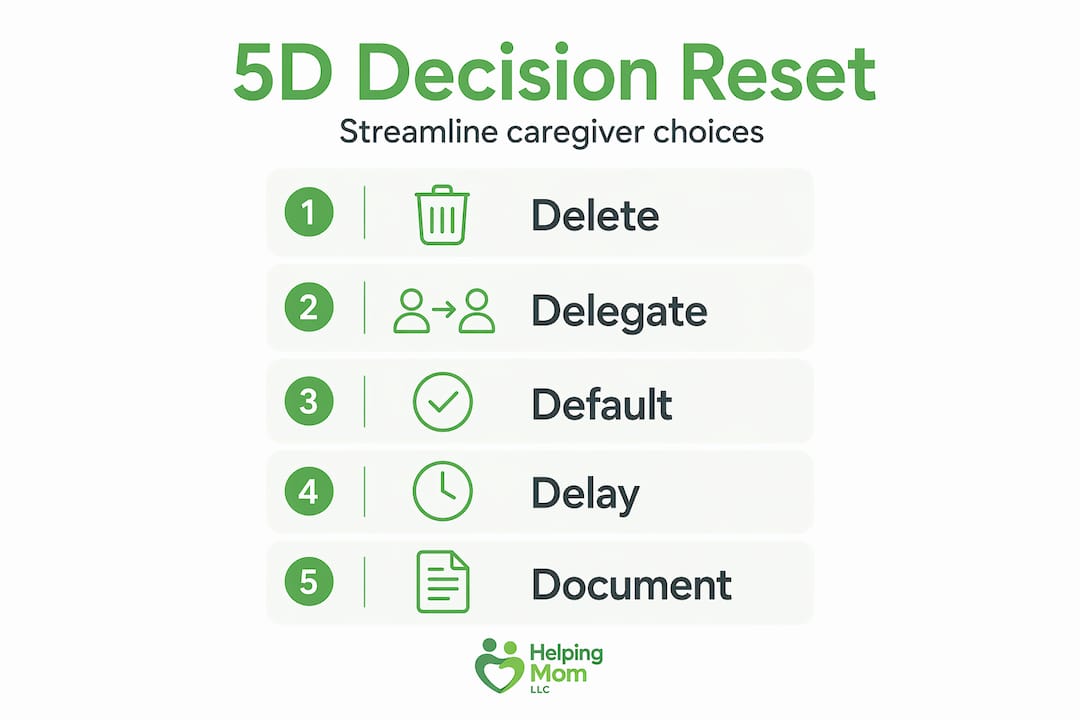
Delete choices that don't actually matter. Does breakfast variety change your parent's care outcome? Probably not. Pick three rotating meals and stop deciding daily.
Delegate decisions that others can make. If your sibling can handle scheduling transportation, let them own that decision entirely.
Default to a fixed routine wherever possible. When medications, meals, and morning hygiene follow the same order every day, your brain stops spending energy on sequencing.
Delay non-urgent decisions to a weekly planning window. Not everything needs an answer today.
Document everything in a centralized place. Maintaining a caregiver command center, a simple binder or shared digital document with your parent's care schedule, medications, and important contacts, reduces anxiety and cognitive load significantly.
| Strategy | What it does | Example |
|---|---|---|
| Delete | Removes unnecessary choices | Fixed weekly meal rotation |
| Delegate | Transfers decisions to others | Sibling handles transportation |
| Default | Automates recurring decisions | Same medication schedule daily |
| Delay | Batches non-urgent choices | Weekly planning session |
| Document | Reduces memory burden | Centralized care binder or app |
Pro Tip: A printable caregiver schedule can serve as the foundation for your command center. Start simple, add to it as you go, and keep one copy accessible to anyone helping with care.
External tools like pill dispensers with alarms, shared family calendars, and reminder apps take decisions off your plate and onto a system that never gets tired.
My honest take on caregiver self-care
I've spoken with many adult children caring for aging parents, and the pattern I see most often is this: the caregiver waits until they're depleted to start taking care of themselves. They believe rest is something they'll earn eventually, once their parent is more stable or the situation settles.
The situation rarely settles. And waiting for it to do so means waiting until you're running on very little.
What I've learned is that the caregivers who hold up best over time are not the ones who sacrifice the most. They are the ones who treat their own recovery as part of the caregiving work itself. Not separate from it. Not a treat. A requirement.
The guilt is real. I understand that. But consider this: when you are rested, calmer, and emotionally steadier, your parent experiences a measurably better version of you. That is not selfishness. That is good caregiving strategy.
Start with one habit. One small shift. The full picture doesn't need to come together at once. You just need to take a step today that tomorrow-you will thank you for.
— Mike
Resources to support you and your parent at home
At Helping-mom, we know that managing caregiver stress works best when your parent's home environment also supports their safety and independence. When your surroundings are set up well, you spend less mental energy anticipating accidents or managing avoidable crises. That gives you back some breathing room.
Explore our caregiver well-being resources for practical guidance on emotional support, burnout prevention, and building sustainable caregiving habits. If your parent is aging at home, our home safety guide for seniors walks you through the most impactful changes you can make to reduce fall risk and give yourself greater peace of mind. You can also connect with professional support brokerage services if you need help coordinating care options in your area.
FAQ
What are the first signs of caregiver burnout?
Early signs include persistent fatigue, emotional withdrawal, irritability over small things, and a growing sense of resentment. Recognizing these symptoms early allows you to take corrective steps before they worsen.
How can caregivers reduce anxiety on a daily basis?
Short recovery habits like box breathing, five-minute walks, and brief social check-ins each day help regulate stress hormones and reduce anxiety without requiring large blocks of time.
Is it normal to feel guilty about taking breaks from caregiving?
Yes, caregiver guilt is extremely common, but taking breaks is necessary. Self-care directly improves care quality, so resting is not abandoning your parent. It is preparing yourself to show up better.
What is decision fatigue in caregiving?
Decision fatigue is the mental exhaustion that builds from making constant caregiving choices throughout the day. Simplifying routines and delegating decisions reduces this cognitive load and helps you think more clearly.
When should a caregiver ask for outside help?
If you feel consistently overwhelmed, emotionally exhausted, or physically unwell, it is time to bring in additional support. Respite care, support groups, or professional care coordination are all reasonable and worthwhile options to consider.
Recommended
- How to Find Caregiver Support: Practical Steps for Adult Children | Helping Mom LLC
- Caregiver Stress Dementia: Practical Support | Helping Mom LLC
- The Role of Caregivers: Practical Support for Adult Children Caring for Aging Parents | Helping Mom LLC
- Feeling Overwhelmed Caring for Elderly Parent? Get Help | Helping Mom LLC