

Setting boundaries with aging parents is the single most effective way to sustain a caring relationship without losing yourself in the process. Adult children who establish clear, consistent limits report lower rates of caregiver burnout, stronger family communication, and more energy for the long haul. The clinical term for this practice is caregiver boundary management, and it applies whether your parent calls you ten times a day, shows up unannounced, or expects you to handle every errand and appointment. This article walks you through exactly how to identify your limits, communicate them with warmth, and build a support system that holds them in place.
How to set boundaries with aging parents: what it really means
Caregiver boundary management is defined as the deliberate practice of identifying your personal limits and communicating them clearly to protect both your well-being and the quality of care you provide. In an elder caregiving context, boundaries are not walls. They are agreements that make the relationship sustainable for everyone involved.
The stakes are real. Over 50% of caregivers report difficulty maintaining their mental health, and 40% describe persistent loneliness. That means the majority of adult children providing care are already stretched thin, often before they recognize it. Boundaries are not a luxury for caregivers. They are a health intervention.
Boundaries in caregiving typically fall into four areas:
- Time: How many hours per week you are available, and which hours are off-limits.
- Communication: How often your parent can call, and what channels you use.
- Physical space: Whether drop-in visits are acceptable or require advance notice.
- Emotional labor: Which decisions are yours to make versus your parent's to own.
Pro Tip: Write your boundaries down before any conversation. Vague intentions become vague limits. A written list helps you stay grounded when emotions run high.
Recognizing that you need limits is not a failure of love. It is a recognition that caregiver vitality depends on recovery time. Without it, the emotional and physical toll compounds over months and years.
How do you identify what's actually triggering you?
Before you can set a limit, you need to name the specific behavior causing stress. Vague complaints like "Mom is too demanding" do not translate into clear agreements. Specific behaviors do.
Mapping behaviors to boundaries is the most practical starting point. The process works like this: you observe a behavior that drains you, name it precisely, and then define the rule that addresses it directly.
Here is a simple four-step process to get started:
- Log the behavior for one week. Write down every moment you feel resentful, overwhelmed, or interrupted. Note the time, what happened, and how you felt.
- Identify the pattern. After a week, you will likely see two or three recurring behaviors. Frequent phone calls during work hours. Unannounced visits on weekends. Repeated requests for tasks you have already delegated.
- Convert each behavior into a concrete rule. "Dad calls me at work five times a day" becomes "Dad calls me once at lunch and once after 5 p.m." "Mom drops by without warning" becomes "Mom calls at least two hours before visiting."
- Write the rule in plain language. Avoid emotional language in the rule itself. Keep it factual and specific so there is no room for misinterpretation.
This behavior-to-boundary mapping approach removes the emotional charge from the conversation. You are not saying your parent is wrong. You are saying what works for you. That distinction matters enormously when you sit down to talk.
What's the best way to communicate limits without damaging the relationship?

Communicating limits with empathy is the part most adult children dread, and it is also the part that determines whether the boundary holds. The good news is that the language you use matters more than the topic itself.
Using "I" statements is the most reliable way to lower defensiveness. "I feel overwhelmed when I get multiple calls during my workday" lands very differently than "You call too much." The first describes your experience. The second assigns blame. Your parent is far more likely to hear the first version.
Leading with love and concern rather than criticism sets the tone for the whole conversation. Open with something like, "I want to keep showing up for you in a way that's good for both of us." That framing makes the boundary feel collaborative rather than punitive.
A few practical communication principles that hold up in real conversations:
- Frame it as shared decision-making. Ask your parent what would work for them within the limit you are setting. This preserves their sense of autonomy and reduces resistance.
- Expect pushback and prepare for it. Resistance is normal, not a sign that you are doing something wrong. Have a calm, prepared response ready: "I understand this feels different. I need this to work for me so I can keep being here for you."
- Plan for multiple conversations. Boundary conversations are processes, not single events. Give your parent time to adjust, and revisit the conversation as needed.
- Involve your parent's physician when relevant. If your parent resists a safety-related limit, a doctor's input depersonalizes the boundary. It becomes a health recommendation, not a family argument.
Pro Tip: Rehearse the opening two sentences of your boundary conversation out loud before you have it. The first 30 seconds set the emotional tone for everything that follows.
The goal is not to win the conversation. The goal is to reach a workable agreement that both of you can live with over time.
How do you build a system that keeps boundaries in place?
Individual conversations are necessary, but they are not sufficient. Boundaries stick when they are backed by a practical system. That system includes other people, scheduled routines, and clear communication tools.
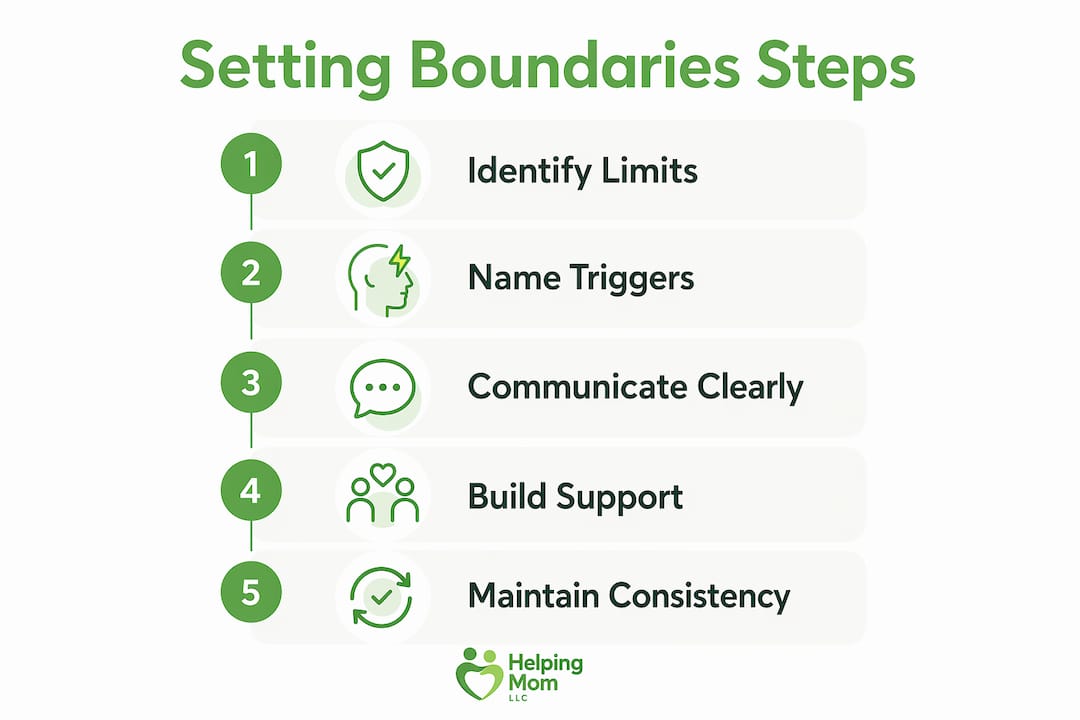
Rallying a caregiving team is one of the most effective ways to make limits operational. When siblings, other family members, or a home care agency share the load, your parent has multiple points of contact. You are no longer the only person they can call. That structural change reduces pressure on you without reducing the quality of care your parent receives.
Here is a comparison of two common approaches to operationalizing limits:
| Approach | How it works | Best for |
|---|---|---|
| Call windows with voicemail | Set specific hours for calls; voicemail handles the rest | Caregivers managing frequent interruptions during work |
| Assigned alternate contacts | Siblings or agency staff cover specific days or tasks | Families with multiple available members |
| Scheduled visit days | Visits happen on agreed days rather than spontaneously | Parents prone to unannounced drop-ins |
| Pre-planned coverage for breaks | Arrange backup care before taking time off | Preventing guilt around personal time |
Treating boundaries as scheduling systems rather than emotional negotiations removes much of the guilt. When your parent knows that Tuesday and Thursday evenings are your protected time, and that your sibling is available on Saturdays, the limit feels like a plan rather than a rejection. You can also explore coordinating family care as a structured way to assign roles and reduce the burden on any one person.
Trying to manage everything alone is one of the most common mistakes adult children make. The team approach is not a sign of weakness. It is the only model that works sustainably over years of caregiving.
What happens when your parent pushes back hard?
Resistance is the most common reason adult children abandon limits they have already set. Understanding why resistance happens makes it easier to hold your ground without becoming cold or dismissive.
Watch for these signs that you need to strengthen your limits rather than soften them:
- You feel dread before every phone call or visit.
- You cancel your own plans regularly to respond to non-urgent requests.
- You feel irritable, fatigued, or withdrawn from people outside the caregiving relationship.
- You find yourself resenting your parent, even when you love them.
Fatigue, irritability, and withdrawal are recognized warning signs of caregiver burnout. When these appear, they signal that your current limits are not holding, not that you need to try harder. Adjusting your boundaries upward at this point is a practical response, not a selfish one.
When your parent resists verbally, avoid debating the limit itself. Instead, bring concrete options and, where appropriate, involve their physician. A boundary anchored to a doctor's recommendation feels less personal and more like a shared health decision. This approach, recommended by the NDPA, consistently reduces conflict because it shifts the conversation from "what you want" to "what supports everyone's well-being."
Professional support through a therapist or a caregiver support group can also help you process guilt and maintain consistency. Self-care for caregivers is not a side topic. It is the foundation that makes everything else possible.
Key takeaways
Healthy boundaries with aging parents require specific behaviors, clear communication, and a practical support system working together.
| Point | Details |
|---|---|
| Name specific behaviors | Convert vague frustrations into concrete, measurable rules before any conversation. |
| Use "I" statements | Lead with your experience, not criticism, to reduce defensiveness and keep dialogue open. |
| Treat limits as schedules | Use call windows, voicemail, and assigned contacts to make boundaries operational and guilt-free. |
| Rally your team | Involve siblings, agencies, or community resources so you are not the sole point of contact. |
| Watch for burnout signals | Fatigue and irritability are signs to strengthen limits, not push through without change. |
What I've learned about holding the line with love
I want to be honest with you about something most articles skip over. Setting limits with your aging parent is not a one-time conversation that resolves everything. It is a practice. Some weeks it holds beautifully. Other weeks, one emotional phone call can undo months of progress.
What I have found, working with families in the thick of this, is that the caregivers who do best are not the ones with the firmest limits. They are the ones who are the most consistent and the most self-aware. They notice when they are starting to slip back into old patterns. They course-correct without drama. They also ask for help before they are desperate, not after.
Empathy and assertiveness are not opposites. You can say "I love you and I cannot take calls after 8 p.m." in the same breath. The two things belong together. When you frame limits as acts of care, for yourself and for your parent, the guilt loses most of its grip.
One more thing: gradual progress is still progress. If your parent now calls twice a day instead of six times, that is a real win. Celebrate it. Build on it. This is not about achieving a perfect system. It is about walking alongside your parents in a way that you can sustain for years, not just months.
— Mike
Practical tools to support you and your parent
At Helping-mom, we know that setting limits is only one piece of a larger caregiving picture. When your parent has a safer, more independent home environment, the pressure on you naturally decreases. Our senior home safety guide walks you through practical modifications that help your parent age in place with confidence. For the emotional side of caregiving, our caregiver well-being resources offer support specifically designed for adult children managing stress and burnout. And if you are working through how to share responsibilities with siblings or outside help, our guide on supporting aging parents covers the full picture from a family coordination perspective.
FAQ
What does "setting boundaries with aging parents" actually mean?
It means identifying specific behaviors that affect your well-being and communicating clear, consistent limits around them. The goal is a sustainable caregiving relationship, not distance or control.
How do I set limits without feeling guilty?
Frame each limit as a condition that allows you to keep showing up as a caregiver. Research from Harvard Health confirms that protected personal time is a practical tool for preventing burnout, not a selfish choice.
What if my parent refuses to respect my limits?
Bring concrete options and, where appropriate, involve their physician to depersonalize the conversation. Resistance is normal and rarely permanent when limits are communicated consistently and with empathy.
How many conversations does it take to establish a new limit?
Most families need multiple conversations over weeks or months. The NDPA recommends treating these discussions as an ongoing process rather than a single event, with patience and follow-through as the key factors.
When should I consider professional help?
When you notice persistent fatigue, irritability, or withdrawal, Kaiser Permanente identifies these as burnout warning signs that call for outside support, whether through therapy, a caregiver support group, or a home care agency.