

Starting a serious conversation with your aging parent can feel like standing at the edge of something you're not sure how to cross. You know something important needs to be said, whether it's about a health concern, a home safety issue, or plans for the future, but finding the right words feels genuinely hard. You don't want to upset them, and you don't want to come across as taking over their life. The good news is that with a little preparation, the right approach, and some patience with yourself, these conversations can go much better than you expect.
Table of Contents
- Understand the emotional landscape before starting the conversation
- Prepare for the conversation: Practical steps and tools
- How to start the conversation: Approaches and language that works
- Managing challenging moments: De-escalation and troubleshooting
- Moving forward: Next steps after the conversation
- Our perspective: What most guides miss about talking to aging parents
- Get more support for conversations and caregiving
- Frequently asked questions
Key Takeaways
| Point | Details |
|---|---|
| Empathy is essential | Approaching conversations with patience and understanding leads to better outcomes. |
| Preparation sets the tone | Gathering information and planning ahead allows for smoother, less stressful discussions. |
| Use supportive language | Framing questions and statements to respect parental autonomy reduces defensiveness. |
| De-escalation helps progress | Managing tense moments calmly keeps communication open and productive. |
| Follow-up ensures clarity | Summarizing agreements and regular check-ins prevent misunderstandings and build trust. |
Understand the emotional landscape before starting the conversation
Before you say a single word to your parent, it helps to understand what's happening emotionally, for both of you.
For you, there's often a mix of worry, guilt, and uncertainty. You may feel anxious about saying the wrong thing, or frustrated if past conversations haven't gone well. You might also carry a quiet fear about what a difficult conversation might reveal, or where it might lead. These feelings are completely normal, and they don't mean you're doing anything wrong.
For your parent, the emotions at play are just as real. Many aging parents feel a quiet grief about losing independence. They may be defensive not because they're being difficult, but because they're afraid. When a grown child raises concerns about driving or living alone, a parent can hear, "You're no longer capable," even when that's not what you mean at all.
Common emotions on both sides include:
- Fear of change, loss of control, or becoming a burden
- Defensiveness triggered by feeling scrutinized or doubted
- Sadness around aging and what it means for their identity
- Love and worry that can make both of you say things less gently than you intended
- Uncertainty about the future, finances, and health
Recognizing these feelings before you walk into a conversation gives you a real advantage. Empathy isn't just a soft skill here. It's a practical strategy. When your parent feels genuinely heard, they're far more likely to engage with you openly. Our compassionate guide for tough talks goes deeper on this if you want to explore it further.
Pro Tip: If you're feeling overwhelmed before a conversation, write down two or three things you genuinely appreciate about your parent. Starting from a place of gratitude, even privately, shifts your tone in ways they can feel.
Prepare for the conversation: Practical steps and tools
Once you've done the emotional groundwork, preparation becomes much more straightforward. Think of this phase as getting your materials ready before a meeting. You wouldn't walk into an important work conversation unprepared, and this one deserves the same care.
Here's a simple numbered process to follow:
- Identify the key topics you want to cover. Don't try to address everything at once. Choose one or two priorities, such as home safety or an upcoming doctor's appointment.
- Gather any relevant materials. This could be a list of medications, recent medical notes, or a home safety checklist. Our aging parents checklist is a practical starting point.
- Choose the right time. Mid-morning or early afternoon tends to work better than evenings, when energy is lower. Avoid holidays, family gatherings, or moments right after a difficult event.
- Pick a comfortable setting. Your parent's home, where they feel secure, is often the best location. Familiar surroundings reduce defensiveness naturally.
- Keep the tone light at first. Start the visit with warmth before steering toward serious topics. A little casual connection goes a long way.
The timing and setting of a conversation matter more than most people realize. Research consistently shows that stress and cognitive fatigue affect how well people process information. For older adults, this is especially true later in the day. Choosing a calm, unhurried window gives everyone the best chance to listen clearly and respond thoughtfully.

| Preparation element | Why it matters |
|---|---|
| Written notes or checklist | Keeps you focused and prevents forgetting key points |
| Relevant documents | Avoids back-and-forth and shows you've done the work |
| Chosen time and place | Reduces stress and signals respect |
| One or two focused topics | Prevents overwhelm and encourages real dialogue |
If you're navigating the broader question of how your parent will continue living safely at home, the aging in place resource hub has detailed guidance that can inform what topics you bring to the conversation.
Pro Tip: Keep a small notebook or use your phone's notes app to jot down things you want to say before the visit. Seeing your thoughts written out often helps you realize which ones are most important and which ones can wait.
How to start the conversation: Approaches and language that works
You've prepared emotionally and practically. Now comes the part that most people dread: actually starting. The opening of these conversations sets the entire tone, so it's worth thinking carefully about how you begin.
The most effective approach is almost always gentler than you expect. Open-ended questions work far better than statements or directives. Compare these two ways of raising a concern about driving:
| Direct, directive approach | Open, collaborative approach |
|---|---|
| "I'm worried about you driving, and I think you should stop." | "How has driving been feeling lately? I've been thinking about it and wanted to hear your thoughts." |
| "You need to see a doctor about your memory." | "I've noticed a few things and I care about you. Would you be open to talking to someone about it together?" |
| "This house isn't safe for you anymore." | "I'd love to walk through the house with you. I want to make sure we're thinking ahead together." |
The open, collaborative approach invites your parent into the conversation as a partner rather than putting them on the defensive. It honors their autonomy, which is one of the most important things you can do throughout this process. Your parent is still an adult with full rights to make decisions about their own life.
Some language patterns that tend to work well:
- "I've been thinking about this because I love you and I want to support you."
- "Can I share something I've been wondering about? I'd really value your perspective."
- "What do you think would help you feel more comfortable about this?"
"The goal isn't to win the conversation. It's to open a door. Even a small opening is real progress."
If you're looking for more specific phrasing and strategies, our pages on talking about care with parents and practical support steps offer detailed examples you can adapt to your situation.
Initial resistance is common and shouldn't discourage you. Your parent may say "I'm fine" or "I don't want to talk about it." When that happens, don't push. Acknowledge what they've said, affirm that you hear them, and let it rest for now. A short, warm conversation that ends well is more valuable than a longer one that ends in tension.
Managing challenging moments: De-escalation and troubleshooting
Even when you've done everything right, a conversation can shift quickly. Your parent may become upset, raise their voice, or shut down entirely. This is normal. It doesn't mean you've failed.
When things get tense, these strategies can help:
- Pause before responding. Take a slow breath. A five-second pause can change the entire direction of a conversation.
- Reflect back what you heard. Saying "It sounds like you're feeling like I don't trust you" shows you're listening, not attacking.
- Lower your voice slightly. When someone else raises theirs, lowering yours has a calming effect.
- Name the emotion gently. "I can see this is upsetting. I understand why." This often defuses a moment faster than any argument.
- Offer to take a break. "Let's take a few minutes and come back to this" is not a failure. It's wisdom.
Pro Tip: If a conversation is escalating and you feel yourself getting reactive, it's okay to say, "I love you, and this matters too much for us to talk about when we're both upset. Can we come back to it tomorrow?" Choosing the right moment to pause shows maturity, not weakness.
"Sometimes the most productive thing you can do in a hard conversation is slow it down."
If the conversation stalls entirely, follow up with a small, low-pressure gesture. Send a card, drop off their favorite meal, or call just to say hello. Rebuilding the warmth of the relationship makes the next conversation easier. More guidance on navigating this carefully is available in our resource on how to help without upsetting your parent.
Moving forward: Next steps after the conversation
After the conversation, the work isn't quite done. What happens in the days that follow shapes whether anything actually changes.
Here's how to follow up effectively:
- Write down what was discussed and any agreements made. Even informal notes help. Memory fades, and having a record prevents misunderstandings later.
- Send a brief, warm message. A short text or phone call thanking your parent for talking with you reinforces the relationship and keeps the door open.
- Follow through on anything you agreed to do. If you said you'd research home modification options or look into a doctor, do it promptly. This builds trust.
- Schedule the next conversation. Not every issue gets resolved in one sitting. Setting a natural next touchpoint removes pressure from both sides.
- Involve siblings or other close family members thoughtfully. Share what was discussed, invite their input, and coordinate who will take which responsibilities.
Siblings can be enormously helpful here, but only if everyone is aligned. Before looping others in, think about whether a sibling's involvement will support the conversation or complicate it. If you're all on the same page, a united family approach often carries more weight with a resistant parent.
Staying organized after these conversations also helps you care for yourself. Tracking what's been discussed and what's pending means you're not carrying it all in your head. Our broader guidance on caring for aging parents includes strategies for managing this ongoing role without burning out.
Our perspective: What most guides miss about talking to aging parents
Most articles on this topic treat a difficult conversation as an event. You plan it, you have it, and then it's done. But that's not really how this works.
Talking to an aging parent about health, safety, or the future is a process, not a single moment. The first conversation rarely resolves anything. Often, it just plants a seed. That seed needs time, follow-through, and repeated gentle effort to grow into real understanding or change.
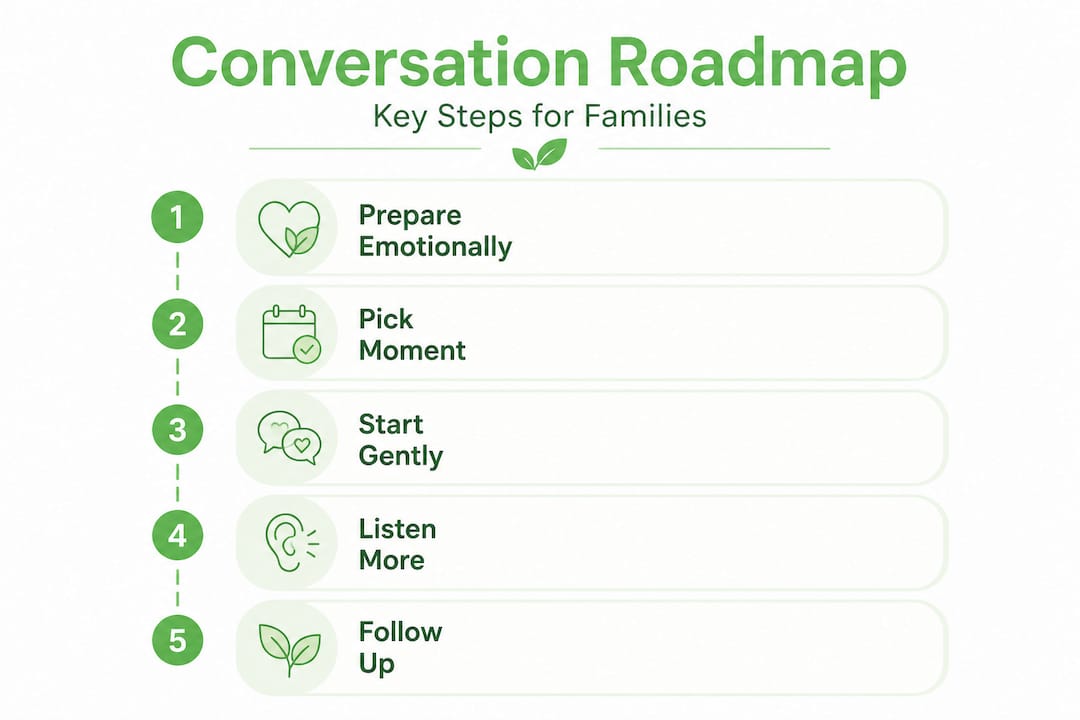
Here's something that often gets overlooked: listening matters more than talking. In these conversations, adult children frequently prepare what they want to say but spend far less time thinking about how to hear their parent. Your parent's perspective, fears, and priorities deserve real airtime. When they feel genuinely listened to, they're more likely to trust you, and trust is what makes future conversations possible.
We also think most guides are too focused on achieving a specific outcome. Yes, you may want your parent to install grab bars in the bathroom or agree to have fewer people over during flu season. But if the conversation ends with your parent feeling respected and you feeling connected, that is a genuine win, even without a definitive answer. Progress in caregiving is rarely dramatic. It's mostly small, steady, patient movement in the right direction.
The compassionate approach we advocate isn't about giving up on practical goals. It's about recognizing that the relationship is the foundation everything else is built on. Protect it, and the practical conversations get easier over time.
Get more support for conversations and caregiving
Navigating these conversations is one part of a much larger caregiving journey, and you don't have to figure it all out on your own. At Helping Mom, we've created practical resources designed specifically for adult children like you, people who are showing up with love and doing their best in a genuinely complex role.
If home safety is part of what you need to discuss, our aging in place home safety guide walks through the most important areas of a parent's home to assess and address. The elderly home safety checklist gives you a simple, printable tool to use during or after your visits. And when you're ready to keep the conversation going, our full resource on talking with aging parents provides more depth on phrasing, timing, and handling specific situations. We're here to make this road a little easier to walk.
Frequently asked questions
How do I start a conversation if my parent is resistant?
Start gently with a lower-stakes topic to build trust, and acknowledge their feelings before moving into anything they might find threatening. Patience and small steps forward matter more than tackling everything at once.
What topics should I prioritize when talking to aging parents?
Focus first on health, home safety, and immediate wellbeing, then move toward future planning and legal or financial matters once trust is established. Addressing the most urgent needs first keeps the conversation grounded and practical.
How can I avoid upsetting my aging parent during these talks?
Use collaborative, respectful language that invites their input rather than directing them, and listen more than you speak. Keeping the tone warm and non-confrontational goes a long way toward making the conversation feel safe rather than threatening.
Should siblings be involved in the conversation?
Yes, when siblings are aligned and supportive, involving them can reinforce your concern and share the caregiving load. It works best when the family has agreed on the key points beforehand, rather than arriving with conflicting messages.
Recommended
- How to Talk to Aging Parents About Independence | Helping Mom LLC
- 8 Thoughtful Questions to Ask Your Aging Parents | Helping Mom LLC
- Having Difficult Conversations with Aging Parents: A Compassionate Guide | Helping Mom LLC
- How to Talk to Aging Parents About Safety | Helping Mom LLC
- Essential end-of-life documentation steps for California families | Graceland Hospice Care Blog