
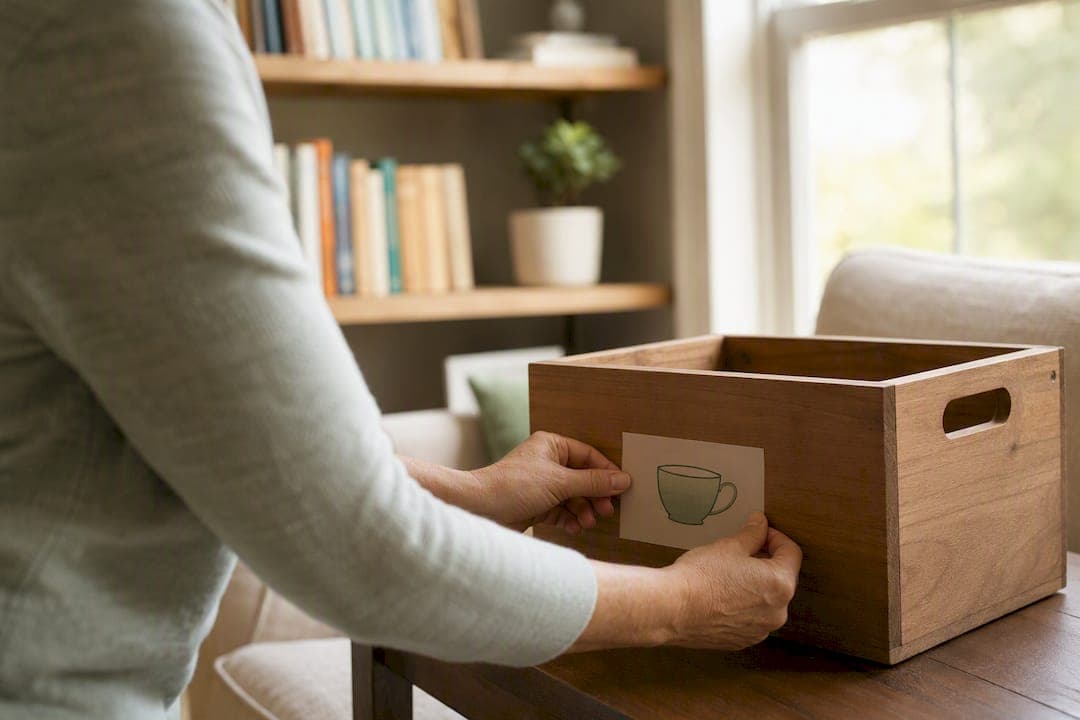
Yes, simple labels help. High-contrast text paired with a real photo, placed at eye level on a few key drawers and doors, often reduces confusion and lets your parent do more without asking for help. Start with three to five high-priority spots (bathroom, bedroom, kitchen) rather than labeling the whole house at once.
TL;DR:
- Labels work best for people in the mild to moderate stages of dementia, when reading and recognition are still intact.
- Use large, high-contrast, sans-serif fonts between 24 and 28 points, paired with real photos and consistent formatting for maximum effectiveness.
- Focus on labeling high-priority areas such as the bathroom, bedroom, and kitchen with specific items to reduce confusion and promote independence.
- Keep labels simple, placed at eye level, and avoid labeling everything to prevent visual noise and maintain clarity.
- Labels should be part of a broader safety plan, including environmental modifications and hazard-proofing, especially for dangerous or high-risk items.
Table of Contents
- Why Labeling for Dementia at Home Actually Works
- What Makes a Label Dementia-Friendly?
- Room-by-Room Labeling Checklist
- How to Label a Home for Dementia in One Afternoon
- Materials and Templates That Won't Break the Bank
- When Labeling Stops Working
- A Caregiver's Honest Take on What Actually Moves the Needle
- Get the Practical Guide and Skip the Guesswork
- Sources
- FAQ
Why Labeling for Dementia at Home Actually Works
Dementia makes it harder to hold new information in working memory, but it doesn't erase the ability to read and recognize a familiar photo. A label does the remembering so your parent doesn't have to. Think of it as an external memory: the information sits right there on the drawer, visible and stable, instead of relying on a mind that's having a harder time retrieving it on demand.
This isn't a workaround someone invented on a caregiving forum. The National Institute on Aging recommends signs with simple instructions and pictures placed at eye level, prioritizing the bathroom, bedroom, and kitchen specifically because those are where confusion causes the most frustration and risk. The NIA's broader home safety guidance also makes an important point: it's usually far more effective to change the environment than to try to change the behavior. You're not correcting your parent. You're adjusting the house to meet them where they are.
The practical payoff shows up in daily life:
- Fewer "where is the..." interruptions during the day
- More moments of your parent handling something on their own, which protects dignity
- Less caregiver stress, since you're not narrating every task from across the room
- A calmer household overall, because confusion often triggers frustration on both sides
Pro Tip: Labels work best in the mild to moderate stages, when reading and recognition are still intact. If your parent no longer connects the word "toilet" with the photo of a toilet, that's a sign to shift strategies, which we cover further down.
What Makes a Label Dementia-Friendly?
Not every label helps. A tiny, cursive font taped inside a cabinet door is nearly useless. Design choices matter as much as the decision to label in the first place.
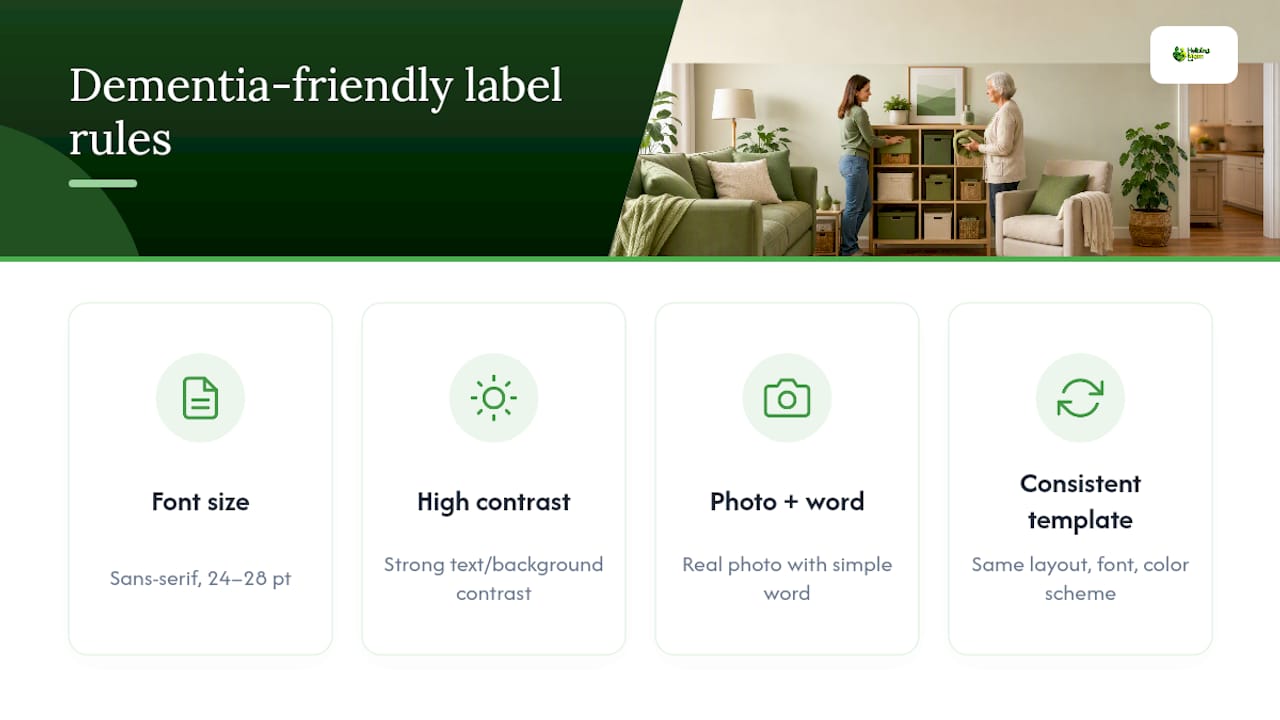
Font and size. Use a plain sans-serif font, sized between 24 and 28 points, so it reads clearly from a few feet away, not just up close. HelpDementia's testing guidance recommends strong contrast between text and background, well beyond typical web accessibility minimums, and suggests checking legibility in the room's actual lighting before committing to a final version. A label that looks crisp under your kitchen's bright overhead light might wash out completely in a dim hallway.

Photos over icons. A real photograph of socks beats a generic sock icon every time. Abstract symbols require interpretation, which is exactly the cognitive step dementia makes harder. Pair the photo with a simple word underneath, since combining image and text consistently outperforms either one alone.
Consistency builds a visual language. Use the same template, the same font, the same color scheme for every label in the house. Over time, your parent starts recognizing the format itself, not just individual words, which speeds up recognition throughout the home.
Granular beats generic. Labeling an entire cabinet "kitchen stuff" doesn't help anyone. A discussion among caregivers on Mayo Clinic Connect points to a better approach: label individual drawers and containers with specific words like "Socks" or "Coffee Mugs" so there's no guessing once the drawer opens.
Matte finish, no glare. Glossy laminate looks nice but reflects light and can make a label unreadable from certain angles. Matte finishes solve this.
A final rule that's easy to forget: don't label everything. A house covered in labels becomes visual noise, and too much text competing for attention defeats the purpose. Focus on the items your parent reaches for daily.
Room-by-Room Labeling Checklist
Here's where to start, in order of impact. Work through this list and you'll cover the spots that cause the most daily friction.
- Bathroom door: the word "TOILET" in large text with a photo, placed at eye level on the outside of the door, not inside where it's only visible once someone's already lost.
- Bathroom cabinet: separate labels for "Toothbrush," "Towels," and "Soap" rather than one label for the whole cabinet.
- Bedroom dresser: individual drawer labels, "Socks," "Underwear," "Shirts," "Pants," so getting dressed doesn't require rifling through every drawer.
- Bedroom closet: a photo label of a favorite outfit or robe on the hanger area, especially helpful for choosing clothes without frustration.
- Kitchen cabinets: "Plates," "Cups," "Cereal" on individual doors, and a clear "Coffee" label on whichever container actually holds it.
- Kitchen appliances: if your parent still uses the microwave or toaster independently, a simple photo label near the "on" button can help, though appliances with multiple settings often warrant a closer look at our kitchen safety guidance for seniors.
- Living room: a label on the remote control's power button if that's a recurring point of confusion, and a photo label on any storage bin holding frequently used items like glasses or a favorite blanket.
- Laundry room: "Detergent" and "Dryer Sheets" on their respective containers, plus a simple photo sequence taped near the machine if your parent still does laundry.
- Entry area: a photo label for keys and a separate one for a coat hook, since these are often the last things touched before heading out.
Placement matters as much as wording. Put labels on the outside of drawers and doors, not inside, and test readability standing at a normal distance, not with your face six inches from the label. Eye level for a seated or standing adult, generally between 48 and 60 inches from the floor, works for most placements.
One category deserves a different approach entirely: anything hazardous. Cleaning chemicals, sharp tools, and medications shouldn't just get a warning label. A broader home safety checklist can help you audit what needs to be locked away or removed rather than simply marked, since a label doesn't stop someone from opening a bottle. For medications specifically, dosing and timing details belong on a schedule you control, with the medication itself kept in a locked or supervised space rather than left out with just a label for identification. Color coding alone becomes unreliable as dementia progresses, so don't lean on it as a safety measure.
How to Label a Home for Dementia in One Afternoon
You don't need a weekend for this. A focused session, roughly two to three hours, is usually enough to cover the highest-priority spots.
- Triage for 30 minutes. Walk the house with a notepad and list the ten spots causing the most confusion right now. A helpful split: three in the bedroom, three in the kitchen, two in the bathroom, two in the living or entry area.
- Photograph the items. Use your phone to snap a clear photo of the actual sock drawer's contents, the actual coffee mug, the actual bathroom door. Real photos of your parent's real belongings work better than stock images.
- Build simple label templates. Pair each photo with a short word in a 24 to 28 point sans-serif font. Keep the same layout across every label.
- Print and test one label first. Before printing all ten, print one and hold it where it'll go. Check it under the room's actual lighting.
- Apply the rest, then observe. Once the format checks out, apply all ten labels and watch how your parent interacts with them over the next 48 to 72 hours.
- Adjust based on what you see. If your parent walks past the sock label without noticing, try a different placement or a slightly larger photo.
Two things make this process sustainable rather than a one-time scramble:
- Save your label templates in a folder (digital or a simple binder) so relabeling later takes minutes, not another full afternoon.
- Set a loose reminder to check labels every few months, since dementia changes over time and wording that worked in the spring may need a photo swap by fall.
Materials and Templates That Won't Break the Bank
You don't need specialty equipment for this. A basic printable sticker paper from any office supply store, run through a home printer, covers most needs. Adhesive photo labels work well for drawers and cabinet doors, while laminated photo cards on a ring or hung near a hook survive better in humid spots like the bathroom or laundry room.
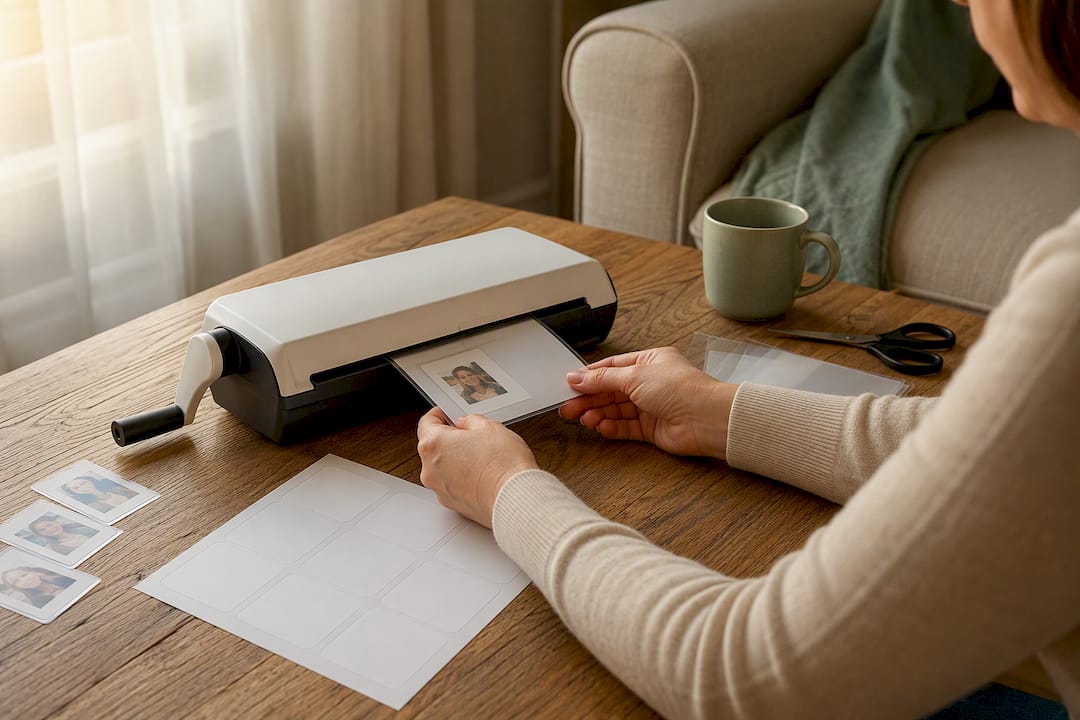
A simple label maker can handle text-only labels, but for anything where a photo genuinely helps, a printed sticker or laminated card beats a label maker's tiny built-in fonts.
Keep these guidelines in mind when sourcing materials:
- Choose matte over glossy finishes to cut down on glare, especially near windows or under bright kitchen lighting.
- Size most labels to fill roughly a third of the drawer front or door panel, large enough to read from a few feet away without overwhelming the surface.
- Pre-made dementia labeling kits can save time if you want something ready-made, but they often use generic icons instead of your parent's actual belongings, which is where custom photo labels tend to work better.
- Avoid tiny handwritten labels or anything printed smaller than 18 point font. They look thoughtful but rarely get read.
When Labeling Stops Working
Labels aren't a permanent fix, and that's worth saying plainly so you don't blame yourself when they stop helping. Watch for these signs that it's time to shift strategy:
- Your parent looks directly at a label and still asks what's in the drawer.
- Confusion happens even in rooms they've lived in for decades, not just new spots.
- They seem to notice the label but can't connect the photo to the object anymore.
When that happens, labeling usually needs a supplement rather than a replacement. Clear storage bins that show contents without reading anything, simplified routines with fewer choices, cabinet locks on hazardous items, and pathway decals guiding someone from bedroom to bathroom at night all pick up where labels leave off. A decluttered environment paired with fewer, better-chosen labels tends to outperform a house full of labels competing for attention. If wandering or nighttime confusion becomes a bigger concern than daytime object recognition, it's worth exploring monitoring options alongside your broader aging in place plan.
Pro Tip: If your parent resists a new label, don't argue about whether it's helpful. Just leave it up for a few days without commentary. Resistance to any visible change is common early on, and it often fades once the label becomes part of the background rather than something new to react to.
A Caregiver's Honest Take on What Actually Moves the Needle
Most advice on dementia and the home skips straight to elaborate systems: color-coded everything, smart home gadgets, full house overhauls. What I've seen matter more is restraint. Ten well-chosen labels, tested and adjusted over a few days, consistently outperform forty labels applied all at once and never revisited.
One family I worked with labeled every single cabinet in the kitchen in one go. Within a week, their mother was more confused, not less, because the sheer volume of new text competing for her attention made the kitchen feel unfamiliar. We stripped it back to five labels: the coffee, the mugs, two food staples, and the trash bin. Confusion dropped almost immediately, and she started making her own coffee again for the first time in months.
Today's 30-minute starter plan: pick three rooms, photograph three to five daily-use items in each, apply large-text photo labels at eye level, and watch for 48 hours before adding anything else. Small and specific beats comprehensive and rushed. A well-placed balance and mobility routine, like the fall-prevention exercises many physical therapists recommend, pairs naturally with this kind of home setup, since a safer, easier-to-navigate house works hand in hand with steadier movement through it.
— Mike C.
Get the Practical Guide and Skip the Guesswork
If you'd rather not build every label from scratch, the Practical Guide: How to Make Home Safer for Seniors gives you room-by-room templates, printable labels sized and formatted the way this article recommends, and a 30-minute starter checklist you can hand to any family member helping with setup. It's built specifically for the afternoon-length project we walked through above, so you're not reinventing fonts and photo sizes on your own.
A short paid Zoom consult is also available if you want a second set of eyes on placement or wording before you commit to a full house. Many families find an hour of guided setup saves several afternoons of trial and error later. Head to the Practical Guide page to see what's included and get started today.
Sources
The guidance above draws on established caregiving and safety resources, not opinion alone. The National Institute on Aging's home safety tips cover signage and eye-level placement in depth. The Alzheimer's Society's review of self-adhesive signs offers firsthand caregiver feedback on what worked in real homes. For font, contrast, and finish specifics, HelpDementia's labeling guide is worth bookmarking as your parent's needs change.
- Alzheimer’s and dementia: caregiving and home safety tips — NIA
- How to Choose Dementia-Friendly Labels — HelpDementia
FAQ
What activities can I do at home with a dementia patient?
Simple, familiar tasks work best: folding laundry, sorting silverware, looking through old photo albums, or watering plants together. Pair these with clearly labeled supply drawers so your parent can locate what's needed without asking.
When should someone with dementia stop living alone?
There's no single trigger date. It typically becomes unsafe when confusion leads to missed medications, unattended stoves, wandering outside, or repeated inability to recognize labeled essentials despite adjustments, which is when a full safety reassessment matters more than another round of labels.
What are some practical tips for dementia caregivers?
Keep routines consistent, reduce choices rather than eliminating them entirely, use labels with photos at eye level in high-traffic rooms, involve your parent in decisions when possible, and expect to adjust your approach every few months as needs shift.
What are common warning signs of dementia?
Signs include memory loss that disrupts daily life, difficulty completing familiar tasks, confusion about time or place, trouble with words, poor judgment, withdrawal from activities, and mood or personality changes. A doctor should evaluate any combination of these rather than a caregiver making that call alone.
Do labels really help someone with dementia stay independent?
Yes, for many people in the mild to moderate stages. Large, high-contrast labels combining a photo and a word, placed at eye level, reduce the memory burden of finding everyday items and let your parent complete more tasks without help.