

Most families only start thinking about long-term care planning after something goes wrong. A fall, a diagnosis, or a sudden decline in health can force urgent, emotional decisions when there is little time to think clearly. Long-term care planning is the ongoing process of anticipating future needs for personal and medical support, estimating realistic costs, and arranging how care will actually be provided and paid for. When you start before a crisis, you give your family more choices, more time, and far less stress. This guide walks you through every major step, from understanding what planning really covers to knowing when to revisit your decisions.
Table of Contents
- What is long-term care planning?
- The five key domains of long-term care planning
- Comparing care settings and costs
- Planning for caregiver support and responsibilities
- Legal preparations and advance directives
- What most families miss about long-term care planning
- Find the right resources to support your caregiving journey
- Frequently asked questions
Key Takeaways
| Point | Details |
|---|---|
| Plan before crisis | Starting early gives families more options and reduces emotional and financial strain. |
| Cover all domains | Effective long-term care planning addresses needs, costs, settings, legal steps, and regular review. |
| Compare care options | Costs and quality vary among in-home care, assisted living, and nursing homes, so benchmark locally. |
| Support caregivers | A family care plan should include backup plans and self-care strategies for caregivers. |
| Update legal documents | Key legal paperwork ensures health and financial decisions are made by trusted people if needed. |
What is long-term care planning?
Many people assume long-term care planning is mainly about buying insurance or updating a will. That is only a small part of the picture. Real planning means looking at the full spectrum of your parent's life: their health trajectory, housing preferences, financial situation, legal protections, and what kind of care they would actually want.
According to AARP's caregiving resource center, a practical approach maps housing, health, and finances together, aligning your parent's choices about where they want to live with their medical wishes and budget before any crisis occurs. This alignment is what makes planning genuinely useful, rather than just a stack of documents sitting in a drawer.
Here is what strong long-term care planning actually covers:
- Health and function: Understanding your parent's current health status and likely future needs
- Housing: Deciding whether aging in place, moving in with family, or transitioning to a care community is most realistic
- Finances: Estimating costs and identifying funding sources like savings, insurance, or benefits programs
- Legal protections: Making sure the right documents are in place so decisions can be made if your parent loses capacity
- Caregiver roles: Defining who does what and how responsibilities will be shared among family members
"Long-term care planning is not a one-time checklist. It is a living process that needs to be revisited as health, finances, and family circumstances change."
The most important shift in thinking is this: planning is not about having all the answers right now. It is about starting the conversation early enough that your parent can participate in their own decisions, and your family is not scrambling in a moment of crisis.
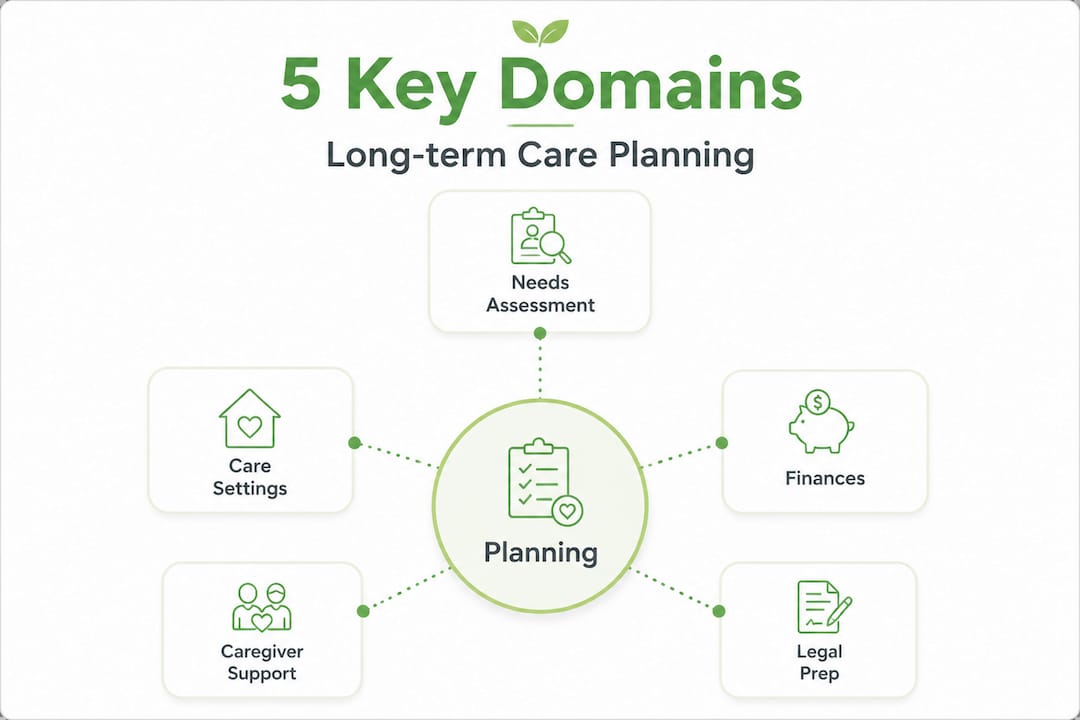
The five key domains of long-term care planning
With the big picture in mind, the next step is understanding each domain of planning and how they work together. A multi-domain and iterative approach is widely recognized as the most effective framework. It helps you treat planning as a connected system rather than a series of isolated tasks.
Here are the five domains to work through:
- Needs assessment: Evaluate your parent's current functional abilities and health conditions. Consider whether they need help with daily tasks like bathing, cooking, or managing medications. Think about what their needs are likely to look like in five or ten years.
- Care setting choice: Decide where care will happen. Options include staying at home with support, moving into an assisted living community, or living with a family member. Your aging in place guide is a useful starting point for families who want to explore keeping a parent at home safely.
- Cost estimation: Research realistic costs for your parent's likely care setting and level of support. Use national data as a baseline but account for local pricing differences, which can be significant.
- Funding and legal preparation: Identify how care will be paid for, whether that is personal savings, long-term care insurance, Medicaid, veterans benefits, or a combination. Make sure legal documents like power of attorney and advance directives are in place.
- Ongoing review: Revisit the plan at least once a year or whenever your parent's health or family situation changes meaningfully.
| Domain | Key action | Why it matters |
|---|---|---|
| Needs assessment | Observe daily function and health trends | Shapes all other decisions |
| Care setting | Evaluate home, community, or family options | Affects quality of life and costs |
| Cost estimation | Research local and national data | Prevents financial surprises |
| Funding and legal prep | Set up documents and funding sources | Protects your parent's wishes |
| Ongoing review | Schedule annual check-ins | Keeps the plan realistic |
Pro Tip: Schedule a family meeting once a year, even if nothing has changed. It keeps everyone aligned and makes updates feel routine rather than urgent.
The five domains interact constantly. For example, your parent's need for memory care (domain one) will affect which care settings are even an option (domain two), which then changes your cost estimates (domain three). Planning in isolation misses these connections.
Comparing care settings and costs
Having grasped the framework, it is time to see how different care settings and their costs shape your decisions. One of the most common surprises for families is just how significant care costs can be, and how quickly they can grow.
Long-term care costs can be benchmarked using Genworth's Cost of Care Survey, which tracks national median rates across all major care types. Importantly, this data also shows that care costs frequently rise faster than general inflation, meaning a plan built on today's numbers can fall short within just a few years.
Here is a simplified look at how the major care settings compare:
| Care setting | National median cost (monthly) | Level of support | Best suited for |
|---|---|---|---|
| In-home aide (part-time) | $2,000 to $3,500 | Basic daily assistance | Early to mid-stage needs |
| In-home aide (full-time) | $5,000 to $7,500+ | Intensive daily support | Advanced needs at home |
| Assisted living community | $4,500 to $6,000 | Personal care and housing | Moderate to high support needs |
| Memory care community | $5,500 to $8,000+ | Specialized dementia care | Cognitive decline requiring structure |
| Nursing home (semi-private) | $8,000 to $10,000+ | 24-hour skilled care | High medical or physical needs |
Note: These figures are national medians. Costs in major metro areas or high cost-of-living regions can be significantly higher. Always get local quotes.
A few important points to keep in mind as you use these numbers:
- Location matters enormously. Care in rural areas may cost 30 to 50 percent less than in major cities. Research rates in your parent's specific region.
- Costs can escalate over time. A parent who starts with part-time help may need full-time support within a few years as health changes.
- Quality of life is part of the equation. The least expensive option is not always the best fit for your parent's social, emotional, and physical well-being.
- Understand what is included. Assisted living costs often do not cover medications, specialized therapies, or added personal care services.
Understanding what assisted living really means for your parent, including what daily life looks like and what services are genuinely included, can save you from surprises after a move has already happened.

Planning for caregiver support and responsibilities
While budgeting and care settings are vital, families often underestimate the human challenges of being a caregiver. The focus tends to land on the person receiving care, but the experience of the caregiver matters just as much for the plan to actually work.
Caregiving planning must also address caregiver responsibilities and support, including how to get help, share the workload fairly, and maintain the caregiver's own health. When families skip this part, the most dedicated caregiver often ends up overwhelmed and isolated.
Here is what thoughtful caregiver planning looks like:
- Share the responsibilities. Even if one sibling lives closest to a parent, others can contribute financially, handle scheduling, or manage research and appointments remotely.
- Build a local support network. Identify neighbors, faith community members, or local senior services that can step in for transportation, companionship, or emergency help.
- Create a backup plan. What happens if the primary caregiver becomes ill, needs to travel, or is dealing with their own family demands? A backup caregiver or respite care arrangement should be identified in advance.
- Know the warning signs of burnout. Exhaustion, resentment, social withdrawal, difficulty sleeping, and feeling like there is no end in sight are all signals that a caregiver needs more support.
- Prioritize your own health. Caregivers who neglect their own medical appointments, sleep, and social connection are less effective and more likely to reach a breaking point.
Exploring caregiver well-being resources early, rather than waiting until you feel burned out, makes a meaningful difference. The goal is sustainable caregiving, not heroic caregiving.
Pro Tip: Write out a simple responsibility list with your siblings or family members before care becomes intensive. Deciding in advance who handles what prevents resentment and gaps in care later.
If you are just starting to think through what supporting an aging parent actually involves day to day, these practical steps for families offer a grounded starting point for the conversations ahead.
Legal preparations and advance directives
Finally, strong legal planning ties together your practical and emotional efforts around care. Many families feel uncomfortable starting legal conversations, worried it will seem presumptuous or upsetting to a parent. In reality, these documents are a gift. They protect your parent's wishes and protect you from having to make impossible decisions without guidance.
Legal documents and advance directives are a central part of long-term care planning because they ensure the right people can act on health and financial decisions if your parent's capacity declines. Without these in place, families can face court proceedings and painful disagreements during an already difficult time.
Here are the key documents to prioritize:
- Durable power of attorney (financial): Gives a trusted person legal authority to manage financial matters if your parent becomes unable to do so.
- Healthcare proxy (medical power of attorney): Designates someone to make medical decisions if your parent cannot speak for themselves.
- Living will (advance directive): Documents your parent's wishes for end-of-life care, including resuscitation preferences and life-sustaining treatment decisions.
- POLST or MOLST form: A medical order (different from a living will) that travels with your parent and gives specific instructions to healthcare providers.
- Updated beneficiary designations: Check that retirement accounts, life insurance policies, and bank accounts are designated correctly, as these pass outside of a will.
"Having these documents in place before a health crisis means your parent's voice is heard even when they can no longer speak for themselves. That clarity is one of the most meaningful things a family can offer."
Action steps for your legal planning:
- Ask your parent if any of these documents already exist, and where they are stored.
- If documents do not exist or are outdated, connect with an elder law attorney who can guide you through state-specific requirements.
- Store copies in a secure but accessible location, and make sure key family members and your parent's primary doctor have copies.
- Review documents every two to three years or after any major health change or family event.
What most families miss about long-term care planning
Here is something most planning guides will not tell you. The families who navigate long-term care most successfully are not the ones with the most thorough spreadsheets or the most expensive plans. They are the ones who stay flexible and keep talking.
Most adult children approach planning as a project to be completed. Once the documents are signed and the finances are mapped out, they feel a sense of relief and move on. But a parent's needs rarely follow a predictable path. Health changes, family circumstances shift, and what seemed like the right care setting two years ago may no longer fit.
A long-term care plan only works if it is treated as a living document you return to regularly, not a binder you file away. The families who do this well hold regular conversations, not just formal reviews. They check in about how a parent is actually feeling about their living situation. They update siblings when something shifts. They ask questions before a crisis forces an answer.
There is also an emotional side that practical planning often misses. When families stop talking about long-term care after the initial planning phase, resentments can build quietly. The sibling who does more starts to feel unacknowledged. The parent who never wanted to be a burden starts to feel like one. Honest, ongoing conversation prevents these dynamics from becoming entrenched.
Equally important is planning for the caregiver, not just the care recipient. As noted, the primary caregiver's capacity can change due to illness, burnout, or distance. A plan without a backup is one health event away from falling apart. Building in contingency from the start, rather than hoping it will not be needed, is one of the wisest things you can do.
If you want to go deeper on any aspect of your family's plan, our complete caregiving guides walk through each area in detail.
Find the right resources to support your caregiving journey
Putting a long-term care plan into action is easier when you have the right tools beside you. At Helping Mom, we have built practical, calm resources designed specifically for adult children navigating this process. Whether you are just starting out or refining a plan that is already underway, you will find clear guidance without the overwhelm.
Start with our elderly home safety checklist to make sure your parent's current living space supports their safety and independence. If burnout or caregiver stress is something you are already feeling, our caregiver well-being resources offer honest, practical support. And for families thinking about keeping a parent at home as long as possible, our aging in place home safety guide covers what to assess, what to modify, and how to plan ahead with confidence.
![CTA image for caregiving resources]
Frequently asked questions
When should we start long-term care planning for our parents?
The best time to start is well before a health crisis arises, because early planning aligns housing, health, and finances before pressure forces a rushed decision. Starting early also allows your parent to be an active participant in decisions about their own care.
Are there ways to estimate how much long-term care will cost?
Yes. The Genworth Cost of Care Survey provides national median rates across different care settings, though local costs can vary significantly, so always verify rates in your parent's specific area.
What legal documents are most important for long-term care planning?
A durable power of attorney, healthcare proxy, and living will are the core documents, as they ensure the right people can make health and financial decisions if your parent's capacity declines.
How can caregivers avoid burnout when managing care for an aging parent?
Sharing responsibilities, building a support network, and maintaining your own health are the most effective protections against burnout, along with recognizing early warning signs before they become a crisis.
Recommended
- How to Support Aging Parents: Practical Steps for Families | Helping Mom LLC
- Aging in Place Resource Hub - Helping Mom LLC
- Non-Medical Home Care: A Practical Guide for Families | Helping Mom LLC
- Elder Care for Parents - Comprehensive Caregiving Guide | Helping Mom LLC
- Home-Based Long Term Care - Vivid Care Services