

TL;DR:
- Engaging in simple at-home exercises can improve balance, strength, flexibility, and endurance for older adults. Regular practice and environmental modifications help maintain independence and prevent falls in the home. Tracking progress and integrating routines into daily life encourage sustained mobility and safety.
If your parent is moving more carefully around the house, holding walls for balance, or skipping trips to certain rooms, these are the exercises that can genuinely help. The ten movements below target the four areas that matter most for safe indoor movement: strength, balance, flexibility, and endurance. Each one can be done at home, with no equipment beyond a sturdy chair.
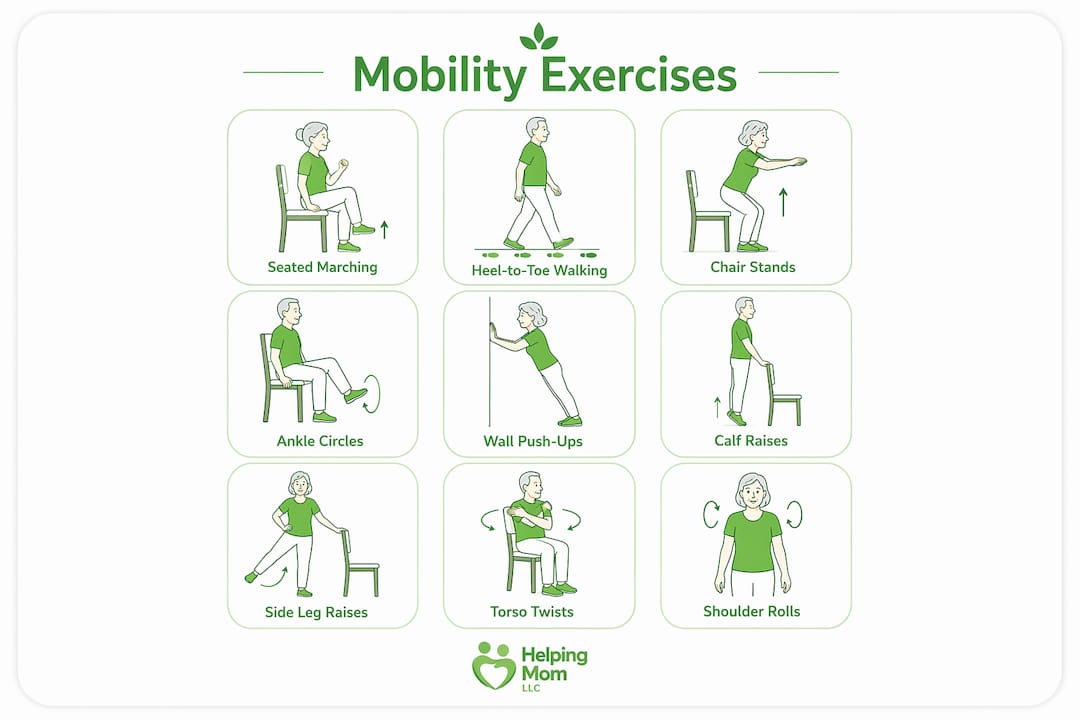
Here is a quick overview of the exercises covered in this guide:
- Seated marching — builds hip flexor strength and gets the blood moving without standing risk
- Heel-to-toe walking — trains the balance system used every time your parent walks a hallway
- Chair stands (sit-to-stand) — the single most functional lower-body exercise for daily independence
- Ankle circles — restores ankle mobility, which directly affects fall risk on uneven surfaces
- Wall push-ups — builds upper-body strength for pushing up from chairs or counters
- Calf raises — strengthens the lower leg muscles that stabilize every step
- Side leg raises — targets the hip abductors that keep gait steady and reduce sway
- Seated torso twists — improves spinal rotation needed for reaching and looking behind
- Shoulder rolls — releases tension and maintains shoulder range of motion for dressing and reaching
- Gentle neck stretches — supports the head control needed for safe balance and spatial awareness
All of these can be modified for different ability levels, and none require getting down on the floor. If your parent has a specific condition like osteoarthritis, check with their doctor or physical therapist before starting.
How to do each mobility exercise safely and correctly
Working through these exercises one at a time, with clear form cues, makes the difference between a habit that sticks and one that causes strain.
1. Seated marching
Sit tall in a firm chair with feet flat on the floor. Lift one knee toward the chest, hold for two seconds, then lower slowly. Alternate legs for 10 repetitions each. Breathing stays steady throughout. This exercise warms up the hip flexors and gets circulation moving before standing exercises begin.

Modification: If lifting the knee high causes discomfort, a small lift of just a few inches still activates the muscles.
2. Heel-to-toe walking
Stand near a wall or countertop for support. Place one foot directly in front of the other so the heel of the front foot touches the toes of the back foot. Walk forward for 10 steps, then turn carefully and return. This is the same movement physical therapists use to assess balance, and it trains the exact coordination needed for hallway walking.
Modification: Hold the wall lightly with one hand. Reduce to 5 steps if 10 feels unsteady.
3. Chair stands (sit-to-stand)
Sit at the front edge of a firm chair, feet hip-width apart. Lean slightly forward, then press through the heels to stand. Lower back down slowly and with control. Aim for 8–10 repetitions. This movement builds the quadriceps and glutes that make getting up from a toilet, car seat, or sofa possible without assistance.
Modification: Place hands on the armrests for the first few weeks. Remove hand support gradually as strength improves.
4. Ankle circles
Seated with one foot lifted slightly off the floor, rotate the ankle slowly in a full circle, 10 times clockwise and 10 times counterclockwise. Switch feet. Stiff ankles are a quiet contributor to falls because they reduce the body's ability to self-correct on uneven ground.
5. Wall push-ups
Stand facing a wall, arms extended at shoulder height with palms flat on the wall. Bend the elbows to bring the chest toward the wall, then push back. Keep the body in a straight line throughout. Ten repetitions is a solid starting point. Upper-body strength supports transfers, pushing up from chairs, and steadying against counters.
Modification: Step closer to the wall to reduce the load; step farther away to increase it.
6. Calf raises
Stand behind a chair, holding the back lightly for balance. Rise up onto the balls of both feet, hold for two seconds, then lower slowly. Repeat 10–15 times. Strong calves act as a pump for circulation in the lower legs and provide the push-off power needed for each step.
Modification: Perform seated with feet pressing into the floor if standing balance is limited.
7. Side leg raises
Stand behind a chair, holding the back for support. Lift one leg out to the side, keeping the toes pointed forward and the body upright. Hold briefly, then lower. Ten repetitions per side. The hip abductors targeted here are the muscles that prevent the sideways stumble that often precedes a fall.
8. Seated torso twists
Sit tall with arms crossed over the chest. Rotate the upper body slowly to the right, hold for two seconds, then return to center and rotate left. Repeat 8 times per side. This movement maintains the spinal rotation needed for everyday tasks like checking traffic before crossing a room or reaching across a table.
9. Shoulder rolls
Sitting or standing, roll both shoulders forward in a slow circle five times, then reverse direction. This takes under a minute and releases the tension that builds from gripping walkers or armrests. It also maintains the shoulder mobility needed for dressing independently.
10. Gentle neck stretches
Sitting tall, slowly tilt the right ear toward the right shoulder. Hold for 10 seconds, return to center, then repeat on the left. Follow with a slow chin-to-chest drop and return. Never rotate the neck forcefully. Good neck mobility supports the head-turning needed to check surroundings before moving, which is a real safety factor indoors.
A note from physical therapists: The American Physical Therapy Association recommends that adults with balance concerns or recent falls have a professional movement assessment before beginning a new exercise program. A physical therapy evaluation can identify specific weaknesses and tailor exercises to your parent's exact needs, which generic guides cannot do.
How to track progress and keep the routine going
Consistency matters more than intensity. A five-minute daily practice will produce more change over two months than an ambitious session done twice a week.
Simple ways to measure progress:
- Count how many chair stands your parent can complete before needing a rest, and note it weekly
- Time the heel-to-toe walk and watch whether confidence increases even if the time stays the same
- Ask your parent to rate their steadiness on a simple 1–10 scale after each session
- Note which rooms they are willing to walk to independently, since avoidance is a real mobility signal
Building the routine into daily life:
- Attach seated exercises to an existing habit, like morning coffee or the evening news
- Keep a simple paper checklist on the refrigerator so completion feels visible and satisfying
- Use a free app like Apple Health or Google Fit to log activity if your parent is comfortable with technology
- Aim for five days a week, with two rest days to allow muscle recovery
Pro Tip: Set one small, specific goal for the first two weeks, such as completing chair stands three mornings in a row. Celebrating that milestone, even quietly, builds the confidence to keep going.
Rest is part of the program. Soreness that fades within a day is normal. Pain that lingers or worsens is a signal to pause and check with a doctor or physical therapist before continuing.
Understanding common indoor mobility challenges and their impact
Most people think of falls as the main concern, and they are serious. Falls send an estimated 2.9 million adults aged 65 and older to U.S. hospitals every year due to injuries at home, with falls as the main hazard. But the daily reality of indoor movement difficulties is often quieter than a fall. It shows up as your parent taking a longer route to avoid the bathroom step, or sitting down more often than they used to during simple tasks.
A 2025 systematic review of 1,833 older adults identified four main indoor mobility challenges: fatigability, poor balance, environmental barriers, and reduced strength or limb weakness. These four factors rarely appear alone. They compound each other, and together they shrink the space your parent feels safe moving through.
The four challenges, up close:
- Fatigability: Approximately one in four older adults report fatigue during indoor movement, with higher rates among those managing multiple health conditions. Slowing down to conserve energy is a rational response, but it also reduces the activity that builds endurance.
- Poor balance: About one-third of older adults report a fear of falling, which itself reduces mobility by causing them to move less and grip more. Fear of falling is not irrational. It is a signal worth taking seriously.
- Environmental barriers: Falls account for more than half of all product-related emergency room visits among adults aged 65–74, and more than three-quarters for those 75 and older. Loose rugs, dim hallways, and furniture placed in walking paths are common contributors. Standard interior doorways are often too narrow for wheelchair clearance, blocking access to bedrooms and bathrooms in ways families do not notice until a mobility aid enters the picture.
- Reduced strength: Leg muscle loss is a gradual process that affects walking speed, stair climbing, and the ability to recover from a stumble before it becomes a fall.
There is also a perception gap worth knowing about. Research from the Harvard Joint Center for Housing Studies found that most older adults rate their homes as meeting their accessibility needs well, even when basic features like a step-free entry or a first-floor bathroom are missing. Nearly 11% of older adult households report difficulty using their home, rising to about 24% among those aged 80 and over. Your parent may genuinely feel fine at home while quietly adapting around limitations they have stopped noticing.
Watch for behavioral signs: avoiding certain rooms, always sitting near the wall, or pausing longer before standing. These patterns often appear before a fall does. A home safety assessment by an occupational or physical therapist can identify specific risks and recommend personalized changes that generic checklists miss. Simple modifications costing $500–$1,500, like removing throw rugs and adding grab bars, can reduce hazards immediately without major renovation.
For a room-by-room look at what to address, Helping-mom's aging in place modifications guide walks through practical changes you can make alongside your parent at whatever pace works for your family.
If you want a broader starting point for home safety, Helping-mom's practical guide to making home safer for seniors covers the full picture, from grab bars to lighting to assistive devices, in the same calm, step-by-step format.
Key Takeaways
Consistent, targeted home exercises combined with simple environmental changes give aging adults the best chance of staying mobile and independent indoors.
| Point | Details |
|---|---|
| Start with chair-based exercises | Seated marching and chair stands build strength safely without standing balance risk. |
| Track progress simply | Weekly chair stand counts and a 1–10 steadiness rating reveal real gains over time. |
| Four core indoor challenges | Fatigability, poor balance, environmental barriers, and reduced strength compound each other. |
| Falls are widespread | An estimated 2.9 million adults 65 and older are treated in U.S. hospitals annually from home-related falls. |
| Low-cost changes reduce risk fast | Home modifications costing $500–$1,500, like grab bars and rug removal, cut hazards without major renovation. |
FAQ
What is the best exercise for people with mobility issues?
Chair stands (sit-to-stand) are widely recommended by physical therapists because they build the exact leg strength needed for daily tasks like rising from a toilet or car seat. Heel-to-toe walking is a close second for improving balance directly.
What are 2-minute mobility exercises someone can do at home?
Ankle circles, shoulder rolls, and seated torso twists each take under two minutes and can be done from a chair. Stringing all three together makes a quick morning routine that covers flexibility and joint mobility without any standing required.
What is the 3-3-3 rule for exercise?
The 3-3-3 rule is not a formally established clinical standard, so definitions vary. A common version used in rehabilitation settings suggests exercising three times per day, three days per week, or for three sets of a movement. Check with a physical therapist for a version tailored to your parent's specific condition.
When should my parent see a physical therapist about mobility?
A physical therapist visit is worth scheduling after any fall, after a new diagnosis affecting movement, or when your parent starts avoiding rooms or activities they used to manage easily. The National Institute on Aging recommends a professional home safety assessment after a fall to identify specific risks and personalized solutions.
How do I help my parent stay motivated to do these exercises?
Attach exercises to an existing daily habit, keep a visible checklist, and acknowledge small wins. Motivation tends to follow visible progress, so tracking something concrete, like how many chair stands they can complete, gives your parent a reason to keep going.