

TL;DR:
- Respecting parents' independence involves honoring their decision-making rights, even when disagreements occur.
- Balancing safety with autonomy requires using the least restrictive options and involving them in decisions to maintain dignity and trust.
Respecting parents' independence is defined as honoring your aging parent's right to make their own decisions, even when you disagree with those choices. This is not a passive stance. It is an active commitment to treating your parent as a capable adult whose dignity matters as much as their safety. Adult children often step into caregiving with the best intentions, yet the shift from helper to controller can happen quietly. Understanding where that line sits, and how to stay on the right side of it, protects both your parent's wellbeing and your relationship with them.
Why does autonomy matter so much for aging parents?
Autonomy is a core part of senior identity. The ability to make small daily choices, from what to eat for breakfast to which doctor to see, is directly linked to dignity and self-worth. When those choices are taken away, even with loving intent, the emotional cost is real.
Seniors who maintain choice autonomy have better mental health outcomes, lower rates of depression, and often better physical health. That connection between decision-making and wellbeing is not coincidental. Feeling in control of your own life is one of the most fundamental human needs, and it does not disappear at age 70 or 80.
When an adult child takes over decisions "for their parent's own good," they often trigger grief, not gratitude. Resistance to help frequently stems from a parent mourning their lost independence, not stubbornness. Responding to that grief with compassion, rather than frustration, changes everything about how the conversation goes.
Overcontrol also carries a legal dimension worth knowing. Age alone does not remove decision rights without a formal medical determination of incapacity. Until that threshold is reached, your parent retains the legal right to make their own choices, including ones you find risky. Honoring parental autonomy is not just emotionally wise. In most cases, it is also legally required.
How do you balance safety concerns with honoring independence?
Safety and independence are not opposites. The goal is to find the least restrictive path to keeping your parent safe while leaving as much control in their hands as possible.
Here is a practical framework for that balance:
- Start with observation, not intervention. Notice what your parent can still do well before focusing on what they cannot. Strengths matter.
- Raise concerns during calm moments. Crisis conversations about care decisions are unproductive. A quiet Tuesday afternoon is a better time than the middle of an emergency.
- Involve a neutral third party when needed. A geriatric care manager, family doctor, or social worker can raise safety concerns in a way that feels less like an attack on your parent's competence.
- Respect a refusal of help when capacity is intact. If your parent understands the risks and still says no, that is their right. Your role is to make sure they have good information, not to override their answer.
- Adapt the environment before restricting behavior. A grab bar in the bathroom, better lighting in the hallway, or a safer home setup reduces risk without removing freedom.
Pro Tip: Frame safety conversations around your feelings, not their limitations. "I worry when the stairs are dark" lands very differently than "You're going to fall."
The key shift is moving from "How do I stop this from happening?" to "How do I make this safer while keeping Mom in charge?" That reframe changes the entire tone of caregiving.

How do you set healthy boundaries between adult children and aging parents?
Boundaries in caregiving are not about pulling away. They are about defining where your responsibility ends and your parent's begins, so that both of you can show up with energy and respect rather than resentment.
Clear boundaries improve family communication, reduce conflict, and protect emotional wellbeing without weakening family ties. The families who struggle most are often the ones who never named their limits out loud. Unspoken expectations become silent grievances.
Setting boundaries that actually hold requires a few concrete steps:
- Name what you can realistically offer. Be honest about your time, finances, and emotional capacity. Overpromising leads to burnout, and burnout leads to resentment.
- Separate your role from your parent's choices. You can provide information and support without being responsible for the outcome of every decision your parent makes.
- Limit financial entanglement early. Decide in advance what financial support, if any, you are able to give, and communicate it clearly before a crisis forces the conversation.
- Protect your own relationships. Your marriage, your children, and your friendships need tending too. Caregiving that consumes everything else is not sustainable.
- Revisit boundaries as needs change. What works at 75 may not work at 85. Build in regular check-ins with yourself and your siblings about whether the current arrangement still fits.
Setting boundaries protects relationships from burnout and shifts interactions from obligation to genuine connection. That shift matters enormously for the long term. You can read more about this at Helping-mom's guide to setting boundaries with aging parents.
Practical ways to support parents' choices without taking control
Supporting your parent's choices means staying in the role of supporter, not manager. The distinction sounds simple, but it is easy to slip across that line without noticing.
Parents who act as managers rather than supporters cause the people they love to pull away. The same dynamic applies in reverse. When adult children manage aging parents like projects, treating every conversation as a problem to solve, parents disengage, resist, or simply stop sharing what is really going on.
The table below shows the difference between a controlling approach and a supporting one in everyday caregiving situations.
| Situation | Controlling approach | Supporting approach |
|---|---|---|
| Doctor's appointment | Schedule it and tell them when to be ready | Ask which day works and offer to drive |
| Home modifications | Install grab bars without asking | Show options and let them choose placement |
| Meal planning | Decide what they should eat | Ask what they enjoy and suggest additions |
| Social activities | Sign them up for a program | Share options and let them decide |
| Hiring a caregiver | Choose someone and announce it | Interview candidates together |
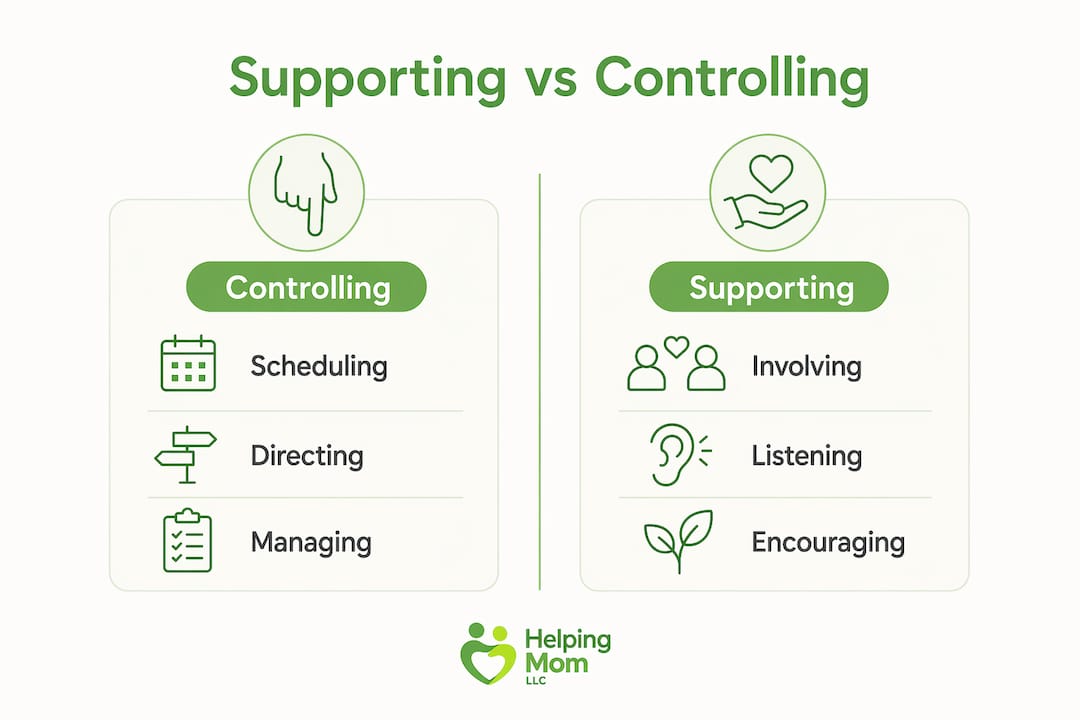
Involving parents in small decisions preserves dignity and creates a sense of agency that directly supports mental health. The goal is not to hand over all responsibility. It is to make sure your parent feels like the author of their own life, not a passenger in it.
Pro Tip: When your parent pushes back on help, pause before responding. Ask yourself: "Is this actually unsafe, or does it just make me uncomfortable?" The answer often changes what you do next.
Nurturing parents' self-reliance also means celebrating what they can still do. Focusing only on decline misses the full picture. Many older adults manage finances, maintain friendships, cook meals, and contribute meaningfully to their communities well into their 80s. Noticing and naming those strengths out loud reinforces their confidence and yours. For more practical ideas, Helping-mom's guide on supporting senior independence at home is a good next step.
The autonomy paradox in caregiving is this: true support feels like freedom, not structure. When your parent feels genuinely in charge of their decisions, they are more likely to accept help when they actually need it. Control, even well-meaning control, closes that door.
Key Takeaways
Respecting parents' independence requires honoring their right to make daily choices, setting clear boundaries, and shifting from a managing role to a supporting one.
| Point | Details |
|---|---|
| Autonomy protects wellbeing | Seniors with decision-making control have better mental health and lower depression rates. |
| Safety and freedom coexist | Use least-restrictive interventions and adapt environments before restricting behavior. |
| Boundaries reduce burnout | Naming limits early protects relationships and keeps caregiving sustainable long-term. |
| Support, do not manage | Involve parents in all decisions affecting them, from caregiver choice to daily schedules. |
| Calm conversations work better | Raise safety concerns during quiet moments, not during crises, to preserve trust and dignity. |
What I have learned from watching families get this right and wrong
I have seen adult children do everything right on paper and still damage their relationship with a parent. They researched care options, arranged appointments, and set up safety equipment. What they missed was asking their parent what they actually wanted.
The families who get this right share one habit: they ask before they act. Not "Do you need help?" but "What would feel most helpful to you right now?" That small shift in phrasing signals respect. It tells your parent that their answer matters, that you are not just going through the motions of consulting them before doing what you planned anyway.
Healthy family interdependence with clear responsibility boundaries improves emotional wellbeing and reduces conflict. I believe that, but I also know it requires ongoing effort. Boundaries drift. Roles blur. The parent who was fiercely independent at 74 may need more support at 79, and that transition deserves a real conversation, not a quiet takeover.
The hardest part of this work is sitting with uncertainty. You cannot guarantee your parent's safety. You can only offer good information, a safe environment, and your presence. Sometimes that has to be enough. Caregiver burnout is real, and it often starts with the belief that you are solely responsible for outcomes you cannot fully control. Protecting your own wellbeing is not selfish. It is what makes sustained, loving care possible. You can find support for that side of caregiving at Helping-mom's caregiver wellbeing resources.
Walking beside your parent, rather than ahead of them, is the whole practice. Some days you will get it right. Some days you will slip into fix-it mode. What matters is that you keep coming back to the question: "Whose life is this, and whose choice should it be?"
— Mike C.
Practical resources from Helping-mom for families navigating this
Helping-mom exists to make this part of caregiving less confusing and more manageable. If you are working through how to keep your parent safe at home while preserving their freedom, the home safety guide for seniors walks you through practical, low-disruption changes that your parent can be part of choosing. For families thinking longer-term, the aging in place resource hub covers everything from home modifications to family conversations. These resources are built for adult children who want real guidance, not generic checklists. Helping-mom also offers a caregiver's role guide that helps you define your role clearly so you can show up with confidence and care.
FAQ
What does respecting parents' independence actually mean?
Respecting parents' independence means honoring your aging parent's right to make their own decisions, including ones you disagree with, as long as they have the capacity to understand the consequences. It is the foundation of dignified caregiving.
When is it appropriate to step in and override a parent's choice?
Overriding a parent's choice is appropriate only when there is an immediate safety risk and a medical determination of incapacity has been made. Age alone does not remove decision rights without that formal determination.
How do I talk to my parent about safety without starting a fight?
Raise safety concerns during calm, non-crisis moments rather than in the middle of an emergency. Crisis conversations about care decisions are consistently unproductive and damage the trust you need for long-term cooperation.
Why does my parent resist help even when they clearly need it?
Resistance to help often stems from grief about lost independence, not stubbornness or denial. Understanding that emotional layer helps you respond with patience rather than frustration.
How do boundaries help me be a better caregiver?
Clear boundaries protect you from burnout and keep your interactions with your parent grounded in genuine care rather than obligation. Families with early, clearly communicated boundaries report less conflict and stronger emotional connection over time.