
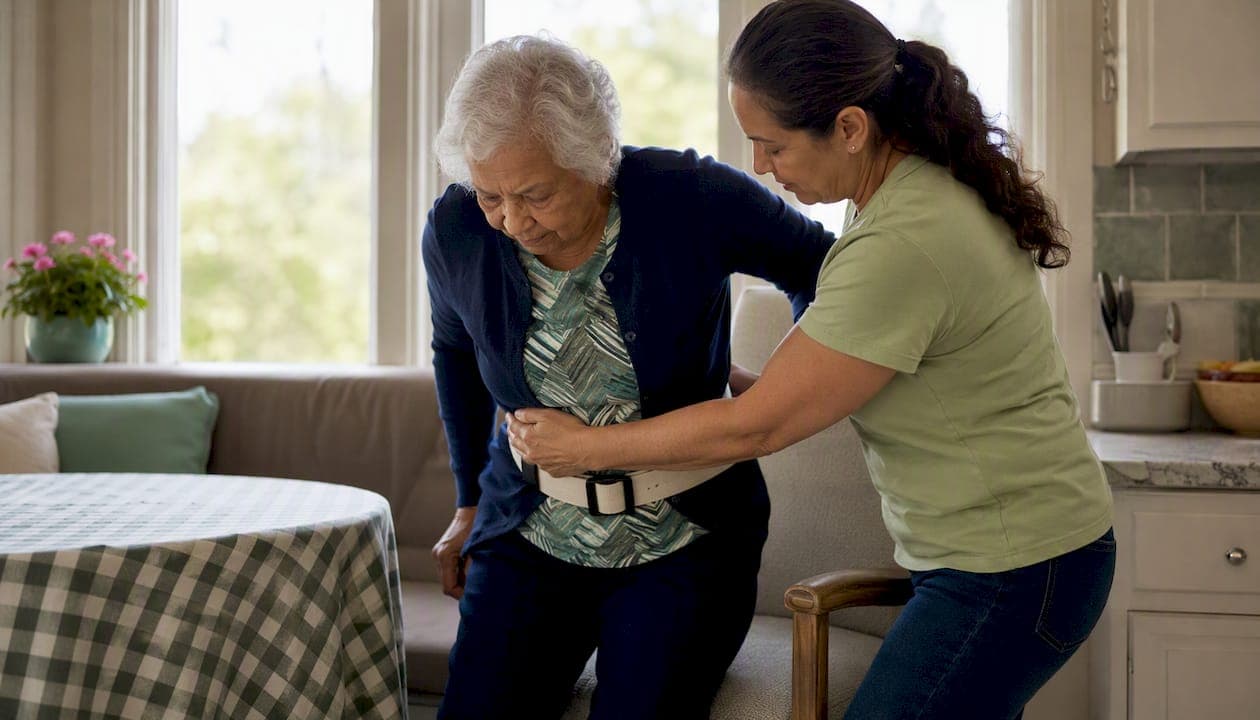
If you need to move your parent right now, pause first and run this three-part check: Can they bear some weight on their feet? Can you keep your back straight without straining? Is the path clear and the chair or bed locked? If all three are yes, proceed with a guided, assisted stand. If any answer is no, stop and get help before moving them.
Quick decision checklist:
- Can the senior put at least some weight through their legs?
- Is your path clear of rugs, cords, and furniture?
- Is the bed, wheelchair, or chair locked or braced against a wall?
- Do you feel physically ready, with no back pain or fatigue right now?
Immediate do's and don'ts:
- Do lock wheelchair brakes and lower the bed before starting.
- Do wear non-slip shoes and ask your parent to do the same.
- Don't let your parent grab your neck or pull on your arms.
- Don't attempt a lift alone if they are fully dead weight.
- Do call a second person or use a gait belt when in doubt.
Pro Tip: Before you say "okay, let's go," agree on a shared signal, such as "on three." That one-second pause prevents the jerky, reflexive movements that cause most acute transfer injuries.
Key Takeaways
Safe lifting for seniors requires a three-part check before every transfer, consistent body mechanics, the right assistive device for the mobility level, and hands-on training when transfers happen frequently.
| Point | Details |
|---|---|
| Run the three-part check first | Confirm weight-bearing ability, caregiver readiness, and a clear environment before every transfer. |
| Use legs, not your back | Bend at hips and knees, keep your parent close, and pivot your feet to change direction. |
| Match the device to the need | Use a gait belt for partial weight-bearing; escalate to a sit-to-stand or Hoyer-style lift when they cannot assist. |
| Call 911 on red flags | Do not attempt to lift after a fall if there is head, neck, or back pain, loss of consciousness, or visible deformity. |
| Helping-mom supports your plan | Zoom consultations and in-person assessments (Central Florida) help you choose techniques, devices, and home modifications. |
Table of Contents
- How to assess the situation before any safe transfer
- Core body mechanics every caregiver should know
- Step-by-step guidance for common home transfers
- What to do when a senior has fallen
- Which assistive devices make transfers safer?
- When should you get professional training or outside help?
- What the research says about manual lifting risks
- Why caregiver fitness matters as much as technique
- A perspective on asking for help
- How Helping-mom can support your transfer safety plan
- Sources
- FAQ
How to assess the situation before any safe transfer
Taking sixty seconds to assess before you move anyone is one of the most protective things you can do, for both of you.
Environment checklist:
- Clear a straight path between the starting and ending point.
- Remove throw rugs, cords, and any furniture in the way.
- Check lighting; turn on a lamp if the room is dim.
- Lock wheelchair or walker brakes; brace a regular chair against the wall.
- Adjust bed height so your parent's feet rest flat on the floor when sitting on the edge.
Senior status checklist:
- Are they alert and able to follow simple instructions?
- Do they have pain anywhere, especially in the hips, knees, or back?
- Have they fallen or been injured in the last 24 hours?
- Are they wearing non-slip footwear, not socks alone?
- Note that medications can change mobility hour to hour; check medication side effects if their steadiness seems different than usual.
Caregiver self-check:
- Is your back, shoulder, or knee bothering you today?
- Can you bend at the hips and knees without pain?
- Are you wearing supportive, closed-toe shoes with non-slip soles?
Once you've run through these, decide: proceed alone, call a second person, or use a device. CaregiverAction's guidance is clear that environment prep and communication are as protective as any technique.
Pro Tip: A quick home safety walkthrough once a month catches hazards before they become emergencies. Five minutes of prevention beats a fall every time.
Core body mechanics every caregiver should know
The single most important rule: use your legs, not your back. Keep your parent close to your body, and pivot your feet instead of twisting your spine. Those three principles, applied consistently, prevent the majority of caregiver back, neck, and shoulder injuries.
Step-by-step technique:
- Stand with feet shoulder-width apart, one foot slightly in front of the other for stability.
- Bend at the hips and knees, not at the waist. Your back stays long and neutral.
- Tighten your core muscles before you begin to move.
- Position your parent as close to your body as possible before initiating movement.
- Initiate the lift by straightening your legs, not by pulling with your arms or rounding your back.
- Move in one smooth, controlled motion. No jerking.
- To change direction, pivot your feet. Never rotate your spine while holding weight.
The AAOS recommends keeping your head and spine aligned, engaging your core, and bending at the hips and knees rather than the waist. These principles reduce strain on the structures most vulnerable to caregiver injury.
Body mechanics work only when the environment supports them. A locked chair, a clear path, and the right footwear matter as much as your posture. Technique alone cannot compensate for a slippery floor or a bed at the wrong height.
Do's and don'ts:
- Do keep your elbows close to your sides throughout the move.
- Do ask your parent to lean forward and push through their feet when standing.
- Don't reach forward or away from your body to grab them.
- Don't allow them to pull on your neck or shoulders.
- Don't rush. A slow, steady pace gives both of you time to adjust.
Footwear and clothing: Both you and your parent should wear supportive, closed-toe, non-slip shoes. Loose robes, long nightgowns, or socks on hardwood floors increase fall risk significantly. Dress your parent in fitted clothing before any planned transfer.
Pro Tip: If you find yourself holding your breath during a transfer, you've lost core stability. Breathe out steadily as you lift or lower. It keeps your core engaged and signals to your body that this is a controlled movement, not an emergency.
Step-by-step guidance for common home transfers
Bed to chair (and back)
Readiness check: Bed at a height where feet rest flat on the floor. Chair or wheelchair positioned at a 45-degree angle to the bed, brakes locked.
- Help your parent roll to their side, then push up to sitting on the edge of the bed.
- Let them sit for 30 seconds. Dizziness on standing is common and dangerous.
- Place their feet flat on the floor, slightly behind their knees.
- Stand in front of them, feet shoulder-width apart, knees slightly bent.
- Ask them to lean forward ("nose over toes") and push through their feet as you guide them up.
- Once standing, pivot your feet together toward the chair. Do not twist.
- Ask them to feel the chair seat behind their legs before lowering slowly.
The step-by-step approach of guiding forward momentum rather than lifting upward keeps the senior contributing to the move and reduces the load on you.
Common mistake: Pulling them straight up by the arms. Guide the forward lean instead.
Chair to toilet and bathroom transfers
Bathroom transfers carry extra risk because of tight spaces and wet floors. A transfer bench lets your parent slide sideways onto the toilet seat without a full stand, which is safer when balance is poor.
A raised toilet seat reduces the depth of the lower, making it easier for both of you. Position the wheelchair or walker parallel to the toilet, lock brakes, and follow the same forward-lean and pivot sequence from above.
Pro Tip: Install a grab bar on the wall beside the toilet before you need it. A grab bar gives your parent something stable to push from, which means less work for you.
Standing assistance with a gait belt
A gait belt (also called a transfer belt) wraps around the senior's waist and gives you a secure, safe grip. Thread it snugly through the buckle, flat against their clothing, and grasp it from underneath with both hands. Guide them forward and up, never pull upward on the belt alone.
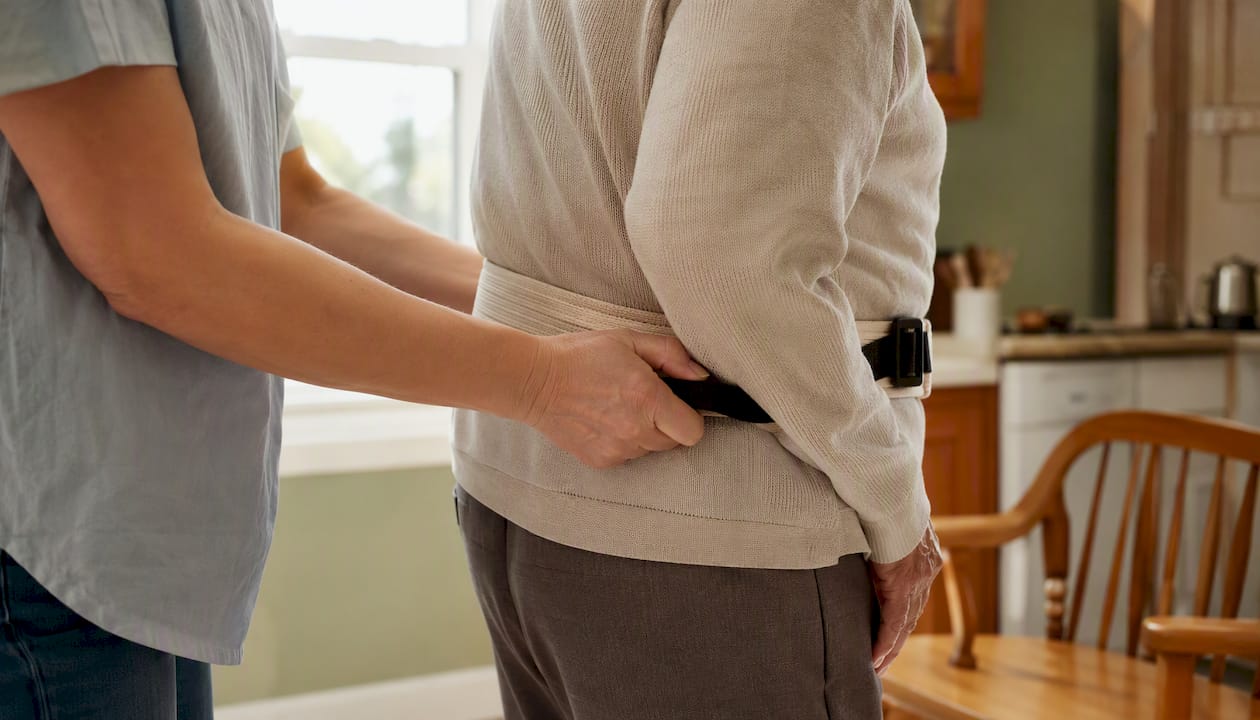
Two caregivers are worth considering when your parent weighs significantly more than you can comfortably manage, when they have had a recent fall, or when they tend to lurch or grab unexpectedly.
Car transfers
Lower the car seat as far back as it goes, or use a swivel cushion (a firm, rotating disc that sits on the seat). Help your parent stand beside the open door, then guide them to sit on the edge of the seat. Lift their legs in together rather than one at a time. Reverse the sequence to exit.
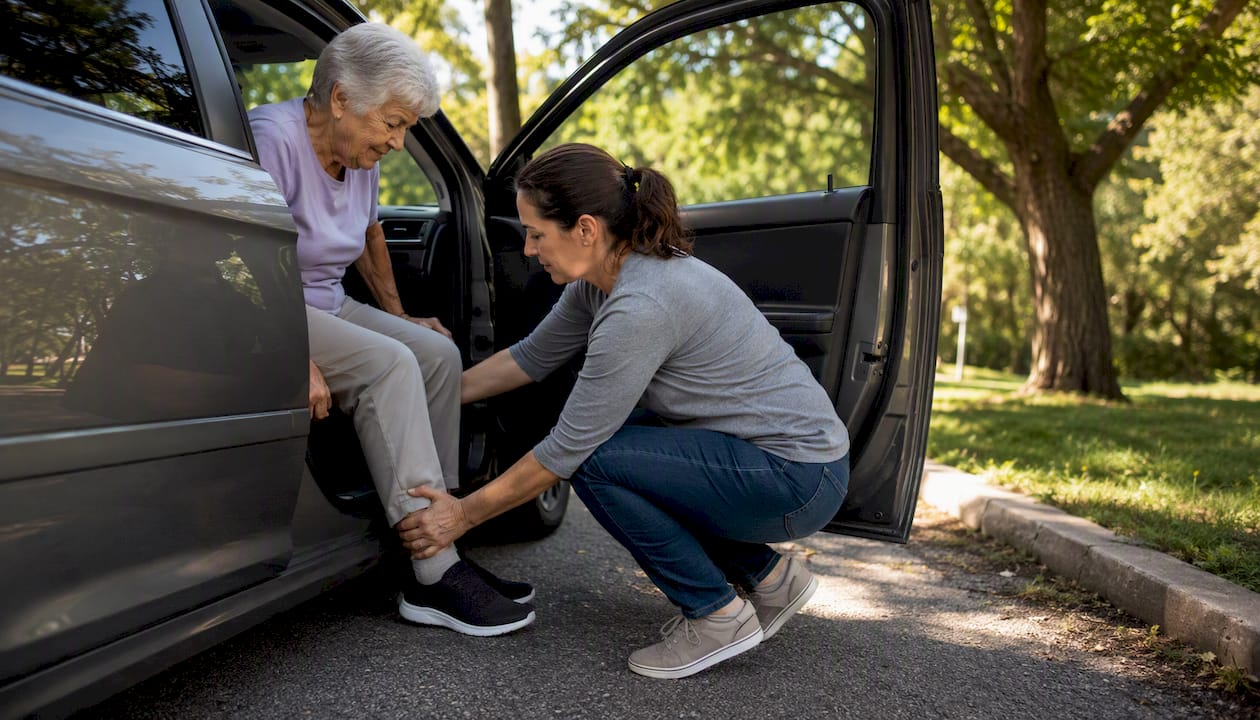
Protect your own back by bending at the knees when reaching into the car. Never lean over the door frame while supporting weight.
Adapting for arthritis, osteoporosis, or cognitive impairment
For arthritis or osteoporosis, keep movements slow and avoid gripping joints tightly. Use a gait belt rather than holding the arm. For a parent with dementia or confusion, simplify your instructions to one step at a time, make eye contact, and use a calm, steady voice. Explain what you're about to do before you do it. Familiar routines reduce resistance significantly.
What to do when a senior has fallen
Don't move them immediately. Your first job is to assess, not to lift.
Assessment steps:
- Speak to them calmly. Are they conscious and responding?
- Ask where they hurt. Listen for head, neck, or back pain.
- Look for visible injury: deformity, swelling, or bleeding.
- Ask them to wiggle their fingers and toes.
- If anything is unclear or concerning, call 911 and stay with them.
Call 911 immediately if you see:
- Loss of consciousness, even briefly
- Head, neck, or back pain or suspected injury
- A limb that looks deformed or at an unusual angle
- Severe bleeding that won't slow
- Difficulty breathing or sudden chest pain
If they are uninjured and alert, you can help them up using this sequence: guide them to roll to their side, then to hands and knees, then to sit beside a sturdy chair, then to use the chair seat to push to standing. Stay close and let them set the pace. Never rush this.
Pro Tip: Sit on the floor beside your parent while you assess. It brings you to their level, reduces their anxiety, and keeps you from the instinct to pull them up before you know it's safe.
Which assistive devices make transfers safer?
Many adult transfers exceed what one caregiver can safely manage manually. CareFor's guidance recommends assistive equipment when the senior cannot safely bear weight or when you feel any strain during the move.
Essential devices and when to use them:
- Gait/transfer belt: A firm webbing belt worn around the waist. Use for any standing transfer where the senior needs guidance but can bear some weight. Costs roughly $15–$30. No training beyond basic instruction needed.
- Slide board: A smooth, rigid board that bridges two surfaces (bed to wheelchair, for example). Allows a seated transfer without standing. Good for seniors who cannot stand but can shift their weight. Costs roughly $30–$80.
- Transfer bench: Straddles the bathtub edge, letting the senior slide in and out without stepping over the tub wall. Reduces fall risk in the bathroom significantly. Costs roughly $40–$100.
- Sit-to-stand (stand-assist) lift: A wheeled frame the senior grips while the device supports their rise to standing. Requires the senior to have some arm and leg strength. Costs roughly $300–$700 to buy; rental is available through durable medical equipment (DME) suppliers.
- Mechanical (Hoyer-style) full-body lift: A sling-based lift that moves a fully non-weight-bearing person. Requires two people for safe operation and some training. Best for bariatric needs or when the senior cannot assist at all. Costs roughly $1,000–$3,000 to buy; rental is often available and may be covered by Medicare Part B when medically necessary.
- Shower chair: A waterproof seat placed inside the shower. Removes the need to stand throughout bathing. Costs roughly $25–$80.
- Raised toilet seat: Adds 3–5 inches of height to a standard toilet, reducing the depth of the lower and making standing easier. Costs roughly $20–$60.
For a broader comparison of assistive devices for elderly parents, including lift chairs, Helping-mom has a dedicated guide worth bookmarking.
Choose a mechanical lift when your parent is fully non-weight-bearing, when bariatric weight is involved, or when cognitive resistance makes manual transfers unpredictable.
Pro Tip: Before buying, ask your DME supplier about a one-week rental trial. It lets you confirm the device fits your home layout and that your parent tolerates it before committing to a purchase.
When should you get professional training or outside help?
Get hands-on training if you will be doing transfers more than a few times a week. Training reduces caregiver injury and improves your parent's safety, and it's one of the most practical investments you can make early in a caregiving role.
Signs you need more support:
- You feel strain, pain, or fear during transfers
- Your parent is fully dependent and cannot assist at all
- Transfers are happening multiple times daily
- Your parent's weight significantly exceeds what you can manage comfortably
- Cognitive resistance or unpredictable movement makes transfers feel unsafe
Where to get training:
- Ask your parent's physician for a physical therapy referral. A PT can assess your parent's mobility and teach you specific techniques for their situation.
- Home health agencies often provide caregiver training as part of a care plan.
- Community caregiver programs, including those supported by federal family caregiver initiatives, offer low-cost or free training in many areas.
- Helping-mom's paid Zoom consultations and in-person home safety assessments (available locally in Central Florida) cover transfer safety, device selection, and hands-on guidance.
Questions to ask a trainer or vendor:
- Can I practice the technique with you watching before I do it alone?
- What devices do you recommend for my parent's specific mobility level?
- Is there a follow-up check after I've tried it at home?
- What is the cost, and does Medicare or Medicaid cover any of it?
What the research says about manual lifting risks
Major safety organizations agree: manual lifting of adults is often unsafe, and programs that replace it with mechanical lifts and training substantially reduce caregiver injury.
NIOSH research found that where mechanical-lift programs, training, and written policies were implemented, some studies reported roughly 61% lower workers' compensation injury rates and approximately 66% fewer lost-workday injuries among caregiving staff. Those figures come from institutional settings, but the underlying principle applies directly at home: when you remove manual lifting from the equation, injuries drop.
| Outcome measured | Reported reduction | Source |
|---|---|---|
| Workers' compensation injury rate | ~61% lower | NIOSH, CDC |
| Lost-workday injury rate | ~66% lower | NIOSH, CDC |
The AAOS adds that body mechanics training, specifically keeping the spine neutral, using leg strength, and keeping the person close, reduces back, neck, and shoulder injuries for caregivers who perform frequent transfers.
Use this evidence practically. If a family member questions why you need a transfer belt or a mechanical lift, the research gives you a clear answer: the equipment exists because manual lifting of adults is a documented injury risk, not a sign of weakness or over-caution.
Why caregiver fitness matters as much as technique
Good technique helps, but it works best when your body is ready to support it. Caregivers who perform regular transfers benefit from building the physical capacity to do so safely over time.
The AAOS recommends that caregivers who perform frequent transfers invest in core strength, flexibility, and posture as part of their preparation. That doesn't mean a gym membership. It means a few minutes of stretching in the morning, some basic core work, and paying attention to your own posture throughout the day.
Fatigue is a real factor. A transfer that feels manageable at 9 AM can feel genuinely risky at 9 PM after a long day. Recognize when your body is telling you to wait, ask for help, or use a device instead of pushing through. Your caregiver well-being is not separate from your parent's safety. They are connected.
Short walks, gentle yoga, and even seated stretching routines all build the physical resilience that makes caregiving sustainable. If you're experiencing regular back or shoulder pain, that's a signal to see your own doctor, not to push harder.
A perspective on asking for help
There's a quiet pressure many adult children feel to handle everything themselves. You're the one who's there, so you're the one who lifts, transfers, and manages. But asking for help with a transfer isn't giving up. It's the most practical thing you can do.
The caregivers who avoid injury aren't necessarily stronger or more skilled. They're the ones who decided early on that a gait belt, a second person, or a mechanical lift was worth the small effort of getting it. They asked the physical therapist to show them the technique. They rented the equipment before buying it.
If you're doing this mostly alone, consider one concrete step this week: order a transfer belt, schedule a PT visit, or book a home safety assessment. You don't need to overhaul everything at once. One change, done well, makes the next transfer safer than the last.
How Helping-mom can support your transfer safety plan
Helping-mom offers short, focused Zoom consultations and in-person home safety assessments designed specifically for adult children navigating situations like this. A consultation covers your parent's current mobility, the transfers you're doing most often, and which devices or home modifications would make the biggest difference. In-person assessments are available locally in Central Florida.
You can also download a practical home safety checklist that walks through the environment prep steps in this guide, room by room. It's a good starting point before a consultation or as a standalone tool if you want to work through it yourself.
To get started, visit Helping-mom's home safety guide for next steps, or book a Zoom consult directly through the site.
Sources
- Safe Lifting and Movement of Nursing Home Residents | NIOSH | CDC
- CaregiverAction — Lifting your loved one safely
- How to Safely Lift and Transfer a Senior | Step-by-Step Guide
- Essential Tips for Safe Lifting and Transfers at Home - CareFor
For hands-on training, ask your parent's physician for a physical therapy referral or contact a local home health agency. No guide replaces a trained professional watching you practice the technique in your own home.
This article is general information, not a substitute for advice from a qualified doctor. Consult a qualified healthcare professional about your own circumstances before acting on anything here.
FAQ
How do you safely help a senior get up from the floor?
If they are uninjured and alert, guide them to roll to their side, then to hands and knees, then to sit beside a sturdy chair, and finally to push to standing using the chair seat. Stay close, let them set the pace, and call 911 if there is any pain in the head, neck, or back before attempting this.
How much can a 70-year-old man safely lift?
There is no universal figure, since strength varies widely by individual health and fitness. The practical guidance from NIOSH and the AAOS is that caregivers should not attempt to manually lift a non-weight-bearing adult regardless of their own strength, and should use a mechanical lift or call for help instead.
What is the right way to lift a heavy person from the floor?
If the person cannot assist at all, do not attempt a manual lift. Use a mechanical (Hoyer-style) full-body lift with a second person, or call 911. If they can partially assist, follow the roll-to-side, hands-and-knees, sit-to-stand sequence described above, using a gait belt for grip and support.
What footwear should both the caregiver and senior wear during transfers?
Both should wear closed-toe, non-slip shoes with supportive soles. Socks alone on hardwood or tile floors significantly increase the risk of slipping during a transfer. Loose slippers without heel support are also a fall risk for the senior.
When should a family caregiver stop doing transfers alone?
Stop attempting solo transfers when you feel physical strain, when your parent is fully non-weight-bearing, when transfers happen multiple times daily, or when cognitive resistance makes the process unpredictable. At that point, get hands-on training from a physical therapist or home health professional, and consider a mechanical lift or additional caregiver support.