

Saying no as a caregiver is one of the most protective things you can do, for yourself and for the person you're caring for. It is not a rejection of your loved one. It is a constructive pause, a moment to renegotiate what you can realistically give so that care stays sustainable over months and years, not just weeks. The caregivers who struggle most are often the ones who waited too long, who kept saying yes until they hit a wall and then said no in anger or exhaustion. Starting earlier, before you reach that point, changes everything.
Here is where to begin:
- Write down every task you currently handle, from driving to appointments to managing medications to emotional support.
- Identify which tasks drain you most and which ones someone else could realistically take on.
- Name one thing you will stop doing or hand off this week, not eventually.
- Practice saying no to one small request before you tackle the harder conversations.
That list is not about doing less. It is about doing what you do with more steadiness and less resentment.
Table of Contents
- How do you know when it's time to say no?
- Practical strategies for saying no without guilt
- How to talk to family members about your limits
- How to find help so you are not carrying this alone
- Why self-care is the foundation of every boundary you set
- When should you actually say no?
- Dealing with guilt and the emotional weight of saying no
- What are the long-term benefits of setting caregiving limits?
- Legal and ethical considerations when refusing certain tasks
- Key Takeaways
- FAQ
How do you know when it's time to say no?
Your body usually signals overload before your mind admits it. Caregiver stress shows up as disrupted sleep, frequent headaches, irritability, and a creeping withdrawal from people and activities you used to enjoy. These are not personality flaws. They are data points telling you the current load is too heavy.
Watch for these signs across three areas:
Physical signals:
- Waking up tired even after a full night's sleep
- Headaches or stomach tension that appear on caregiving days
- Getting sick more often than usual
Emotional signals:
- Feeling resentful toward your parent or other family members
- Guilt that follows you even when you are doing everything right
- A low-grade irritability that spills into unrelated parts of your life
Behavioral signals:
- Skipping your own doctor's appointments or meals
- Making small mistakes you would not normally make
- Pulling away from friends or your own household
Recognizing these signs early matters because the longer you wait, the harder the conversation becomes. A calm, clear "I can't take that on right now" is much easier to deliver than a tearful or angry refusal after months of silent overload. If you are already seeing several of these signs, recognizing caregiver burnout before it fully sets in gives you more options, not fewer.
Pro Tip: Keep a simple weekly log, even just five minutes on Sunday evening, rating your energy, mood, and sleep on a scale of 1 to 5. Patterns become visible quickly, and having that record makes it easier to explain your limits to family members without it feeling like a complaint.
Practical strategies for saying no without guilt
The most effective refusals are honest, calm, and grounded in sustainability rather than frustration. You are not saying no because you do not care. You are saying no because you want to keep caring well.
A few approaches that work in practice:
- Lead with care, not refusal. Start with what you are committed to, then name what you cannot add. "I'm handling Mom's medications and all her appointments. I can't also take on the grocery runs every week."
- Offer an alternative. You do not have to solve the whole problem, but pointing toward a solution softens the conversation. "I can't do Saturdays, but I could help find a grocery delivery service she'd be comfortable with."
- Use scripted phrases when you feel put on the spot. A few that work well: "I need to think about that before I commit." "That's not something I can take on right now." "I want to help, but not in that way."
- Treat limits as experiments, not permanent decisions. Healthy caregiving limits are flexible and worth reviewing every 60–90 days as needs change. Framing a boundary as a trial period reduces the emotional weight of it feeling final.
- Reframe self-care as responsible caregiving. Protecting your sleep, your health, and your time is not selfishness. It is what keeps you functional. Self-care is a safety strategy, not a luxury.
The guilt will likely show up anyway. That is normal. But guilt is not the same as wrongdoing. You can feel guilty and still be making the right call.
How to talk to family members about your limits

Clear, factual language works better than emotional appeals when you are setting limits with siblings or other family members. Vague statements like "I'm overwhelmed" invite debate. Specific ones do not.
Try this approach in family conversations:
- State your current role plainly. "Right now, I handle all of Dad's medical appointments, his medications, and his daily check-ins. That takes a substantial amount of time each week."
- Explain the limit as a sustainability issue, not a complaint. "I can keep doing this well if I'm not also covering weekend visits. I need those days to recover."
- Share a caregiving calendar. Shared caregiving schedules make your workload visible and factual rather than a matter of opinion. When siblings can see the calendar, the conversation shifts from "you're exaggerating" to "how do we fill this gap?"
- Anticipate pushback and prepare for it. Common responses include "But you live closer" or "You've always handled it." Acknowledge those points without accepting them as reasons to take on more. "I know I'm nearby, and that's exactly why I need us to divide this more evenly."
- Invite problem-solving. "I can't add weekend visits. Can we figure out together who can cover those, or whether we should look at a paid option?"
A family meeting is often the right setting for this conversation. It signals that the discussion is serious and gives everyone a chance to prepare rather than react.
How to find help so you are not carrying this alone
Seeking help is not a sign that you have failed. Involving family and external resources is what sustainable caregiving actually looks like. The caregivers who last longest are the ones who build a team, even a small one.
Practical places to start:
- Community resources: Your local Area Agency on Aging can connect you with meal delivery, transportation, and in-home support services. The national Eldercare Locator is a free starting point.
- Respite care: The CDC recognizes respite care as a core tool for caregivers who need consistent breaks from their responsibilities. Even a few hours a week makes a measurable difference.
- Siblings and friends: Be specific when you ask. "Could you take Dad to his Thursday appointment twice a month?" lands better than "I need more help."
- Digital coordination tools: Shared calendars and group messaging apps reduce the back-and-forth and make it easier to divide tasks without repeated conversations.
- Plan for predictable crises. Most caregiving emergencies, including falls, hospitalizations, and medication changes, are predictable in nature. Having a simple care plan or contact list ready means you are not making decisions under pressure.
If sibling conflict is making it hard to share the load, that is worth addressing directly rather than absorbing the extra work in silence.
Why self-care is the foundation of every boundary you set
You cannot set a limit you are not willing to protect, and you cannot protect it when you are running on empty. Caregiver self-care is not a reward for doing enough. It is the baseline that makes doing enough possible.
The basics matter more than people expect:
- Sleep, nutrition, and movement are not optional extras. They directly affect your patience, your judgment, and your ability to have calm conversations.
- Social connection, even brief, keeps you from the isolation that makes caregiving feel impossible.
- Scheduling time off is not selfish. It is what allows you to show up fully when you are on.
Pro Tip: Mark your "off" times on the shared caregiving calendar in the same way you mark appointments. When your unavailability is visible and consistent, it becomes part of the plan rather than a source of conflict.
Review your caregiving role every 60–90 days. Ask yourself honestly: what is working, what is draining me, and what needs to change? That regular check-in is how limits stay realistic rather than becoming either too rigid or quietly abandoned. For more on self-care strategies that fit into a busy schedule, small consistent habits tend to outlast ambitious overhauls.

When should you actually say no?
The clearest signal is when saying yes would require you to sacrifice your own health, your job, your relationships, or your sleep on a regular basis. A one-time stretch is part of caregiving. A permanent pattern of self-sacrifice is not.
Say no when:
- A request falls outside your physical or emotional capacity right now, not just today but consistently.
- Taking it on would mean dropping something that keeps you functional, like your own medical care or your work schedule.
- You are being asked to do something that requires professional training you do not have, such as wound care or medication adjustments that should involve a nurse or doctor.
- You have already said yes to the limit of what you can give, and this is one more thing on top.
AARP has long emphasized that saying no is not only acceptable for family caregivers but necessary for the long-term quality of care. Saying no early, before resentment builds, keeps the relationship with your parent intact.
Dealing with guilt and the emotional weight of saying no
Guilt is almost universal among caregivers who set limits. It does not mean you are doing something wrong. Caregiver guilt can be managed by reframing the act of saying no as responsible caregiving rather than abandonment.
A few things that help:
Remind yourself that a caregiver who is depleted provides worse care, not better. Your limits protect your parent as much as they protect you. When guilt surfaces, name it without acting on it. "I feel guilty about this, and I'm still not going to take it on" is a complete sentence. Talking to a counselor, a support group, or even a trusted friend who understands caregiving can help you process the emotional side without letting it drive your decisions. Mental Health America notes that saying no demonstrates that you know your limits, and that when you are present, you are truly present. That is a gift, not a failure.
For more on working through caregiver guilt, the feelings are real and worth taking seriously, but they do not have to be the deciding factor.
What are the long-term benefits of setting caregiving limits?
Caregivers who set and maintain limits consistently report lower rates of burnout, better physical health, and stronger relationships with the people they care for. The care recipient benefits too. A caregiver who is rested and not resentful is more patient, more attentive, and more capable of noticing when something is genuinely wrong.
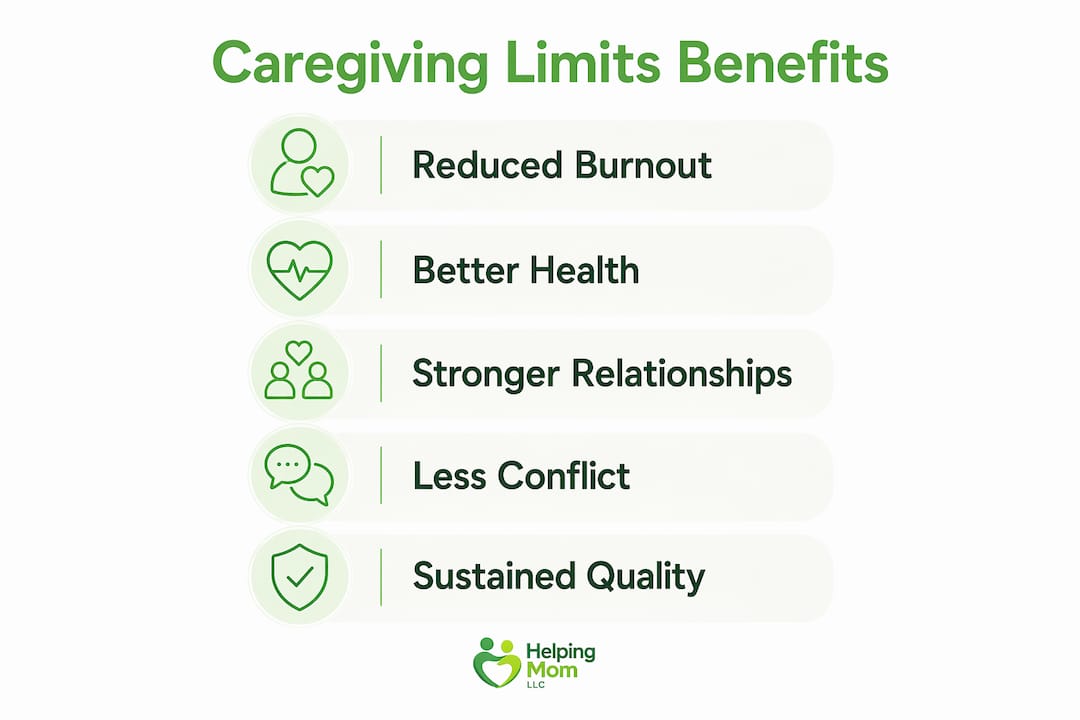
Over time, clear limits also reduce family conflict. When everyone knows what you are and are not responsible for, there is less room for unspoken resentment to build. Siblings who might otherwise assume you have everything handled are more likely to step in when the division of responsibility is explicit. And for you personally, setting healthy boundaries creates a caregiving role you can sustain for years rather than one that burns out in months. The mental health benefits of saying no extend well beyond caregiving itself, touching your relationships, your work, and your sense of self.
Legal and ethical considerations when refusing certain tasks
There are situations where saying no is not just reasonable but legally and ethically appropriate. Caregivers are not licensed medical professionals, and taking on tasks that require clinical training creates real risk for both you and your parent.
You have every right to decline:
- Medical procedures that require professional training, such as wound care, catheter management, or medication injections. These should be handled by a home health nurse or visiting medical professional.
- Tasks that conflict with your parent's care plan as established by their physician or care team. If a doctor has specified a certain protocol, a family caregiver should not be expected to override or substitute for it.
- Requests that place you in legal jeopardy, such as administering medications outside of prescribed instructions or making medical decisions without proper legal authority like a healthcare power of attorney.
The VA Caregiver Support Line (1-855-260-3274) offers guidance specifically on setting limits and navigating these situations. If you are unsure whether a task falls within your role, asking a social worker or care coordinator is the right move. Saying no to something you are not qualified to do is not a failure of care. It is the responsible choice.
Key Takeaways
Saying no as a caregiver is a skill that protects your health, sustains the quality of care you provide, and keeps your caregiving role manageable over the long term.
| Point | Details |
|---|---|
| Say no early | Waiting until you are overwhelmed leads to angry refusals; early limits preserve relationships and care quality. |
| Review limits regularly | Healthy caregiving limits are worth revisiting every 60–90 days as needs and capacity change. |
| Use clear, factual language | Stating your role and hours specifically makes limits easier for family to understand and accept. |
| Self-care is the foundation | Sleep, nutrition, and scheduled time off directly affect your patience and judgment as a caregiver. |
| Declining clinical tasks is appropriate | Caregivers are not medical professionals; refusing tasks that require clinical training protects everyone. |
FAQ
How do you say no as a caregiver?
Lead with what you are committed to, then name what you cannot add, using calm and specific language. Phrases like "That's not something I can take on right now" or "I need to think about that before I commit" give you space without closing the door entirely.
What are three signs of caregiver stress?
Caregiver stress commonly shows up as disrupted sleep, frequent irritability or anger, and withdrawal from friends and activities you previously enjoyed. Recognizing these signs early gives you more options before burnout sets in.
How do you cope with caregiver resentment?
Resentment usually signals that you have been giving more than you can sustain. Naming your limits clearly, asking for help from family or community resources, and scheduling regular time off are the most direct ways to reduce it over time.
What is caregiver fatigue?
Caregiver fatigue is the physical and emotional exhaustion that builds when a caregiver consistently gives more than they can recover from. It differs from ordinary tiredness in that rest alone does not resolve it; structural changes to the caregiving load are usually needed.