
TL;DR:
- Regular home safety modifications, strength exercises, and a medication review significantly reduce fall risk in older adults.
- Early signs of mobility decline can be detected through simple tests and careful observation to prevent falls.
The five highest-impact actions you can take right now: clear fall hazards from main pathways, start a simple strength and balance routine, review all medications and get a current vision check, fit the right mobility aid, and schedule a professional assessment if you've noticed changes. According to the National Institute on Aging, more than 1 in 4 adults over 65 fall each year, and most of those falls are preventable with exactly these steps. You don't need to do everything at once. Start with the bathroom and the main walking path, then build from there. Helping-mom's Practical Guide: How to Make Home Safer for Seniors gives you a ready-to-use checklist if you want a printable version to work from today.
Quick action list:
- Remove loose rugs and clutter from main pathways
- Add a nonslip mat and grab bar in the bathroom
- Check all medications with a pharmacist or doctor
- Schedule an eye exam if it's been more than a year
- Book a PT or OT assessment if gait or balance has changed
Table of Contents
- What can you do today to reduce fall risk at home?
- How do you spot early signs of mobility decline?
- Which home changes make the biggest difference for safe movement?
- What exercises actually reduce fall risk, and how do you start?
- How do you choose the right mobility aid?
- How do you help your parent move safely through daily tasks?
- Which medications and health factors quietly increase fall risk?
- When should you call an OT, PT, or home-safety assessor?
- What do common safety interventions typically cost?
- Key Takeaways
- What most families get wrong about mobility safety
- Helping-mom can walk you through this step by step
- Useful sources and resources
- FAQ
What can you do today to reduce fall risk at home?
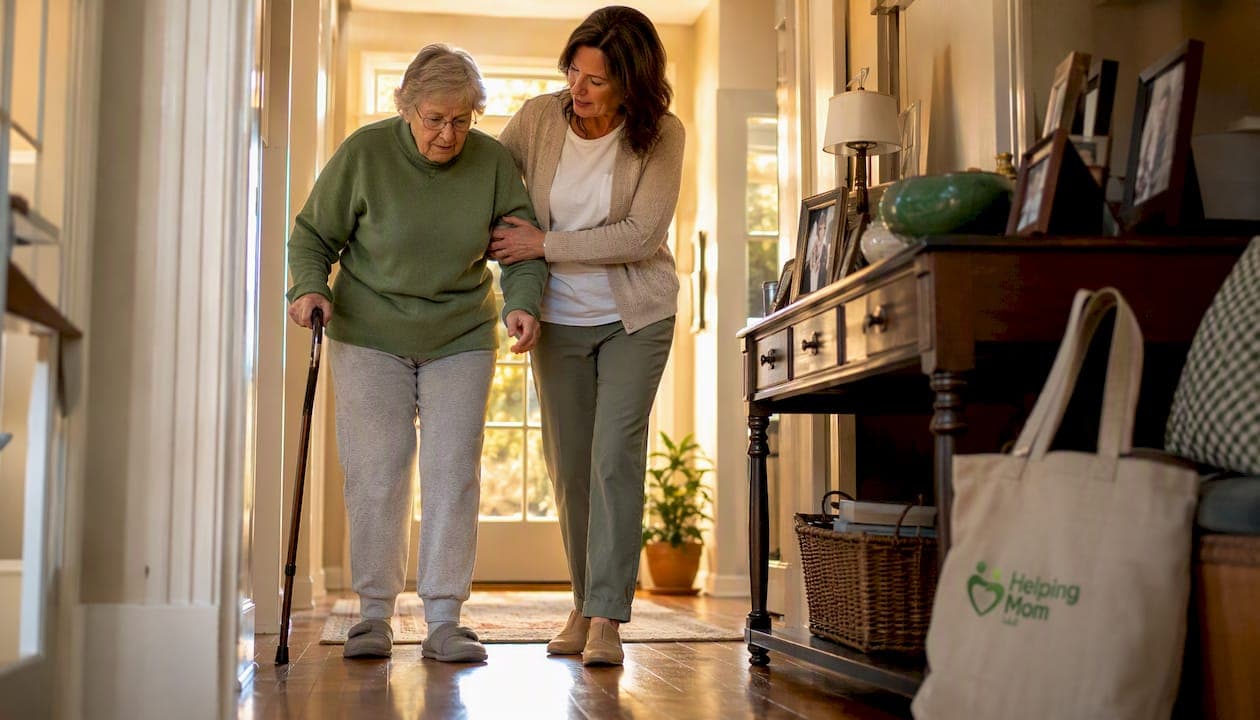
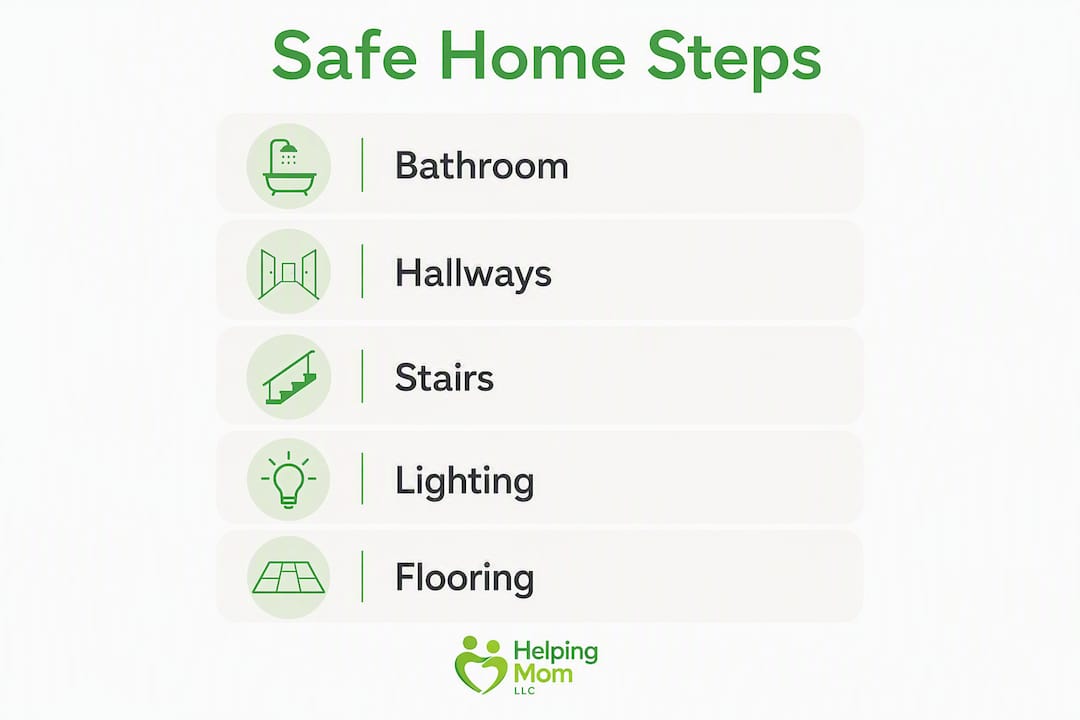
Small changes made today can cut fall risk significantly. Work room by room, starting where falls are most likely.
Bathroom first:
- Place a nonslip mat inside and outside the tub or shower
- Install a grab bar beside the toilet and inside the shower (wall-mounted, weight-rated — a towel bar is not a substitute)
- Add a shower chair or bench so your parent can sit while bathing
Main pathways and living areas:
- Remove throw rugs or secure edges with double-sided carpet tape
- Clear clutter from hallways, especially between the bedroom and bathroom
- Add nightlights along the path used at night
Footwear and behavior:
- Replace slippery slippers with nonskid, close-backed shoes
- Keep hands free when walking (no carrying laundry baskets or trays while moving)
Pro Tip: In older homes, prioritize the bathroom, the path from the bedroom to the bathroom, and any stairs before tackling other rooms. These three areas account for the majority of household falls in older adults.
The Helping-mom elderly home safety checklist is a printable room-by-room guide you can bring along during a home walk-through.
How do you spot early signs of mobility decline?
Mobility decline tends to be gradual, which means the early signals are easy to miss or explain away. Catching them early gives you more options.
Signs worth noting:
- Slower walking pace or shorter steps
- Grabbing furniture, walls, or counters for balance
- Avoiding outings or activities they used to enjoy
- Increased fatigue after short tasks
- Near-falls, even ones they brush off
Simple home tests to track over time:
- Timed Up-and-Go: Ask your parent to rise from a chair, walk 10 feet, turn, and return. Time it. Consistent times over 12 seconds suggest increased fall risk.
- One-leg stand: Can they stand on one leg for 10 seconds while holding a counter lightly? Difficulty here points to balance concerns.
- Walking speed: A noticeably slower pace over a short hallway distance, compared to a month ago, is a meaningful change.
- Daily log: Track energy levels, near-falls, and any new hesitation before tasks for one week. Bring that log to the next doctor's appointment.
Pro Tip: Keep a simple notes app entry or a paper log on the fridge. Date each observation. Patterns over 7–10 days are far more useful to a clinician than a general "she seems a little off lately."
When you see new dizziness, a sudden change in gait, or two or more near-falls in a week, treat that as urgent. The NIA advises seeing a doctor after any fall, even when there's no immediate pain, because a fall can signal an underlying issue that needs attention.

Which home changes make the biggest difference for safe movement?
Harvard Health identifies nonslip mats, grab bars, handrails, and good lighting as priority home interventions. The bathroom, stairs, and main pathways deliver the highest return on effort.
This week:
- Install grab bars in the shower and beside the toilet (hire a handyman if needed; weight-rated bars require wall studs)
- Add handrails on both sides of any staircase
- Replace dim bulbs with brighter LEDs in hallways and bathrooms
This month:
- Secure or remove all loose rugs
- Raise low chairs or add firm cushions so standing up is easier
- Level any uneven thresholds at doorways; add a small ramp if needed
Longer-term projects:
- Walk-in shower conversion ($3,000–$10,000 depending on scope)
- Stair lift installation ($3,000–$6,000 for a straight staircase)
Pro Tip: Suction-cup grab bars feel reassuring but are not safe for weight-bearing use. A properly installed, wall-anchored bar rated for 250+ lbs costs $30–$80 for the bar itself, plus installation. That's a much safer investment than a suction version that can pull free mid-transfer.
For detailed room-by-room guidance, the Helping-mom post on making home safer for an elderly parent walks through each area with practical examples.
What exercises actually reduce fall risk, and how do you start?
Harvard Health recommends targeted strength and balance work as the most effective way to reduce falls in older adults. Core and leg strength translate directly to safer daily movement.
A simple 10-minute daily starter routine:
- Chair stands (10 reps): Rise from a chair without using hands, then sit back slowly. This builds the exact leg strength needed for safe transfers.
- Heel-to-toe walk (20 steps): Walk in a straight line placing the heel of one foot directly in front of the toes of the other. Hold a wall lightly if needed.
- Single-leg stand (3 x 10 seconds each side): Stand near a counter for safety. Progress to fingertip contact only as balance improves.
- Seated resistance-band leg press (10 reps each leg): Loop a light band around the foot and press forward. Builds quad strength with low fall risk.
Start three days a week. Add a fourth day after two weeks if fatigue is manageable. Resistance can increase when 10 reps feel easy.
When to refer to a physical therapist:
- Your parent has had a fall in the past six months
- They're unsteady on uneven ground or stairs
- They've recently had surgery, a stroke, or a hospitalization
A physical therapist (PT) assesses gait and strength and fits mobility aids. An occupational therapist (OT) focuses on daily tasks like bathing, dressing, and safe transfers. Both roles are distinct, and professional assessment is recommended when mobility needs change.
Pro Tip: When encouraging exercise, frame it around what your parent wants to keep doing: "This will help you keep getting to church on your own" lands better than "You need to do this so you don't fall."
How do you choose the right mobility aid?
Match the aid to the actual problem, not to what looks easiest to buy.
| Aid | Best for | Common pitfall |
|---|---|---|
| Single-point cane | Mild balance support on one side | Wrong height; held on the wrong side |
| Standard walker | Significant balance or weight-bearing needs | Lifting gait can cause trips |
| Rollator (wheeled walker) | Good strength but needs rest stops | Brakes must be checked regularly |
| Transport wheelchair | Caregiver-assisted outings; limited endurance | Not for self-propulsion |
| Manual wheelchair | Full-time seated mobility | Requires upper-body strength or a pusher |
| Mobility scooter | Longer distances outdoors | Poor for tight indoor spaces |
Before buying, ask a PT or OT:
- What is the correct handle height for this person's arm length?
- Are the brakes reliable and easy to engage?
- Does the seat height allow safe sit-to-stand?
- What's the turning radius for the home's hallways?
Pro Tip: An aid that "looks comfortable" in the store can still be unsafe at home. A rollator with stiff brakes, or a cane set two inches too short, creates new hazards. Fit matters more than style.
Guidance on matching equipment to balance, strength, and daily tasks consistently shows that equipment chosen without an environmental review can mask worsening health problems rather than address them. For a deeper look at categories and fitting tips, see Helping-mom's guide to assistive devices for elderly parents.
How do you help your parent move safely through daily tasks?
Safe transfers reduce injury risk during the moments of highest vulnerability: getting up, sitting down, and moving between surfaces.
Sitting to standing:
- Move to the edge of the seat.
- Place feet flat, hip-width apart.
- Lean forward slightly ("nose over toes").
- Push up from the armrests, not from a caregiver's hands.
- Pause standing before moving.
Shower transfer with a bench:
- Position the bench so your parent can sit on the outside edge first.
- Sit, then swing both legs in together.
- Use a handheld showerhead to avoid reaching or twisting.
Caregiver mechanics:
- Stand close, with a wide base of your own feet
- Communicate each step before it happens ("I'm going to help you stand on three")
- Never rush; fatigue and hurrying cause most transfer injuries
- Use a gait belt if trained to do so
For stairs and outdoor transitions:
- Always lead with the stronger leg going up; lead with the weaker leg going down
- Plan rest stops on longer outings
- Nonskid shoes matter more outdoors than any other single item
Which medications and health factors quietly increase fall risk?
The CDC advises a comprehensive medication review that includes prescription drugs, over-the-counter medicines, and supplements. Sedatives, antihistamines, blood-pressure medications, and sleep aids are the most common contributors to dizziness and unsteady gait.
Prepare for the clinician visit:
- Write down every medication, dose, and time of day taken, including vitamins and OTC products
- Note any recent changes in dosage
- Ask specifically: "Could any of these affect balance or cause dizziness?"
Vision and hearing: An outdated glasses prescription changes depth perception and can temporarily worsen gait after new lenses are fitted. An eye exam every one to two years is a reasonable baseline. Hearing loss also affects balance, so flag it if it's been a while.
Feet and footwear: Bunions, neuropathy, and poorly fitted shoes all affect stability. A podiatrist visit is worth scheduling if foot pain is present.
Pro Tip: Bring the written medication list to every appointment, not just the bottles. A one-page list with drug name, dose, and prescribing doctor is faster for a clinician to review and easier for you to update.
Mayo Clinic lists medication review, vision checks, and footwear as practical fall-prevention steps alongside home safety and staying active.
When should you call an OT, PT, or home-safety assessor?
Call a professional when mobility changes are persistent, when falls or near-falls have happened, or when daily tasks like bathing or getting dressed have become risky.
Who does what:
- OT (occupational therapist): Daily living tasks, safe transfers, bathroom adaptations, and home modification recommendations
- PT (physical therapist): Gait analysis, strength and balance training, mobility-aid selection and fitting
- Home-safety assessor: Environment-focused review of the home for hazards and modification priorities
Booking script: "I'm calling to schedule a home safety or mobility assessment for my parent. They've had [one near-fall / a recent change in walking / difficulty with stairs]. I'd like to bring a medication list and a short log of what I've observed. What information do you need from me to get started?"
Triage:
- New dizziness, sudden gait change, or a fall with injury: call the primary care doctor first, same day.
- Persistent unsteadiness or difficulty with daily tasks: schedule PT or OT within the week.
- General home-safety review or mobility-aid fitting: book within the month.
What do common safety interventions typically cost?
Small fixes are genuinely low-cost. Larger projects take more planning, but the timeline for seeing improvement from exercise is shorter than most families expect.
| Intervention | Typical cost range | Time to impact |
|---|---|---|
| Grab bar (bar + installation) | — | Same day |
| Shower chair or bench | $30–$80 | Same day |
| Basic standard walker | $30–$80 | Same day |
| Rollator | $80–$250 | Same day |
| Home-safety assessment | — | Within a week |
| PT session (per visit) | — (varies by insurance) | 2–6 weeks for early change |
| Walk-in shower conversion | $3,000–$10,000 | 1–4 weeks (contractor) |
| Stair lift (straight staircase) | $3,000–$6,000 | 1–2 weeks (installation) |
With consistent exercise, measurable mobility improvement typically appears within 1–3 months. The grab bar and shower chair are the fastest, lowest-cost wins available.
Key Takeaways
Consistent strength and balance work, combined with targeted home modifications and a medication review, are the most effective ways to reduce fall risk for an older adult.
| Point | Details |
|---|---|
| Start in the bathroom | Grab bars, a nonslip mat, and a shower chair deliver the fastest fall-risk reduction for the lowest cost. |
| Exercise matters most | Chair stands, heel-to-toe walks, and single-leg stands build the leg and core strength that prevent falls. |
| Medications and vision | A full medication review, including OTC products and supplements, can reveal reversible fall-risk factors. |
| Call a PT or OT early | Professional assessment is the fastest path to safe independence after a fall, surgery, or persistent gait change. |
| Helping-mom resources | The Helping-mom Practical Guide and Aging in Place Checklist give caregivers a ready-to-use plan for this week and this month. |
What most families get wrong about mobility safety
Most families wait for a fall before acting. That's understandable — bringing up safety with a parent who values independence is genuinely uncomfortable. But the evidence is clear: the window between "I've noticed something has shifted" and "there's been a fall" is exactly when intervention does the most good.
The other thing families often underestimate is how much the environment shapes behavior. A parent who refuses a walker at home will often use one without complaint in a well-lit, uncluttered space where the walker is simply the obvious tool for the task. The resistance isn't usually to the aid itself. It's to what the aid represents. Framing changes matter: "This lets you get to the kitchen on your own" is a different conversation than "You need this so you don't fall."
Small wins build confidence, and confidence builds compliance. One grab bar, one week of chair stands, one honest conversation with the pharmacist. That's a real plan.
Helping-mom can walk you through this step by step
If you're looking at this guide and thinking "I know what needs to happen, I just need help making it real," that's exactly what Helping-mom is built for. The Practical Guide: How to Make Home Safer for Seniors is a printable, room-by-room resource you can use during a home walk-through this week. For families who want a guided conversation, Helping-mom offers paid 1:1 Zoom consultations, typically 30–60 minutes, that result in a clear action checklist and a follow-up plan. Caregivers in Central Florida can also book an in-person home safety assessment. All guidance is non-medical and safety-focused, so you get practical next steps without clinical jargon. To get started, visit the Practical Guide page or book a consultation directly at helping-mom.com.
Useful sources and resources
- Falls and Fractures in Older Adults: Causes and Prevention — National Institute on Aging; covers fall statistics, prevention steps, and when to see a doctor after a fall.
- Fall Prevention: Strategies to Help Keep You From Falling — Harvard Health; strength, balance, and home-safety guidance grounded in clinical evidence.
- Fall Prevention: Simple Tips to Prevent Falls — Mayo Clinic; practical checklist covering medications, vision, footwear, and home changes.
- CDC Fall Prevention Resources — Centers for Disease Control and Prevention; medication review guidance and prevention frameworks.
- Practical Guide: How to Make Home Safer for Seniors — Helping-mom; printable room-by-room guide and checklist for caregivers.
- Elderly Home Safety Checklist for Caregivers — Helping-mom; printable checklist for a home walk-through.
Bring your written medication list and one-week mobility log to every clinician appointment. Both give your parent's care team the specific information they need to make good decisions quickly.
FAQ
How many seniors fall each year in the United States?
More than 1 in 4 adults over age 65 fall each year, according to the National Institute on Aging. Most falls are preventable with home modifications, exercise, and medication review.
What is the difference between a PT and an OT for senior mobility?
A physical therapist focuses on gait, strength, balance, and mobility-aid fitting. An occupational therapist addresses daily living tasks like bathing, dressing, and safe transfers.
What are the first home changes to make for a parent with balance problems?
Install a grab bar and nonslip mat in the bathroom, secure or remove loose rugs, and improve lighting along the path from the bedroom to the bathroom. These three changes address the highest-risk areas first.
How long does it take to see improvement from balance and strength exercises?
Early changes in steadiness and confidence typically appear within 2–6 weeks of consistent exercise. Measurable mobility improvement usually takes 1–3 months with a regular routine.
What does Helping-mom offer for caregivers who need personalized help?
Helping-mom provides a printable Practical Guide, a paid 1:1 Zoom consultation with a clear action checklist, and in-person home safety assessments for families in Central Florida, all focused on non-medical, safety-first guidance.