

TL;DR:
- Starting a difficult conversation with a parent benefits from leading with care, a clear goal, and scheduling a follow-up.
- Using "I feel — when — because" statements helps keep the discussion blame-free and focused on specific behaviors.
The most effective opener you can use right now: "I need to talk with you about something because I love you and want you to be safe. When is a good time this week?" That single sentence does three things at once. It signals care rather than criticism, it names a reason, and it asks permission rather than ambushing your parent.
Before you schedule anything, run through these three steps:
- Schedule it. Text or call to ask for a 10–20 minute window. Scheduling signals respect and dramatically lowers the chance your parent shuts down.
- Remove distractions. Choose a private space, put phones away, and avoid mealtimes or moments of visible stress.
- State your takeaway first. Lead with the conclusion ("I'm concerned about your driving") rather than building up to it slowly.
TL;DR: Lead with your takeaway, use "I feel — when — because" statements to stay blame-free, be ready to pause if emotions spike, and always schedule a follow-up. Rehearsing your wording beforehand, even alone in the car, lowers anxiety and sharpens clarity when it counts.
Pro Tip: Write your opening sentence on a notecard and read it aloud twice before the conversation. Hearing your own words out loud reveals whether they sound caring or accusatory.
Table of Contents
- What do you actually want from this conversation?
- How do you pick the right time and place to talk?
- Opening lines that lower anxiety right away
- Concrete communication tools that keep blame out of the room
- How to listen so your parent actually feels heard
- How do you set a boundary and hold it without damaging the relationship?
- When should you pause the conversation and take a break?
- When is it time to bring in a professional?
- Scripts for the conversations caregivers avoid most
- How do you turn one conversation into a real plan?
- Key Takeaways
- These conversations are harder than they look, and that's worth saying
- Helping-mom can help you prepare and follow through
- Useful sources and further reading
- FAQ
What do you actually want from this conversation?
Defining one clear goal before you say a word is the single most underrated preparation step. Without it, the talk tends to drift into old grievances, and your parent ends up feeling like they're on trial rather than being cared for.

A simple goal template: "By the end of this conversation, I want us to [agree on / understand / decide] ___."
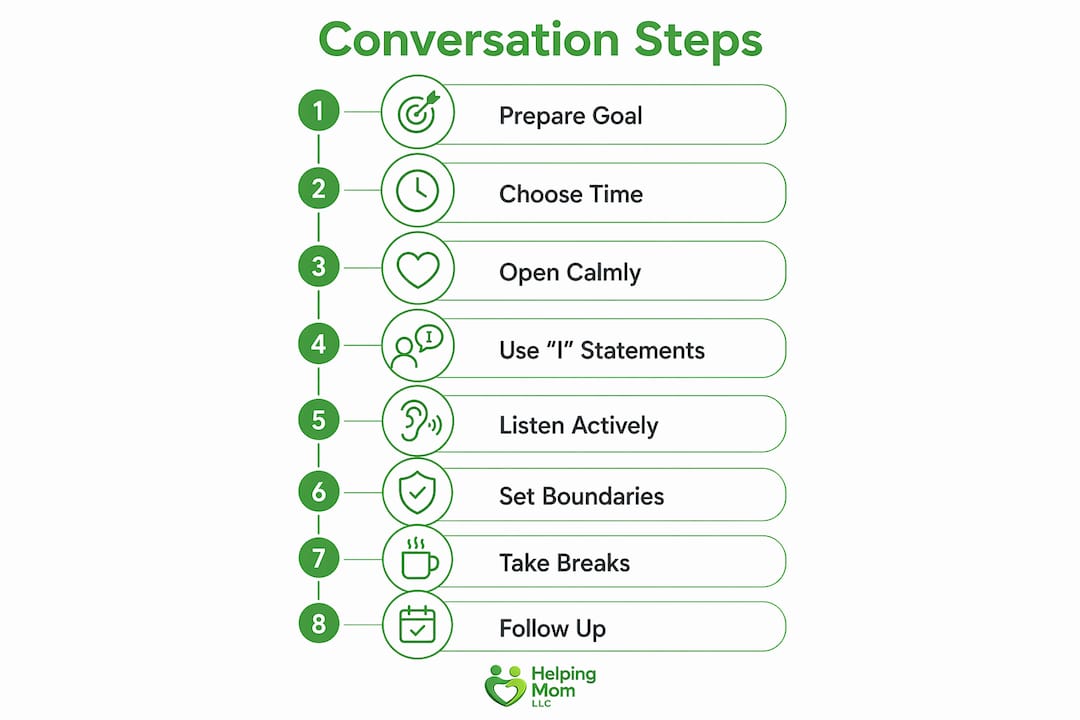
Three examples of what that looks like in practice:
A safety goal sounds like: "By the end of this conversation, I want us to agree on one change to the bathroom that will reduce fall risk." That's specific, achievable in a single sitting, and easy for your parent to say yes to.
A decision goal sounds like: "By the end of this conversation, I want us to understand what Mom's options are for managing her medications, so we can decide together which one fits her routine." Notice the word "together." It shifts the frame from you telling her what to do to both of you solving a shared problem.
A boundary-setting goal sounds like: "By the end of this conversation, I want Dad to know that I can no longer drive him to every appointment, and I want us to identify one alternative." This one is harder, but naming it clearly beforehand keeps you from softening the message so much that it disappears.
Choose your single highest-priority goal before you pick up the phone to schedule the talk. One conversation, one goal.
Pro Tip: Write your goal at the top of a notepad and keep it visible during the conversation. If the talk starts to wander, glance at it and gently redirect: "Can we come back to the main thing I wanted to cover?"
How do you pick the right time and place to talk?
Timing matters more than most people expect. A conversation started at the wrong moment, say, right after your parent gets home from a doctor's appointment or in the middle of a family dinner, is almost guaranteed to go sideways. Planned conversations allow you to gather your thoughts, choose a calm environment, and give your parent the mental space to actually hear you.
Dos:
- Ask permission with a short script: "I have something important I'd like to talk through with you. Can we find about 10 minutes this week?"
- Choose a private, comfortable space, ideally somewhere your parent feels at ease.
- Pick a time when neither of you is rushed, hungry, or already stressed.
- Put phones in another room. It's a small gesture that communicates the conversation matters.
Don'ts:
- Don't start the talk right before or after a stressful event (a medical appointment, a holiday gathering, a difficult phone call).
- Don't bring it up in front of other family members unless you've planned a family meeting specifically for that purpose.
- Don't let "finding the right moment" become an excuse to delay indefinitely. A scheduled imperfect moment beats a perfect moment that never comes.
Pro Tip: If your parent tends to be sharper and more relaxed in the morning, schedule for then. If evenings work better, use that. Matching the conversation to their natural rhythm is a quiet act of respect.
Opening lines that lower anxiety right away
The first sentence sets the emotional temperature for everything that follows. Experts advise leading with the conclusion rather than a long preamble, because a slow build-up creates dread. Your parent's brain starts filling in worst-case scenarios while you're still clearing your throat.
Here are eight openers you can adapt or copy directly:
- Gentle: "I've been thinking about something, and I want to talk with you about it because I care about you."
- Firm: "I need to bring something up that's been worrying me, and I'd like us to figure it out together."
- Curious: "I've noticed a few things lately, and I'd love to hear your perspective on them."
- Safety-focused: "I want to talk about something related to your safety at home. I'm not trying to alarm you, I just want us to be prepared."
- Driving: "Dad, I need to bring up driving. I know this isn't easy to hear, and I want to approach it with you, not at you."
- Money: "Mom, I'd like to understand how the bills are going. Not to take over, just to make sure nothing falls through the cracks."
- For text or email: "Hey, I have something I'd like to talk through with you when you have a few minutes. Nothing urgent, but it matters to me."
- For phone: "Before we hang up, can I bring something up? It'll only take a few minutes, and I want to get your thoughts."
The through-line in all of these: name the topic, signal care, and invite rather than demand. That combination keeps the door open even when the subject is hard.
Concrete communication tools that keep blame out of the room
The "I feel — when — because" formula is the most practical tool you have for describing behavioral concerns without blaming. It keeps the focus on your experience and the specific behavior, not on your parent's character.

The structure: "I feel [emotion] when [specific behavior] because [impact]."
Applied to common caregiver situations:
- Medication: "I feel worried when I notice the pill organizer is still full on Thursday because I know those medications are important for your heart."
- Driving: "I feel scared when I hear about close calls on the road because I can't bear the thought of you getting hurt."
- Home safety: "I feel anxious when I see the bathroom rug bunched up because I know how quickly a fall can happen."
- Hygiene: "I feel concerned when I notice you haven't showered in several days because I want you to feel comfortable and well."
One distinction worth holding onto: criticizing behavior is very different from criticizing character. "I noticed the bills haven't been paid" is a behavior observation. "You're irresponsible with money" is a character attack. The first opens a conversation; the second closes it.
Pro Tip: Swap "you need to" for "I need your help with." Compare: "You need to stop driving" versus "I need your help figuring out how we handle transportation safely." The second one makes it a shared problem, not a verdict.
How to listen so your parent actually feels heard
Active listening is not just staying quiet while the other person talks. It's reflecting back what you hear, asking questions that invite more, and validating feelings even when you disagree with the conclusion.
Here are eight prompts you can use in real time:
- "It sounds like you're saying you feel like you're losing control. Is that right?"
- "That must feel really frustrating, especially after everything you've managed on your own."
- "Help me understand what worries you most about this."
- "What would feel like a good outcome to you?"
- "I hear you. Can you tell me more about what that's been like?"
- "So if I'm understanding correctly, you're okay with X but not Y?"
- "What would you do if you were in my position?" (This one, drawn from AFCCA guidance, gently shifts a defensive parent from emotional reaction to problem-solving.)
- "I don't want to put words in your mouth. What am I missing?"
A short practice exercise: Before the real conversation, ask a trusted friend to play the role of a resistant parent. Practice paraphrasing their responses back to them before you reply. The goal is to pause, breathe, and reflect before reacting. Even one run-through builds real confidence.
The pacing rule: pause after your parent finishes speaking. Take one breath. Paraphrase what you heard. Then respond. That three-beat rhythm prevents the reactive back-and-forth that turns a conversation into an argument.
How do you set a boundary and hold it without damaging the relationship?
A boundary stated once and never enforced is just a preference. The goal is to name the boundary clearly, explain the reason briefly, and follow through consistently, without anger and without apology.
Common boundaries in elder care:
- No driving after dark (or at all, depending on the assessment).
- Medication reminders at a set time each day.
- A home-safety change that must happen before you can feel comfortable with the current living situation.
A script for stating the boundary: "I need us to agree that [specific boundary]. I'm asking for this because [brief reason]. I want to support you staying at home, and this is one of the things that makes that possible."
If the boundary is ignored: "I noticed [specific thing] happened again. I want to revisit what we agreed on, because it matters to me and to your safety."
Dos and don'ts for follow-through:
- Do stay calm and specific. Name the behavior, not the person.
- Do give a brief, consistent consequence if the boundary continues to be crossed ("If this keeps happening, I'll need to involve your doctor in the conversation").
- Don't enforce boundaries passive-aggressively, through sighing, withdrawing, or making comments to other family members.
- Don't apologize for the boundary itself. You can be kind and firm at the same time.
The language that preserves dignity: "I'm not trying to take over. I'm trying to make sure you can keep living the way you want to."
Pro Tip: Write the agreed boundary down and share a copy with your parent after the conversation. A simple text or note ("Just to confirm what we talked about...") removes the "I never agreed to that" dynamic later.
When should you pause the conversation and take a break?
Some conversations need to stop before they're finished. Pushing through when emotions are running high rarely produces good decisions. Professionals advise pausing a gridlocked or escalated talk and scheduling a follow-up rather than forcing resolution in the moment.
Signs it's time to pause:
- Your parent is crying, shouting, or repeating the same point in a loop.
- You feel your own voice tightening or your thoughts scattering.
- The conversation has shifted from the original topic to old grievances.
- Either of you has said something you'll need to walk back.
A timeout script: "I'm getting a little emotional right now, and I want to give this the attention it deserves. Can we pause and pick this up tomorrow at [specific time]?"
After the conversation, take care of yourself. A short walk, a call to a trusted friend, or even fifteen minutes of quiet can help you process what happened without carrying it into the rest of your day. Helping-mom's caregiver well-being resources offer practical tools specifically for this kind of emotional reset.
Pro Tip: Always name a specific time when you call the timeout. "Let's talk tomorrow at 2 PM" is a commitment. "Let's talk later" is an exit.
When is it time to bring in a professional?
Some conversations genuinely need a third voice. That's not a failure; it's good judgment. A neutral professional can defuse dynamics that have calcified over decades and provide framing that carries more weight than a family member's words alone.
Signs you need outside help:
- Your parent's safety is at immediate risk and they're refusing all support; in such cases, coordinating family roles through a geriatric care manager can help reduce conflict and manage logistics.
- You've had the same conversation three or more times with no movement.
- There are signs of cognitive decline that are affecting decision-making.
- Siblings are in conflict about the right course of action.
- Your parent becomes verbally aggressive or completely shuts down every time the topic comes up.
A script for suggesting professional support: "I love you and I want us to figure this out together. Would you be open to talking with someone who helps families work through exactly this kind of thing? It doesn't have to be a big commitment, just a conversation."
Options, ranked by formality:
- Primary care physician: Often the most trusted voice for an aging parent. A doctor raising a concern carries different weight than a child raising the same concern.
- Family therapist: Useful for long-standing communication patterns and emotional gridlock.
- Geriatric care manager: Ideal when the issues are practical (care coordination, safety, transitions) and you need a professional plan. [Coordinating family roles](https://caremanagers.co.uk/how-to-coordinate-family-elderly care-responsibilities) through a care manager can also reduce sibling conflict significantly.
- Mediator: A good fit when family members disagree sharply and need a structured process to reach decisions.
It's also completely fine to suggest the idea, get a "no," and revisit it in a few weeks. Timing matters here too.
Scripts for the conversations caregivers avoid most
These are the topics most adult children put off the longest. Each script below includes a brief rationale and an alternate phrasing for when your parent gets defensive.
| Topic | Primary goal | Best opener tone | When to bring in help |
|---|---|---|---|
| Driving safety | Collaborative decision | Gentle, curious | When parent refuses all discussion |
| Medication adherence | Problem-solving | Warm, practical | When missed doses affect health |
| Home safety changes | Joint planning | Calm, specific | When parent refuses changes after a fall |
| Finances / bill-paying | Understanding | Non-judgmental | When bills are unpaid or scams suspected |
| Loss of independence | Validation first | Empathetic, slow | When cognitive decline is a factor |
Driving safety Rationale: Lead with your fear, not their failure. Script: "Dad, I've been worried about your safety on the road. I'm not trying to take your keys. I'd like us to look at this together and figure out what makes sense." If defensive: "I hear you. You've been driving for fifty years. Can I just share what I've been noticing, and get your thoughts?"
Medication adherence Script: "Mom, I noticed the pill organizer has some gaps. I'm not upset, I just want to make sure we're not missing anything important. Can we look at it together?" If defensive: "What would make it easier to keep track? I want to help, not hover."
Home safety changes Script: "I'd love to make a few small changes around the house so you can keep living here comfortably. Can we walk through it together and you tell me what feels okay?" For a practical starting point, Helping-mom's home safety guide for seniors walks through the most common changes room by room. If defensive: "What would need to be true for you to feel comfortable with even one small change?"
Finances / bill-paying Script: "I want to make sure nothing slips through the cracks with the bills. Would you be open to going through them together once a month, just so I understand what's happening?" If defensive: "I'm not trying to take over. I just want to be a backup for you, not a replacement."
Loss of independence Script: "I know this is hard to talk about. I want you to stay as independent as possible for as long as possible. Can we talk about what that looks like, and what support might actually help rather than get in the way?" If defensive: "What does independence mean to you right now? I want to understand that before we figure anything else out."
A few notes on tone and timing: collaborative openers work best for driving and finances. Empathetic, slower openers work better for independence conversations. For any of these topics, talking with aging parents about care before a crisis hits produces far better outcomes than waiting until a decision is urgent.
How do you turn one conversation into a real plan?
One conversation rarely resolves anything on its own. What makes the difference is what happens in the 48 hours after it ends.
A simple follow-up template:
- Who will do what, by when? (Name the person and the specific action.)
- What did we agree on? (One or two sentences, written down.)
- When will we check in? (A specific date, not "soon.")
Documentation checklist:
- Date of the conversation
- Who was present
- The main topic discussed
- What was agreed (even informally)
- The next check-in date and format (call, visit, text)
A short follow-up text you can send within 24 hours: "Hey Mom, I just wanted to say thank you for talking with me today. I know it wasn't easy. To recap what we agreed: [one sentence]. I'll check in with you on [date]. Love you."
That message does three things: it expresses gratitude, it confirms the agreement in writing, and it sets a next touchpoint. Documentation reduces the "I never said that" dynamic that can undo a productive conversation. For families managing multiple siblings or complex care situations, a family meeting agenda template can help structure these follow-ups more formally.
Key Takeaways
Starting difficult conversations with parents works best when you lead with care, name one clear goal, and always schedule a follow-up before the conversation ends.
| Point | Details |
|---|---|
| Lead with your takeaway | State the topic and your reason in the first sentence; don't build up slowly. |
| One goal per conversation | Define a single, specific outcome before you start to keep the talk focused. |
| Use "I feel — when — because" | This formula keeps the focus on behavior and impact, not character or blame. |
| Pause before it escalates | Call a timeout with a specific resume time rather than pushing through when emotions spike. |
| Helping-mom supports the follow-up | Use Helping-mom's guides, checklists, and Zoom consultations to prepare scripts and document next steps. |
These conversations are harder than they look, and that's worth saying
There's a version of this advice that makes it sound simple: pick the right words, use the right formula, and everything will go smoothly. That's not quite honest. Starting difficult conversations with aging parents is genuinely hard, not because you're doing it wrong, but because you're navigating love, fear, role reversal, and decades of family history all at once.
What I've seen, working with families in this space, is that the adult children who do this well aren't the ones who say everything perfectly. They're the ones who show up, try, pause when they need to, and come back. The scripts and frameworks in this article aren't magic. They're scaffolding. They give you something to hold onto when your emotions want to take over.
One thing that often gets missed: your parent's resistance is usually not about you. It's about fear. Fear of losing independence, of being seen as diminished, of what the conversation implies about where things are heading. When you can hold that understanding alongside your own worry, the conversation changes. You're no longer two people in opposition. You're two people who are both a little scared, trying to figure out the same thing.
Helping-mom can help you prepare and follow through
Knowing what to say is one thing. Having the right tools to prepare, document, and follow up is another. Helping-mom offers practical, non-clinical resources built specifically for adult children navigating these conversations, including downloadable scripts and checklists, a step-by-step aging-in-place home safety guide, and paid one-on-one Zoom consultations where you can talk through your specific situation with someone who understands the caregiving context.
If you're preparing for a conversation about home safety, finances, or care transitions, the caregiver well-being resources are a good place to start. And if you'd like personalized support before a high-stakes talk, you can book a short Zoom consult directly through the site. Sometimes having one conversation with the right person first makes the next conversation with your parent much easier.
Useful sources and further reading
These are the primary sources that informed the scripts, frameworks, and listening prompts in this article.
| Source | What it covers | When to consult it |
|---|---|---|
| Oprah Daily: How to Start a Tough Conversation | Lead-with-the-takeaway openers; scheduling and permission scripts | Before your first conversation |
| Psychology Today: Conversations You've Been Avoiding | Single-goal preparation; active listening and paraphrasing | Planning and listening phases |
| Berkeley Executive Education: How to Have Difficult Conversations | Timeout scripts; planned vs. reactive conversations | When emotions escalate |
| AFCCA: Tough Talking | "I feel — when — because" formula; curiosity-based questions | Communication tools and defensive responses |
| Nemours KidsHealth: Talking to Your Parents | Rehearsal and role-play to build confidence | Preparation and practice |
These sources inform the evidence behind the scripts and listening prompts used throughout this article. For U.S.-specific caregiving resources, NAMI and Centerstone also offer practical communication guidance for families navigating mental health and care conversations.
FAQ
What should I say first in a difficult conversation with a parent?
Lead with the topic and your reason in one sentence: "I need to talk with you about [topic] because [brief reason]." Experts recommend stating the conclusion first rather than building up to it, which reduces anxiety for both of you.
Why do I struggle to communicate with my parents about hard topics?
Role reversal, fear of conflict, and decades of established family dynamics all make these conversations harder than they look. The resistance you feel is normal, and preparing a single clear goal before you start significantly reduces the chance the talk drifts into old grievances.
What are the four C's of difficult conversations?
Definitions vary across communication frameworks. A widely used version covers: Clarity (know your goal), Curiosity (ask before assuming), Compassion (acknowledge the other person's feelings), and Commitment (agree on a next step). These align closely with the preparation and listening steps covered in this article.
What is the "I feel — when — because" formula?
It's a structured way to raise a concern without blaming: "I feel [emotion] when [specific behavior] because [impact]." AFCCA guidance recommends this formula specifically because it keeps the focus on behavior and your experience, not on your parent's character or intentions.
When should I involve a professional in a family conversation?
Bring in a professional (a physician, family therapist, or geriatric care manager) when the same conversation has stalled three or more times, when safety is at immediate risk, or when cognitive decline may be affecting your parent's decision-making. A neutral third party often carries more weight and can reframe the conversation in ways a family member cannot.