
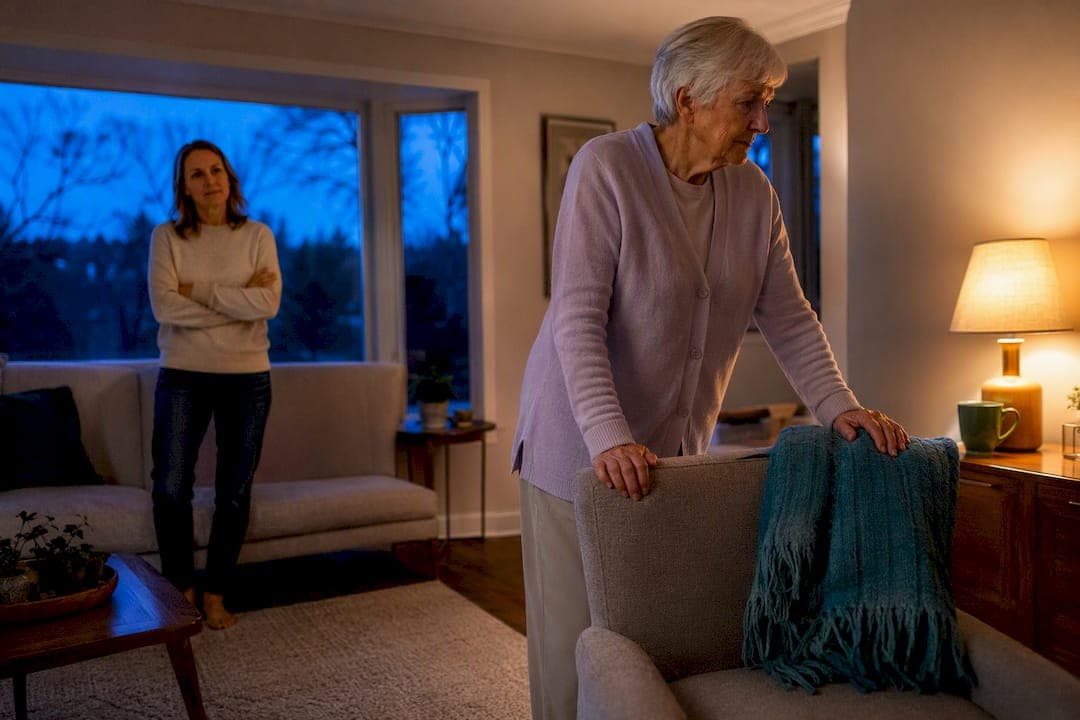
Sundowning is a late-day surge of confusion, agitation, or restlessness in someone with dementia. It's a symptom pattern, not a separate illness. The first move when it starts: check the basics (light, hunger, thirst, pain, bathroom needs), turn down noise and clutter, and redirect gently instead of arguing. Environmental fixes usually work better, and feel safer for everyone, than reasoning or physical restraint.
TL;DR:
- Small, fixable triggers like fatigue, hunger, pain, or disruptive lighting often cause sundowning, and addressing these can prevent episodes.
- Environmental adjustments such as increasing daytime light, limiting late naps, and turning on soft evening lamps help mitigate confusion at sunset.
- During episodes, slowing your movements, validating feelings, and redirecting with simple activities can de-escalate agitation safely.
- Installing nightlights, clearing walkways, and using door alarms reduce fall risk and wandering during evening confusion.
- Routine recording and help from clinicians or support resources improve management strategies and reduce caregiver stress.
Table of Contents
- What Does Sundowning at Home Look Like?
- What Triggers Sundowning at Home?
- How Can You Prevent Sundowning Before It Starts?
- What Should You Do in the Moment During an Episode?
- How Do You Reduce Falls and Wandering Risk at Home?
- When Should You Call a Doctor or 911?
- How Do You Take Care of Yourself While Managing This?
- Should You Consider Medication for Sundowning?
- Does Diet or Dehydration Make Sundowning Worse?
- Can Technology Help Manage Evening Confusion?
- What Other Environmental Changes Reduce Agitation?
- A Caregiver's Honest Take on Managing Sundowning
- How Helping-mom Can Support Your Evening Safety Plan
- Where to Learn More About Sundowning
- Sources
- FAQ
What Does Sundowning at Home Look Like?
Sundowning affects about 20% of people with dementia, and it tends to intensify as dementia progresses. It shows up as pacing, shadowing you room to room, sudden suspicion, hallucinations, or trouble settling for sleep. Some parents get restless and want to "go home" even while sitting in their own living room.
Most families notice it in late afternoon, around sunset, or right after dinner, but timing varies person to person. Your mother's pattern might start at 4:00 PM sharp; your neighbor's father might not spiral until 8:00 PM. What matters is recognizing the shift as a pattern tied to time of day, not a random bad mood or something you caused.
What Triggers Sundowning at Home?
Sundowning rarely comes from nowhere. It's usually a stack of small, fixable irritants that pile up by evening. Common triggers include fatigue, hunger, thirst, pain, and infections like UTIs, along with disruption to the body's internal clock.
Walk through your parent's space and routine with these in mind:
- Environmental: long shadows near dusk, dim or flickering light, a loud TV, cluttered walkways, mirrors that create confusing reflections.
- Physical needs: hunger, thirst, a full bladder, unaddressed pain, or a brewing infection.
- Medication timing: side effects that peak in the evening hours.
- Daily rhythm: a two-hour afternoon nap, little movement all day, or no morning daylight at all.
None of these require a medical background to spot. They require paying attention for a few days and writing down what you see.
How Can You Prevent Sundowning Before It Starts?
Prevention beats damage control every time, and it starts hours before dusk. The National Institute on Aging recommends a steady daily schedule, real daylight exposure, limited late naps, and less stimulation as evening approaches.
Morning and daytime:
- Get your parent outside or near a sunny window within an hour of waking. Morning light helps anchor the body's internal clock.
- Build in physical movement daily, even a slow walk around the block or a few laps of the hallway.
- Save quiet, low-stimulation activities for the afternoon rather than exciting outings or visits.
Meals and naps:
- Serve the largest meal earlier in the day and keep dinner lighter and at an earlier time.
- If a nap happens, limit naps to short durations earlier in the afternoon.
- Skip caffeine and alcohol after lunchtime.
Lighting:
- Maximize bright daylight during the day.
- Close blinds before the sun starts setting, not after confusion has already crept in.
- Switch on soft, consistent lamps in early evening so the house never goes from bright to dark in one jump.
- Keep nightlights on in hallways and bathrooms overnight.
Health checks:
- Loop your parent's clinician in if evening confusion suddenly worsens. Pain, infection, or a medication side effect can masquerade as "just sundowning."
Pro Tip: Set a phone alarm for "close the blinds" thirty minutes before sunset. Doing it on a timer, before your parent gets restless, works far better than trying to calm the room down after shadows have already set the mood.
What Should You Do in the Moment During an Episode?
When agitation hits, your own state matters as much as anything you say. A caregiver who slows their breathing and softens their voice gives the moment less to escalate against. Here's a simple sequence to try:
- Steady yourself first. Lower your voice, slow your movements, and keep a little physical distance if your parent seems startled by closeness.
- Name the feeling, don't fight the facts. If she says she needs to "get home," don't correct her. Try, "It sounds like you're feeling unsettled. Let's figure this out together."
- Redirect with something concrete. Offer a snack, a warm drink, or a simple task like folding towels. Walking alongside her is usually far more effective than blocking a doorway.
- Clear the immediate area of hazards (throw rugs, sharp objects, anything blockable that could turn a walk into a fall).
- Know when to step back. If things escalate past what feels manageable, keep your phone within reach and have a backup person you can call.
Pro Tip: Never physically block an exit or restrain your parent's arms during an episode. Dementia UK's guidance notes this often increases aggression. Walking beside them toward a "destination" (the kitchen, a chair by the window) tends to de-escalate faster than any argument.
How Do You Reduce Falls and Wandering Risk at Home?
Evening confusion plus a dark hallway is exactly how falls happen, and it's also when parents are most likely to try to "leave." A few concrete changes lower both risks without turning the house into a hospital ward.
- Place nightlights in hallways, bathrooms, and the path between bedroom and bathroom, since that's the most walked route after dark.
- Clear walkways of cords, loose rugs, and furniture with sharp corners.
- Store car keys, cleaning supplies, and anything sharp somewhere out of sight, not locked in an obvious way that draws attention or feels punitive.
- Add door alarms or out-of-sight sliding locks at the top of doors rather than visible deadbolts, which can feel like confinement and trigger frustration.
- Decide now who responds if a door alarm sounds at 2:00 AM, you, a sibling, or a monitored system, so it's not a scramble in the moment.
- Lay out pajamas and set a full water glass on the nightstand before evening confusion sets in, so bedtime doesn't require decisions.
Pro Tip: Skip complicated nighttime routines altogether during a rough patch. If flossing and three skincare steps aren't happening tonight, that's fine. A simple, predictable bedtime beats a "complete" one.
When Should You Call a Doctor or 911?
Most evening confusion is ordinary sundowning. But a few signs point to something medical that needs quicker attention. Call a clinician promptly, or 911 if severe, for a sudden and significant change in alertness, a new fever, unusual weakness, trouble breathing, fainting, or hallucinations that are new and intense rather than part of an established pattern.
Sudden worsening of evening confusion can signal a treatable issue like a urinary tract infection, dehydration, or a medication reaction, not a permanent decline. Before you call, jot down when it started, what changed recently in eating, sleeping, or medications, and have the current medication list on hand. That short summary saves the clinician time and often speeds up the right answer.
How Do You Take Care of Yourself While Managing This?
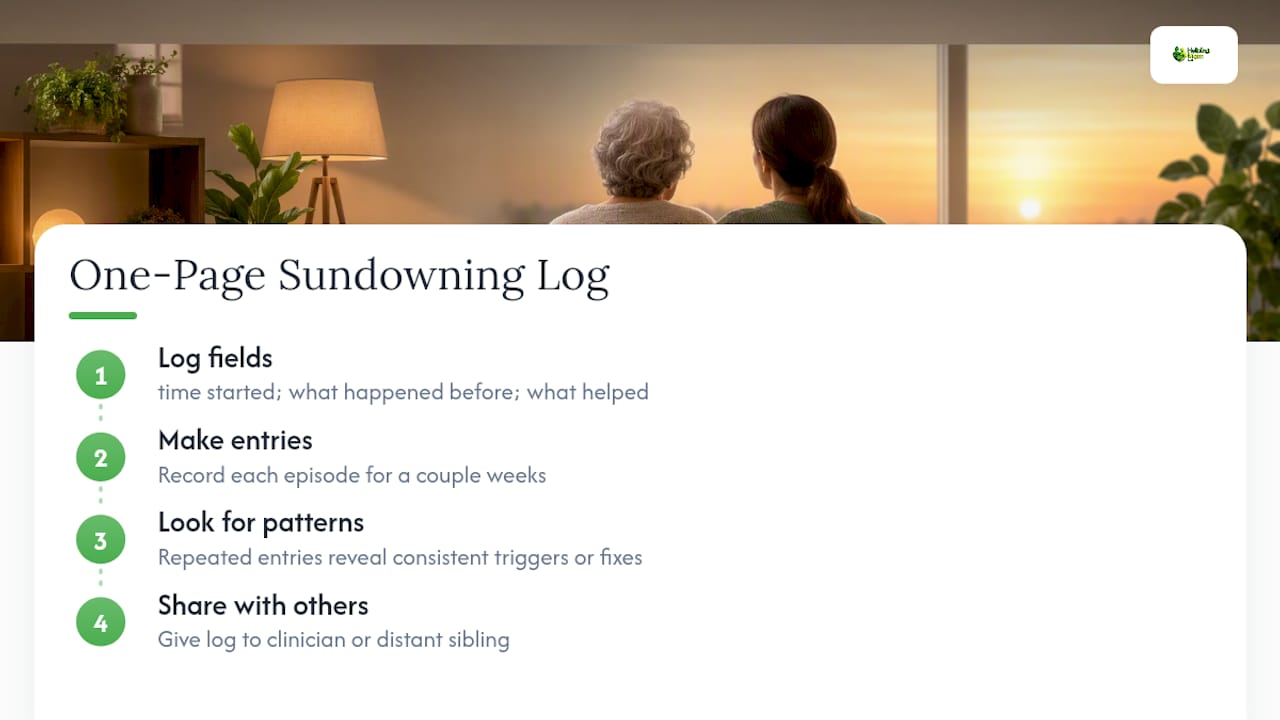
Watching for patterns protects your parent and your own sanity. Keep a simple one-page log: time it started, what was happening right before, and what actually helped. Over a couple of weeks, that log turns vague worry into a pattern you can hand to a clinician or share with a sibling who lives far away.
Ask for help before you're desperate. A short script works: "Evenings between 4 and 7 are hard right now. Could you take Tuesday and Thursday?" Line up a backup list, a neighbor, a sibling, a respite care service, so you're not improvising during a bad week.
Build in micro breaks. Even 90 seconds of slow breathing in another room resets your own tension before you walk back in. If evenings are wearing you down consistently, that's a signal worth discussing, not a personal failing. The caregiver stress resources at Helping-mom walk through pacing yourself so this doesn't become unsustainable.
Should You Consider Medication for Sundowning?
Environmental and routine changes come first, always. Nonmedication approaches such as light therapy, music, and calming daily structure are the standard first-line response, with medication considered only when those steps genuinely aren't enough.
That said, some situations do call for a conversation with your parent's doctor. If agitation is severe, if it's putting your parent or you at physical risk, or if sleep loss has gone on for weeks, it's reasonable to ask what pharmacological options exist. Some research suggests low-dose melatonin may ease sundowning-related sleep issues, though the evidence is mixed and it should be tried only under a clinician's guidance, never as a first move you try alone.
Before that appointment, bring your tracking notes. A clinician who sees "confusion starts around 5:30 PM, worse on days with no outdoor time" can make a far more targeted call than one working from "evenings are hard." Ask directly about interactions with existing prescriptions, since many medications for other conditions, blood pressure drugs, certain antihistamines, even some pain relievers, can worsen evening confusion as a side effect. This is a decision to make with a doctor, not something to adjust on your own based on what worked for a friend's parent. If a medication is started, keep tracking. You want to know within a week or two whether it's actually helping or just adding a new variable to the pattern.
Does Diet or Dehydration Make Sundowning Worse?
What your parent eats and drinks during the day shows up in behavior by evening, often more than people expect. Dehydration alone can deepen confusion, and older adults frequently don't feel thirsty even when they need water, so waiting for them to ask isn't a reliable plan.
Offer water regularly through the day rather than a large amount all at once, small glasses with meals and in between work better than trying to catch up in the evening. A dehydrated brain is a more agitated brain by dinnertime.

On the food side, keep the biggest, most nutrient-dense meal at lunch when appetite and energy are usually strongest. A heavy dinner close to bedtime can work against good sleep, while a lighter evening meal, something simple like soup or a sandwich, tends to sit easier and avoid the sluggish, cranky aftermath of a big plate. Limit caffeine to mornings only, and watch sugar intake late in the day, since a sugar spike followed by a crash can look a lot like agitation.
If your parent seems to refuse food or water during an episode, don't force it in the moment. Offer a favorite snack or a warm drink after redirecting, once things have calmed slightly, rather than pushing during the peak of confusion. And if refusal becomes a pattern over several days, mention it to the clinician; appetite changes can be an early sign of an infection or other issue separate from sundowning itself.
Can Technology Help Manage Evening Confusion?
Simple tech can take some of the guesswork out of a hard evening without turning your parent's home into a surveillance project. Motion-sensor nightlights that switch on automatically when someone gets up avoid the fumbling-in-the-dark moment that often triggers a fall or startles someone awake into confusion.
Door and window sensors that send a phone alert when opened after a set hour let you sleep without staying half-awake listening for footsteps. Some families use simple video monitors, the kind built for nurseries work fine, positioned in a hallway rather than a bedroom, to preserve privacy while still catching a wandering episode early.
Apps that let you log behavior patterns quickly, even a basic notes app with timestamps, do the same job as a paper tracking sheet but travel with you and are easy to share with a sibling or clinician. The goal with any of these tools isn't constant monitoring; it's catching the one moment that matters, a door opening at 2:00 AM, without you needing to be awake for it. Start with one tool, see if it actually reduces your worry, and add more only if a specific gap shows up.
What Other Environmental Changes Reduce Agitation?
Light gets most of the attention, but sound and temperature shape evening mood just as much. A television left on with background chatter or a loud news broadcast can quietly ratchet up anxiety over an hour without anyone noticing why the room feels tense.
Turn down or turn off the TV as evening approaches, and swap it for quiet, familiar music if your parent likes background sound. Calm, low-volume, and instrumental works better than talk radio or anything with sudden noise. Kitchen appliances, a blender or a loud dishwasher cycle, are worth timing around the evening window when possible.
Temperature matters more than most families expect. A room that's too warm can make anyone restless, and older adults often can't communicate that discomfort clearly once confusion sets in. Keep the house on the cooler, comfortable side in the evening rather than warm, and check that bedding isn't too heavy for the season. A fan's steady white noise can also mask sudden household sounds, footsteps upstairs, a car outside, that might otherwise pull attention and spike anxiety. Small, boring changes like these often do more than any single dramatic intervention.
A Caregiver's Honest Take on Managing Sundowning
Most guidance treats sundowning like a puzzle to solve once. It isn't. It's a pattern you observe, adjust to, and revisit as dementia changes month to month. The caregivers who handle the challenges best observe small clues and adapt their approach rather than trying to argue with a brain that can no longer follow them.
A free checklist and a practical guide can get you most of the way there tonight, before you need anything more formal. And on the nights it still goes sideways: that's not you failing. It's you adapting to the brain in front of you today, which is the only job here that actually matters.
— Mike C.
How Helping-mom Can Support Your Evening Safety Plan
Reading advice online only gets you so far when it's 6:00 PM and your father is pacing the hallway. There are practical, non-medical tools designed to help in moments like this, without jargon or panic. The Elderly Home Safety Checklist gives you the quick fixes, nightlight placement, clutter removal, door safety, in one printable pass you can complete this weekend.
For a deeper walkthrough of preparing the whole home for evening confusion and aging in place more broadly, the Practical Guide to Making Home Safer for Seniors covers the room-by-room details a single checklist can't.
If evenings have become especially challenging, personalized guidance through a short consultation can provide a plan tailored to specific patterns instead of general advice. Start with the checklist tonight, and book a consultation when you're ready for a plan tailored to your situation.
Where to Learn More About Sundowning
- National Institute on Aging: clear, government-backed tips on daily routines and light exposure.
- Mayo Clinic: trigger breakdown and general medical context.
- Dementia UK: prevalence data and family-facing guidance.
- Cleveland Clinic: overview of nonmedication and medication approaches.
Sources
- Tips for coping with sundowning | National Institute on Aging
- Sundowning: Late-day confusion | Mayo Clinic
- Sundowning | Dementia UK
- Sundown syndrome | Cleveland Clinic
FAQ
How Do You Combat Sundowning at Home?
Focus on prevention first: consistent routines, daylight exposure during the day, a lighter dinner, and calm, dimmed lighting in early evening. When an episode starts, lower your voice, validate the feeling, and redirect with a simple activity rather than arguing or correcting.
What Is Sundown Anxiety?
Sundown anxiety describes the restlessness, worry, or fear that often accompanies sundowning as evening approaches, sometimes showing up as pacing, repeated questions, or wanting to leave the house. It's part of the same symptom cluster as sundowning rather than a separate condition.
What Medications Are Commonly Used to Treat Sundowning?
There's no single standard medication for sundowning, and nonmedication approaches like light therapy and routine changes are the first-line response. Some clinicians discuss low-dose melatonin for sleep disruption, but any medication decision should go through your parent's doctor.
What Is Sundowning in Older Adults?
Sundowning is a pattern of increased confusion, agitation, or restlessness that shows up in the late afternoon or evening in people with dementia, affecting roughly 20% of people with dementia. It's considered a symptom cluster, not a diagnosis on its own.
How Do You Handle Sundowning Safely at Night?
Keep nightlights on in hallways and bathrooms, clear walking paths of hazards, and use out-of-sight door locks or alarms rather than obvious barriers that can feel confining. Lay out pajamas and water ahead of time so bedtime stays simple and predictable.