

TL;DR:
- Older drivers are more likely to listen to concerns from a spouse than from an adult child.
- Observing specific unsafe behaviors like getting lost or running stop signs can trigger helpful conversations.
If your parent has a spouse or close trusted friend, ask that person to start the conversation. Research from the Hartford Center for Mature Market Excellence and MIT AgeLab shows that older drivers are nearly twice as likely to listen to driving concerns from a spouse than from an adult child. If no spouse is available, the calmest, most local adult child should lead. Your next step this week: write down one or two specific driving incidents you've observed, then schedule a quiet, private conversation.
If the risk feels immediate right now:
- Offer to drive instead of riding along in an unsafe situation.
- Suggest skipping a long trip for now, framing it as a favor to you.
- Call the primary care physician's office to flag your concern before the conversation happens.
The NHTSA's older driver resources and the AMA Journal of Ethics both offer guidance that can help you feel grounded before you say a single word.
Table of Contents
- What warning signs tell you it's time to talk about driving?
- How to prepare before you have the conversation
- What to say: scripts that keep the conversation calm
- What to do when your parent pushes back
- Practical alternatives that preserve your parent's independence
- How to create a simple driving plan together
- When safety is urgent: what to do right now
- Key Takeaways
- What this conversation is really asking of you
- Helping-mom is here when the conversation feels too hard to start alone
- FAQ
What warning signs tell you it's time to talk about driving?
Concerns rooted in specific, observable behavior carry far more weight than a general feeling that something is off. Before any conversation, spend a week or two watching and recording what you see.
| Warning Sign | Why It Matters | What to Record |
|---|---|---|
| Getting lost in familiar places | Many older adults say this alone warrants a conversation | Date, location, how long they were lost |
| New dents, scrapes, or unexplained damage | Physical evidence of misjudged space or delayed reaction | Date noticed, which part of the car |
| Running stop signs or red lights | Suggests attention or processing gaps | Intersection, time of day |
| Difficulty staying in lane | May indicate vision or cognitive changes | Road type, lighting conditions |
| Slow reaction to hazards or near misses | Families often cite a serious accident or near miss as the right trigger | Who was present, what happened |
| Increased anxiety or confusion while driving | Self-reported or observed distress | Specific trip, what triggered it |
Vision changes, cognitive shifts, and medication side effects are among the most common contributors to unsafe driving in older adults. If your parent takes multiple medications, check with their pharmacist about any that affect alertness or reaction time.
Pro Tip: Keep a simple notes app entry on your phone. Log the date, location, and a one-sentence description of what you saw. Three documented examples are far more persuasive than a general worry.
When you see your parent voluntarily limit their own driving, such as avoiding highways or skipping night trips, acknowledge it. That kind of self-regulation deserves praise, not silence. It opens the door to a much easier conversation later.
How to prepare before you have the conversation
Good preparation turns a tense confrontation into a calm, caring discussion. Start by deciding who speaks first.

57% of married older drivers prefer to hear concerns from their spouse first. If your parent's spouse is willing and able, ask them to lead. If not, the adult child with the closest, calmest relationship should open. Avoid sending a group of family members at once. That feels like an ambush, and it usually backfires.
Here's a practical prep checklist before the conversation:
- Write down two or three specific driving examples with dates and locations.
- Review your parent's current medications for any that affect driving ability. The HealthInAging tip sheet is a useful starting point.
- Note any recent health changes: new diagnosis, vision prescription update, or a fall.
- Research two or three local transportation alternatives before you sit down, so you can offer solutions, not just concerns.
- Talk to siblings or other family members in advance. Agree on a single, consistent message and assign roles: one person opens, one listens and supports, one follows up afterward.
- Choose a calm, private setting with no time pressure. Not at the dinner table, not right after an incident.
A family meeting agenda can help you structure this coordination so everyone arrives on the same page. Rehearse your opening sentence out loud at least once. It sounds small, but it genuinely reduces the chance you'll stumble when the moment arrives.
What to say: scripts that keep the conversation calm
For many parents, driving equals independence. When the conversation feels like a threat to who they are, resistance is almost guaranteed. The goal is to reframe the talk as safety for everyone, not a verdict on their abilities.
Opening lines that work:
- "I've noticed a couple of things lately that worried me, and I care too much about you not to say something."
- "I'm not here to take anything away from you. I just want us to figure out how to keep you safe and independent for as long as possible."
- "Can I share something I've been thinking about? I'd really like to hear your thoughts too."
Dos and don'ts:
- Do name specific behaviors: "Last Tuesday on Route 9, you ran the stop sign at Oak Street."
- Do use "I" statements: "I felt scared when that happened."
- Do validate their feelings: "I know this is hard to hear, and I understand if you're upset."
- Don't say "You're not safe to drive anymore." That closes the conversation.
- Don't bring up age: "You're 82" is not a reason. A specific behavior is.
- Don't have this conversation with multiple family members present unless your parent has agreed to that format.
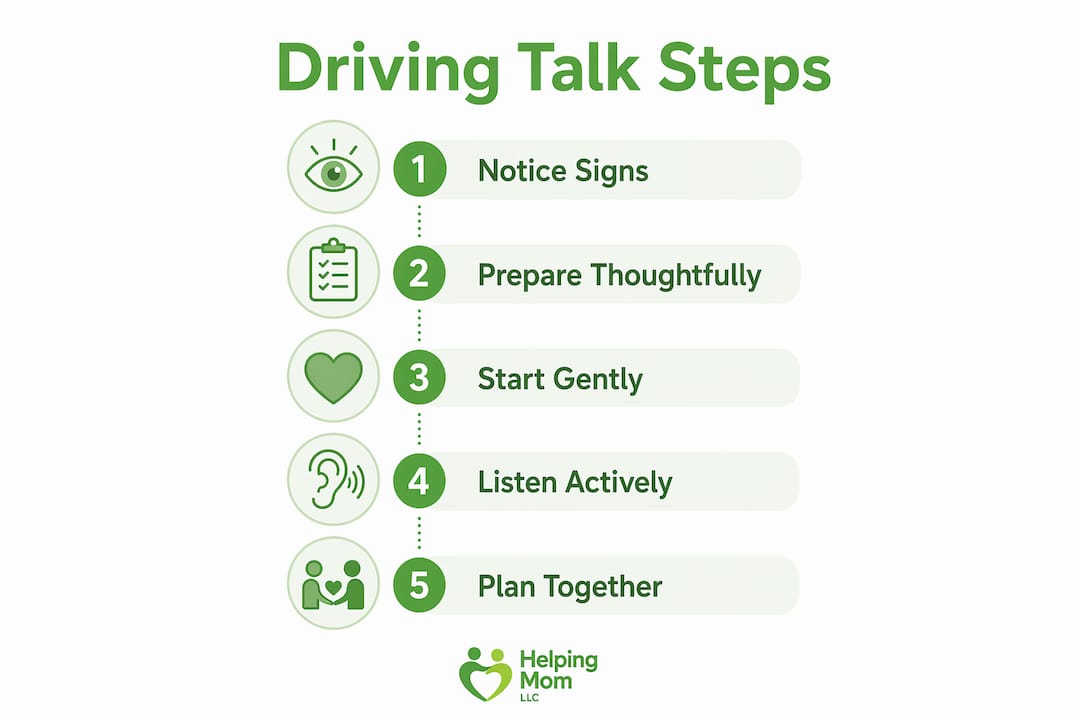
A suggested flow: open with care → listen without interrupting → share one or two specific examples → propose a small, time-limited change → agree on a follow-up date together. For more on talking to aging parents about safety, Helping-mom has additional conversation frameworks that fit this approach.
What to do when your parent pushes back
Resistance is normal. It doesn't mean the conversation failed. It means you may need a neutral voice.
The primary care physician is often the most effective one. AMA Journal of Ethics guidance describes physicians as uniquely positioned to assess functional ability related to driving, document concerns objectively, and, where state law requires, report to licensing authorities. Before your parent's next appointment, call the office and share your observations. Ask the physician to raise the topic directly. Most will.
If the physician conversation doesn't resolve things, a staged escalation gives you clear next steps:
| Stage | Action | Who Initiates |
|---|---|---|
| 1 | Repeat the family conversation with new examples | Adult child or spouse |
| 2 | Physician assessment and documented recommendation | Primary care physician |
| 3 | Professional driving evaluation by a certified specialist | Occupational therapist or rehab specialist |
| 4 | DMV reassessment or licensing authority notification | Family or physician, per state law |
Occupational therapists who specialize in driving rehabilitation can conduct a behind-the-wheel evaluation that carries far more authority than a family member's concern. Ask your parent's physician for a referral, or search the AOTA's database of certified driving rehabilitation specialists.
Pro Tip: Frame the professional evaluation as something you're doing together, not something being done to your parent. "I'd feel so much better if we got an expert's opinion" lands very differently than "You need to be tested."
If family dynamics make these conversations especially difficult, the mental health of elderly parents resource from MindShift Psychological Center offers useful context on emotional adjustment and resistance.
Practical alternatives that preserve your parent's independence
Before you ask your parent to drive less, have a plan for how they'll get where they need to go. The perceived loss shrinks considerably when real options are already on the table.
- Family rides: Assign specific trips to specific people. Predictability reduces the feeling of dependence.
- Rideshare with assisted booking: Apps like Lyft and Uber can be set up so a family member books rides on the parent's behalf. Lyft offers a "Lyft for Seniors" program in many areas.
- Community paratransit: Most U.S. counties offer ADA-compliant paratransit for eligible riders. Eligibility and cost vary by location.
- Volunteer driver programs: Organizations like ITNAmerica and local Area Agencies on Aging coordinate volunteer drivers for medical and errand trips, often at low or no cost.
- Grocery and medication delivery: Services like Instacart, Amazon Fresh, and most major pharmacy chains now offer home delivery, removing the most common daily driving need.
Let your parent be part of choosing. Pilot two or three options over two to four weeks and ask them which felt most comfortable. Giving them a say in the solution makes the transition feel less like something happening to them.
How to create a simple driving plan together
A written plan removes ambiguity and gives everyone something to refer back to. Keep it short and respectful, not a legal document.
| Element | Example |
|---|---|
| Defined restrictions | No driving after dark; no highway driving |
| Who monitors | Daughter (Sarah) rides along once per week |
| Follow-up date | Scheduled appointment with Dr. [Name] |
| Reassessment criteria | No new incidents; physician clears continuation |
At the follow-up, start with what went well. Then review any incidents using the same specific, behavior-based language from the original conversation. If the trial went smoothly, say so clearly and agree on the next period. If concerns remain, move to the next step in the escalation plan.
A family meeting guide can help you document this plan and keep all family members aligned without repeated difficult conversations.
When safety is urgent: what to do right now
Some situations can't wait for a scheduled conversation. If you believe your parent poses an immediate risk on the road, act the same day.
- Do not ride with them if you genuinely believe the drive is unsafe. Say so calmly: "I'd rather we take my car today."
- Call the physician's office and describe the specific incident. Ask for an urgent appointment or a phone consultation.
- Request an expedited driving evaluation through an occupational therapist or your state's DMV medical review unit.
- Contact your state DMV if the risk is serious and ongoing. Most states allow family members or physicians to request a medical review of a driver's license. Requirements vary by state.
- Do not hide or take the car keys without prior agreement. This approach destroys trust and often increases resistance, making future conversations harder.
For a full breakdown of when elderly drivers should stop driving, Helping-mom's guide covers the clinical and practical markers in plain language.
This article provides general information, not medical or legal advice. For guidance specific to your parent's health or your state's reporting requirements, consult their physician or your state DMV directly.
Key Takeaways
Starting the conversation with the right messenger, specific examples, and a concrete plan makes the difference between a talk that helps and one that damages trust.
| Point | Details |
|---|---|
| Choose the right messenger | A spouse is nearly twice as likely to be listened to; use them first when available. |
| Ground concerns in specifics | Document date, location, and behavior before any conversation. |
| Involve the physician early | A primary care physician can assess, document, and depersonalize the concern. |
| Offer alternatives before asking to stop | Have two or three mobility options ready before the conversation begins. |
| Helping-mom resources | Conversation scripts, a family meeting agenda, and 1:1 coaching calls are available at Helping-mom to support families through every stage. |
What this conversation is really asking of you
The hardest part of talking with a parent about driving isn't finding the right words. It's accepting that you can't control the outcome, only the quality of the conversation you bring.
Most adult children wait too long because they dread the conflict. But the families who handle this well tend to share one habit: they start early, before a crisis forces the issue. A calm conversation at the first sign of concern is almost always easier than the one that follows an accident.
There's also something worth naming about the emotional weight your parent carries. Driving isn't just transportation. For many older adults, it represents decades of independence, the ability to show up for grandchildren, to get to church, to run their own errands. When you approach the conversation as a partner in preserving that independence rather than as someone taking it away, the dynamic shifts. Not always immediately, but it shifts.
The goal isn't a single conversation that resolves everything. It's a series of honest, caring check-ins that keep your parent safe while keeping the relationship intact. That's a long game, and it's worth playing carefully.
Helping-mom is here when the conversation feels too hard to start alone
Knowing what to say and actually saying it are two different things. Helping-mom offers practical, done-with-you support for families navigating exactly this kind of conversation: downloadable conversation scripts, a family meeting agenda template, and a printable driving safety checklist you can use to document observations before you sit down.
For families who want guided support, a paid 1:1 Zoom consultation walks you through the conversation step by step, including how to handle resistance, coordinate siblings, and build a driving plan your parent can actually agree to. Families in Central Florida can also book an in-person home safety assessment that includes mobility planning as part of the visit.
Start with the free checklist, or book a consultation when you're ready for a conversation partner who's done this before.
Useful sources and further reading
| Source | What It Covers |
|---|---|
| National Institute on Aging: Safe Driving for Older Adults | Conversation tips, warning signs, and community resource guidance |
| AMA Journal of Ethics: Assessing Senior Patients' Ability to Drive Safely | Physician's role in driving assessment and mandatory reporting |
| HealthInAging: Tip Sheet on Stopping Driving | Health and medication factors affecting driving safety |
| CAA: We Need to Talk (pamphlet) | Messenger preferences, trigger events, and conversation timing |
| Care.com: Tips for Discussing Driving With Your Aging Parent | Clinician-backed conversation tips and escalation options |
| Dr. Zara Mulla: How to Talk to Parents About Driving | Identity, independence framing, and emotional handling |
| Helping-mom: Aging Parent Driving Safety Guide | Practical safety interventions and assessment guidance |
| Helping-mom: Caregiving Guides for Aging Parents | Templates, downloads, and paid services for caregivers |
FAQ
Who should start the driving conversation with an aging parent?
A spouse is the most effective first messenger. Research shows older drivers are nearly twice as likely to listen to a spouse than to an adult child. If no spouse is available, the calmest, most trusted adult child should lead.
Can a doctor report my parent to the DMV?
Yes, in many states. AMA guidance notes that physicians can assess driving fitness, document concerns, and, where state law requires, report to licensing authorities. Requirements vary by state, so check your state's DMV for specifics.
What if my parent refuses to stop driving despite clear safety concerns?
Request a professional driving evaluation through a certified driving rehabilitation specialist or your state DMV's medical review unit. A neutral, credentialed assessment carries more weight than a family member's concern and gives everyone a clear next step.
How do I talk about driving without damaging our relationship?
Focus on specific behaviors, not age. Use "I" statements, validate their feelings, and come prepared with alternatives. The conversation frameworks at Helping-mom are built around preserving dignity while addressing safety directly.
What are the most common warning signs that an older driver is unsafe?
Getting lost in familiar places, new unexplained vehicle damage, running stop signs, and difficulty staying in lane are among the clearest behavioral signals. 66% of older adults say getting lost while driving could be cause for conversation.