

More than half of family caregivers report feeling guilty, even when they are doing everything they possibly can. 59% of caregivers experience guilt as a regular emotion, according to a 2025 survey. If you have ever ended a visit with your parent and driven home wondering whether you should have stayed longer, said something differently, or done more, you are not alone. This article will help you understand what caregiver guilt is, why it happens, and what you can do to manage it in a way that protects both you and the person you care for.
Table of Contents
- Defining caregiver guilt: Why it's more common than you think
- What causes caregiver guilt? Expectations vs. reality
- How caregiver guilt impacts your well-being
- Practical ways to break the guilt cycle
- A better way to think about caregiver guilt
- Helpful resources to support your caregiving journey
- Frequently asked questions
Key Takeaways
| Point | Details |
|---|---|
| Guilt is normal | Most caregivers feel guilt even when doing their best, so you’re not alone if you experience it. |
| Unrealistic expectations drive guilt | Holding yourself to an impossible standard fuels guilt; balance effort with what you can truly control. |
| Guilt affects well-being | Unchecked guilt can lead to burnout and emotional distress—early recognition helps prevent this. |
| Action breaks the cycle | Practical steps like boundary setting, self-compassion, and support can reduce guilt's impact. |
Defining caregiver guilt: Why it's more common than you think
Now that we know how widespread this feeling is, let's clarify exactly what caregiver guilt means and why it's so pervasive.
Psychology Today describes caregiver guilt as the persistent feeling that you are not doing enough for a loved one, even when you are already putting in substantial effort. That word "persistent" matters. This is not a fleeting regret after a bad day. It is a steady undercurrent that follows you through work meetings, weekend errands, and quiet evenings when you finally sit down to rest.
"Caregiver guilt doesn't mean you're failing. It usually means you care so much that your standards for yourself exceed what any human being could realistically provide."
This kind of guilt shows up in recognizable ways. You may feel it when you take an afternoon off and try to enjoy yourself, only to feel selfish for doing so. You may feel it when your parent asks a question you cannot answer, or when their condition does not improve despite your best efforts. A 2025 survey confirms guilt was reported by 59% of caregivers, making it one of the most common emotional experiences in caregiving. Yet many caregivers carry it silently, believing it reflects a personal flaw rather than a very normal response to an incredibly demanding role.
Common triggers of caregiver guilt include:
- Comparing yourself to an imagined "perfect caregiver" who somehow does it all without ever feeling tired or frustrated
- Feeling relieved after a break, then immediately feeling bad for feeling relieved
- Seeing your parent decline and feeling responsible, as if you could have prevented it
- Putting your own needs on hold for so long that when you finally meet them, you feel guilty for trying
- Sibling comparisons, where one family member feels they are contributing more or less than others
Understanding coping with caregiver guilt starts with naming the feeling clearly. It is real, it is common, and it does not mean you are doing something wrong.
What causes caregiver guilt? Expectations vs. reality
Understanding the definition is important, but to get a handle on guilt, it helps to know what feeds it day to day.
The most significant driver of caregiver guilt is the gap between what you expect of yourself and what is actually possible. Psychology Today notes that guilt can persist even without any real wrongdoing, because caregivers often blur the line between responsibility and control. You feel responsible for your parent's comfort, safety, and happiness, but you cannot fully control any of those things. That disconnect is where guilt takes root.
Here is a side-by-side look at how idealized expectations collide with everyday reality:
| Idealized expectation | Real-world reality | What you can control |
|---|---|---|
| Always being available | You have a job, family, and your own health | Your availability within limits you set |
| Keeping your parent happy | Mood and health change regardless of your effort | Your consistency and presence |
| Managing everything alone | Caregiving requires a team | Who you ask for help |
| Preventing all health decline | Aging is a natural process | Preparing a safe environment |
| Knowing all the right answers | No caregiver has all the answers | Staying informed and asking questions |
This table shows something important. What you can actually control is much smaller than the job description you have written for yourself in your head. Most caregivers hold themselves accountable for outcomes that are simply not within their power to change.
Understanding caregiver burden and stress often begins here, with the weight of expectations that were never realistic to begin with. The same applies to the question of setting healthy boundaries. Boundaries are not a way of doing less. They are a way of doing the right things more sustainably.
Pro Tip: Try separating your effort from the outcome. Ask yourself: "Did I do my best with what I had today?" If yes, that is success, regardless of how the day turned out. Your parent's health trajectory does not define your worth as a caregiver.
How caregiver guilt impacts your well-being
But why does it matter? Let's look at how this guilt can silently affect both your mind and your health.
Guilt does not just feel uncomfortable. Over time, it wears on you in concrete, measurable ways. When you carry a persistent sense of not being enough, your body and mind respond. You sleep less. You withdraw from friendships. You push through exhaustion rather than resting, because rest feels undeserved.

Healthline recommends coping strategies that address both the emotional and physical dimensions of guilt, specifically self-compassion, realistic boundaries, and seeking outside support. These strategies exist because the impact of unchecked guilt can build into something much heavier over time.
Here are signs that caregiver guilt may be harming your well-being:
- You feel anxious or irritable most days, not just occasionally
- You have stopped doing things you used to enjoy, because enjoyment feels wrong
- You feel resentful, then feel guilty for feeling resentful, creating a cycle
- Your sleep is disrupted by worry or mental replaying of past caregiving moments
- You feel disconnected from your partner, friends, or children because your attention is always elsewhere
- You find it hard to accept compliments about your caregiving, because your inner voice insists you could do better
This cycle is worth paying close attention to. Recognizing caregiver burnout often starts with noticing these quieter signs before they escalate into something harder to recover from.
| Emotional symptom | Physical sign | Social impact |
|---|---|---|
| Persistent guilt or shame | Fatigue that sleep does not fix | Withdrawing from friends |
| Anxiety or dread | Headaches, tension, digestive upset | Less time with partner or children |
| Feeling inadequate | Getting sick more often | Avoiding social invitations |
| Numbness or detachment | Changes in appetite | Feeling isolated or unseen |
"Taking care of yourself is not a luxury in caregiving. It is one of the most important things you can do for the person you are caring for."
Caregiver emotional support is not a nice-to-have. It is a genuine necessity. When your emotional reserves run dry, your capacity to show up for your parent shrinks with them.
Practical ways to break the guilt cycle
Knowing the effects is the first step, but let's get practical about what really helps lift the burden of guilt.
The good news is that caregiver guilt responds well to intentional strategies. You do not have to wait until you feel better to start. Small shifts in how you think and act can interrupt the guilt cycle and gradually loosen its hold on you.
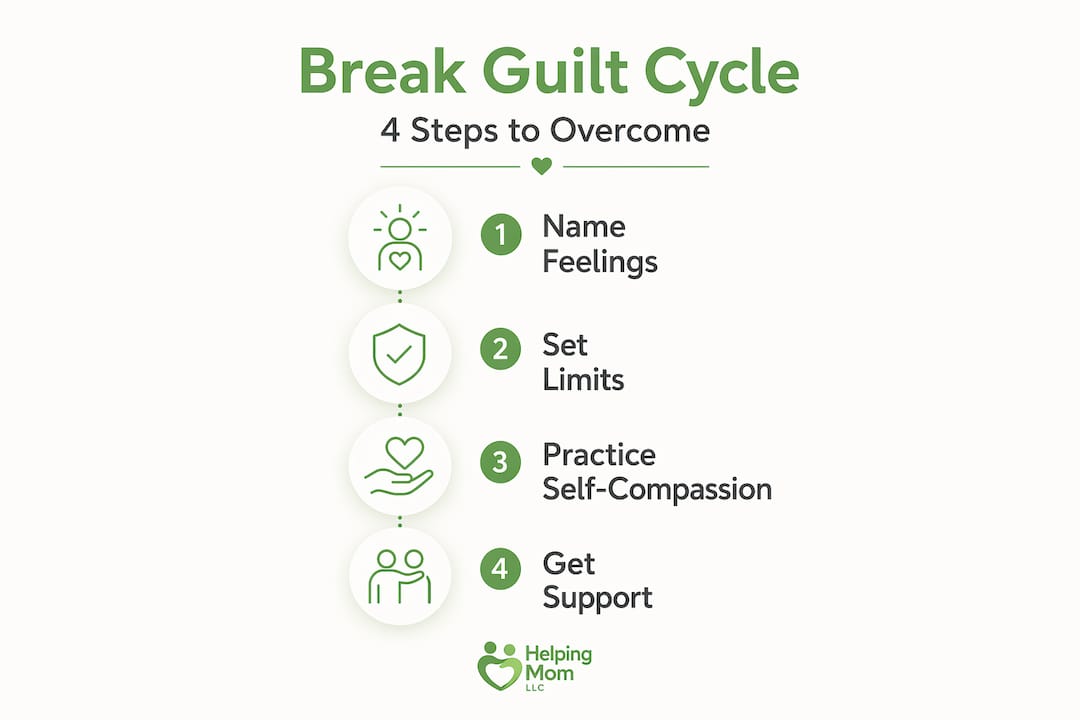
Healthline's guidance on caregiver guilt highlights several approaches that genuinely help: acknowledging your feelings, practicing self-compassion, setting realistic boundaries, and asking for help from others or professionals. These are not abstract ideas. They are practical actions you can start today.
Here are five strategies to begin with:
-
Name the guilt out loud. Simply saying "I feel guilty right now" to yourself or someone you trust takes away some of its power. Guilt grows in silence. Naming it interrupts that process.
-
Challenge the story you're telling yourself. When guilt speaks, it often sounds absolute: "I should have stayed longer," or "A better child would not have taken that break." Ask yourself whether the story is actually true, or whether it is a standard you would never hold a friend to.
-
Set one realistic boundary this week. You do not have to overhaul everything at once. Choose one area where you can set a clearer limit. Maybe it is committing to one evening per week that is yours. The setting boundaries guide at Helping Mom walks through this process step by step.
-
Accept help without apology. Asking a sibling to cover a visit, or arranging respite care for an afternoon, is not abandonment. It is smart, sustainable caregiving. The people who love your parent want to help. Let them.
-
Build in one moment of self-compassion each day. This could be as simple as writing one sentence at the end of the day that acknowledges something you did well. It retrains your inner voice over time.
If the guilt feels heavy and persistent, talking with a counselor or joining a caregiver support group can make a significant difference. You can find practical tips for coping with guilt and resources for emotional support that fit where you are right now.
Pro Tip: Respite care is not giving up. It is refueling. Even a few hours away from caregiving gives you the space to come back more present, more patient, and more capable. Think of it as an investment in the quality of your care.
A better way to think about caregiver guilt
Even with tactics in hand, it helps to step back and see caregiver guilt from a wider lens.
Here is something worth sitting with: guilt is not proof that you are failing. It is almost always evidence that you care deeply and that you take your role seriously. The caregivers who feel no guilt at all are often the ones who have stopped paying attention. You feel guilty precisely because this matters to you.
That said, guilt left unaddressed does not stay quiet forever. It tends to grow. It can shade into resentment, then exhaustion, then a kind of numbness that makes caregiving feel mechanical rather than meaningful. 59% of caregivers experience guilt, which means it is best understood as a common emotional response to an extraordinarily demanding role, not as a personal failing that sets you apart from others.
Consider this kind of scenario: a caregiver named Susan, a 54-year-old with a demanding full-time job and two teenage kids, decided after months of exhaustion to arrange for a home health aide to come in twice a week. She felt enormous guilt the first few times she used those afternoons to rest and spend time with her kids. But within a month, something shifted. She arrived at her mother's home more present and more patient. She was less reactive. She actually enjoyed their conversations again instead of just getting through them.
The break did not make her a less devoted daughter. It made her a more effective one. Balancing your needs with your parent's care is not a form of selfishness. It is a skill, and like any skill, it improves with practice. Managing caregiver fatigue is part of what makes long-term caregiving sustainable.
The mark of a thoughtful caregiver is not that guilt never shows up. It is that you notice it, question it, and gently keep moving forward rather than letting it steer you into the ground.
Helpful resources to support your caregiving journey
If you are navigating caregiver guilt, you do not have to figure it out alone. Helping Mom offers a growing library of practical, compassionate resources designed specifically for adult children in your situation. From emotional support for caregivers that helps you recognize burnout and build resilience, to step-by-step guides on making home safer for seniors so you can reduce daily worry about your parent's safety, these resources are built around real caregiving challenges. Taking one small step, reading one article, trying one new strategy, is how this journey moves forward. You are already doing something right by asking these questions.
Frequently asked questions
What does caregiver guilt feel like in daily life?
Caregiver guilt often feels like a nagging sense of not doing enough, even when you are doing your best. Psychology Today describes it as a persistent feeling of falling short despite considerable effort, and it can include feeling selfish simply for needing rest or support.
Is caregiver guilt a sign of failure?
No. Caregiver guilt is extremely common and usually reflects caring deeply rather than failing. 59% of caregivers experience it, which means it is a normal emotional response to a demanding role, not evidence of inadequacy.
How can I stop feeling guilty as a caregiver?
Begin by naming your feelings rather than suppressing them, then set more realistic expectations and practice self-compassion with small daily actions. Healthline's coping strategies include acknowledging feelings, setting realistic boundaries, and accepting help from others or professionals.
Does caregiver guilt lead to burnout?
Prolonged, unaddressed guilt can contribute significantly to emotional burnout, which is why Healthline emphasizes addressing guilt early through self-compassion and boundary-setting rather than waiting until exhaustion sets in.
Recommended
- Feeling Guilty About Your Aging Parent? Practical Ways to Cope with Caregiver Guilt | Helping Mom LLC
- Recognizing Caregiver Burnout: What It Really Feels Like (and What Helps) | Helping Mom LLC
- Managing Caregiver Stress - Practical Strategies for Caregivers | Helping Mom LLC
- Managing Caregiver Stress - Practical Strategies for Caregivers | Helping Mom LLC