

Daily living support is the non-medical help someone receives with basic self-care tasks and higher-order daily activities so they can stay safe and independent at home. Clinicians organize these tasks into two categories: Activities of Daily Living (ADLs) and Instrumental Activities of Daily Living (IADLs), which together form the backbone of how care needs are measured and planned in the U.S.
If you've noticed a subtle shift in how your parent is managing at home, here's what you need to know right now:
- What it covers: ADLs are basic self-care tasks like bathing, dressing, and eating. IADLs are more complex tasks like managing medications, paying bills, and preparing meals.
- Who typically helps: Family caregivers, personal care aides, home health aides, occupational therapists (OTs), and community programs all play a role depending on the level of need.
- One red flag to watch for: Missed medications or unpaid bills often signal IADL decline before basic self-care slips, and that's usually the right moment to act.
- One step to take this week: Run a brief ADL/IADL check at home, or call your parent's primary care doctor to request an OT assessment.
Helping-mom offers home-safety guides and caregiver checklists designed specifically for adult children navigating these early decisions.
Table of Contents
- What daily living support actually covers: ADLs vs. IADLs
- How daily living needs are assessed
- Types of daily living support and who provides each
- Signs your parent may need more daily living support
- How daily living support is paid for in the U.S.
- Practical ways to provide daily living support with dignity
- Key Takeaways
- A calm perspective on daily living support
- How Helping-mom can support your next steps
- Useful sources
- FAQ
What daily living support actually covers: ADLs vs. IADLs
Understanding the difference between ADLs and IADLs helps you see your parent's situation more clearly, without guesswork or alarm.
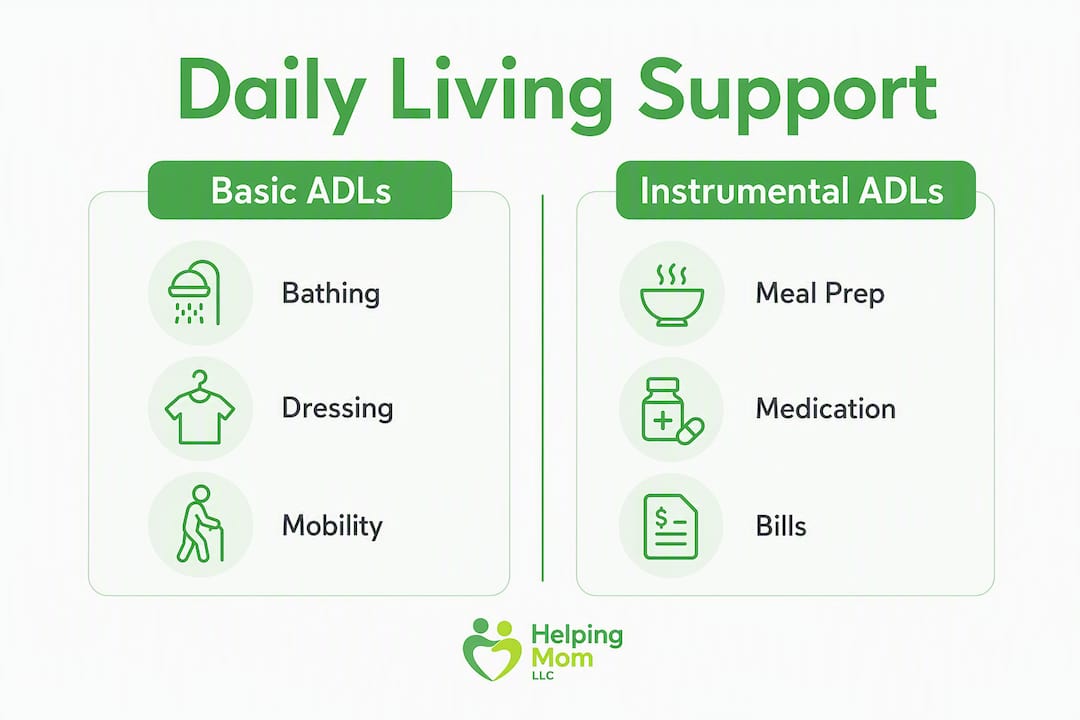
Basic ADLs are the foundational self-care tasks most people do every day without thinking:
- Bathing and showering
- Dressing and undressing
- Eating and swallowing
- Toileting and managing continence
- Transferring (moving from bed to chair, standing from seated)
- Personal hygiene and grooming
Instrumental ADLs are the more complex tasks that require planning, memory, and judgment:
- Preparing meals
- Grocery shopping and running errands
- Managing medications (ordering, organizing, taking correctly)
- Handling finances and paying bills
- Housekeeping and laundry
- Arranging transportation and managing appointments
- Using a phone or technology
Here's something worth knowing: IADLs require higher executive functioning and tend to decline before basic self-care does. A parent who still bathes and dresses independently may already be struggling to track their prescriptions or pay utilities on time. That gap between "looks fine" and "is actually managing" is where early intervention makes the biggest difference.
| Basic ADLs | Instrumental ADLs |
|---|---|
| Bathing and showering | Meal preparation |
| Dressing | Medication management |
| Eating | Managing finances and bills |
| Toileting and continence | Grocery shopping and errands |
| Transferring and mobility | Transportation and appointments |
| Personal hygiene and grooming | Using phone or technology |

A simple check you can do at home: Ask your parent to walk you through how they would prepare a simple lunch, step by step. Hesitation, confusion about steps, or an inability to name what's in the refrigerator can reveal more than a formal conversation ever would.
How daily living needs are assessed
Assessments take the emotion out of the conversation. Instead of debating whether Mom "seems fine," you have an objective picture of what she can and cannot do safely.
The Katz Index of Independence in Activities of Daily Living is the most widely used clinical tool for measuring basic ADL function. It evaluates six core tasks, bathing, dressing, toileting, transferring, continence, and eating, and scores each as independent or dependent. Clinicians often pair it with the Lawton IADL Scale, which covers the eight instrumental tasks listed above.
Who performs these assessments?
Occupational therapists, physical therapists, nurses, and social workers each bring a different lens:
- Occupational therapists (OTs): Focus on daily-task performance and home modifications. An OT can show you exactly which tasks your parent struggles with and recommend adaptive equipment.
- Physical therapists: Concentrate on mobility, balance, and safe transfers, particularly after a fall or hospitalization.
- Nurses: Assess medical stability alongside functional status and coordinate care plans.
- Social workers and case managers: Focus on eligibility for community services, funding, and care transitions.
Assessments use a mix of direct observation, performance-based tasks, caregiver reports, and standardized questionnaires. Scores translate into practical guidance: a person who scores as fully independent needs monitoring; someone who needs supervision for most tasks may benefit from part-time paid help; someone dependent across multiple ADLs may need daily personal care or a residential setting.
Before an assessment, bring:
- A written list of recent falls, including dates and circumstances
- A current medication list
- Two or three specific examples of IADL struggles you've observed
- Photos of the home environment if modifications may be needed
One more thing: assessments are not a one-time event. Functional ability can fluctuate with illness, hospitalization, or gradual decline, so providers often repeat them after a hospital discharge, an acute illness, or any noticeable change. Request a reassessment whenever something shifts, not just at annual checkups.
Key insight: Accurate documentation of functional decline is frequently required by insurance and government programs to authorize home help or long-term services and supports. An OT's written assessment is often the document that opens the door to paid services.
Types of daily living support and who provides each
Matching the right type of help to the right task makes care more effective and less expensive. Here's how the main options break down.
Non-medical personal care (private home care): Personal care aides and companion caregivers help with bathing, dressing, meal preparation, light housekeeping, and mobility assistance. This is the most common form of daily living assistance for people aging at home. It's typically private-pay or covered through certain Medicaid programs.
Home health vs. private home care: These two are often confused. Home health services are clinical, ordered by a physician, and covered by Medicare when a skilled need exists (wound care, physical therapy, medication management by a nurse). Private home care is non-medical and focuses on ADLs and companionship. Clinical tasks like injections or wound care fall outside the scope of a private home care agency and require licensed home health providers.
Community programs: Adult day centers offer structured daytime support, social engagement, and supervised activities for people who need more than home visits but aren't ready for residential care. Meals on Wheels delivers nutritious meals to homebound adults. Volunteer transportation programs help with medical appointments. Your local Area Agency on Aging can connect you with these services and help determine eligibility.
Residential options: When home-based support is no longer enough, assisted living provides help with ADLs in a supportive community setting. Skilled nursing facilities offer around-the-clock medical care for people with complex clinical needs.
Pro tip: When interviewing a private home care agency, ask these four questions directly: Do you conduct background checks on all caregivers? What training do your aides receive for ADL assistance? Is there an RN or supervisor available if a clinical question comes up? How do you handle scheduling gaps or caregiver absences? The answers tell you a lot about how the agency actually operates.
Best-practice guidance in home care encourages a stepped approach: assist only with what the person cannot do themselves, and enable what they still can. A good caregiver supports independence rather than replacing it.
Signs your parent may need more daily living support
You don't need to wait for a crisis. These observable changes are worth taking seriously:
- Noticeable weight loss or a refrigerator with little or no food
- Poor hygiene, unwashed hair, or wearing the same clothes repeatedly
- Missed medications or a pill organizer that hasn't been touched
- Unexplained falls, bruises, or near-misses
- Unpaid bills, late notices, or confusion about finances
- Inability to drive or arrange transportation to appointments
- A home that's becoming increasingly cluttered, dirty, or unsafe
How needs typically escalate
Help usually follows a predictable pattern, and recognizing where your parent falls on this path helps you plan ahead rather than react:
- IADL support first: — Meal prep, medication reminders, bill management, and transportation are usually the first areas to need outside help.
A simple three-step response plan
- Reassess in 2–6 weeks: — Check whether the support is working, whether needs have changed, and adjust accordingly.
If your parent has had a fall with injury, sudden confusion, or is unable to meet basic needs, call for help the same day. Those situations don't wait for a scheduled reassessment.
For more guidance on recognizing when home care may no longer be enough, Helping-mom's guide on when to consider assisted living walks through the decision with the same calm, step-by-step approach.
How daily living support is paid for in the U.S.
The honest starting point: most non-medical ADL and IADL help is private pay. That said, several funding pathways exist, and knowing them can significantly reduce out-of-pocket costs.
Common payment pathways:
- Long-term care insurance: — Covers personal care and home health services when a policy is in force. Review the policy's benefit triggers, which are usually defined by inability to perform two or more ADLs.
- Medicaid long-term services and supports (LTSS): — For eligible low-income adults, Medicaid waivers can cover personal care aides, adult day programs, and home modifications. Eligibility and covered services vary by state.
Accurate ADL/IADL documentation is often the deciding factor for public funding eligibility. Keep a written log of what your parent can and cannot do, and request that any OT or clinical assessment be documented in writing. That paperwork frequently determines whether a Medicaid waiver or insurance claim is approved.
Practical steps to take now: Check your parent's Medicaid eligibility through your state's benefits portal, call your local Area Agency on Aging (find yours at eldercare.acl.gov), and ask about short-term subsidized services while you explore longer-term options. For a deeper look at financial planning in caregiving, Helping-mom's guide to aging parent finances covers the key decisions without the jargon.
Practical ways to provide daily living support with dignity
How you help matters as much as whether you help. These approaches keep your parent in the driver's seat as much as possible.
Core principles to carry into every interaction:
- Ask before you assist. "Would you like help with that?" preserves autonomy in a way that simply stepping in does not.
- Offer choices rather than directives. "Do you want the blue shirt or the gray one?" keeps your parent engaged.
- Make tasks collaborative. Sit alongside rather than hovering over.
- Use gentle, unhurried language. Rushing creates anxiety and resistance.
Specific tactics for common ADLs:
- Dressing: Use stepwise prompting, lay out clothes in the order they go on, and choose adaptive clothing with Velcro closures or elastic waistbands when buttons become difficult.
- Eating: Adaptive utensils with larger grips, plate guards, and non-slip mats reduce spills and frustration without drawing attention to the difficulty.
- Bathing: A shower chair and a handheld showerhead are two of the highest-impact, lowest-cost modifications you can make. A bedside commode reduces nighttime fall risk significantly.
For IADLs:
- Set up a weekly pill organizer and pair it with a phone alarm or an automated medication dispenser.
- Simplify finances with autopay for recurring bills, and consider a joint account or a trusted third-party bill-pay service for oversight.
- Create a simple one-page weekly meal plan together so your parent feels ownership over what they eat.
Two quick scenarios:
Morning routine: Instead of taking over, lay out your parent's clothes the night before and offer a verbal prompt sequence: "Let's start with your shirt, then pants." Step back and let them do what they can.

Medications and bills: Every Sunday, sit together for ten minutes to fill the pill organizer and review any bills due that week. The routine itself becomes reassuring.
Pro Tip: An OT can visit your parent's home, identify specific fall risks, recommend adaptive equipment, and train family caregivers on safer transfer techniques, often in a single session. Ask the primary care doctor for a referral, or contact a home health agency directly.
Caregiver burnout is real, and it tends to build quietly. If you're providing daily hands-on help, build in at least one regular break each week, whether that's a few hours from a paid aide, an adult day program, or a family member rotating in. Helping-mom's resources on caregiver balance and burnout prevention offer practical strategies for protecting your own health while caring for someone else.
Key Takeaways
Daily living support covers both basic self-care (ADLs) and complex daily tasks (IADLs), and recognizing the difference between the two is the first step toward getting the right help at the right time.
| Point | Details |
|---|---|
| ADLs vs. IADLs | ADLs are basic self-care; IADLs are complex tasks. IADLs typically decline first, signaling early need. |
| Use the Katz Index | The Katz Index objectively scores six basic ADLs; pair it with a Lawton IADL assessment for a full picture. |
| Document everything | Written ADL/IADL records often determine eligibility for Medicaid waivers, VA benefits, and insurance coverage. |
| Match help to task | Non-medical personal care covers ADLs; Medicare covers skilled home health only when a medical need is documented. |
| Helping-mom resources | Helping-mom offers home-safety assessments, caregiver checklists, and Zoom consultations to help you plan next steps. |
A calm perspective on daily living support
Most families don't arrive at this topic with a clear plan. You notice something, a missed pill, a skipped shower, a stack of unopened mail, and a quiet worry takes hold. That's a normal and healthy response. What it usually means is that your parent needs a little more support, not a dramatic change.
Daily living support is not about taking over someone's life. It's about filling in the gaps so they can keep living on their own terms, safely and with dignity. The families who navigate this well tend to start small: one assessment, one conversation, one trial of help. They document what they see, ask the right professionals the right questions, and adjust as things change.
What I find families underestimate most is how much the IADL piece matters early on. When a parent is still physically capable but quietly struggling with medications, bills, or meals, that's the window where a small amount of support prevents a much larger crisis later. Waiting until basic self-care breaks down often means the family is already in reactive mode, making rushed decisions under pressure.
The other thing worth saying plainly: caring for a parent is genuinely hard work, and it tends to fall unevenly on one family member. Protecting your own health and capacity isn't a luxury. It's what makes sustained, quality care possible.
How Helping-mom can support your next steps
When you're trying to figure out where to start, having the right tools in hand makes a real difference. Helping-mom offers practical, low-friction resources built specifically for adult children at this stage of caregiving.
The home safety guide for seniors walks you through the most common ADL-related risks in the home and shows you exactly what to look for and what to change. The aging-in-place checklist gives you a printable, room-by-room tool you can use this week. For families who want a guided conversation, Helping-mom also offers paid 30-minute Zoom consultations where you can talk through your specific situation and get a clear, calm plan. In-person home safety assessments are available locally in Central Florida.
Start with the free checklist, or book a short consultation to get a plan that fits your parent's actual needs.
Useful sources
These are the sources worth bookmarking as you learn more and plan next steps:
- Activities of Daily Living, StatPearls / NCBI Bookshelf — A clinical reference covering ADL definitions, assessment tools, and how functional status guides care planning and eligibility decisions.
- Activities of Daily Living (ADLs and IADLs), Cleveland Clinic — A clear, reader-friendly explanation of both ADL categories with examples; a good starting point for family conversations.
- Katz Index of Independence in ADLs, Hartford Institute for Geriatric Nursing — The actual Katz Index tool in PDF form; print it and bring it to your parent's next clinical appointment.
- Eldercare Locator, U.S. Administration on Aging — The federal tool for finding your local Area Agency on Aging, which can connect you with funded in-home services and eligibility checks.
- Helping-mom Caregiving Resources — Guides, checklists, and planning templates for adult children managing home safety, aging in place, and caregiver wellness.
Contact your local Area Agency on Aging directly after reading. They can tell you within one call what funded services your parent may qualify for in your state.
This article provides general information for caregivers and is not a substitute for professional medical, legal, or financial advice. Confirm current program eligibility and care options with a qualified clinician or your state's relevant agency.
FAQ
What does assistance with daily living mean?
Assistance with daily living means non-medical help with the tasks a person needs to stay safe and independent, including basic self-care (ADLs like bathing and dressing) and more complex activities (IADLs like managing medications and finances). It can be provided by family members, paid personal care aides, or community programs.
What is the most common ADL assessment tool?
The Katz Index of Independence in Activities of Daily Living is the most widely used clinical tool; it scores six basic ADLs and is often paired with the Lawton IADL Scale for a complete picture of functional status.
Does Medicare pay for daily living support at home?
Medicare covers skilled home health services (nursing, physical therapy, occupational therapy) when ordered by a physician and tied to a medical need. It does not cover routine personal care or homemaker services unless they are part of a documented skilled care plan.
Who should I call first if I think my parent needs daily living support?
Start with your parent's primary care physician to request a functional assessment or an OT referral. You can also call your local Area Agency on Aging (find yours at eldercare.acl.gov) for a free needs assessment and information about funded community services.
When should IADLs raise a red flag?
Missed medications, unpaid bills, or an inability to manage grocery shopping are early warning signs that IADLs are declining, often before basic self-care is affected. Because IADLs require higher executive functioning and tend to decline first, acting on these signs early gives families the most options.