
Many families assume in-home care simply means hiring someone to help with light housework or drive their parent to appointments. That's a natural assumption. But in-home care is far broader than that, and understanding its full scope can genuinely change how you approach your parent's safety, independence, and quality of life. This guide walks you through what in-home care truly means, how it reduces real risks at home, how it supports you as a family caregiver, and how to take your first practical steps forward with confidence.
Table of Contents
- What is in-home care? Defining support at home
- How in-home care improves safety and independence
- Supporting caregiver wellness and family harmony
- Getting started: Steps for choosing in-home care
- Why in-home care decisions are about more than safety features
- Explore tailored resources for your family's care journey
- Frequently asked questions
Key Takeaways
| Point | Details |
|---|---|
| More than housekeeping | In-home care means broad support for safety, wellness, and family communication. |
| Safety upgrades matter | Simple changes like removing rugs and improving lighting can make a home much safer for aging parents. |
| Caregiver relief is crucial | Regular in-home support lets family caregivers maintain their own well-being and prevent burnout. |
| Family talks pay off | Sensitive, open discussions with aging parents make care transitions smoother and less stressful. |
What is in-home care? Defining support at home
In-home care is professional support provided to older adults in their own homes, covering a wide range of non-medical services. It is not just a housekeeper. And it is not a medical nurse. It sits somewhere in between, offering hands-on, day-to-day support that keeps aging parents safe, comfortable, and as independent as possible.
Here are some common misunderstandings families have about in-home care:
- "It's just housekeeping." In reality, it includes personal care, meal preparation, medication reminders, companionship, and safety monitoring.
- "It's only for people with serious health issues." Many families begin in-home care early as a preventive step, well before a crisis occurs.
- "It means giving up independence." The opposite is often true. Good in-home care is designed to preserve your parent's independence, not replace it.
- "It's the same as a nursing home." In-home care allows older adults to stay in their own familiar environment, which most prefer.
- "It's unaffordable for most families." Costs vary widely, and some services may be covered by long-term care insurance or other programs.
Understanding aging in place explained helps clarify why so many families choose in-home care. The goal is to allow your parent to remain in the home they know and love, with the right support around them.
Here is a helpful overview of the main types of in-home care services:
| Type of service | What it includes | Who it helps most |
|---|---|---|
| Personal care | Bathing, dressing, grooming, toileting | Those with limited mobility or early dementia |
| Homemaker services | Meal preparation, laundry, light cleaning | Anyone needing daily household support |
| Home modifications | Grab bars, ramps, improved lighting, non-slip surfaces | Anyone at risk of falls |
| Specialized memory care | Dementia-specific routines, safety monitoring | Parents with Alzheimer's or memory concerns |
| Companionship care | Social engagement, errands, conversation | Those experiencing isolation or mild depression |
| Respite care | Temporary relief for family caregivers | You, the adult child caregiver |
Home safety for aging in place focuses heavily on fall-risk reduction, including removing tripping hazards like area rugs, improving lighting, and adding bathroom safety supports such as grab bars and non-slip surfaces. Safety is woven into the very definition of quality in-home care, not added as an afterthought.
With the basics framed, let's look closer at why so many families choose in-home care.
How in-home care improves safety and independence
Falls are one of the most serious risks for older adults living at home. In fact, they are a leading cause of injury-related hospital visits for people over 65. In-home care providers often conduct home safety checks as a core part of their service, helping you and your parent identify risks before an accident happens.
The reassuring thing is that many of the most effective safety changes are straightforward. You do not need to renovate an entire home to make a meaningful difference.
Here are the essential safety improvements that in-home care providers typically prioritize:
- Remove area rugs and loose cords. These are among the most common tripping hazards. Replace rugs with non-slip alternatives or remove them entirely.
- Improve lighting throughout the home. This includes hallways, staircases, and bedrooms. Motion-activated lights are especially useful at night.
- Add grab bars in the bathroom. Near the toilet and inside the shower or tub, bathroom grab bar options can prevent serious falls during the most vulnerable moments of the day.
- Install non-slip strips and mats. Especially in the bathroom and on steps, these surfaces provide traction that standard flooring does not.
- Secure carpets firmly. Any carpet that shifts or bunches at the edges needs to be fixed flat or replaced.
- Clear pathways throughout the home. Furniture arrangements that made sense years ago may now create obstacles for someone with reduced mobility or slower reflexes.
NIA recommendations include removing area rugs and firmly fixing carpets, ensuring good lighting especially at the top and bottom of stairs, installing grab bars near toilets and in the tub or shower, and reducing fall hazards with non-slip strips throughout the home. These are not complicated upgrades. Many can be done in an afternoon.
Here is a practical look at what life with and without professional in-home care can look like:
| Factor | Without in-home care | With in-home care |
|---|---|---|
| Fall risk | Higher, especially with unaddressed hazards | Reduced through regular safety checks and modifications |
| Independence | May decline faster without daily support | Preserved longer through consistent, calibrated help |
| Family caregiver stress | Often high, with no regular relief | Reduced through scheduled respite and expert support |
| Hospital visits | More frequent due to preventable accidents | Fewer, thanks to proactive safety measures |
| Social engagement | May decrease over time | Maintained through companionship services |
Use our home safety checklist to walk through your parent's home room by room. It makes the process manageable and easy to share with siblings or other family members.
Pro Tip: A few well-placed grab bars and one or two brighter light bulbs in key spots can reduce your parent's fall risk more than almost any other single change you could make. Start there.
You can also explore fall prevention tips for additional guidance on keeping your parent safe without turning their home into an obstacle course of caution signs.
Beyond safety, in-home care can also play a crucial role in supporting the wellness of family caregivers themselves.
Supporting caregiver wellness and family harmony
If you are the primary caregiver for an aging parent, you already know how much energy it takes. The grocery runs, the medication reminders, the worry that never quite turns off. In-home care does not replace your role. But it can give you room to breathe.
One of the quieter benefits of in-home care is respite. That simply means a break. It can be a few hours a week or a few days a month, but that regular relief makes a real difference in reducing caregiver burnout. Studies consistently show that family caregivers who have consistent support are less likely to experience depression, anxiety, and physical exhaustion.
Here is how in-home care specifically supports family caregivers:
- Regular scheduled respite so you can rest, work, or simply have time for yourself without guilt.
- Practical help with daily tasks like meals and laundry, which lightens the overall load on the household.
- Expert guidance and observation from trained caregivers who can flag concerns you might not notice during shorter visits.
- Emotional reassurance knowing that your parent is not alone or at risk while you are away.
- Consistency and routine for your parent, which is especially important for those with memory concerns or anxiety.
Placing non-slip mats in bathrooms and installing motion-activated bright lighting are recommended steps that in-home care professionals can help coordinate, so you do not have to figure out all the logistics alone.
Family communication is just as important as the physical setup. When siblings or other relatives have different views on what your parent needs, it can create tension that makes caregiving even harder. Opening a calm, honest conversation early, before a crisis forces the issue, is one of the most protective things you can do for your family's harmony.
Pro Tip: Schedule a brief family check-in once a month, even just a 20-minute video call, to share observations and updates. This keeps everyone informed and reduces the chance of disagreements spiraling.
For more practical strategies, explore caregiver wellness tips and guidance on talking with aging parents when conversations feel difficult.
As you weigh your family's needs, it is helpful to know what to expect and how to get started with in-home care.
Getting started: Steps for choosing in-home care
Starting the process can feel like a lot. There are agencies to research, needs to assess, and conversations to have. But it does not all have to happen at once. Taking it one step at a time makes it manageable.
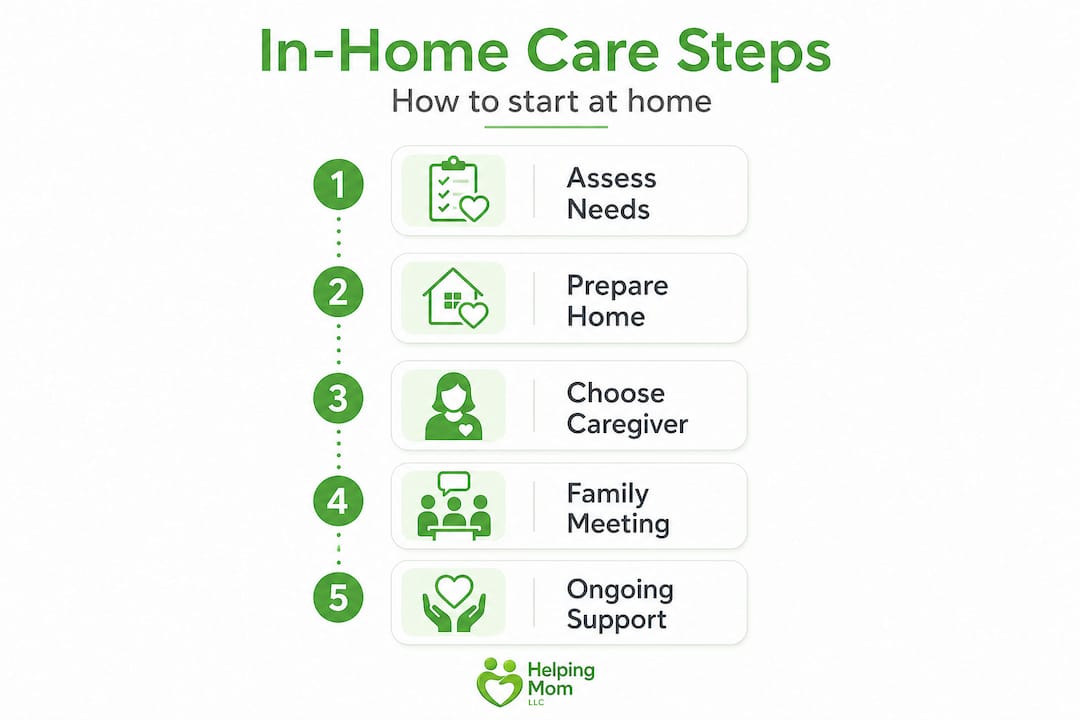
Here is a practical roadmap to get you started:
-
Assess your parent's needs honestly. Think about what tasks they struggle with most. Is it bathing? Meals? Getting around the house safely? Being honest about the current situation helps you find the right level of support.
-
Research qualified agencies in your area. Look for licensed agencies with trained, background-checked staff. Ask about their screening process, how they handle emergencies, and whether they provide consistent caregivers or rotate staff frequently.
-
Consult with a care professional or social worker. A geriatric care manager or hospital social worker can help you assess needs more objectively and point you toward reputable local providers.
-
Complete home safety updates before care begins. This is the right time to walk through the home with fresh eyes. Our guide on making home safer gives you a room-by-room approach that is practical and easy to follow.
-
Start small if needed. You do not have to commit to full-time in-home care from day one. Many families begin with a few hours a week and expand as needs grow.
-
Monitor and adjust over time. Your parent's needs will change. The best in-home care arrangements are ones that adapt alongside those changes, rather than staying rigid when the situation shifts.
Installing non-slip mats and motion-activated lighting are foundational steps in preparing a home for in-home care. These details matter and they are worth addressing before your parent's first care day.
Involve all relevant family members in the early stages if possible. Even siblings who live far away can play a role in research, financial planning, or simply lending a calm voice during family conversations.
Before closing, let's consider a deeper perspective on why conversations and ongoing adaptation really matter in home care decisions.
Why in-home care decisions are about more than safety features
Here is something that does not get said often enough: you can install every grab bar, swap out every area rug, and brighten every hallway in your parent's home, and still miss what matters most.
Physical safety upgrades are real and important. But the families who tend to navigate caregiving most successfully are not just the ones with the safest homes. They are the ones who maintain open, honest, ongoing communication with their parents. The ones who keep asking, "How are you feeling about this?" rather than just "Is the house ready?"
Your parent has opinions about their own care. Often strong ones. And when those opinions are not heard or respected, even the most thoughtfully arranged care plan can feel like an imposition rather than a support. That quiet sense of loss of control can affect a person's mood, motivation, and even their physical health.
This is why communicating openly with parents about care decisions is not optional. It is foundational. No safety checklist replaces the conversation where your parent tells you what they actually want and where you genuinely listen.
In-home care works best when it is designed with your parent, not just for them. That means their preferences about who comes into their home, when, and how often should shape the plan. It means checking in regularly and adjusting as the relationship evolves. And it means treating the caregiver who comes into the home as part of a team, not as a solution you have installed and can now stop thinking about.
The safety features matter. The right caregiver matters. But the conversations, the trust, and the ongoing relationship you maintain with your parent through this process may be what determines how well everything else actually works.
Explore tailored resources for your family's care journey
Taking the next step does not have to feel overwhelming. At Helping Mom, we have put together practical, easy-to-use resources designed specifically for adult children navigating exactly what you are facing right now. Whether you are just starting to think about in-home care or you are already in the thick of it, you will find tools here that help you move forward with clarity.
Start with our home safety guide to understand what changes matter most. Then use the elderly home safety checklist to walk through your parent's home in a structured, manageable way. And when the emotional weight of caregiving feels heavy, our caregiver emotional support resources are there to remind you that taking care of yourself is part of taking care of your parent.
Frequently asked questions
What services are included in in-home care?
In-home care typically includes help with daily activities, meal preparation, medication reminders, safety checks, and companionship. Fall-risk reduction, such as removing tripping hazards and adding bathroom safety supports, is also a core component of many in-home care services.
How is in-home care different from home health care?
In-home care focuses on non-medical, daily living support, while home health care involves clinical services delivered by licensed medical professionals such as nurses or physical therapists.
What home safety changes can help prevent falls?
Removing area rugs, installing grab bars, improving lighting, and placing non-slip mats in bathrooms are among the most effective fall-prevention steps recommended by the National Institute on Aging.
How can families handle disagreements about care?
Open, calm conversations held early and regularly, ideally before a crisis occurs, help families align on shared priorities and reduce conflict when making care decisions together.
Where can I find a home safety checklist for aging parents?
You can use an evidence-based checklist from trusted organizations like the National Institute on Aging, or work through a structured guide with your in-home care agency during an initial home safety assessment.