
When a parent starts showing signs of memory loss, one of the first things families search for is some kind of care that feels right. Many assume that assisted living will cover it, or that a nursing home is the only other option. But memory care is its own category, and understanding what makes it different can change the entire direction of your planning. This guide walks you through what memory care actually is, how it compares to other options, what it costs, and how to find a community that genuinely fits your loved one's needs.
Table of Contents
- What is memory care?
- How memory care compares to assisted living
- How memory care supports safety and quality of life
- Understanding memory care costs and planning ahead
- How to choose a quality memory care community
- A compassionate perspective on memory care decisions
- Next steps and helpful resources for your family
- Frequently asked questions
Key Takeaways
| Point | Details |
|---|---|
| Memory care basics | Memory care is a specialized, secure environment for people with dementia needing 24-hour support. |
| Key differences | Unlike assisted living, memory care focuses on cognitive safety, structure, and specially trained staff. |
| Safety and quality | Effective memory care combines secure design, routines, and staff expertise to improve well-being and comfort. |
| Planning and costs | Expect median monthly costs near $6,690 and research local options based on your parent’s needs. |
| Choosing wisely | Tour communities, ask key questions, and look for warning signs to choose the best memory care fit. |
What is memory care?
Memory care is residential care built specifically for people living with Alzheimer's disease or other forms of dementia. It is not a wing of a hospital or a catch-all senior care setting. It is a purpose-built environment designed around the unique challenges that come with cognitive decline.
Memory care is a type of long-term residential care designed for people with Alzheimer's disease or other dementia who need 24-hour supervision in a secured environment. That definition matters because it sets memory care apart from most other care options available to families today.
Here is what you can generally expect a memory care community to include:
- 24-hour staffing and supervision from trained caregivers who understand dementia behaviors
- Secured building design with controlled exits, alarm systems, and layouts that reduce the risk of wandering
- Structured daily routines that provide consistency and reduce anxiety for residents
- Therapeutic activities designed to engage memory, creativity, and movement at an appropriate level
- Personalized care plans that evolve as the resident's needs change
- Meals, housekeeping, and personal care integrated into a single living environment
Memory care is not just about keeping someone safe. It is about preserving their dignity, engaging their remaining strengths, and creating an environment where they can feel calm and understood.
If you are still learning about what dementia looks like in an aging parent, it helps to start with understanding dementia in parents before you begin comparing care options. And if your parent is still at home, helping a parent with memory loss offers practical guidance for the day-to-day.
With this foundation, let's clarify how memory care distinguishes itself from standard assisted living.
How memory care compares to assisted living
Many families arrive at this question after something goes wrong. Maybe their parent moved into assisted living and began wandering at night. Or staff called to say they were not equipped to manage aggressive behavior. These are not failures of the family's planning. They are signs that the needs outgrew what assisted living is designed to provide.
Memory care differs from assisted living: it is built around cognitive safety needs including supervision, structure, and environment, rather than only help with activities of daily living. Assisted living is a great fit for someone who needs help with bathing, dressing, or medication management but still has relatively intact judgment and awareness. Memory care is designed for someone whose cognitive impairment affects safety, communication, and daily functioning in ways that go much deeper.

Here is a side-by-side look at how the two compare:
| Feature | Assisted living | Memory care |
|---|---|---|
| Staff training | General senior care | Dementia-specific training |
| Security | Standard building | Secured exits, alarms, monitored |
| Daily structure | Flexible, resident-led | Highly structured routines |
| Activities | Social and recreational | Cognitively targeted therapies |
| Cost | Lower on average | Higher due to staffing and security |
| Supervision level | Available but not constant | 24-hour active supervision |
| Resident population | Mixed senior population | Dementia-specific community |
Some key differences families often overlook:
- Staff-to-resident ratios are typically higher in memory care because residents need more hands-on support
- Physical environment in memory care is designed to reduce confusion, with clear sightlines, simple layouts, and calming colors
- Communication approaches are different because staff are trained to meet residents where they are, not correct or argue with them
Pro Tip: If you are unsure which level of care your parent needs, start by noting how often they get lost in familiar places, whether they have wandered, and how they respond when routines are disrupted. These patterns often tell you more than a diagnosis alone.
For families thinking ahead, practical long-term care planning can help you map out what your options look like over time. And if you are still watching for warning signs at home, reviewing early dementia symptoms may help you understand where your parent currently falls on the spectrum.
Understanding these distinctions sets the stage for practical concerns like safety and real-life quality of life.
How memory care supports safety and quality of life
Safety in memory care goes well beyond locked doors. It is the result of many intentional design and staffing decisions working together. When you tour a memory care community, you are looking at an environment that has been shaped around a very specific question: how do we keep someone with impaired judgment safe, calm, and engaged every single day?
The meaningful differences in memory care typically show up in staffing training, secured and safety-oriented environment design, and the day-to-day structure provided to residents. These are not just selling points. They are the factors that determine whether a person with dementia thrives or deteriorates in a residential setting.
Here is how these elements actually play out in practice:
-
Secured exits and monitored pathways. Wandering is one of the most common and dangerous behaviors in dementia. Memory care communities use alarmed doors, keypad entries, and enclosed outdoor spaces so residents can move freely without risk.
-
Consistent staffing. Familiar faces matter enormously to someone with memory loss. When the same caregivers show up each shift, residents feel a sense of safety they cannot always articulate but clearly experience. High staff turnover disrupts this in ways that are hard to overstate.
-
Structured daily routines. A predictable schedule reduces anxiety and behavioral distress. Residents know when meals happen, when activities occur, and when it is time to rest. That structure functions like an anchor when internal time awareness fades.
-
Therapeutic activities tailored to ability. Good memory care activities are not just recreation. They are designed to engage preserved abilities, whether that is music recognition, simple crafts, gentle movement, or reminiscence conversations. These activities help maintain dignity and connection.
-
Environmental design that reduces confusion. Soft lighting, low noise, simple wayfinding cues, and familiar-feeling spaces all reduce overstimulation. It sounds subtle, but it makes a real difference in how calm and oriented residents feel throughout the day.
A well-designed memory care community does not feel like a locked facility. It feels like a calm, familiar neighborhood where your parent belongs.
If you are thinking about memory care safety features in the context of your parent's current home, these same principles of reducing hazards and increasing predictability apply at home too.
With a grasp on what effective memory care looks like, families can turn to the practical question: what does it cost and how do you plan for it?
Understanding memory care costs and planning ahead
Cost is often the point where families feel most overwhelmed. The numbers can feel large, and the uncertainty about how long care will be needed makes planning feel impossible. But taking a clear look at the actual figures, and what drives them, makes the picture more manageable.
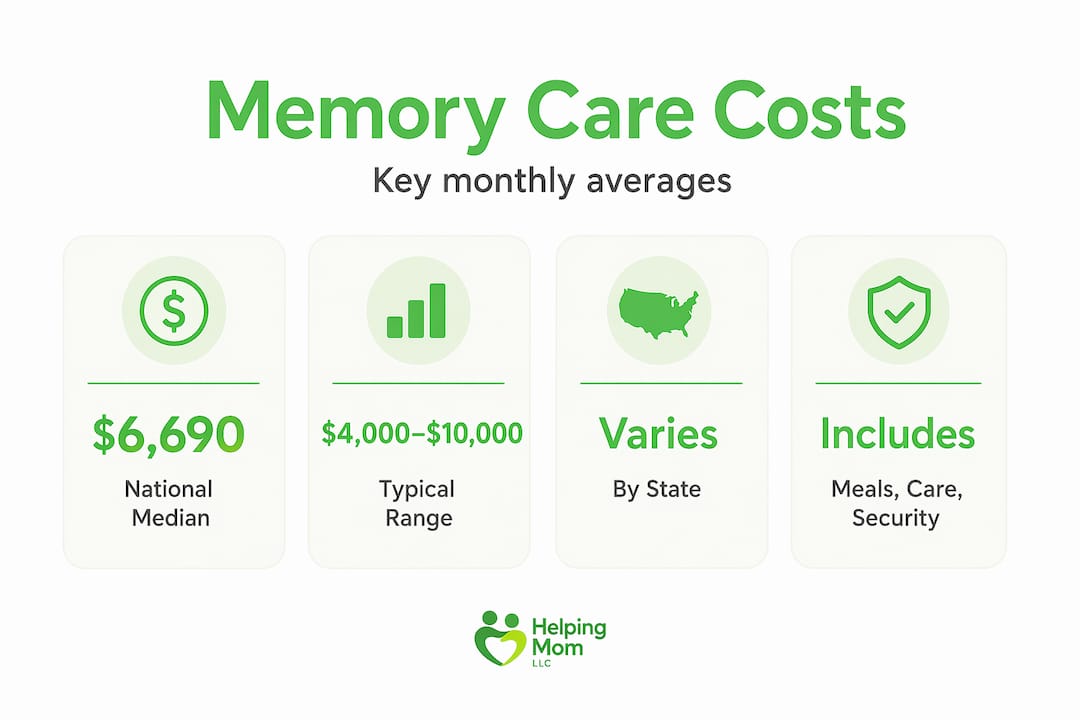
The national median cost of memory care is about $6,690 per month, and prices vary significantly by state, location, and level of care needed. That is roughly $80,000 per year at the median, though families in high-cost states like California or New York often see rates well above that.
Here is a general sense of how costs vary:
| Care type | Estimated monthly cost |
|---|---|
| In-home dementia care (part-time) | $2,000 to $4,500 |
| Assisted living (standard) | $4,000 to $5,500 |
| Memory care (dedicated community) | $5,500 to $9,000+ |
| Skilled nursing facility | $7,000 to $10,000+ |
What drives memory care costs higher than standard assisted living?
- Higher staffing levels with specialized dementia training
- Security systems and physical design built into the facility
- Structured programming that requires trained activity coordinators
- Higher supervision requirements around the clock
Here are the key planning steps families should take sooner rather than later:
- Compare local rates directly. National medians only tell part of the story. Rates in your region may be significantly different.
- Understand what is included in the base fee. Some communities charge extra for medication management, incontinence care, or behavioral support.
- Estimate length of stay. The average person lives with dementia for 4 to 8 years after diagnosis. Not all of that time will require memory care, but planning for 2 to 4 years of residential care is a reasonable starting point.
- Review financial resources early. Long-term care insurance, veterans benefits, and Medicaid (in many states) may help offset costs. Explore these options before they are urgently needed.
For a broader framework, long-term care financial planning walks through how to think about care timelines and funding sources without the overwhelm. If you are still in the observation phase with your parent, reviewing early signs of dementia can help you understand how much time you may have to plan.
Finally, understanding the basics enables families to make informed, compassionate decisions as needs evolve.
How to choose a quality memory care community
Choosing a memory care community is one of the most significant decisions a family can make. The options can feel overwhelming, and the emotional weight of the decision makes clear thinking harder. A practical checklist helps.
When you tour a memory care community, look for these specific things:
- Secured exits with clear protocols. Ask how often residents attempt to leave and how staff respond. The answer tells you a great deal about the community's experience level.
- Staff interactions with current residents. Watch whether caregivers make eye contact, speak calmly, and use residents' names. This is more revealing than any brochure.
- Daily activity schedule posted and in use. Ask to see a sample week. Are activities happening, or just listed?
- Family communication policies. How are families notified of changes in behavior, health, or medication? Is there a care coordinator you can contact directly?
- Smell and cleanliness throughout. A well-run memory care community is clean and odor-free in all areas, not just the lobby.
Questions to ask during your tour:
- What is the staff-to-resident ratio during daytime and overnight shifts?
- How do you handle residents who become agitated or resistant to care?
- How often are care plans reviewed and updated?
- What happens if my parent's needs increase significantly? Do you have a transfer protocol?
- What is your staff turnover rate in the past year?
Warning signs to take seriously:
- Staff who seem distracted, rushed, or unable to answer basic questions
- Inconsistent or unclear routines when you ask about the daily schedule
- Unsecured or propped-open exit doors during your visit
- Residents left alone in common areas without engagement or supervision
- Vague answers about how behavioral challenges are managed
Memory care is built around 24-hour supervision in a secured environment, and any community that cannot clearly demonstrate how they deliver that should raise concern. Use the caregiving resource library to find additional checklists and tools to prepare for tours and family conversations.
A compassionate perspective on memory care decisions
Here is something that does not get said enough: memory care is not a finish line. Moving a parent into memory care does not mean the hard part is over. In many ways, it opens a new chapter of caregiving, one that happens from a distance and requires a different kind of attention.
The families who navigate this transition best are the ones who stay involved. They visit regularly, even when their parent may not always recognize them. They build relationships with staff. They speak up when something feels off. They treat the community not as a solution but as a partner.
Memory care is only as effective as the fit between the person and the community. A diagnosis does not tell you which community is right. Your parent's personality, history, and emotional world still matter. Someone who was deeply social may thrive in a community with robust group programming. Someone more introverted may do better with quieter, one-on-one engagement. Trust what you know about your parent, not just what the brochure describes.
The care planning journey is not about finding the perfect answer. It is about making thoughtful, loving decisions with the information you have, and staying present enough to adjust when something needs to change.
There is also a truth about family involvement that many families underestimate. Even in the best memory care community, your presence matters. Your parent may not always know who you are, but they feel that someone cares. That feeling is real, and it is irreplaceable.
Next steps and helpful resources for your family
Navigating memory care options is a lot to carry. Whether you are in the early stages of planning or facing an urgent transition, you do not have to figure it out alone. At Helping Mom, we have gathered practical tools to help you move forward with confidence and calm.
Start with our elderly home safety checklist if your parent is still at home and you are assessing whether that can continue safely. When you are ready to focus on your own wellbeing through this process, our caregiver well-being support resources offer honest, grounded guidance for the emotional side of caregiving. You are making hard decisions out of love, and the support you need is here when you are ready for it.
Frequently asked questions
Who qualifies for memory care?
Memory care is for people diagnosed with Alzheimer's or other dementias who need 24-hour supervision and a secure, structured living environment to stay safe.
How is memory care different from a nursing home?
Memory care focuses specifically on cognitive safety and dementia support, while nursing homes are designed to provide medical care for people with serious or chronic physical health conditions.
What is usually included in the monthly cost of memory care?
Most memory care communities include housing, meals, 24-hour dementia-trained staff, structured activities, and secured supervision in the base monthly fee, though some services may cost extra.
How much does memory care cost each month?
The national median is about $6,690 per month, though costs vary considerably depending on your location, the level of care needed, and the specific community.
Is memory care only for Alzheimer's disease?
No. Memory care serves people with any type of dementia, including Alzheimer's and other related conditions that cause significant cognitive decline and safety concerns.