

Senior financial abuse is the illegal, unauthorized, or improper use of an older adult's money, property, or assets for someone else's benefit. It can happen in a single afternoon, when a stranger convinces your father to wire money for a "grandchild in trouble," or it can unfold slowly, over years, when a trusted family member quietly redirects your mother's Social Security checks.
If you suspect this is happening to your parent right now, here is where to start:
- Preserve everything. Do not shred, delete, or return anything, bank statements, checks, emails, text messages. Photograph documents if you're worried they'll disappear.
- Contact the bank's fraud department directly and ask about placing a temporary hold on suspicious transactions.
- Call Adult Protective Services (APS) in your parent's county, and local police if money has already been taken.
- Freeze new credit through the three credit bureaus if identity theft is a concern.
You don't have to have proof to make these calls. You just need a reasonable concern, and the people on the other end of that line have heard it before. Acting early protects your parent's dignity as much as their money.
Key Takeaways
Senior financial abuse is the unauthorized or improper use of an older adult's money or property, and it's most often stopped by early documentation, quick reporting, and small ongoing safeguards rather than dramatic intervention.
| Point | Details |
|---|---|
| Know the definition | Senior financial abuse means someone uses an older adult's funds, property, or assets without authorization or for their own benefit. |
| Watch for combined red flags | Unexplained withdrawals paired with a new "best friend" or sudden defensiveness about money are the clearest warning combination. |
| Act fast if you suspect it | Preserve records first, then contact the bank's fraud team and Adult Protective Services the same day. |
| Build a small safeguard | Set up a spending alert or trusted-contact designation on your parent's bank account this month. |
| Use Helping-mom's guides | Helping-mom's finance and family meeting templates give caregivers a structured way to monitor accounts and start these conversations calmly. |
Table of Contents
- What Is Senior Financial Abuse, Officially?
- What Does Financial Abuse Actually Look Like?
- Who Commits This, and Why Do They Target Older Adults?
- What Are the Warning Signs of Financial Abuse?
- How Does Financial Exploitation Usually Unfold?
- What Should You Do If You Suspect Abuse?
- How Can Families Prevent Financial Abuse?
- How Do You Bring This Up Without Damaging Trust?
- A Word of Encouragement From Helping-mom
- Where Helping-mom Can Help You Take the Next Step
- Where to Report and Get More Help
- Sources
- FAQ
What Is Senior Financial Abuse, Officially?
Federal agencies use slightly different names for the same core problem. The Department of Justice and most researchers call it elder financial exploitation, while everyday conversations tend to say senior financial abuse or elder financial abuse. All three refer to the same issue: someone using an older adult's funds, property, or assets in a way that wasn't authorized or that benefits the wrong person.
The Department of Justice's Elder Justice Initiative notes that this kind of exploitation is often committed by someone the older adult trusts, which is a big part of why victims stay quiet. Shame, fear of losing independence, and simple dependency on the person doing the harm all keep families from reporting it. FinCEN's own definition backs this up: elder financial exploitation is the illegal or improper use of an older adult's funds, property, or assets, and FinCEN's 2022 advisory calls it the most common form of elder abuse overall, more common than physical neglect or emotional abuse.
The scale is bigger than most families expect. Suspicious activity reports (SARs), the forms banks file when they spot a transaction that looks wrong, show a clear upward trend.
Those figures come from the CFPB's report on suspicious activity reports related to elder financial exploitation, and they only reflect what banks caught and reported. Plenty of cases never generate a SAR at all, especially when the person taking money is a relative with legitimate account access.
Older adults made up roughly 35% of victims in fraud reports where age was provided, according to FTC data cited by the Department of Justice. It's something worth watching for in every family, not just the ones where a red flag has already appeared.
What Does Financial Abuse Actually Look Like?
Reading a legal definition doesn't prepare you for spotting it in real life. Here are the patterns caregivers run into most often, with a quick example for each.
- Theft by a trusted person. A live-in caregiver or adult child "borrows" cash from a wallet or writes checks to themselves from a parent's account.
- Power-of-attorney abuse. An agent with valid POA paperwork starts paying personal bills, like a car payment or a credit card, out of the parent's account.
- Romance and imposter scams. An online "friend" who never video calls asks for gift cards to cover a medical emergency overseas.
- Medicare and insurance fraud. Someone bills Medicare for equipment or services the senior never received, often using a stolen Medicare number.
- Identity theft. A new credit card shows up in the mail that your parent never applied for.
- Investment scams. A cold caller pitches a "guaranteed" return on a fake annuity or cryptocurrency deal.
- Home-sale or title fraud. Someone pressures a senior to sign over property rights, sometimes disguised as a reverse mortgage or home-repair contract.
- Financial neglect. A caregiver has access to funds but lets bills go unpaid anyway, leaving the senior without utilities or medication.
Pro Tip: If your parent suddenly can't explain a transaction, that's more telling than the transaction itself. Confusion about where money went, more than the amount, is usually the fastest way to catch a problem early.
Who Commits This, and Why Do They Target Older Adults?
Perpetrators generally fall into two very different camps, and knowing which one you're dealing with changes how you respond. The first group is people your parent already trusts: adult children, grandchildren, in-home caregivers, or even a professional fiduciary appointed to manage finances. The second group is strangers, running scams by phone, email, or a dating app, who will never meet your parent in person.
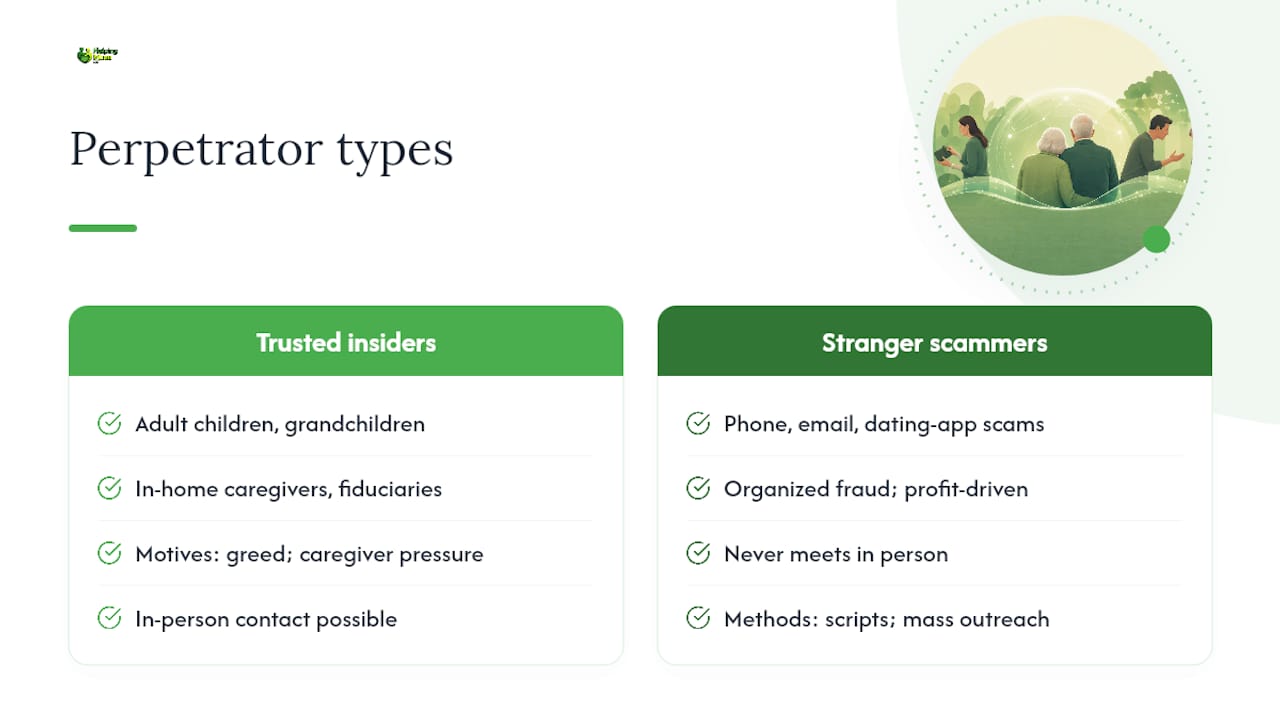
Motives vary just as much as the methods. Sometimes it's straightforward greed. Sometimes a family caregiver who started out helping with groceries slides into treating a parent's account as a shared resource, especially if that caregiver is under financial pressure themselves. Organized scam operations, meanwhile, run at scale, targeting thousands of older adults with the same script because a small percentage will respond.
Why older adults specifically? They often hold significant savings after a lifetime of work, and they may also carry the kind of vulnerabilities that make exploitation easier: isolation after losing a spouse, early cognitive decline that makes it harder to catch inconsistencies, or simple reliance on someone else to handle bills and banking. The Merck Manual's professional guidance on elder abuse points out that financial exploitation frequently overlaps with other forms of abuse or neglect, and that cognitive impairment and social isolation are two of the clearest risk factors. None of this means an exploited senior did anything wrong. Perpetrators are skilled at applying emotional pressure, not exploiting a lack of intelligence.
What Are the Warning Signs of Financial Abuse?
Red flags tend to show up in two forms: changes you can see in the bank statement, and changes you notice in your parent's mood or behavior. Neither one alone proves abuse, but when they show up together, it's worth a closer look.
Financial red flags:
- Unexplained withdrawals or transfers, especially cash withdrawals in round numbers
- Unpaid bills or bounced checks despite adequate funds in the account
- A new joint account holder or authorized user your parent can't clearly explain
- Sudden changes to a will, deed, or power of attorney, particularly if made quickly
- Missing belongings, jewelry, or property that can't be accounted for
Behavioral red flags:
- Withdrawal from longtime friends or family members
- Defensiveness or vagueness when you ask about money
- A new "best friend" or caregiver who seems unusually involved in financial decisions
- Signs of fear or anxiety around a specific person
A short example shows how this usually comes together, not as one dramatic event, but a string of small ones. A daughter notices her mother's checking account balance dropping faster than her spending habits explain. Her mother mentions a "helpful neighbor" who's been driving her to the bank. A few weeks later, that neighbor is added as an authorized signer. No single piece screams fraud, but together, these signs are worth acting on.
How Does Financial Exploitation Usually Unfold?
Exploitation rarely starts with a big theft. It usually starts small and builds, which is exactly why it goes unnoticed for so long.
With a trusted-person case, the pattern often looks like grooming: a caregiver or relative starts by helping with small tasks, paying a bill here, picking up groceries there. Over time, that person gains more access, maybe a debit card "for convenience," then a spot on the bank account, then power of attorney. Once they have control, withdrawals get larger and harder to trace, and if the senior notices, the perpetrator can lean on guilt, threats of abandonment, or the senior's own fear of conflict to keep them quiet.
Scam-based exploitation moves faster. Take the well-known "grandchild in trouble" phone scam: a caller claims to be a grandchild who's been arrested or hospitalized, pressures the senior not to tell other family members, and asks for money wired immediately, often through gift cards or a courier. The entire timeline, first call to money handed over, can happen in under an hour. Speed and secrecy are the tactics, not sophistication.
Both patterns can escalate through forged signatures, stolen identity information, or online impersonation, and both can repeat. The Merck Manual describes this as polyvictimization: once one form of exploitation starts, other types, financial, emotional, even physical neglect, often follow, because the same vulnerabilities that allowed the first incident tend to stay in place.
What Should You Do If You Suspect Abuse?
Move through this in order. You don't need certainty to start, just a reasonable concern.
- Preserve records immediately. Gather bank statements, canceled checks, account histories, and any relevant emails or texts. Don't alert the suspected perpetrator yet.
- Contact the bank's fraud team. Ask whether they can place a temporary hold or flag the account, and ask directly whether they've filed or will consider filing a suspicious activity report.
- Keep your parent safe and calm. This is a stressful moment for them too. Reassure them this isn't their fault.
- File a report with Adult Protective Services in the county where your parent lives. APS can investigate and connect you with local resources.
- File a police report if theft has occurred, especially for identity theft or large cash losses.
- Report to your state attorney general's office and the FTC, particularly for scams involving wire transfers, gift cards, or online impersonation.
- Consult an elder law attorney about next steps, which might include revoking a power of attorney, pursuing conservatorship, or recovering assets through civil action.
- Contact Social Security or Medicare directly if benefits were misdirected or a Medicare number was misused.
- Build an evidence inventory as you go: date, transaction amount, account involved, and who had access, in a simple spreadsheet or notebook.
Keeping a clear record of your parent's finances from this point forward makes every one of these steps faster and gives investigators something concrete to work with.
How Can Families Prevent Financial Abuse?
Prevention works best when it doesn't feel like surveillance. The goal isn't stripping your parent of independence, it's building small, visible safeguards that make exploitation harder to pull off and easier to catch early.

A limited power of attorney, one that specifies exactly what an agent can and can't do, is safer than a broad, unrestricted one. Many banks now offer dual-notification features or trusted-contact designations, where a second family member gets alerted to unusual activity without having account access themselves. Spending alerts, set for any withdrawal over a certain amount, catch problems within a day instead of a month. If your family is considering a paid caregiver or professional fiduciary, a basic vetting checklist, background check, references, and a written agreement about scope of duties, closes an obvious gap. Identity-theft protections, like a credit freeze, cost little and prevent a huge share of the identity-theft cases that show up in exploitation statistics.
These safeguards work best when they're part of a regular family habit, not a one-time fix triggered by a scare. An annual finance check-in, where you sit down together and review statements, works the same way a smoke detector battery check does: boring until the day it isn't. A shared password manager reduces the temptation to write down account numbers where anyone can find them. And naming a trusted contact on financial accounts gives the bank someone to call before a situation spirals.
If you're planning a family meeting to talk through these safeguards, keep the agenda simple: start with why you're meeting ("we want to make sure Mom's accounts stay protected, not take anything away from her"), review current account access together, agree on who gets notified about unusual activity, and end with one concrete next step, like setting up a spending alert before you leave the room. A family meeting template can keep the conversation focused instead of emotional.
How Do You Bring This Up Without Damaging Trust?
This is often the hardest part, harder than the paperwork. Your parent may hear "I'm worried about your finances" as "I think you're losing control," and that fear can shut the conversation down fast.
Start small and specific instead of broad and accusatory. Try something like: "I noticed a withdrawal I didn't recognize on the statement, can you help me understand it?" That opens a door without implying blame. Another option: "I want to set up an alert so we both get notified about big transactions, just for peace of mind." Framing it as protection you're both adding, rather than control you're taking, changes the entire tone.
A short family communication plan helps keep everyone aligned:
- Who attends: ideally one or two family members, not the whole extended family at once
- What to bring: recent statements, a written list of specific concerns, not vague worries
- Decision rules: agree in advance on what happens if a red flag is confirmed
- If your parent refuses to engage: give it time, revisit gently, and involve a neutral third party like a doctor or elder law attorney if concerns continue
Pro Tip: Avoid leading with "you" statements like "you're being scammed." Lead with your own experience instead, "I noticed something and wanted to check with you," which keeps your parent from feeling cornered and preserves their sense of control over the conversation.
A Word of Encouragement From Helping-mom
If you're reading this because something feels off with your parent's finances, take a breath. Noticing is the hard part, and you've already done it. Most caregivers we hear from feel a wave of guilt the moment they start asking these questions, as if suspecting something means they've failed to protect their parent sooner. That's not true. Financial abuse is built on confusion and secrecy, and the fact that you're looking closely is exactly what starts to unravel it.
You don't need to solve everything today. Pull the last two months of bank statements, look for anything that doesn't add up, and if something concerns you, call Adult Protective Services. That one phone call is often the entire first step.
Where Helping-mom Can Help You Take the Next Step
Once you've made those first calls, the real work is building a system that keeps your parent's finances protected without turning them into a full-time worry. That's where a practical finance guide built for adult children comes in, walking you through account monitoring, documentation habits, and the conversations that come next.
If your family needs more structure around who's responsible for what, Helping-mom's family meeting agenda template gives you a script to follow instead of starting from a blank page. And if you're feeling stretched between caring for a parent and managing your own household budget, the Sandwich Generation Financial Survival Guide covers the planning gaps that often go ignored until they become urgent.
For families who want more direct support, a paid Zoom consultation with Helping-mom gives you a chance to walk through your specific situation, red flags you've noticed, account structures, or family tension, with someone who can help you build a plan. Start with the elder care planning guide for adult children to see what a consultation could cover, and book a session when you're ready for hands-on help.
Where to Report and Get More Help
Different agencies handle different parts of this process, so knowing who does what saves time when you're already stressed.
- Adult Protective Services (APS): investigates suspected abuse and can intervene directly; find your local office through the Eldercare Locator or your state's APS directory.
- Local police: files a report when theft, forgery, or identity theft has occurred.
- FinCEN: publishes red-flag guidance for financial institutions; ask your bank whether a suspicious activity report has been filed.
- FTC: collects fraud and scam reports nationwide, useful for imposter scams and identity theft.
- FBI: investigates larger-scale or interstate financial exploitation, including organized scam rings.
- State attorney general's office: handles consumer protection complaints and can pursue civil or criminal action.
- DOJ Elder Justice Initiative: offers federal guidance, definitions, and resources for families and professionals.
This article provides general information and is not a substitute for advice from an elder law attorney or a qualified financial or legal professional familiar with your state's laws.
Sources
- Elder Justice Initiative: Financial Exploitation (U.S. Department of Justice)
- FinCEN Advisory: Elder Financial Exploitation (June 2022)
- CFPB: Suspicious Activity Reports: Elder Financial Exploitation (report)
- Merck Manual Professional: Elder abuse (geriatrics)
FAQ
What are the signs of financial abuse in the elderly?
The clearest signs combine financial changes, like unexplained withdrawals or unpaid bills despite available funds, with behavioral changes, like withdrawal from family or new defensiveness about money.
What are examples of financial elder abuse?
Common examples include theft by a trusted caregiver, power-of-attorney misuse, romance or imposter scams, Medicare fraud, identity theft, investment scams, and home-title fraud.
What are the signs of financial abuse in adults more generally?
The same patterns apply beyond older adults: sudden account changes, missing funds without explanation, and a caregiver or acquaintance who becomes unusually controlling over someone's finances.
What evidence is needed to prove elder abuse?
Bank statements, canceled checks, account access logs, copies of legal documents like powers of attorney, and a dated record of concerning conversations or behavior all help build a case for investigators or an attorney.
How do you report suspected senior financial abuse?
Contact Adult Protective Services in your parent's county, notify the bank's fraud department, and file a police report if theft has occurred; the FTC and your state attorney general can also take reports for scams.