

TL;DR:
- Assisted living is appropriate when an older adult's safety concerns and care needs steadily exceed what family care can provide. Recognizing patterns like falls, hygiene issues, medication errors, and social withdrawal helps determine the right timing for transition. Early planning, documentation, and gentle family conversations facilitate a smoother move that preserves independence and quality of life.
Assisted living is a residential care option designed for older adults who need help with daily activities but do not require intensive medical or skilled nursing care. Knowing when to consider assisted living is one of the most meaningful decisions you will make as an adult child, and the right timing is driven by safety and independence thresholds, not just a diagnosis. When your parent struggles with personal hygiene, medication management, nutrition, or social connection, and those struggles exceed what you can safely manage at home, assisted living becomes a genuinely supportive next step. This guide gives you the concrete signs, practical tools, and calm guidance to make that decision with confidence.
What are the common signs it's time for assisted living?
The clearest signs for assisted living are observable, specific, and repeatable. A single bad day does not define a trend, but a pattern of missed medications, unexplained falls, or unwashed dishes tells a different story. Multiple warning signs including falls, hygiene problems, depression, and memory changes are the most consistent triggers families encounter. Recognizing these patterns early gives you time to plan thoughtfully rather than react in a crisis.
Here are the key signs to watch for:
- Frequent falls or near-misses. A fall that results in injury, or several close calls in a short period, signals that the home environment or your parent's physical stability has shifted beyond safe management alone.
- Difficulty with personal hygiene. Unwashed hair, unchanged clothing, or body odor that was never typical before points to a real struggle with bathing and dressing, two core activities of daily living (ADLs).
- Medication errors. Missed doses, double doses, or confusion about which pills to take when can have serious health consequences. This is one of the most common and underestimated signs.
- Poor nutrition or weight loss. Expired food in the refrigerator, skipped meals, or noticeable weight loss suggests your parent is no longer managing meal preparation safely.
- Social withdrawal or depression. Isolation is both a sign and a cause of decline. When your parent stops calling friends, skips activities they once loved, or seems persistently low, that shift deserves attention.
- Memory loss affecting safety. Leaving the stove on, getting lost in familiar places, or forgetting to lock doors are not just memory lapses. They are safety risks that require a structured environment.
- Caregiver burnout. Caregiver exhaustion including sleep disruption, anxiety, and relationship strain directly compromises the quality of care your parent receives. Your wellbeing is part of the equation.
Pro Tip: Keep a simple notebook or phone note for two to four weeks. Log specific incidents, not general impressions. "Mom left the stove on twice this week" is far more useful in a family conversation than "Mom seems forgetful lately."
For a broader look at early warning patterns, the Helping-mom guide on signs your parent needs help walks through these indicators in detail.

How can you assess assisted living needs using practical tools?
Assessing your parent's care needs does not require a medical degree. It requires structured observation and the right framework. The standard tool professionals use is the ADL checklist, which evaluates six core functions: bathing, dressing, eating, transferring (moving from bed to chair), toileting, and continence. When your parent needs help with two or more of these consistently, that is a meaningful threshold.
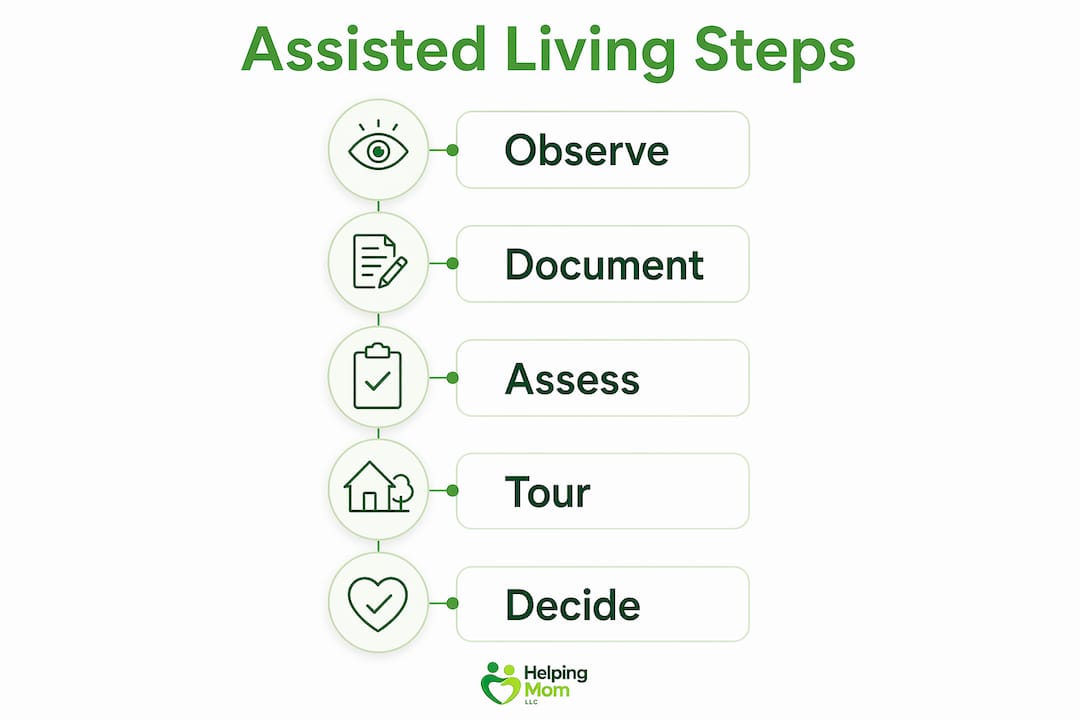
Here is a practical four-step process to assess care needs before approaching any facility:
- Document specific support gaps over two to four weeks. Note missed meals, skipped medications, hygiene issues, and any safety incidents. Concrete documentation replaces vague worry with real evidence.
- Use a structured ADL checklist. Rate each of the six core ADLs as independent, needs some help, or fully dependent. The Katz ADL index is a standardized tool used by facilities and families alike to measure functional status.
- Add instrumental ADLs (IADLs) to your review. These include managing finances, driving, shopping, housekeeping, and using the phone. Decline in IADLs often precedes ADL decline and signals the early stages of a care gap.
- Project needs 12 to 24 months ahead. Anticipating future ADL needs helps you choose a facility that can accommodate expected decline, preventing a rushed second move within a year.
When you tour or apply to an assisted living facility, a pre-admission health assessment will be required. This typically includes a physician's report, cognitive screening, and a nurse care plan to confirm the facility can meet your parent's needs within its licensed scope.
| Assessment area | What to observe |
|---|---|
| Personal hygiene | Bathing frequency, grooming, clothing changes |
| Medication management | Pill organizer use, missed or doubled doses |
| Nutrition | Meal preparation, food freshness, weight changes |
| Mobility and safety | Falls, balance issues, use of assistive devices |
| Cognitive function | Memory lapses, confusion, disorientation |
| Social engagement | Frequency of contact with friends, family, activities |
Pro Tip: Bring your documented observations to the pre-admission assessment. Facilities use this information to build a care plan, and your notes from home often capture patterns that a single evaluation appointment cannot.
The Helping-mom caring for aging parents checklist is a practical starting point if you want a ready-made framework to work from.
What distinguishes assisted living from other care options?
Assisted living sits in the middle of the elder care continuum, and understanding where it fits helps you match the right level of care to your parent's actual needs. Choosing too little support too late leads to crisis. Choosing more than is needed can feel like a loss of independence before it is necessary.
Here is how the main options compare:
| Care level | Who it serves | Key distinction |
|---|---|---|
| Independent living | Active seniors needing minimal support | Social community, no personal care included |
| Assisted living | Seniors needing help with ADLs | Personal care, medication support, 24/7 staff |
| Memory care | Seniors with dementia or significant cognitive decline | Secured environment, specialized dementia programming |
| Skilled nursing | Seniors needing medical or rehabilitative care | Licensed nursing staff, medical monitoring |
Assisted living prevents crisis-driven transitions to skilled nursing or memory care when timed well. A parent who moves to assisted living while still relatively independent adjusts more easily and maintains more autonomy than one who moves during a medical emergency.
Memory care is a distinct option for parents whose primary challenge is dementia. The Helping-mom guide on dementia signs and planning covers how cognitive decline changes the assisted living decision specifically. One practical limit to know: facilities must decline admission when care needs exceed their licensed scope, particularly for continuous skilled nursing or severe behavioral risks. Understanding this boundary helps you avoid placing your parent in a setting that cannot safely serve them.
How do you start the conversation about assisted living with your parent?
Most parents resist the idea of assisted living at first. That resistance is not stubbornness. It is a reasonable response to the fear of losing control over their own life. Your role is not to convince them they are incapable. Your role is to walk alongside them toward a safer, more supported life.
These approaches make the conversation more productive:
- Lead with specific observations, not general concerns. "I noticed you've had three falls this month and I'm worried about your safety" lands differently than "I think you need more help." Concrete evidence is harder to dismiss and easier to discuss calmly.
- Frame assisted living as gaining support, not losing independence. Many residents report feeling more confident and socially connected after moving, because daily stressors like cooking and medication management are handled for them.
- Involve a neutral third party. A geriatric care manager, your parent's physician, or an elder care counselor can offer perspective that carries different weight than a family member's concern. Fact-based conversations that identify specific safety concerns improve family alignment and parent acceptance.
- Plan ahead rather than waiting for a crisis. A move made after a serious fall or hospitalization is rushed, emotionally charged, and limits your options. Starting the conversation early, even as a "what if" discussion, gives everyone time to adjust.
- Include all key family members. Decisions made by one sibling without others often create conflict later. A shared family meeting, even by video call, keeps everyone informed and reduces friction.
Pro Tip: Tour two or three facilities together with your parent before any decision is made. Seeing real spaces and meeting real staff often shifts the conversation from abstract fear to practical evaluation.
The Helping-mom resource on coordinating care as a family offers a step-by-step approach to these conversations.
Key takeaways
The right time to consider assisted living is when your parent's daily safety needs consistently exceed what family caregiving can sustainably provide, and when structured support would improve their quality of life.
| Point | Details |
|---|---|
| Safety thresholds drive timing | Consider assisted living when falls, medication errors, or hygiene decline become consistent patterns. |
| ADL assessments clarify the decision | Use the Katz ADL index and IADL review to document specific care gaps objectively. |
| Plan 12 to 24 months ahead | Projecting future needs helps you choose a facility that fits both now and later. |
| Assisted living prevents bigger crises | A well-timed move reduces the risk of emergency transitions to skilled nursing care. |
| Caregiver burnout is a valid signal | Your own exhaustion and stress are meaningful indicators that the current arrangement is not sustainable. |
What I've learned about timing this decision well
I have seen families wait far too long, and I have seen families move too quickly out of fear. Both paths create unnecessary pain. The families who navigate this best share one habit: they start observing and documenting early, long before a crisis forces their hand.
The most common mistake I see is treating assisted living as a last resort. Families often frame it as giving up, when the reality is the opposite. A parent who moves to a well-matched assisted living community while still socially engaged and physically capable tends to thrive there. They make friends, join activities, and feel less isolated than they did at home. The parent who moves after a serious fall, a hospitalization, or a cognitive crisis arrives exhausted and disoriented, and the adjustment is much harder.
Caregiver burnout is the signal families most often ignore. If you are losing sleep, canceling your own medical appointments, or feeling resentful, that is not a personal failing. It is data. Unsustainable caregiving demands affect the quality of care your parent receives, even when your intentions are excellent. Recognizing that limit is an act of love, not abandonment.
Start the conversation before you need to. Tour a facility as a "just in case" visit. Build a picture of what good care looks like for your parent specifically. That preparation does not commit you to anything. It gives you options when the moment comes.
— Mike
How Helping-mom can support your next steps
If you are starting to notice changes in your parent and wondering whether assisted living is the right direction, Helping-mom has practical resources to help you think it through clearly. Start with the home safety guide for seniors to evaluate whether the current home environment can still support your parent safely, which is often the first question to answer before exploring care options. If caregiver stress is part of your picture, the caregiver wellbeing resources offer calm, grounded support for what you are carrying. And if you want a structured starting point for evaluating your parent's safety at home, the elderly home safety checklist gives you a clear, practical tool to work from today.
FAQ
What are the main signs it's time for assisted living?
The most consistent signs include repeated falls, medication errors, declining personal hygiene, poor nutrition, social withdrawal, and memory changes that affect safety. Observable patterns across multiple areas, rather than a single incident, are the clearest indicators.
How is assisted living different from a nursing home?
Assisted living supports seniors who need help with daily activities but do not require continuous medical or skilled nursing care. Nursing homes serve residents with higher medical needs, and facilities must decline admission when care needs exceed their licensed scope.
How do I assess whether my parent needs assisted living?
Use an ADL checklist to evaluate bathing, dressing, eating, mobility, toileting, and medication management. Document specific support gaps over two to four weeks, then review those observations with your parent's physician or a geriatric care manager.
Is it too early to start planning for assisted living?
Planning early is always the right call. Projecting care needs over a 12 to 24 month window helps families choose the right facility and avoid rushed decisions during a health crisis.
What if my parent refuses to consider assisted living?
Start with specific, calm observations about safety rather than general concerns. Involving a neutral professional such as a physician or geriatric care manager, and touring facilities together before any decision is made, significantly improves acceptance over time.