
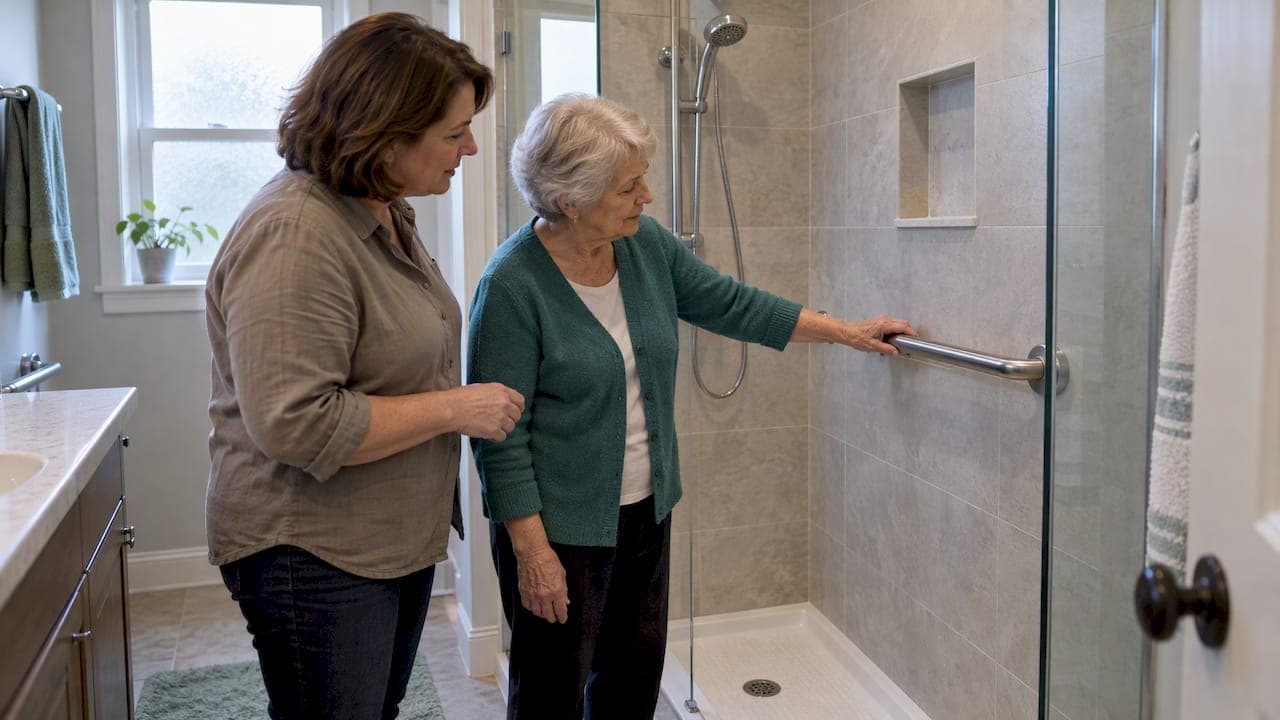
The simplest path to a safer aging-in-place bathroom starts with five changes: grab bars anchored into blocking, a curbless or low-threshold shower, a comfort-height toilet, slip-resistant flooring with a DCOF rating of 0.42 or higher, and layered lighting that removes dark corners. You can phase these upgrades over months or years, and a home safety assessment from an occupational therapist helps you place everything exactly where your parent needs it.
TL;DR:
- Grab bars provide dependable support only when anchored into blocking or load rated toggle anchors; position them for actual reach, not standard dimensions alone.
- Curbless showers remove the entry edge and suit walkers or wheelchairs; walk in tubs favor seated soaking but require waiting through filling and draining.
- Basic safety upgrades start around $2,000, while accessible remodels cost $8,000 to $25,000; phased work can defer a curbless conversion until another renovation.
- An occupational therapist can map bar placement and transfer risks to your parent's mobility, while early wall blocking avoids reopening finished walls during later upgrades.
- Matte porcelain, small mosaic, textured vinyl, and rubber flooring improve grip; busy patterns can confuse depth perception for aging eyes.
Table of Contents
- 1. High-impact features to prioritize now and later
- 2. Shower and tub options: curbless, transfer, and seating solutions
- 3. Toilet area and transfers: comfort-height, grab bars, and short-term fixes
- 4. Flooring, lighting, and visibility for aging eyes
- 5. Grab bars, anchors, and blocking: installation basics that make bars work
- 6. Costs, budgeting, and funding options
- 7. How to plan the project: OT assessments, contractor questions, and timeline
- 8. Phased priority checklist families can use
- 9. Storage solutions for bathroom essentials within easy reach
- 10. Emergency response systems or alert devices suitable for bathrooms
- 11. Recommendations for moisture and mold control to maintain a safe environment
- Author perspective: a calm, dignity-first approach to changes
- How we can help you plan your bathroom upgrades
- FAQ
- Sources
1. High-impact features to prioritize now and later
Not every upgrade carries the same weight. Some changes cost under $50 and take an afternoon. Others mean opening walls and hiring a contractor. Knowing which is which helps you spend wisely.
Grab bars offer the best return on investment in the entire bathroom. They cost little, install quickly when blocking exists, and directly support the moments when falls happen most: standing up, sitting down, and stepping over a tub wall. Stanford Medicine research points to the transfer itself, not walking across the room, as the most common failure point in bathroom falls. That's why bars belong in the toilet and inside the shower or tub, not just near the door.
A curbless or low-threshold shower removes the single biggest tripping hazard in most bathrooms: the step-over edge. A walk-in tub solves a different problem (seated bathing for someone who struggles to stand for long) but it takes longer to fill and empty, and getting in before the water drains can feel awkward for some older adults.
Comfort-height toilets, sitting a few inches taller than standard models, reduce strain on knees and hips during transfers. If a full toilet swap isn't in the budget yet, a raised seat or safety frame bridges the gap.
Flooring and lighting round out the list. Slip-resistant tile or vinyl reduces traction loss, while layered lighting (ambient, task, and night-path) helps aging eyes see edges and transitions clearly after dark.
Here's how these upgrades typically sort by effort:
- Fast and low-cost: grab bars (where blocking exists), non-slip strips, motion night-lights, handheld showerheads.
- Moderate investment: comfort-height toilet swap, new flooring, safety frames.
- Structural and time-intensive: curbless shower conversion, walk-in tub installation, door widening.
2. Shower and tub options: curbless, transfer, and seating solutions
Showers deserve the most attention in any aging-in-place plan because that's where wet surfaces, tight turns, and unsupported transfers combine into the highest fall risk in the home.
A curbless shower removes the step-over edge entirely, so the floor flows from the bathroom straight into the shower pan. A linear drain with a single-direction slope makes this easier to build than a center drain, since the floor only needs to pitch one way instead of four. Most curbless designs call for a minimum interior dimension of about 36 by 36 inches, though larger is more comfortable for a caregiver who needs to stand inside with the person bathing. A built-in or fold-down seat, paired with a handheld sprayer on a sliding bar, lets someone bathe seated without sacrificing water pressure or reach.
A walk-in tub makes sense when someone wants a soak more than a quick shower, or when standing balance is a bigger concern than stepping over a low edge. The trade-off is fill and drain time, often several minutes on each end, during which the person sits in a cooling or empty tub.
- Add a shower seat and handheld sprayer now, even before a full remodel.
- Save the curbless conversion for when you're already replacing flooring or renovating.
Pro Tip: If a full curbless conversion isn't in the budget yet, a low-profile threshold ramp (under half an inch) paired with a shower seat gets you most of the safety benefit for a fraction of the cost.
3. Toilet area and transfers: comfort-height, grab bars, and short-term fixes
The toilet is one of the two places (along with the shower) where most transfer-related falls happen, according to Stanford Medicine. A comfort-height bowl, built to 17 to 19 inches from floor to seat, puts less strain on knees and hips during the sit-to-stand motion than a standard 15-inch toilet.
Grab bars work best in a specific layout: one bar mounted behind the toilet and one along the side wall, both 33 to 36 inches above the floor. That height suits most adults, but your parent's actual arm length and chair height matter more than a chart, which is one reason a professional walk-through is worth the time.
If replacing the toilet isn't realistic right now, a raised toilet seat or a freestanding safety frame can approximate the same height and support for under $100.
- Comfort-height bowl: 17 to 19 inches, reduces knee and hip strain during transfers.
- Rear and side grab bars: mounted 33 to 36 inches high, positioned for your parent's reach.
- Raised seat or safety frame: a fast, affordable bridge until a full swap happens.
If a caregiver sometimes helps with transfers, leave at least 18 inches of clear space beside the toilet so two people can maneuver without bumping into a vanity or wall.
4. Flooring, lighting, and visibility for aging eyes
Flooring and lighting work together. A slip-resistant floor does little good in a dim room, and bright lighting can't fix a floor that turns slick the moment it's wet.
For flooring, look for a dynamic coefficient of friction, or DCOF, rating of 0.42 or higher for wet areas, with shower floors ideally rated higher still. Matte porcelain tile and small-format mosaic tile (more grout lines mean more traction) both perform well. Textured vinyl and rubber flooring offer similar grip at a lower cost and are softer underfoot, which matters if your parent stands for grooming tasks.
Nearly 1 in 4 adults 65 and older falls every year, and bathroom falls are more than twice as likely to cause injury as falls in the living room. That gap is exactly why flooring and lighting upgrades, often the cheapest line items on this list, carry outsized value.
Layered lighting means three things working together: ambient light for general visibility, task lighting near the mirror and vanity, and a low-glare, motion-activated night light along the path from bed to toilet. Motion sensors remove the need to fumble for a switch in the dark, and low color-temperature bulbs reduce glare off tile and glass.
- Choose matte, textured, or mosaic flooring with a DCOF of 0.42 or higher.
- Add a motion-activated night light along the bedroom-to-bathroom path.
- Pick grab bars and seats in a color that contrasts with the wall, so they're easy to spot at a glance.
- Skip busy floor patterns, which can look like steps or obstacles to aging eyes.
5. Grab bars, anchors, and blocking: installation basics that make bars work
A grab bar is only as strong as what's behind it. Blocking, meaning solid wood or metal backing installed inside the wall before drywall goes up, is what lets a bar hold real weight instead of pulling loose the first time someone leans on it.

If you're already opening walls for any reason (a shower remodel, a plumbing fix), adding blocking at that point costs very little. Skipping it means paying to reopen a finished wall later just to anchor a bar correctly.
Bars should sit 33 to 36 inches above the floor, with a diameter of 1¼ to 1½ inches so a hand can wrap fully around it, and at least 1.5 inches of clearance from the wall. A properly anchored bar should support roughly 250 pounds without flexing.
- Never rely on a suction-cup bar for primary support. They're fine for travel, not for daily use.
- When studs aren't available where you need a bar, heavy-duty toggle anchors rated for the load are the next best option.
- Ask your contractor to add blocking anywhere a bar might go in the future, even if you're not installing one today.
Pro Tip: Even if you only need one grab bar today, ask your contractor to add blocking across the whole shower wall. It costs almost nothing extra now and saves you from reopening tile later.
For more on choosing and placing bars correctly, our grab bar safety guide walks through specific product types and installation scenarios.
6. Costs, budgeting, and funding options
Costs vary widely depending on how much you're changing, but two rough tiers help with planning. Basic safety upgrades, such as grab bars, non-slip treatments, and nightlights, typically start around $2,000. A full accessible bathroom remodel, including a curbless shower, comfort-height toilet, and new flooring, runs $8,000 to $25,000.
The phased approach keeps costs manageable: install blocking and grab bars now, swap the toilet and flooring next, and save the curbless shower conversion for when you're ready for a larger project or already renovating for another reason. Blocking added during an early phase means the later, pricier phase doesn't require reopening finished walls.
A few funding avenues are worth checking before you pay entirely out of pocket:
- HUD's Older Adults Home Modification Program has funded grab bars and railings for qualifying low-income homeowners.
- Veterans may have access to benefits that cover home modifications tied to service-connected needs.
- Some Medicare Advantage plans include supplemental allowances for home safety items, though original Medicare generally does not cover home improvements.
7. How to plan the project: OT assessments, contractor questions, and timeline
A plan that starts with a professional assessment almost always costs less in the end, because it prevents paying for changes that don't fit your parent's actual mobility.
- Schedule a home safety assessment. CDC's STEADI program recommends an occupational therapist evaluate grip strength, balance, and daily habits before any contractor touches the bathroom.
- Use the assessment to build a priority list. An OT typically flags exact grab bar placement, transfer risks, and lighting gaps specific to your parent, not generic recommendations.
- Interview contractors with specific questions. Ask whether they add blocking as standard practice, whether they're familiar with DCOF-rated flooring, whether they've installed linear-drain curbless showers, and what warranty covers the work.
- Check permit requirements for plumbing or structural changes before work begins; this varies by municipality.
- Sequence the work sensibly. Grab bar installation often takes a single day. A toilet swap usually takes a few hours. A full curbless shower conversion can take several weeks, including demolition, plumbing adjustments, and tile work.
Our elderly home safety checklist gives you a starting point to bring to that first walk-through, whether it's with an OT or a contractor.
8. Phased priority checklist families can use
Breaking the work into three phases keeps the project from feeling like one overwhelming decision.
- Phase 1, under $500 to $2,000: grab bars where blocking allows, non-slip strips, motion night-lights, and a handheld showerhead.
- Phase 2, roughly $1,000 to $6,000: comfort-height toilet, new slip-resistant flooring, and blocking added behind shower and toilet walls for future bars.
- Phase 3, $6,000 and up: curbless shower conversion, door widening, and any layout changes needed for a wheelchair or walker.
Our guide to senior-friendly home setup extends this phased thinking to the rest of the house.
9. Storage solutions for bathroom essentials within easy reach
Storage matters more than most families expect when planning a safer bathroom. Reaching into a high cabinet or bending to a low one under the sink is exactly the kind of motion that leads to a lost balance moment, especially right after a shower when the floor is wet and footing is less certain.
The fix is usually simple rearranging rather than a remodel. Keep everyday items, soap, shampoo, a razor, toothbrush, at a height between the waist and shoulder, so your parent never has to stretch or crouch. A wall-mounted shower caddy within arm's reach of the seat removes the need to lean or twist while bathing. Pull-out drawers under the vanity work better than deep cabinets, since nothing gets pushed to the back where it's hard to reach.
If your parent uses a walker or wheelchair, look at clearances too. A single lever-style pull on cabinets is easier to grip than a small knob, and leaving at least a few inches of open floor space in front of storage areas prevents the kind of pivoting that can throw off balance.
Small, inexpensive organizers (a turntable in the cabinet, a shower shelf, a few over-the-door hooks) often solve 90% of the reach problem without a single tool or contractor involved.
10. Emergency response systems or alert devices suitable for bathrooms
Bathrooms are private spaces, which makes them one of the hardest rooms for a caregiver to monitor and one of the places where a fall is most likely to go unnoticed for a while.
A waterproof wearable pendant or wristband, the kind that calls for help with one press, is worth considering if your parent spends meaningful time alone. Many newer models are rated for shower use and don't require being near a landline, unlike older plug-in base station systems. Voice-activated smart speakers placed in or just outside the bathroom offer a lower-cost alternative; a simple voice command can call a family member or trigger an alert routine.
For families who want something less visible, pull-cord alarms mounted near the toilet and shower connect to a chime or phone notification elsewhere in the house. These work well paired with grab bars, since the cord can sit right where someone's hand would naturally reach if they lost balance.
Whichever option you choose, test it with your parent present, not just in theory. A device only helps if it's worn, within reach, and understood well enough to use without hesitation in a stressful moment.
11. Recommendations for moisture and mold control to maintain a safe environment
A safe bathroom is a dry one. Moisture buildup doesn't just damage tile and grout, it creates the exact slick surfaces and musty air that make a bathroom harder to use safely over time.
Run the exhaust fan during and for about twenty minutes after every shower, and consider a timer switch if remembering to turn it off (or on) is a hassle. Squeegeeing shower walls after use takes under a minute and meaningfully cuts down on standing water and mildew growth between cleanings.
Caulk and grout lines are worth checking every few months. Cracked or missing caulk lets water seep behind tile, where it can sit against blocking and framing for months before anyone notices a problem. If you're already planning a remodel, ask your contractor about mold-resistant drywall (often green or purple board) for any wall near the shower.
A dehumidifier isn't necessary in most climates, but in especially humid regions it can help keep a windowless bathroom from feeling perpetually damp. Simple habits, cracking the door after a shower, wiping down the bottom of the shower curtain, and keeping bath mats laundered, go a long way toward keeping the room both pleasant and safe.
Author perspective: a calm, dignity-first approach to changes
I've watched families put off bathroom changes for years because the whole project felt like an announcement that something was wrong. It isn't. A grab bar that matches the towel bar, a bench that looks like it belongs in a spa, these aren't concessions. They're upgrades that make the room better for everyone who uses it, at any age.
Start with the one change that's bothering you most right now, not the whole list. A single well-placed grab bar or a brighter night light often does more for peace of mind than any five-year plan sitting in a drawer.
— Mike C.
How we can help you plan your bathroom upgrades
Reading about grab bar heights and DCOF ratings is one thing. Knowing exactly what your parent's bathroom needs, in what order, within your actual budget, is another. That's where a second set of eyes helps.
Our Virtual Home Safety Consultations walk you through your parent's bathroom over a video call and give you a prioritized list of modifications, a short checklist you can bring to a contractor, and clear next steps for what to tackle first. If you're local to Central Florida, our In-Home Age-Safe Home Safety Assessments do the same work in person, room by room.
Either way, you walk away with a plan instead of a list of worries. Book a virtual consultation and get a clear, prioritized starting point for your parent's bathroom.
FAQ
What is the single best first upgrade for an aging-in-place bathroom?
A properly anchored grab bar near the toilet or shower is usually the highest-value first step, since transfers are where most bathroom falls happen according to Stanford Medicine. It's also one of the fastest and least expensive changes you can make.
How much does a basic bathroom safety upgrade cost?
Basic safety upgrades like grab bars, non-slip flooring treatments, and nightlights typically start around $2,000. A full accessible remodel, including a curbless shower and comfort-height toilet, runs $8,000 to $25,000.
Do I need a permit for bathroom accessibility modifications?
It depends on your local building codes and the scope of work. Plumbing changes, structural work, or widening a doorway often require a permit, while adding a grab bar to existing blocking usually does not.
How high should bathroom grab bars be mounted?
Grab bars are typically mounted 33 to 36 inches above the floor, with a diameter of 1¼ to 1½ inches so a hand can grip it fully. Exact placement should account for your parent's height and reach, which is why a professional assessment helps.
Should I choose a curbless shower or a walk-in tub?
A curbless shower is generally the safer choice for most aging-in-place needs, since it removes the step-over edge entirely and accommodates a wheelchair or walker more easily. A walk-in tub can suit someone who prefers seated soaking and has good enough balance to wait through the fill and drain cycle.