
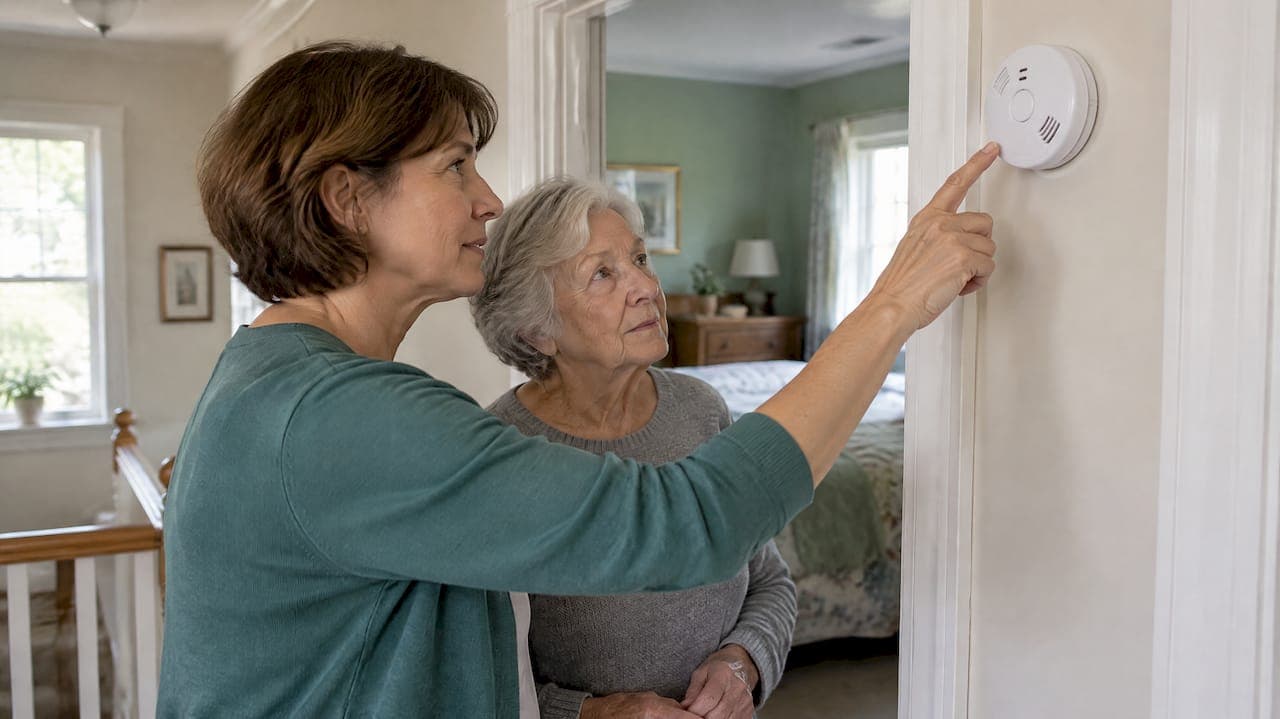
Install at least one carbon monoxide alarm on every level of the home, including the basement, and place additional units outside each sleeping area. If you only have one alarm, put it in the hallway near the bedrooms. Keep every unit away from kitchens and at least 15 to 20 feet from furnaces, water heaters, or other fuel-burning appliances to avoid nuisance alarms and missed coverage.
TL;DR:
- Keep alarms out of kitchens and bathrooms, and place them 15 to 20 feet from furnaces, water heaters, fireplaces, and stoves when possible.
- For an attached garage, install an alarm just inside the home near the entry door, since exhaust and temperature swings can overwhelm units inside garages.
- Interconnected alarms sound throughout the home, helping wake heavy sleepers and people with hearing loss; low level digital monitors can detect smaller leaks earlier.
- Test every alarm monthly, replace standard batteries yearly, and retire each unit by its listed end of life date because sensors degrade over time.
- If an alarm sounds, move everyone and pets outdoors, call emergency services, and stay outside until responders confirm the home is safe.
Table of Contents
- Where to Put Alarms on Each Floor and Near Bedrooms
- Wall, Ceiling, or Plug-In: Choosing the Right Mount
- Spots to Avoid So the Alarm Doesn't Cry Wolf
- Attached Garages, Basements, and Other Special Cases
- A Simple Maintenance Routine That Actually Gets Followed
- If a CO Alarm Goes Off: What to Do Right Away
- A Walk-Through Checklist for Your Next Visit
- Why Placement Matters More Than the Alarm Itself
- How We Can Help You Check Placement and Peace of Mind
- FAQ
- Sources
Where to Put Alarms on Each Floor and Near Bedrooms
Carbon monoxide doesn't stay put. It drifts through a house the way any gas mixes with the air around it, which is why a single alarm on the main floor isn't enough once a home has more than one level. The CPSC recommends an alarm on every level, and the EPA echoes that guidance, adding that each floor needs its own separate detector rather than relying on one unit to cover the whole house.
Think about how your parent's home is laid out, then work through it level by level:
- Main floor: one alarm in a central hallway or near the living area
- Upper floor: one alarm outside each separate sleeping area, since bedrooms sometimes sit on opposite ends of a hallway
- Basement: one alarm near the bottom of the stairs, especially if anyone sleeps down there or spends regular time in a finished space
- Stair landings: a good backup spot in split-level homes where airflow between floors is less predictable
If your parent's home only has room, budget, or willingness for one alarm right now, the EPA is clear that it belongs near the sleeping areas, not in the kitchen or living room. A single hallway alarm outside the primary bedroom will catch a leak long before it catches someone in the kitchen. For a one-story ranch home, that often means one alarm in the hallway connecting the bedrooms. For a two-story colonial, it means one upstairs near the bedrooms and one downstairs near the living space, with a basement unit added if that space gets regular use.
Wall, Ceiling, or Plug-In: Choosing the Right Mount
Carbon monoxide blends evenly into room air rather than settling in one spot, so the CPSC notes that exact mounting height matters far less than room location. A wall-mounted unit, a ceiling-mounted unit, and a plug-in model can all work well as long as they sit in the right room and away from the trouble spots we'll cover next.
Here's how to decide which type fits your parent's home:
- Ceiling or high wall mount: a solid choice for a hallway outside bedrooms, following the manufacturer's instructions for exact spacing from corners
- Standard wall mount, roughly knee to waist height: works fine in most living spaces and avoids the need for a ladder during testing
- Plug-in model: convenient in a home with limited wall space or for a parent who has trouble reaching higher spots to test a unit
For power, battery-operated alarms are simple but need a replacement schedule, sealed long-life battery units reduce how often anyone has to think about them, and hard-wired alarms with battery backup offer continuous power with a safety net if the electricity goes out.
Pro Tip: If your parent struggles with stepladders or reaching overhead, a plug-in or lower wall-mounted model with a loud, distinct alarm tone is often the easier long-term choice.

Spots to Avoid So the Alarm Doesn't Cry Wolf
A carbon monoxide alarm that goes off for the wrong reasons too often gets unplugged, and that's the real danger. The CPSC specifically advises against installing CO alarms in kitchens or directly above fuel-burning appliances, since normal cooking and appliance startup can trigger a false alarm.
Keep these placement rules in mind as you walk through the home:
- Stay at least 15 to 20 feet from furnaces, water heaters, fireplaces, and stoves whenever the layout allows it
- Skip kitchens entirely, even if that's the room your parent spends the most time in
- Avoid bathrooms and other humid spots, where moisture can wear down the sensor over time
- Keep units out of direct sunlight and away from drafty windows or vents that could throw off the reading
- Never tuck an alarm behind curtains, furniture, or in a closet where airflow is blocked
A little extra distance from the appliance and a clear path for air to reach the sensor go a long way toward an alarm your parent will actually trust and leave in place.
Attached Garages, Basements, and Other Special Cases
Some rooms need a different answer than "just install one there." An attached garage is one of them: car exhaust and temperature swings can overwhelm a residential alarm, so the better move is to skip the garage itself and place a unit just inside the house near the garage entry door.
A few other situations worth planning for:
- Finished or lived-in basements need their own alarm, same as any other level
- Unfinished basements with no sleeping or living space can often rely on the main floor and bedroom-area alarms, as long as coverage above is solid
- Mobile and manufactured homes should follow the manufacturer's instructions and local code, with alarms distributed across each level just as in a site-built home
- For a parent who sleeps heavily or has hearing loss, interconnected alarms mean every unit sounds together, and a low-level digital monitor can flag a smaller leak earlier than a standard alarm would
A Simple Maintenance Routine That Actually Gets Followed
An alarm is only useful if it still works when it matters. Build a short routine around three habits: test monthly, replace batteries on schedule, and retire the unit when its service life is up.
- Press the test button on every alarm once a month, ideally on a day that's easy to remember, like the first of the month
- Replace standard batteries once a year unless the unit has a sealed, long-life battery, in which case follow the manufacturer's listed replacement interval
- Replace the entire alarm when it reaches its end-of-life date, since the sensor itself degrades even if the unit still powers on
- Jot down the installation date and the last test date somewhere simple, like a sticky note inside a kitchen drawer or a note in your phone
Unintentional carbon monoxide poisoning sends an estimated 15,000 people to the emergency room each year in the United States, and older adults face higher risk due to other health conditions. That's the practical case for interconnected alarms: when one unit senses CO anywhere in the house, every connected alarm sounds, so your parent doesn't have to be standing near the one that detected it.
If a CO Alarm Goes Off: What to Do Right Away
A sounding alarm is not the moment to start investigating. Get everyone outside into fresh air first, every time.
- Leave the house immediately and move everyone, including pets, to fresh air outdoors
- Call 911 or local emergency services once you're outside, and mention if anyone is feeling dizzy, nauseous, or short of breath
- Do not go back inside to search for the source or open windows on your way out
- Wait for emergency responders to confirm it's safe before anyone re-enters
- Afterward, have a qualified technician inspect any fuel-burning appliances before you rely on them again
A Walk-Through Checklist for Your Next Visit
During your next visit, walk the house room by room with this in mind: one alarm per level, units outside bedrooms, nothing near the stove or furnace. A gentle way to bring it up is simply, "I want to check a few safety things while I'm here, it'll only take a few minutes." That framing keeps the conversation practical instead of worrying.
If you'd rather have a second set of eyes, our 15-minute home safety reset walks through the same checks, and our no-drama home safety walkthrough offers phrasing for the conversation itself. If your parent's home also has gas appliances or an unusual smell you can't place, a professional inspection resource on sewer gas and other household odors can help you figure out when it's time to call someone in.
Why Placement Matters More Than the Alarm Itself
Most of the advice out there treats carbon monoxide alarms like a one-time purchase: buy one, mount it, done. That misses the real issue. An alarm in the wrong spot, too close to the stove, buried in a closet, or sitting unreplaced five years past its service life, gives a false sense of security that's arguably worse than having no alarm at all.

The detail most families overlook isn't the alarm brand or the mounting height. It's whether every level of the home actually has coverage and whether the units near the bedrooms are the ones most likely to wake someone up. For a parent who sleeps through a lot or has hearing changes, interconnection matters more than almost anything else on this list.
If you take one thing from this guide, let it be this: walk the house once, level by level, and ask where your parent sleeps. Everything else follows from that.
— Mike C.
How We Can Help You Check Placement and Peace of Mind
Checking every room yourself can feel like a lot to add to an already full plate. Our Virtual Home Safety Consultations let us walk through your parent's home with you over Zoom, room by room, and flag placement issues as we go. If you're in Central Florida, our In-Home Age-Safe Home Safety Assessments bring that same walk-through to your parent's door, with a simple checklist left behind when we're done.
FAQ
Where should I put a carbon monoxide detector in a one-story house?
Place it in a central hallway near the bedrooms, since the EPA recommends locating a single detector close to sleeping areas when a home has only one unit.
How many carbon monoxide detectors does a home need?
At least one per level of the home, plus a unit outside each separate sleeping area, following the CPSC's guidance for whole-home coverage. Larger or multi-wing homes may need more than one per floor to cover bedrooms on opposite ends of the house.
Can I install a carbon monoxide detector in the kitchen?
No, kitchens are one of the main spots to avoid, since normal cooking can trigger false alarms near fuel-burning appliances. Keep detectors at least 15 to 20 feet from stoves, furnaces, and water heaters when the layout allows.
Should I put a carbon monoxide detector in the garage?
No, standard residential alarms aren't built to handle the exhaust and temperature swings inside a garage. Instead, mount a unit just inside the house near the garage entry door so it still catches any CO that drifts inward.
How often should I test a carbon monoxide alarm?
Test every alarm once a month and replace standard batteries once a year, or follow the manufacturer's schedule for sealed long-life units. Replace the entire alarm once it reaches its listed end-of-life date, since the sensor loses accuracy over time even if the unit still powers on.
Sources
- Carbon monoxide (CO) fact sheet | CPSC
- Where should I place a carbon monoxide detector? | US EPA
- Study on carbon monoxide poisoning and vulnerable populations (PMC)