
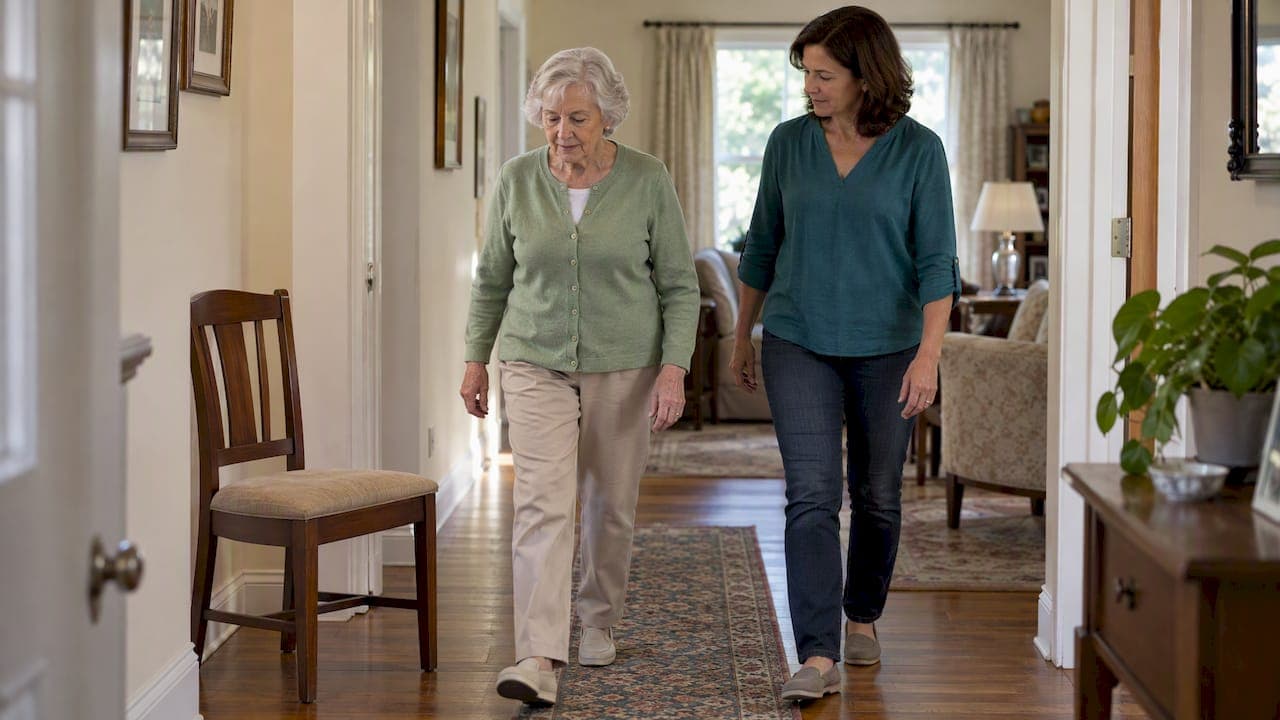
Start today with three steps: walk through each room to spot hazards, run one or two simple screening tests like the Timed Up-and-Go, and review your parent's medications and last vision check. Fix the highest-impact items first: better lighting, clear walkways, and a non-slip bathroom setup. If your parent has already fallen or a screening test raises concern, reach out to a healthcare provider this week rather than waiting.
TL;DR:
- A Timed Up-and-Go result of 12 seconds or longer suggests increased fall risk; stop any test immediately if your parent feels dizzy or reports pain.
- Ask a prescriber or pharmacist to review sedatives, blood pressure drugs, opioids, and any combination of five or more medications, especially when dizziness occurs.
- Repeat screening tests every three months and the full home walkthrough twice yearly, with an earlier review after illness, hospitalization, medication changes, or worsening results.
- Record each check’s date, test result, medication changes, and near falls, then bring the log to appointments so clinicians can compare changes over time.
- Medicare Part B can cover outpatient occupational therapy when medically necessary, with beneficiaries typically paying 20% coinsurance after meeting the deductible.
Table of Contents
- Room-by-room safety checklist caregivers can use now
- Three quick screening tests you can do safely and what results suggest
- Medication, vision, and other risk factors beyond the home itself
- When to get a professional home safety assessment
- A prioritized 7-day action plan that respects your parent's independence
- Why this guidance reflects trusted caregiving practice
- Creating a fall risk assessment timeline and regular review schedule
- How to document and track changes in fall risk factors over time
- Budgeting for home safety upgrades without overspending
- Balancing safety improvements with your parent's independence
- How Helping Mom can turn this checklist into a tailored plan
- FAQ
- Sources
Room-by-room safety checklist caregivers can use now
A fall risk assessment home visit does not need special equipment. Walking through each room with fresh eyes often reveals the same handful of hazards that trip up older adults again and again.
- Living areas: Clear walking paths of cords, baskets, and furniture; secure loose rugs with non-slip backing or remove them entirely.
- Kitchen: Move everyday dishes and food to waist-level shelves, use a stable step stool with a handrail, and add non-slip mats near the sink.
- Bathroom: Install grab bars near the toilet and shower, add non-slip mats, and consider a raised toilet seat or handheld showerhead.
- Bedroom: Keep a reachable night light and a clear path to the bathroom, and remove low furniture like footstools that are easy to trip over in the dark.
- Stairs and entries: Add handrails on both sides when possible, mark step edges with contrasting tape, and make sure light switches are at both the top and bottom.
- Outdoors: Keep walkways clear, add textured treads for wet or icy steps, and check that thresholds and porch edges are easy to see and step over.
The National Institute on Aging's room-by-room checklist covers these same areas and recommends revisiting them as your parent's abilities change rather than treating the walkthrough as a one-time task. Small fixes like better lighting and decluttering tend to reduce risk without feeling like a big disruption to daily life, which matters when your parent is used to things being a certain way.
Pro Tip: Do the walkthrough at the time of day your parent is most active in each room. A kitchen that looks fine at noon can be a hazard at 7 AM before the lights are fully on.
Three quick screening tests you can do safely and what results suggest
These three tests take about ten minutes total and need nothing but a chair, a stopwatch, and some open floor space.
- Timed Up-and-Go (TUG): Have your parent sit in a standard chair, then stand up, walk 10 feet, turn around, walk back, and sit down again. Time the whole thing.
- 30 second chair stand: Count how many times your parent can stand fully upright and sit back down in 30 seconds without using their arms for support.
- 4 stage balance test: Have them stand with feet together, then in a semi-tandem stance, then full tandem (heel to toe), then on one foot, holding each position for up to 10 seconds while you stand close by.
A Timed Up-and-Go time of 12 seconds or more suggests an increased fall risk, according to MedlinePlus. Fewer chair stands than expected for their age points to leg weakness, and any wobbling or loss of balance during the tandem or single-leg stance is worth noting. Always stand close enough to catch your parent, use a sturdy chair against a wall, and stop immediately if they feel dizzy or report pain.
Medication, vision, and other risk factors beyond the home itself
Not every fall risk lives in the floor plan. Some of the most common contributors are things a doctor or pharmacist can help you address directly.
- Medications: Ask your parent's prescriber or pharmacist to review sedatives, blood pressure medications, opioids, and any combination of five or more drugs, since interactions and side effects like dizziness add up quietly.
- Vision and hearing: Schedule a current eye exam and hearing check, and watch for signs that glasses are outdated or being avoided altogether.
- Blood pressure drops on standing: If your parent feels lightheaded when getting up, ask a clinician about checking blood pressure both sitting and standing, since this symptom is worth reporting rather than managing alone.
- Confusion or wandering: New disorientation or nighttime wandering raises the urgency of environmental fixes and may call for a broader conversation about supervision and support.
Raising medication concerns with a prescriber can feel awkward, but framing it as "can we review everything she's taking together" usually opens the door without putting anyone on the defensive.
When to get a professional home safety assessment
A self-guided checklist catches most everyday hazards, but some situations call for a trained eye. An occupational therapist or home health professional evaluates how your parent actually moves through daily tasks: bathing, dressing, getting in and out of bed, and navigating stairs, then recommends specific equipment or modifications.
- Request a referral after any fall, even a minor one, or after a close call that scared your parent.
- New mobility or cognitive changes are a reason to ask a doctor about a home visit evaluation.
- A concerning TUG time, weak chair stand count, or balance loss during your own screening is worth mentioning at the next appointment.
Clinician-led home assessments tend to catch more than checklists alone, since a trained therapist notices details a family member might miss. On coverage, Medicare notes that Part B can cover outpatient occupational therapy when it is medically necessary, typically leaving the beneficiary responsible for 20% coinsurance after the deductible is met.
A prioritized 7-day action plan that respects your parent's independence
You do not need to fix everything at once, and trying to will likely backfire. Spread the work out so your parent stays part of the process instead of feeling managed.
- Today: Clear walking paths, add a night light near the bed, remove any throw rugs, and check that your parent is wearing supportive, closed-back shoes rather than slippers.
- This week: Install grab bars in the bathroom, move frequently used kitchen and closet items to waist height, and book the overdue vision or medication review.
- Ongoing: Revisit the room-by-room checklist monthly or after any health change.
Invite your parent into each decision rather than announcing changes after the fact. Try "Would you rather have the grab bar here or here?" instead of simply installing one while they're out. Affordable items like night lights, non-slip strips, and rug tape are available at most hardware stores, and grab bars can often be installed by a handyman in under an hour.
Pro Tip: Frame every change as something that helps your parent keep doing what they already do, like cooking or gardening, rather than something that takes options away.
Why this guidance reflects trusted caregiving practice
We build our fall prevention guidance around the same framework hospitals and physical therapists use: the CDC's STEADI initiative, which organizes fall prevention into screening, assessment, and follow-up action, paired with the NIA's room-by-room recommendations. Mike C. writes our practical guides on fall risk and home safety, including a step-by-step walkthrough of these three screening tests. We keep every recommendation non-clinical and grounded in what families can realistically do themselves.
Creating a fall risk assessment timeline and regular review schedule
A one-time walkthrough gives you a snapshot, not a safety net. Fall risk shifts as your parent's strength, medications, and daily habits change, so we recommend building a simple review rhythm instead of a single event.
A practical starting point: do a full room-by-room check and all three screening tests once, then repeat the screening tests every three months and the full walkthrough twice a year. Add an extra check any time something changes, a new medication, a hospital stay, a bout of illness that kept your parent in bed for a few days, or a move to a different home.

Mark these reviews on a shared calendar the way you would a dentist appointment, something routine rather than a reaction to a scare. If your parent lives with a spouse or sibling, loop them in on the schedule so the task doesn't fall on one person's memory alone. The NIA's guidance specifically calls out reevaluation as abilities change, which is really the heart of a good timeline: it adjusts to your parent rather than following a fixed calendar no matter what.
If a TUG time or balance test result worsens between scheduled reviews, treat that as a trigger to move your next full assessment earlier rather than waiting out the three months.
How to document and track changes in fall risk factors over time
A simple log turns scattered observations into something you and your parent's doctor can actually use. You don't need special software, a notebook, a shared note on your phone, or a basic spreadsheet works fine.
Track four things each time you check in: the date, the TUG time or chair stand count, any new medications or dosage changes, and anything you noticed that felt "off," like a near-stumble on the stairs or new hesitation getting out of a chair. Over a few months, patterns emerge that a single visit would never reveal, like a TUG time that's crept up by a couple of seconds or a new reluctance to use the back porch steps.
Bring this log to medical appointments instead of trying to recall details on the spot. A doctor reviewing "TUG was 10 seconds in March, 13 seconds in June" has something concrete to act on, compared to a vague "she seems less steady lately." If cognitive changes are part of the picture, a dementia behavior log can help you track confusion or wandering episodes alongside physical fall risk, since the two often influence each other.
Keep the log somewhere both you and your parent can see it if they're comfortable with that. Involving them in the record keeping, rather than tracking everything behind the scenes, tends to keep the whole process feeling collaborative instead of monitored.
Budgeting for home safety upgrades without overspending
Most of the highest-impact fixes cost very little. Removing throw rugs, adding night lights, and clearing walkways cost nothing beyond your time. Non-slip bathroom strips, rug tape, and a basic grab bar typically run under $100 total at a hardware store, and a handyman can usually install a few grab bars in under an hour.
Bigger upgrades, a walk-in shower conversion, stair lift, or widened doorway, cost considerably more and are worth planning for rather than tackling all at once. Start with the low-cost, high-impact items from your room-by-room walkthrough, then set aside a monthly amount for the next tier of changes once those are in place.
If cost is a barrier, your local Area Agency on Aging may know of grants or low-cost modification programs in your parent's area, and an occupational therapist conducting a formal assessment can often point you toward resources you wouldn't find searching on your own. Prioritizing by risk rather than by what's easiest to buy keeps the budget focused on what actually prevents falls, not just what looks like progress.
Balancing safety improvements with your parent's independence
Safety changes land better when they're framed as support, not control. Try a trial period, "let's test the grab bar for a month", rather than presenting changes as permanent. Small, collaborative steps preserve dignity far more than a sudden overhaul ever will.
It's also worth checking your own limits here. If the conversation keeps stalling or the workload feels like too much to carry alone, that's a sign to bring in outside help rather than push through.
— Mike C.
How Helping Mom can turn this checklist into a tailored plan
A written checklist helps, but a trained eye on your parent's actual home catches details a list can't. Our Virtual Home Safety Consultations walk you through a guided assessment over video and leave you with a prioritized action list, no medical jargon, no overwhelm.
If you're local and want someone on-site, our In-Home Age-Safe Home Safety Assessments bring that same practical review directly into your parent's home. And if you just want to talk through where to start, a Caregiving Clarity Session ($97) gives you a focused hour to map out next steps with us.
FAQ
How do you assess a fall risk patient at home?
Start with a room-by-room hazard scan, then run simple screening tests like the Timed Up-and-Go, the 30 second chair stand, and the 4-stage balance test. A TUG time of 12 seconds or more suggests increased risk and is worth mentioning to a doctor.
What are the main types of falls in older adults?
Falls are generally grouped by cause: environmental falls from hazards like loose rugs or poor lighting, physiological falls linked to weakness, balance problems, or medication side effects, and accidental falls from a specific misstep or trip. Many falls involve more than one factor at once, which is why both home checks and health reviews matter.
Why are fall risk assessments important?
Falls are common and serious among older adults. More than one in four adults 65 and older report falling each year, and the unintentional fall death rate reached 69.9 per 100,000 among that group in 2023. A home assessment helps you catch and fix risks before they lead to an injury.
What are effective ways to prevent falls at home?
The most effective steps combine environmental fixes (clear walkways, better lighting, grab bars, non-slip surfaces) with regular screening tests and a review of medications and vision. The CDC's STEADI framework organizes these into screening, assessment, and intervention, which mirrors the approach we recommend for families.
Sources
- Fall risk assessment tests — MedlinePlus
- Medicare coverage: occupational therapy services
- CDC STEADI clinical resources
- Preventing falls at home: room-by-room | National Institute on Aging