
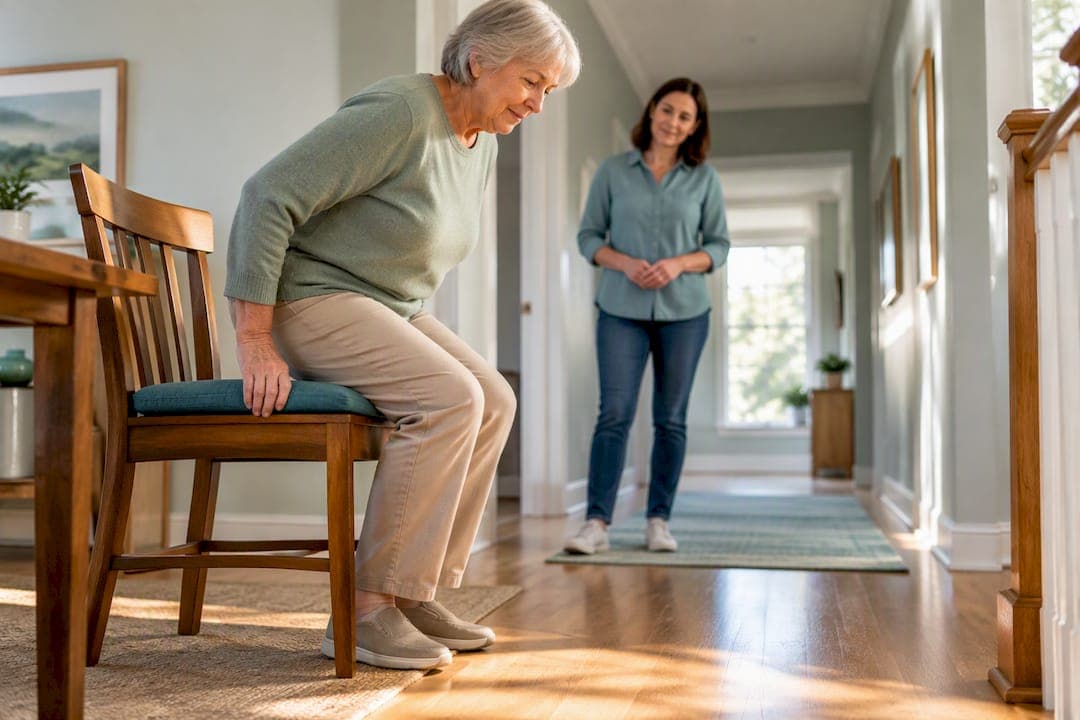
Start with two things this week: walk through your parent's home room by room to clear the obvious hazards, and time how long it takes them to stand from a chair, walk 10 feet, turn, and sit back down. If that takes 12 seconds or longer, or if you notice wobbling, unsteadiness, or a recent fall, it's time to loop in their doctor or a physical therapist. Everything else in this guide builds from those two steps.
TL;DR:
- Clear hazards like loose rugs, tangled cords, and poor lighting first, as they are high-impact and low-cost fixes with immediate effects.
- Conduct quick screening tests such as the Timed Up and Go, Chair Stand, and Balance Test to identify balance or strength issues needing medical evaluation.
- Review intrinsic risk factors such as medications, vision, footwear, and blood pressure changes with healthcare professionals for targeted interventions.
- Use practical equipment like grab bars, non-slip mats, and proper lighting, ensuring they are securely installed and tested before use.
- Reassess fall risk periodically, especially after health changes or falls, and consider professional home evaluations for tailored safety recommendations.
Table of Contents
- A room-by-room checklist: what to fix first
- How to run three quick screening tests safely
- Check medical and personal risk factors: meds, vision, feet, and blood pressure
- Practical fixes and equipment that actually help
- When to request a professional home evaluation
- How to do a first pass before anyone else gets involved
- Sorting what's about the person from what's about the house
- How to talk with your parent about fall prevention
- Why fall risk needs a second look down the road
- Starting the conversation and a simple weekend plan
- How Helping Mom can guide the process with you
- Checklists and resources worth saving
- Sources
- FAQ
A room-by-room checklist: what to fix first
You don't need to overhaul the whole house in a weekend. Some fixes matter far more than others, and most cost little or nothing.
Start with the highest-impact, lowest-cost changes. Loose rugs, dim hallways, and tangled cords cause a large share of preventable falls, and all three take minutes to fix. The National Institute on Aging's room-by-room guidance and the CDC's printable home safety checklist both organize hazards this way, and they're worth printing out before you start.
- Stairs: secure loose handrails on both sides if possible, add non-slip treads, and make sure the top and bottom steps are well lit.
- Bathrooms: install grab bars near the toilet and inside the shower or tub, add a non-slip mat, and consider a raised toilet seat if your parent struggles to sit or stand.
- Bedrooms: clear the path between the bed and bathroom, add a nightlight or motion-sensor light, and keep a phone or medical alert device within reach of the bed.
- Kitchen: move frequently used items to waist or shoulder height so climbing on a stool isn't necessary, and add a stable chair for tasks like chopping or waiting for the kettle.
- Living areas: rearrange furniture so there's a clear, wide walking path, and tuck away cords that cross open floor space.
- Entrances and outdoors: repair cracked walkways, add handrails to porch steps, and light the path from the driveway or car to the front door.
Once you've spotted the hazards, triage them. Immediate fixes, like removing a rug or adding a lamp, can happen today. Bigger projects, like installing grab bars or widening a doorway, may need a handyman or contractor, so put those on a short list with a rough timeline rather than letting them stall the easy wins. Our printable home safety checklist can help you track both categories as you go.
How to run three quick screening tests safely
Once the home itself is safer, a few simple tests can tell you whether your parent's balance and strength need attention too. These aren't medical exams. They're quick screens, the kind physical therapists and the CDC's STEADI initiative use to flag who might benefit from a closer look.
Before you begin, clear a straight, unobstructed path at least 10 feet long, have a sturdy chair with armrests, make sure your parent is wearing their regular shoes (not just socks), and stay close by in case they need steadying.
- Timed Up and Go (TUG): Have your parent sit in the chair, then say "go" and time how long it takes them to stand, walk 10 feet, turn around, walk back, and sit down. A time of 12 seconds or more is flagged by STEADI as worth discussing with a clinician, not a diagnosis on its own.
- 30-Second Chair Stand: With arms crossed over the chest, have them stand up and sit down as many times as they can in 30 seconds. Fewer repetitions than expected for their age can signal reduced leg strength, one of the more common contributors to falls.
- 4-Stage Balance Test: Ask them to hold four positions in sequence, feet together, one foot slightly in front of the other, feet in a tandem line, and standing on one foot, for 10 seconds each. Trouble holding an early stage means you can stop there; it's still useful information.
Write down the results with the date, then share them with your parent's doctor or ask about a referral to physical therapy. A single screening tells you where to look closer, not what's wrong.
Pro Tip: Do the tests on a normal day, not right after a doctor's appointment or a rough night's sleep. You want a realistic baseline, not a worst-case snapshot.
Check medical and personal risk factors: meds, vision, feet, and blood pressure
The house isn't the only place fall risk hides. Some of the biggest factors live in the medicine cabinet, the eyeglass case, and the shoe closet.
- Medications: Certain medications, including some sedatives, blood pressure drugs, and antidepressants, are linked to higher fall risk, so ask a pharmacist or doctor for a full medication review rather than trying to sort this out yourself.
- Vision: Encourage an annual eye exam, and remind your parent to use their correct glasses (not readers) when walking, since bifocals can distort depth perception on stairs.
- Feet and footwear: Supportive shoes with non-slip soles are safer than walking around in socks or loose slippers, and a podiatrist visit is worth considering if foot pain is changing how someone walks.
- Blood pressure changes: Lightheadedness when standing up, known as orthostatic hypotension, is worth mentioning to a doctor. You can watch for it informally by noticing whether your parent pauses or steadies themselves after standing from a chair or bed.
None of these require a medical background to notice. They just require paying attention over a few ordinary days, then bringing what you see to someone who can act on it.
Practical fixes and equipment that actually help
Once you know what needs fixing, a short list of well-placed equipment covers most of the risk.
- Grab bars: Install one vertically by the toilet and one or two inside the shower or tub, anchored into wall studs rather than just drywall, at a height that matches your parent's reach, not a generic standard.
- Non-slip mats and strips: Place a rubber-backed mat outside the tub and adhesive strips inside it. Skip the fluffy bath mat that slides on tile.
- Lighting: Motion-sensor night-lights in hallways and bathrooms solve the "getting up at 2 a.m." problem better than a lamp your parent has to remember to turn on.
- Canes and walkers: These help only when they fit the person using them. A cane that's the wrong height or a walker that's never been adjusted can make balance worse, not better, so have a physical therapist confirm the fit before relying on one daily.
Pro Tip: Test any new grab bar yourself by leaning your full weight on it before your parent uses it. If it wiggles at all, it's not anchored well enough.
For a deeper walkthrough of arranging furniture, lighting, and walking paths, our guide to senior-friendly home setup covers the layout side of this in more detail.
When to request a professional home evaluation
Some situations call for more than a caregiver's eye. Any actual fall, even a minor one, is a reason to request a professional evaluation. So are repeated near-misses, a new mobility issue, or several risk factors stacking up at once, like poor vision plus a recent medication change.
An occupational therapist typically focuses on the home itself, recommending specific modifications and equipment. A physical therapist assesses gait, strength, and balance, and can build an exercise plan. A nurse or pharmacist can lead a medication review. The USPSTF's 2024 recommendation points toward exercise referrals and individualized plans over one-size-fits-all fixes, which is why a professional visit often looks different from one family to the next.
A typical home visit includes a walkthrough of every room, a look at how your parent moves through their daily routine, and a written list of recommendations. Before the visit, jot down any recent falls or near-falls and gather a current medication list so the clinician has the full picture right away.
How to do a first pass before anyone else gets involved
Before you bring in a professional, or even before you say anything to your parent, spend twenty quiet minutes walking through the home as if you were seeing it for the first time. Open closet doors, look under rugs, check whether the porch light actually works after dark.
Take photos on your phone as you go. It's easier to compare "before and after" once you start making changes, and photos help you remember details when you're describing the home to a therapist later. Note anything you're unsure about rather than deciding on the spot whether it's a real hazard. A slightly worn stair tread might be nothing, or it might be the thing that trips someone in low light.

This first pass is about observation, not action. You're building a private list, not making changes yet or raising concerns with your parent. That comes next, and it goes more smoothly when you've already done the looking and can speak from specifics rather than a general worry.
Sorting what's about the person from what's about the house
Fall risk comes from two different directions, and it helps to keep them separate in your head. Intrinsic factors live in the person: weakening leg muscles, slower reflexes, medication side effects, vision changes, inner-ear issues affecting balance. Environmental factors live in the house: a loose rug, a dim staircase, a shower with nothing to hold onto.

The room-by-room checklist and the equipment fixes address the environmental side. The screening tests and the conversation about medications, vision, and footwear address the intrinsic side. Both matter, and neither one alone tells the whole story. A perfectly hazard-free home won't protect someone whose balance has quietly declined, and the strongest, steadiest person can still trip over a cord left across a hallway.
When you're deciding where to focus first, look for overlap. If your parent already seems unsteady on their feet, environmental fixes like grab bars and better lighting become more urgent, not less. If the home has several genuine hazards but your parent moves confidently through it, you still have time to fix things calmly rather than reactively.
How to talk with your parent about fall prevention
Fall prevention conversations tend to go better when they're framed around independence rather than decline. Nobody wants to hear that the house they've lived in for decades is suddenly "dangerous."
Try mentioning a specific, low-stakes observation rather than a broad worry: "I noticed the hallway light burned out. Want me to grab a brighter bulb while I'm at the store?" This opens the door without triggering defensiveness. Framing grab bars or better lighting as things that help someone stay in their own home longer, rather than as concessions to aging, tends to land better too.
Small, visible wins build trust for bigger conversations later. Once your parent sees that a nightlight actually helped them get to the bathroom more easily at night, they're more open to the next suggestion. Repetition helps as well. A single conversation rarely changes habits, but a few relaxed check-ins over weeks usually do.
Why fall risk needs a second look down the road
A home safety check isn't a one-time project. Bodies change, medications change, and seasons change what's slippery or poorly lit. What was a safe bathroom last spring might need a second grab bar after a hip surgery this fall.
Revisit the screening tests every few months, especially after any change in medication, a hospital stay, or a new health diagnosis. A TUG time that was fine in January but has crept up by summer is worth mentioning to a doctor, even if nothing dramatic has happened in between. The STEADI framework treats fall prevention as an ongoing loop of screening, assessing, and adjusting, not a single pass.
Keep a simple record, even something as basic as a note in your phone with the date and the results. Patterns matter more than any single number, and a written history makes it much easier for a clinician to spot a real change instead of guessing from memory.
Starting the conversation and a simple weekend plan
You don't have to fix everything at once, and you don't have to present it as a big project. A short, specific plan for one weekend often works better than a long list that feels overwhelming to everyone involved.
Try this: clear one cluttered walking path, add a nightlight to the hallway or bathroom, and move a few frequently used kitchen items down to waist height. Three small changes, done together, in an afternoon.
Frame it as helping your parent stay comfortable and independent in the home they love, not as taking something away from them. Small, steady changes tend to stick better than a single overwhelming overhaul, and they let your parent keep a sense of control over their own space.
— Mike C.
How Helping Mom can guide the process with you
Reading a checklist is one thing. Walking through your parent's actual home with someone who knows what to look for is another, and that's where a guided assessment often saves you the second-guessing.
Helping Mom offers a few ways to get that support. A Virtual Home Safety Consultation lets you walk your parent's home on a video call with someone trained to spot hazards you might miss. An In-Home Age-Safe Home Safety Assessment brings that same walkthrough to your parent's door for a hands-on look. And a Caregiving Clarity Session, priced at $97 for a one-time session, gives you focused time to talk through what you're seeing and figure out what to prioritize next.
- A full room-by-room walkthrough, similar to the checklist above but tailored to your parent's actual home.
- A prioritized, written action plan you can reference and share with other family members.
- A calm, judgment-free conversation about what's realistic to change now versus later.
If you'd rather have a second set of eyes than guess alone, book a session with Helping Mom and get a clear plan you can act on this week.
Checklists and resources worth saving
Print or bookmark these before your next visit.
- The CDC's STEADI clinical resources include the screening algorithm and test instructions.
- The NIA's room-by-room worksheet walks through hazards by area of the home.
- Our own Elderly Home Safety Checklist is built to print and carry room to room.
This article is general information, not a substitute for advice from a qualified doctor. Consult a qualified healthcare professional about your own circumstances before acting on anything here.
Sources
- Clinical resources | STEADI - Older adult fall prevention | CDC
- Preventing falls at home: room by room | National Institute on Aging
- Check For Safety: A home fall prevention checklist for older adults | CDC
FAQ
What's the most effective way to reduce a person's fall risk at home?
Combining a room-by-room hazard sweep with a review of medications, vision, and footwear covers the two biggest categories of risk at once. The USPSTF points to individualized, multifactorial approaches rather than a single fix, so pairing home changes with an exercise or strength program tends to work better than either alone.
What are the 5 P's of falls prevention?
Different organizations phrase this differently, so there isn't one universal, official list, but common versions cover ideas like proper footwear, physical activity, pharmacy (medication) review, proper lighting, and personal alert devices. Rather than memorizing a specific list, focus on the underlying categories: the home environment, medications, vision, footwear, and strength or balance.
What should a home safety checklist for fall prevention include?
A solid checklist covers stairs, lighting, loose rugs, cords, bathroom grab bars and non-slip surfaces, and clear walking paths through bedrooms and living areas. The CDC's Check for Safety brochure organizes exactly this way, room by room, with specific fixes for each hazard.
What should be included in a fall risk assessment?
A thorough assessment includes a home hazard review, a look at medications, vision, and footwear, and one or more functional tests like the Timed Up and Go, the 30-Second Chair Stand, or the 4-Stage Balance Test. MedlinePlus notes that results typically lead to follow-up steps such as exercise referrals, medication adjustments, or a vision check rather than a single yes-or-no answer.
Can Helping Mom help with a home safety assessment?
Yes. Helping Mom offers a Virtual Home Safety Consultation and an In-Home Age-Safe Home Safety Assessment for families who want a guided walkthrough and a written action plan rather than working through a checklist alone.