
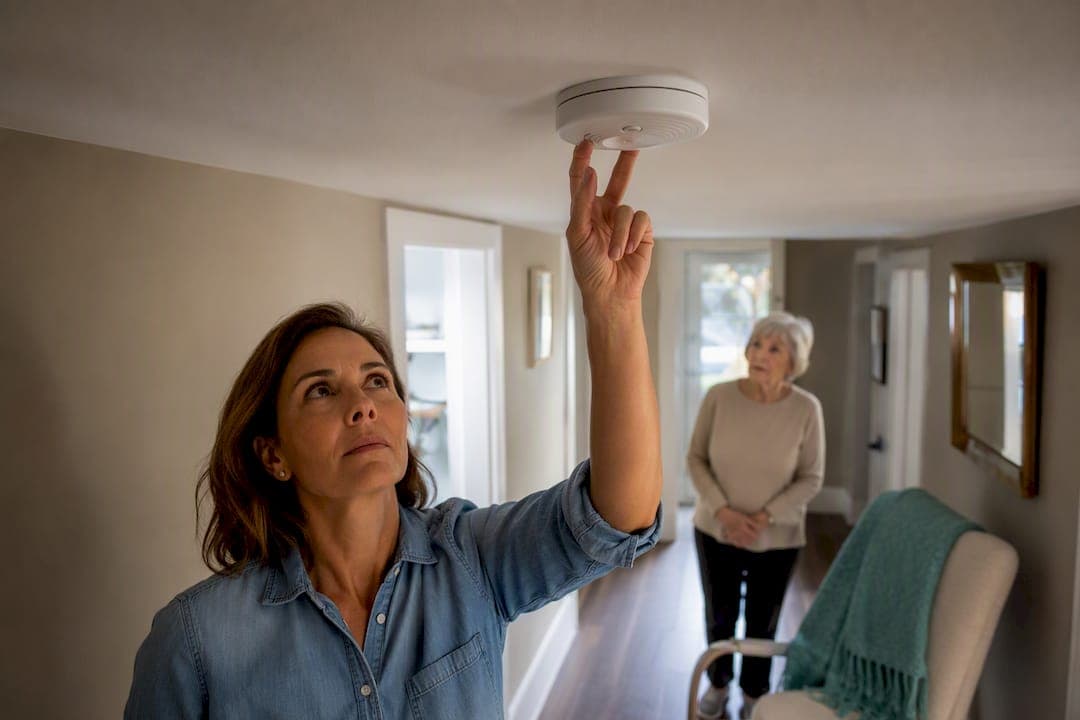
The two actions that matter most are working smoke alarms placed correctly and tested monthly, and an escape plan practiced twice a year that fits your parent's real mobility and hearing. Older adults face 2.5 times the risk of dying in a home fire compared to the general population, and cooking and smoking are the two causes that show up again and again. Everything else in this guide builds on those two priorities.
TL;DR:
- Properly installed and monthly-tested smoke alarms are crucial, with whole units replaced every 10 years to ensure reliable alerts.
- Tailored escape plans must account for your parent's mobility, with practical walk-throughs using actual aids and twice-yearly practice sessions.
- Nighttime fire safety can be improved by using low-frequency alarms, strobe lights, or bed shakers, especially if hearing loss is present.
- Preventing cooking fires involves constant supervision, use of timers, and proper handling of grease fires and pot handles near open flames.
- Safety devices like automatic stove shutoff and fire-retardant bedding add extra layers of prevention, but a strong alarm system combined with good habits remains essential.
Table of Contents
- Fire Safety for Seniors: A Prevention Checklist You Can Use This Week
- How to Build an Escape Plan That Actually Fits Your Parent
- Nighttime Alarms and Bedside Setup for Better Sleep Safety
- Kitchen Habits That Prevent Most Cooking Fires
- Smoking and Oxygen: A Combination That Needs Extra Care
- Electrical and Heating Fixes Worth Arranging
- Clear the Path: Removing Trip Hazards Along Every Exit
- If a Fire Starts: The Order of Actions That Matters
- Where to Get Extra Help: Local and National Resources
- Fire Extinguisher Selection and Use for Seniors
- How Medications and Mobility Affect Evacuation Time
- What Caregivers Can Actually Do to Help
- Devices and Modifications That Reduce Fire Risk
- A Few Words From Helping-mom on What Really Matters Here
- Get Step-by-Step Help With Your Parent's Home Safety Plan
- Sources
- FAQ
Fire Safety for Seniors: A Prevention Checklist You Can Use This Week
You don't need to overhaul your parent's whole house in one weekend. Start with the items that carry the most risk and work down the list as you have time.
- Smoke alarms: install one in every bedroom, outside each sleeping area, and on every level of the home. Test monthly and replace the whole unit every 10 years, not just the battery.
- Carbon monoxide alarms: place near sleeping areas, especially if the home has gas appliances, a fireplace, or an attached garage.
- Cooking: never leave a pan unattended on the stove. Set a timer for anything in the oven, even "just a few minutes."
- Smoking: smoke outside whenever possible, and keep a deep, sturdy ashtray away from anything flammable.
- Heating: keep space heaters at least three feet from furniture, curtains, and bedding, and plug them directly into the wall.
- Clutter: clear papers, boxes, and stacks of mail away from stoves, heaters, and exit paths.
Pro Tip: Put a sticky note on the calendar for the first of every month labeled "Test Mom's alarms." A habit tied to a date sticks better than a vague intention to "check on it sometime."
How to Build an Escape Plan That Actually Fits Your Parent
A generic fire escape diagram from a pamphlet rarely matches how your parent actually moves through their home. If she uses a walker, the plan has to account for the extra seconds and the width of every doorway she'd need to pass through under stress.
- Walk through every room and identify two ways out, not just the front door.
- Test that doors and windows actually open easily, and that any security bars have a quick release your parent can operate without a key or much hand strength.
- Pick a visible meeting place outside, like a specific tree or the neighbor's mailbox.
- Loop in a neighbor, building manager, or the local fire department if your parent would need help getting out safely.
- Practice the plan at least twice a year, and again any time you rearrange furniture or your parent's mobility changes.
Pro Tip: Do a timed walk-through using the actual walker or wheelchair, not an assumption about how wide the hallway "should" be. Families are often surprised that a doorway they thought was fine is a tight squeeze once you're pushing a frame through it under pressure.
Nighttime Alarms and Bedside Setup for Better Sleep Safety
Most fatal home fires happen while people are asleep, which makes nighttime readiness one of the highest-value fixes you can make. Standard smoke alarms rely on a high-pitched tone that many older adults, especially those with age-related hearing loss, simply don't hear while sleeping.
- Consider low-frequency alarms, strobe lights, or bed shakers if your parent has hearing loss. Hearing loss affects a large share of older adults, so this isn't a niche accommodation.
- Interconnect alarms where possible, so one sounding triggers all of them.
- Keep glasses, hearing aids, a phone, and door keys in the same spot by the bed every single night.
- Replace any alarm older than 10 years, even if it still "seems to work."
A home safety device guide can help you compare bed shakers and strobe alarms if you're not sure where to start.
Kitchen Habits That Prevent Most Cooking Fires
Cooking remains the top cause of home fires among older adults, and it's usually not one dramatic mistake. It's a pan left on the stove for "just a minute" while answering the phone or sitting down to rest.
- Stay in the kitchen the entire time something is frying, boiling, or grilling.
- Set a timer, even for a quick reheat, and keep it somewhere visible.
- Keep a pot lid or cookie sheet within reach to smother a small pan fire. Slide it over the flames and turn off the burner. Never pour water on a grease fire.
- Turn pot handles toward the back of the stove so they can't be bumped.
- Avoid loose sleeves near open burners.
If your parent's stove has gotten harder to manage safely, a kitchen safety guide for seniors walks through appliance adjustments that reduce risk without taking away independence.
Smoking and Oxygen: A Combination That Needs Extra Care
If your parent smokes and uses supplemental oxygen, treat this as a non-negotiable safety zone. Oxygen doesn't burn on its own, but it makes any nearby flame burn hotter and faster.
- Never smoke in bed, even "just this once" while half asleep.
- Extinguish cigarettes fully in water or sand, not just an ashtray.
- Follow the oxygen supplier's rules: no smoking or open flames anywhere near the oxygen equipment or tubing.
- Store lighters and matches somewhere your parent can't reach without help if memory or judgment has started to slip.
Electrical and Heating Fixes Worth Arranging
Older homes often carry older wiring, and space heaters get pulled out every winter without a second thought about placement.
- Avoid running extension cords permanently under rugs or behind furniture, and replace any cord that's frayed or cracked.
- Choose space heaters with tip-over shutoff protection, and keep at least three feet of clearance from bedding, curtains, and furniture.
- If breakers trip frequently or lights flicker, call a licensed electrician rather than resetting the panel repeatedly.
- Set the water heater to 120°F to reduce scald risk, which also happens to be a common safe range for skin sensitivity in older adults.
Clear the Path: Removing Trip Hazards Along Every Exit
A fire alarm doesn't help much if the hallway to the door is blocked by a laundry basket or a loose runner rug.
- Clear hallways, stairs, and doorways of boxes, cords, and clutter.
- Check that security bars and window locks have a release your parent can operate quickly, without needing a key.
- Measure doorway widths against the actual walker or wheelchair your parent uses daily.
- Add night lights along the path to the exit, and make sure house numbers are visible from the street for responding firefighters.
Pro Tip: Security bars without an interior quick release are one of the most overlooked hazards in older homes. If your parent needs a key to get out from the inside, that's a fix worth making this month, not someday.
If a Fire Starts: The Order of Actions That Matters
Panic makes people skip steps. A short, memorized sequence helps more than a long list of rules in the moment.
- Get out immediately. Don't stop to gather belongings, medications, or pets.
- Once outside, stay outside. Call 911 from a neighbor's yard or the sidewalk, never from inside the home.
- Check doors before opening them if you can; a hot door means fire on the other side, so use the second exit instead.
- If trapped in a room, close the door, seal the gap with a towel if possible, call 911, and signal from a window.
- If you're the designated helper, focus on getting your parent to the nearest safe exit rather than trying to fight the fire yourself.
Where to Get Extra Help: Local and National Resources
Many local fire departments offer free home-safety visits and can install alarms or help set up a File of Life form for emergency responders. The USFA's printable escape planning flyer is a good starting point for a checklist you can walk through together, and state-level guidance on fire and burn safety often lists local senior-center programs too. Senior centers frequently know which vendors carry bed shakers and strobe alarms locally.
Fire Extinguisher Selection and Use for Seniors
A fire extinguisher only helps if your parent can actually lift it, aim it, and remember how to use it under stress. For most homes, a small ABC-rated extinguisher (rated for wood, liquid, and electrical fires) in the kitchen is the right general-purpose choice. Look for a model in the 2 to 5 pound range, since anything heavier can be difficult for someone with arthritis or reduced grip strength to hold steady.
Mount it somewhere accessible, not under the sink behind cleaning supplies, and somewhere your parent has actually practiced reaching for it. The standard technique is easy to remember as PASS: pull the pin, aim low at the base of the fire, squeeze the handle, and sweep side to side.
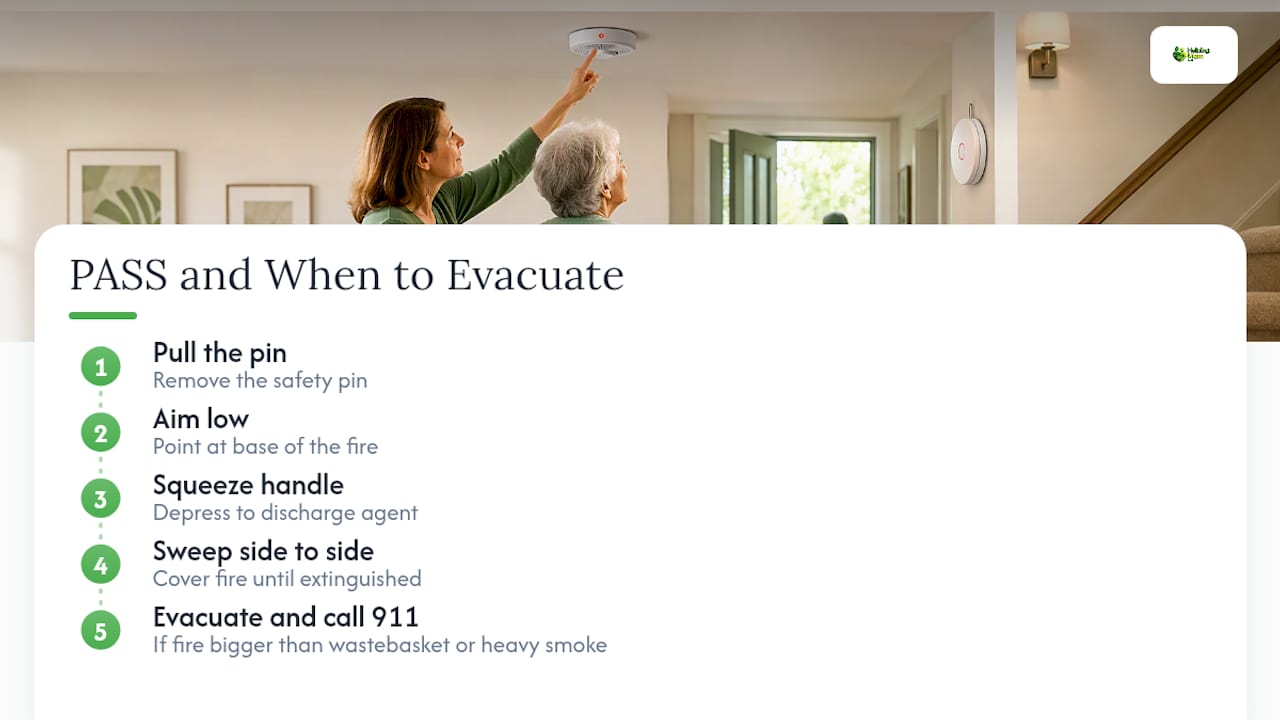
Here's the honest caveat: an extinguisher is only appropriate for a small, contained fire, like a pan fire that hasn't spread past the stove. If the fire is bigger than a wastebasket, or if there's heavy smoke, the right move is to leave and call 911, not to fight it. Talk through this distinction with your parent directly, because the instinct to "just put it out" can cost precious seconds. If your parent has significant hand weakness or memory changes that make the PASS sequence hard to recall reliably, it's often safer to skip the extinguisher altogether and focus entirely on the escape plan instead. A tool that causes hesitation in an emergency isn't helping.
How Medications and Mobility Affect Evacuation Time
Fire safety planning has to account for what your parent's body and mind can actually do at 3 a.m., not what they can do on a good afternoon. Sedating medications, including some sleep aids and pain medications, can slow waking response time and grogginess after an alarm sounds. If your parent takes something that makes them hard to rouse, that's a strong argument for bed shakers or strobe alerts rather than sound alone.
Physical limitations change the math too. Someone who needs 30 extra seconds to get from bed to walker needs that built into the plan, not glossed over. A parent recovering from a hip replacement or managing arthritis may not be able to move quickly down a hallway, let alone navigate stairs. If stairs are part of any escape route, have an honest conversation about whether a ground-floor bedroom makes more sense, at least temporarily.
Cognitive changes add another layer. A parent in the early stages of memory loss may forget the plan entirely in the moment, no matter how many times you've practiced it. In that case, the plan needs to lean more heavily on interconnected alarms, a nearby helper, and simplified single-step instructions rather than a multi-step sequence. None of this means your parent can't stay safely in their home. It means the plan has to match the person, not a generic template.
What Caregivers Can Actually Do to Help
You don't have to do everything at once, and you don't have to do it alone. A few specific habits make a bigger difference than a long to-do list you never finish.
Build alarm checks into visits you're already making. Testing the smoke alarm takes 30 seconds when you're already there for dinner or a doctor's appointment, and folding it into routines you keep anyway improves follow-through far more than a one-time overhaul ever does. Keep a shared note, whether it's a family group chat or a shared calendar, tracking when alarms were last tested and when batteries or units were replaced.
If siblings or other family members share caregiving duties, assign the fire-safety checks to one person so nothing falls through the cracks between visits. When your parent lives alone and family can't visit often, loop in a trusted neighbor who can check in periodically and knows the escape plan too. And when something feels beyond what you can assess yourself, whether that's wiring that looks questionable or a mobility change that makes the current escape plan unrealistic, ask the local fire department for a home visit rather than guessing. Most departments offer this service and it costs you nothing but a phone call.
For a broader look at how these small habits fit into overall home safety, Helping-mom's guide to making a parent's home safer covers more than fire risk alone.
Devices and Modifications That Reduce Fire Risk
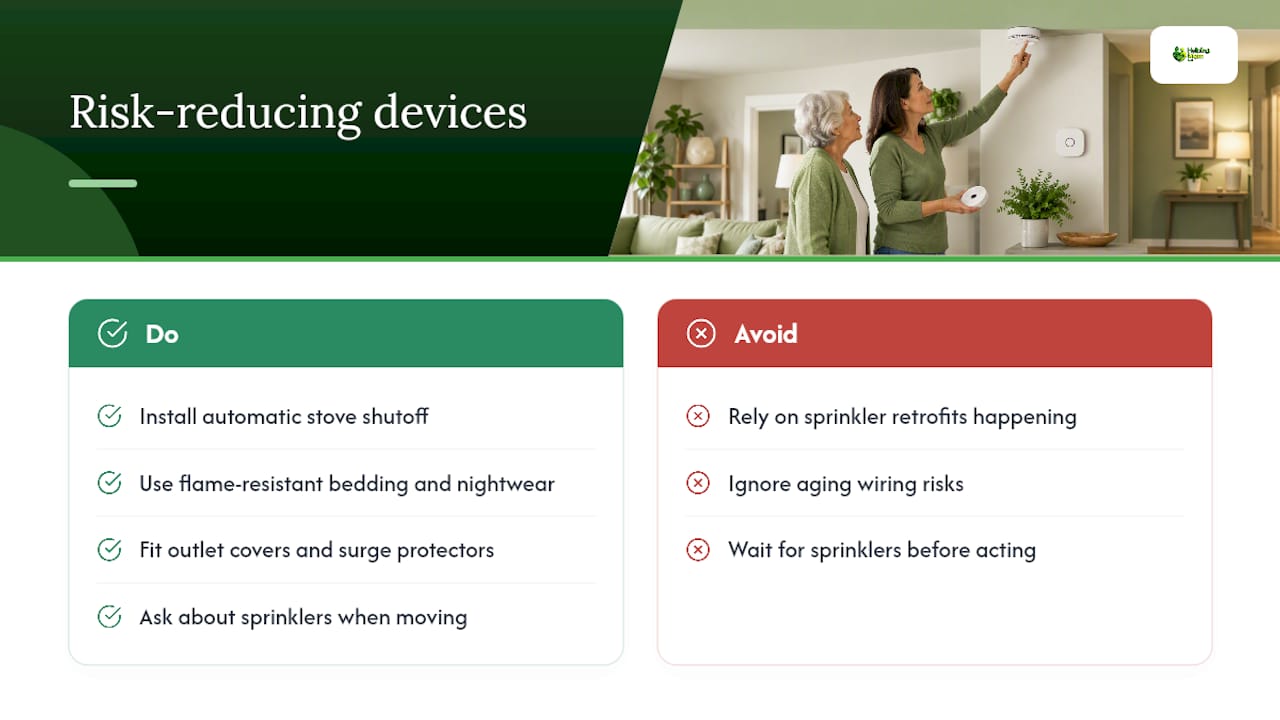
Beyond alarms, a handful of specific devices and small home changes lower fire risk without requiring constant vigilance from your parent. Automatic stove shutoff devices, which cut power to the burner after a set time or if they don't detect motion nearby, address the single most common ignition point in a senior's home. Some plug-in models work with existing electric stoves without any rewiring.
Flame-resistant or fire-retardant bedding and nightwear reduce how quickly a fire spreads if one starts near the bed, which matters given how many fatal fires start or spread during sleep. Outlet covers and surge protectors with built-in overload shutoff add a layer of protection against the aging wiring common in older homes.
For sprinklers, the honest picture is mixed: home sprinkler systems dramatically reduce the odds of dying in a fire, but most single-family homes and older apartments simply don't have them installed, and retrofitting is a significant undertaking most families won't pursue. If your parent is considering a move to a new apartment or assisted living setting, ask directly whether sprinklers are installed. It's a reasonable question to add to any housing checklist. For most families staying in the current home, the more realistic path is combining strong alarm coverage with the prevention habits already covered here, rather than waiting on a sprinkler retrofit that may never happen.
A Few Words From Helping-mom on What Really Matters Here
If you only do two things this month, test every smoke alarm and walk through the escape plan with your parent using whatever mobility aid they actually use. Everything else on this list matters, but those two habits carry the most weight. Ask a neighbor or your local fire department for help if any part of this feels beyond what you can check yourself. Small, steady checks, done consistently, protect your parent more than any single big fix ever could.
— Mike C.
Get Step-by-Step Help With Your Parent's Home Safety Plan
A checklist gets you started, but walking through your parent's actual home, room by room, is where most families realize what they'd missed. Helping-mom's practical guide to making a parent's home safer gives you a step-by-step home safety assessment and downloadable templates you can use the same day you buy it, no waiting for an appointment. It's built specifically for adult children managing this from a distance or squeezed for time, not generic homeowner advice repackaged for seniors.
If your parent also uses a medical alert device or you're weighing options, Savings Grove's guide to low-cost medical alert systems is worth a look alongside your fire safety plan. When you're ready for a deeper walkthrough of your parent's specific home, start with the practical home safety guide and work through it together this week.
Sources
This guide draws on the U.S. Fire Administration's older-adult fire safety data, the NFPA's guidance on sleep-time fires and alarm adaptations, the CPSC's cooking and prevention tips, and NIDCD data on hearing loss in older adults.
FAQ
What can an older adult do to prevent a fire?
The biggest steps are testing smoke alarms monthly, never leaving cooking unattended, keeping space heaters three feet from anything flammable, and smoking outside rather than in bed or near oxygen equipment.
What are the 5 basic fire safety practices?
Install and test smoke alarms, never leave cooking unattended, keep heaters and flames away from flammable materials, plan and practice two ways out of every room, and handle smoking materials and matches carefully.
What is the leading cause of fire deaths in older adults?
Cooking fires are the most common cause of home fires among older adults, while smoking materials remain one of the leading causes of fatal fires, especially at night.
What are the four golden rules of fire safety?
A common version includes: install working smoke alarms, plan and practice an escape route, never leave cooking or open flames unattended, and stay out once you've escaped rather than going back inside.
How often should smoke alarms be tested for seniors?
Test smoke alarms monthly and replace the entire unit every 10 years, not just the battery, since the sensor itself degrades over time.