

Yes, home modification grants for seniors exist, and you don't have to be an expert in government programs to find them. You just have to know where to knock first. Federal, state, and nonprofit funding all flow into this space, but almost none of it reaches families through a direct online application. Instead, it moves through local partners, which means your fastest path forward is a phone call, not a form.
Three programs come up again and again for caregivers doing this research: the Older Adult Home Modification Program (OAHMP).pdf) through HUD, the USDA's Section 504 Single Family Housing Repair program, and VA home modification grants for veterans.
- Call first: your local Area Agency on Aging or dial 211.
- Ask about: OAHMP, USDA Section 504, and VA grants if a veteran is involved.
- Bring: proof of age, income, and homeownership to that first conversation.
Roughly $10,000 in USDA Section 504 grant funding is available to eligible homeowners 62 and older, one of several caps worth knowing before you apply.
TL;DR:
- Most federal and state home modification grants for seniors are accessed through local agencies, making the initial phone call more important than direct applications.
- The USDA's Section 504 grant offers up to $10,000 for homeowners aged 62 or older, with repayment required if the home is sold in less than three years.
- Eligibility often depends on age, income, homeownership status, and assessed safety needs, with assessments typically performed by occupational therapists.
- Local programs and nonprofits, like Rebuilding Together or community grants, sometimes provide faster, more flexible options and additional funding sources.
- Home modifications usually cover small improvements like grab bars and ramps, with budgets often enough for several projects but not full renovations, requiring staged or combined efforts.
Table of Contents
- How Home Modification Grants for Seniors Actually Reach Families
- Which Federal Grant Programs Cover Home Safety Modifications?
- What State and Local Programs Should You Also Check?
- How Do You Apply for a Home Modification Grant?
- What Home Modifications Do These Grants Actually Pay For?
- When Should You Apply, and What Trips People Up?
- A Caregiver's Walk-Through Before the Official Assessment
- Does a Credit or Background Check Affect Your Eligibility?
- Can These Grants Work Alongside Medicaid Waivers?
- What Happens After the Modifications Are Installed?
- Ready to Take the Next Step Toward a Safer Home?
- Key Takeaways
- An Honest Look at What Actually Helps Caregivers Get Funded
- Sources
- FAQ
How Home Modification Grants for Seniors Actually Reach Families
Here's something that surprises a lot of adult children when they start this search: you almost never apply straight to the federal government. HUD doesn't hand out OAHMP money to individual homeowners. It awards funding to nonprofits, local governments, and public housing authorities, who then run the actual program in their community, a model spelled out in HUD's own funding notice. That's why searching "HUD home modification application" so often leads nowhere useful.
What you'll typically encounter instead is a service model that looks something like this:
- You call a local agency and complete an intake conversation about your parent's situation.
- Someone, often an occupational therapist, visits the home to assess fall risks and mobility needs.
- The assessor builds a prioritized list of low-cost, high-impact changes rather than a full renovation wish list.
- A licensed contractor connected to the program installs the approved work.
- The agency follows up to confirm the modifications are working as intended.
Eligibility usually hinges on a few consistent factors: age (62 and older is common for several programs), household income relative to local limits, whether your parent owns or rents, and documented safety need. Renters aren't automatically excluded, but landlord cooperation is often required.
Which Federal Grant Programs Cover Home Safety Modifications?
Three federal programs anchor most of what's available, and each one plays a different role.
HUD's Older Adult Home Modification Program focuses squarely on low-cost, high-impact safety changes for seniors 62 and older, and it's built around occupational therapist input rather than guesswork. The program's NOFO caps individual items at $5,000 unless HUD specifically approves more, and it includes a rural set-aside. Grab bars, ramps, and non-slip surfaces are the bread and butter here. Again, individuals don't apply directly; you find a grantee organization operating in your area.
USDA's Section 504 program is one of the more concrete options on paper. Homeowners age 62 and older can receive a grant of up to $10,000, with loans available up to $40,000 and combined assistance capped around $50,000. There's a catch worth flagging early: grants typically must be repaid if the home is sold within three years. You apply through your local USDA Rural Development office, not a national portal.
- VA grants (SAH, SHA, TRA, HISA): these serve veterans with service-connected needs, and dollar amounts run considerably higher than most civilian programs, according to NerdWallet's summary of VA benefits. HISA covers smaller, medically necessary improvements even for some non-service-connected veterans. A local veteran service officer is usually the best starting point.
What State and Local Programs Should You Also Check?
Federal programs get most of the attention, but state and local options often move faster and carry looser eligibility rules. They also run out of money sooner, so timing matters more here than with federal funding.
Here's what to look for in your area:
- County or city minor-repair grants, often funded through Community Development Block Grants (CDBG).
- Rebuilding Together affiliates, which sometimes pair volunteer labor with material costs, keeping total project expense down.
- Faith-based volunteer repair programs, common in smaller communities and often overlooked in online searches.
- State housing department programs, like the example of a county senior repair grant in Los Angeles that provides roughly $5,600 per household with contractor-managed installation.
The trade-off is real: local programs can be more flexible and personal, but funding is finite and sometimes seasonal. Your Area Agency on Aging, 211, or your state housing department's website are the three most reliable places to start looking.
How Do You Apply for a Home Modification Grant?
Preparation makes the difference between a two-week process and a two-month one. Here's the order that tends to work best.
- Call your Area Agency on Aging first. If a veteran is involved, add a call to your local veteran service officer. If neither applies cleanly, your county community development office is next.
- Gather documents before you call back: proof of age, recent income statements, proof of homeownership or a lease, and photos of the specific hazards you're concerned about.
- Ask about the assessment process. Most programs require an occupational therapist or qualified assessor to visit before any work gets approved.
- Confirm the payment structure. Ask directly whether the program pays the contractor or reimburses you after the fact, since reimbursement programs require you to cover costs upfront.
- Ask about timeline, licensing requirements, and any lien or repayment conditions tied to the funding.
Pro Tip: Write down the exact name of the program and the caseworker you speak with. Caregivers who juggle multiple agencies often lose track of which office promised what, and a simple notebook entry saves real headaches later.
What Home Modifications Do These Grants Actually Pay For?
Most programs are built around small, targeted fixes rather than full remodels, and knowing the typical price range helps you judge whether a grant's cap will actually cover what your parent needs.
- Grab bars: roughly $100 to $400 each, installed.
- Temporary ramps: about $400 to $2,500 depending on length and materials.
- Shower transfer benches: typically $100 to $400.
- Partial bathroom adaptations (new fixtures, walk-in shower conversion): often $1,500 to $8,000.
A $10,000 USDA grant comfortably covers several of these smaller projects, but full ADA-level bathroom remodels or structural work frequently exceed small-grant caps entirely. When that happens, families often combine a grant with a loan, or phase the work in stages, tackling the highest fall-risk items first.
When Should You Apply, and What Trips People Up?
Timing matters more than most caregivers expect. Many programs run on block grants with a fixed yearly budget, and funds can run dry well before the year ends, so reaching out early in the fiscal year gives you a real advantage.
A few common missteps to watch for:
- Assuming a program pays contractors directly when it's actually a reimbursement model, leaving you to cover costs upfront.
- Starting work before securing a required occupational therapist assessment, which is the single most common cause of delayed or denied funding.
- Overlooking repayment terms. USDA Section 504 grants, for example, generally require repayment if you sell the home within three years.
- Waiting until a fall or health scare forces the issue, rather than applying while there's still time to plan.
A Caregiver's Walk-Through Before the Official Assessment
Before a professional ever sets foot in your parent's home, you can do a useful walk-through yourself. Check entrances for steps without rails, hallway and stairway lighting, loose rugs, and bathroom hazards like a slick tub or a toilet that sits too low. Our senior-friendly home setup guide walks through this room by room.
Prioritize in this order: fall and emergency-exit risks first, daily living tasks like bathroom and kitchen access second, comfort or appearance upgrades last, only if the budget allows.
- Walk the entry path, stairs, and bathroom before anything else.
- Note anything your parent has already mentioned struggling with.
- Bring your parent into the conversation early. Frame changes as ways to keep them independent, not as a loss of control.
Pro Tip: Ask your parent to show you, not just tell you, how they get in and out of the shower or off the couch. What sounds fine in conversation often looks different in practice.
Does a Credit or Background Check Affect Your Eligibility?
Most of the programs discussed here, including HUD's OAHMP and USDA Section 504, are built around age, income, and homeownership documentation rather than a credit score review. That's a meaningful difference from private home improvement loans, where credit history plays a central role in approval and interest rate.
That said, a few things can still come into play. If a program includes a loan component, such as the USDA loan option that pairs with its Section 504 grant, a credit check is more likely since you're taking on repayable debt rather than receiving pure grant funding. Programs that involve a lien on the property, common with grants that require repayment if the home sells within a set period, may also pull a basic title or ownership history check rather than a personal credit report.
Background checks, when they appear at all in this space, usually apply to the contractors and volunteers doing the work, not to the senior receiving it. Reputable programs vet the people entering someone's home for safety reasons, which is a good sign of a well-run operation rather than a red flag for your family.
If you're ever asked for a credit check on a program that's supposed to be a straight grant, that's worth a direct question to the administrator. It's not automatically a scam, but it's unusual enough to warrant clarification before you move forward.
Can These Grants Work Alongside Medicaid Waivers?
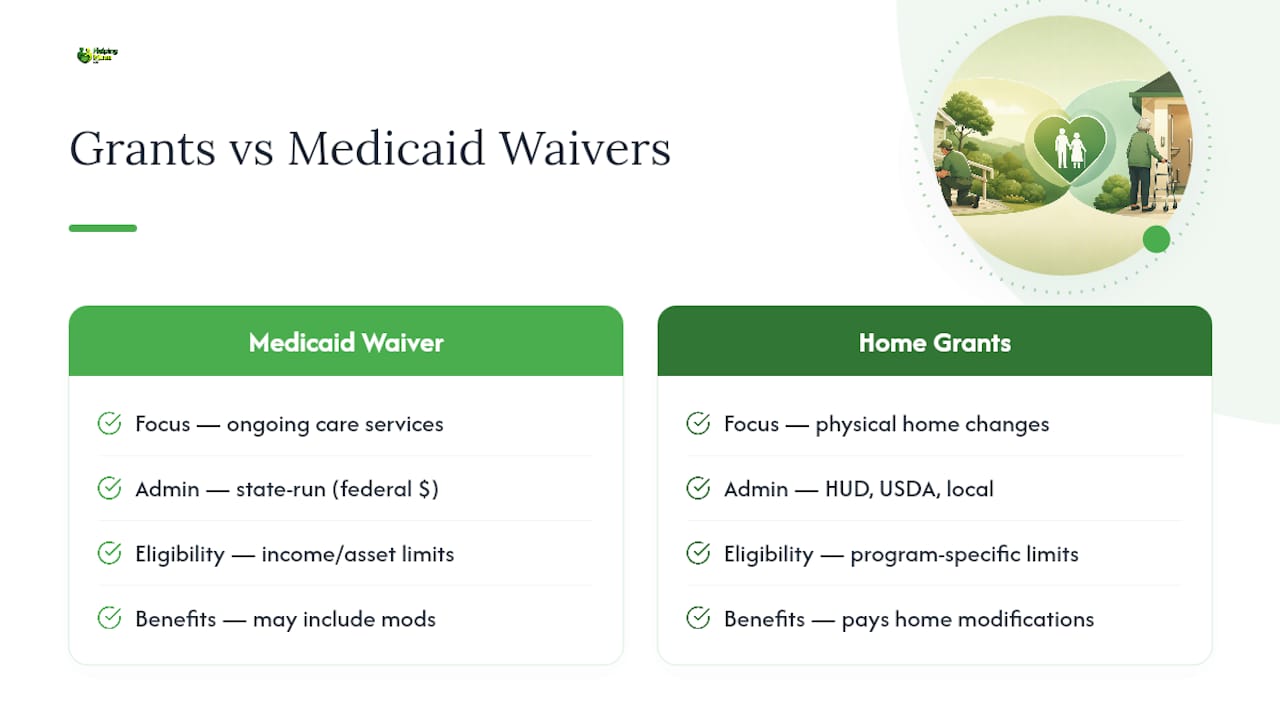
Home modification grants and Medicaid Home and Community-Based Services (HCBS) waivers aren't the same thing, but they frequently work well together, and understanding the difference saves confusion later.
Medicaid waivers typically fund ongoing services like personal care aides, adult day programs, or case management for eligible low-income seniors, and some state waiver programs include a home modification benefit of their own, separate from HUD or USDA funding. If your parent already qualifies for a Medicaid waiver, ask the caseworker directly whether home modifications fall under that specific waiver's covered services. Rules vary significantly by state, since Medicaid waivers are state-administered even though the funding is federal.
Where the programs genuinely complement each other is scope. A Medicaid waiver caseworker often focuses on care services, while a HUD or USDA grant focuses on physical changes to the home. Mentioning one program to the administrator of another rarely hurts and sometimes surfaces funding you wouldn't have found otherwise. Area Agencies on Aging frequently coordinate both types of services, which is another reason that single phone call is worth making early rather than researching each program separately.
Just don't assume approval for one guarantees eligibility for the other. Income limits, asset tests, and age thresholds differ between Medicaid waivers and home modification grant programs, even within the same state.
What Happens After the Modifications Are Installed?
Getting the grant funded and the work completed isn't the finish line. Most programs expect the homeowner to maintain what's been installed, and a few include follow-up inspections to confirm everything still meets safety standards.
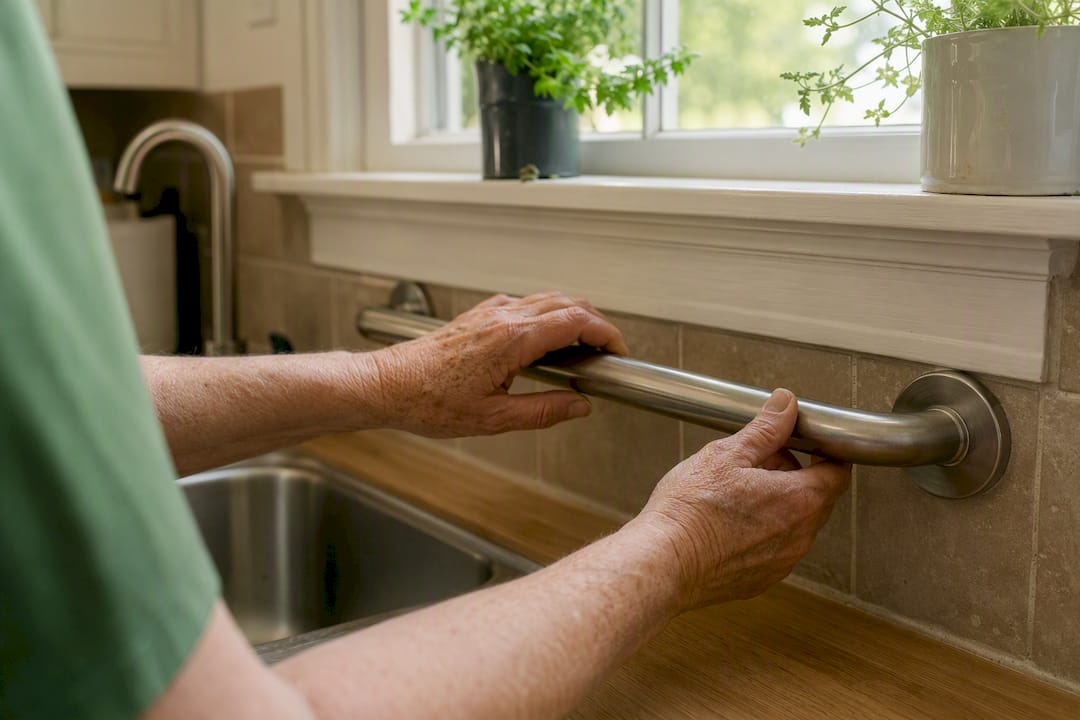
Grab bars need periodic checks to confirm they haven't loosened from the wall anchors. Ramps, especially wooden ones, require basic upkeep to prevent rot or slipping surfaces developing over time. If a contractor pulled a permit for structural work, like a ramp or a widened doorway, your local building department may schedule a follow-up inspection, and skipping that step can create problems if you ever sell the home.
Programs with a repayment or lien condition, such as USDA Section 504's rule about selling within three years, also expect you to keep records of the work done and the funding received. If your parent's home changes ownership or the property transfers to a family trust, notify the program that funded the modifications so you're not caught off guard by a repayment clause you'd forgotten about.
None of this requires special expertise, mostly just a simple habit: check the installed items twice a year, keep your paperwork in one folder, and treat any grant-funded work with the same care you'd give a home warranty. For a broader look at maintaining a safe home over time, our guide on making a home safer for an elderly parent covers ongoing upkeep in more detail.
Ready to Take the Next Step Toward a Safer Home?
Reading about grants is useful, but knowing exactly which hazards matter most in your parent's specific home is where real progress happens. If you'd rather have a clear, guided plan instead of piecing this together alone, Helping-mom's practical guide on making a home safer for seniors walks you through prioritizing changes before you even pick up the phone to call a grant administrator.
For families in Central Florida, Helping-mom also offers in-person home safety assessments, and everywhere else, our Zoom consultations give you a chance to walk through your parent's specific situation with someone who's helped other families through this exact process. It's a smaller step than applying for a grant, but often a clarifying one before you make that first call.
Key Takeaways
Home modification grants for seniors are real and often generous, but they flow through local agencies and occupational therapist assessments rather than direct applications, so your first move should always be a phone call, not a search engine.
| Point | Details |
|---|---|
| Start local, not federal | Call your Area Agency on Aging or 211 rather than searching HUD or USDA websites directly. |
| Know the three main programs | HUD's OAHMP, USDA Section 504, and VA grants (SAH, SHA, HISA) cover most caregiver situations. |
| USDA caps are concrete | Section 504 offers grants up to $10,000 and loans up to $40,000 for homeowners 62 and older. |
| Assessments come before contracting | An occupational therapist evaluation is usually required before work is approved or funded. |
| Repayment terms matter | Some grants, including USDA's, require repayment if the home sells within three years. |
An Honest Look at What Actually Helps Caregivers Get Funded
The conventional advice on this topic tends to bury caregivers in program names before telling them what to actually do first. That's backward. The single most useful thing in this entire process is the phone call to your Area Agency on Aging, and everything else, HUD's model, USDA's dollar caps, VA benefits, only matters once that call is made and you know which door you're walking through.
What's underrated here is the occupational therapist assessment. Families often want to skip straight to "get the ramp installed," but the assessment is what protects your parent from a rushed, poorly prioritized fix. A grab bar installed in the wrong spot because nobody assessed how your parent actually moves through the bathroom isn't a win, it's a missed opportunity dressed up as progress.
What I'd push back on is the assumption that grants alone solve the problem. Most caps are modest, several thousand dollars at most, and real safety often requires layering a grant with a small loan, family funds, or a simplified project scope. Start with the walk-through, make the call, and let the professionals help you prioritize from there.
— Mike C.
Sources
- Opportunity Listing - Older Adults Home Modification Grant Program
- Single Family Housing Repair Loans & Grants - USDA Rural Development
FAQ
Are There Government Grants for Home Improvements?
Yes. Programs like HUD's Older Adult Home Modification Program and USDA's Section 504 offer funding for safety-related home improvements, though individuals typically access them through local agencies rather than applying directly to the federal government.
How Do You Qualify for Home Improvement Grant Programs?
Eligibility generally depends on age (often 62 and older), household income limits, homeownership status, and documented safety needs, though exact rules vary by program and state.
What Grants Are Available for Older Adults Needing Home Repairs?
The main options are HUD's OAHMP for low-cost safety modifications, USDA Section 504 for homeowner repairs and grants up to $10,000, and VA grants for eligible veterans needing accessibility changes.
How Can You Get Home Renovations Covered at Little or No Cost?
Full free renovations are rare, but combining a federal grant, a local nonprofit program like Rebuilding Together, and volunteer labor can significantly reduce out-of-pocket costs for qualifying seniors.
Who Should You Contact First to Start the Grant Process?
Call your local Area Agency on Aging or dial 211, since most home modification grants are administered locally even when the funding originates at the federal level.