

Download a free, AHRQ-style printable medication list today and fill it out this afternoon, before the next appointment or emergency catches you unprepared. This multi-section format, organized by daily, occasional, and as-needed medicines, works better than a plain notepad list because it prompts you for details doctors actually need. Keep one printed copy on the fridge and a photo of it on your phone, so it travels with you and stays put at home.
TL;DR:
- A printable medication list should include drug names, doses, schedules, forms, reasons, prescribers, allergies, and emergency contacts to ensure comprehensive safety tracking.
- Updating the list immediately after any prescription change and reviewing it at every medical appointment keeps it accurate and current.
- Pairing a printed master list with a digital app or daily checklist provides redundancy and ensures medication management remains effective during power outages or phone issues.
- Using large-print or color-coded versions helps caregivers and seniors with vision challenges distinguish medications easily.
- Downloading templates from official sources like the FDA or AHRQ simplifies setup, while templates from Helping-mom offer caregiver-friendly options ready to use.
Table of Contents
- Downloadable Medication List Templates You Can Use Today
- What Information Should Go on a Medication List?
- How Do I Keep a Medication List Updated and Accurate?
- Should You Use a Printable Chart or a Medication App?
- Special Considerations for Caregivers Managing a Parent's Medications
- A Caregiver's Take on Why the List Matters More Than the Format
- A Simpler Next Step If You'd Rather Not Start From Scratch
- Where to Find the Official Templates
- Sources
- FAQ
Downloadable Medication List Templates You Can Use Today
You don't need to design anything from scratch. A handful of formats cover almost every caregiving situation, and most take just a few minutes to fill in once you gather the bottles.
- Caregiver master list (AHRQ/FDA-style PDF or Word doc). This is your command center: one page listing every medication, dose, and schedule, organized the way AHRQ's My Medicines List structures it, with separate sections for daily medicines, medicines taken regularly but not every day, and as-needed medicines.
- Printable wallet card. A folded card sized to fit a wallet or purse, listing current medications and emergency contacts. It's the version you actually carry, not just the one you keep at home.
- Daily medication chart. Different from the master list, this is a simple grid for checking off doses as they're taken. It catches missed pills before they turn into a bigger problem.
- Side-effect log. A short notes page for tracking anything unusual, a rash, dizziness, appetite changes, tied to when a new medicine started.
- Editable spreadsheet. Useful if your parent takes ten or more medications and you want to track refill dates or running inventory alongside the basics.
Format matters more than people expect. A PDF is best when you just need to print and fill by hand. A Word document works better if you'll be typing changes often, since retyping a PDF every time a dose changes gets old fast. An Excel sheet earns its place when you want simple math, like counting days until a refill is due.
If your parent has trouble reading small print, look for large-print versions or fillable PDFs that let you type directly on a screen before printing. A few practical habits make any of these hold up over time: laminate the wallet card so it survives a purse or coat pocket, print two or three extra copies of the master list before a big appointment, and slide the weekly chart into a dry-erase sleeve so it can be reused without printing a new sheet every seven days.
Helping-mom's own medication schedule template follows this same layout, built with the fields caregivers actually fill in first.
What Information Should Go on a Medication List?
A complete medication list needs more than a drug name and a guess at the dose. The FDA's guidance on medication lists lays out the core fields clearly, and skipping any one of them is where most lists fall short.
Here's what belongs in each box:
- Brand and generic name. Write both if you know them. "Lipitor (atorvastatin)" tells a pharmacist more than either name alone.
- Strength. The number on the label, like 20 mg or 500 mg, exactly as printed on the bottle.
- Exact dose and schedule. Not "twice a day," but "one pill, 8 AM and 8 PM." If the dose is unusual, spell it out the way AHRQ recommends, noting something like "40 mg, taken as two 20 mg pills," so nobody assumes a typo.
- Form and appearance. Round, white, scored in half. This detail matters more than people realize when bottles get separated from their labels or when a caregiver with vision changes needs to double check by sight.
- Reason for taking it. "Blood pressure," "thyroid," "sleep." A one or two-word reason helps a new doctor connect the dots fast.
- Prescriber and pharmacy. Which doctor prescribed it and which pharmacy fills it, especially useful when multiple specialists are involved.
- Start and stop dates. When it began, and if it's since been stopped, when and why.
- Allergies and known reactions. Both drug allergies and reactions to specific medications, even ones no longer taken.
- Emergency contact. Name and phone number for whoever should be called if your parent can't answer for themselves.
Pro Tip: Write "2 tablets of 20 mg" instead of just "40 mg." A pharmacist reading a vague dose has to guess whether that means one 40 mg pill or two smaller ones, and that guess is exactly the kind of gap that leads to a missed or doubled dose.
Don't limit the list to prescriptions. Over-the-counter pain relievers, vitamins, fish oil, melatonin, herbal teas taken for sleep, all of it belongs on the same page, because these can interact with prescribed medications in ways that surprise even attentive families. Discontinued medications matter too. Agency templates specifically ask for medicines that caused an allergic reaction or side effect, even after they've been stopped, because that history prevents a doctor from prescribing something similar down the road.
How Do I Keep a Medication List Updated and Accurate?
A medication list only works if it reflects reality right now, not what your parent was taking three months ago. The FDA's own guidance treats updating the list immediately after any change as a core habit, not an afterthought, and reviewing it at every medical appointment as a second checkpoint in case something slipped through.
A few habits keep the list honest over time:
- Update it the same day a prescription changes, not "sometime this week."
- Bring it to every appointment and ask the doctor to glance over it, even for a routine visit.
- Write the date you last updated it somewhere on the page, so anyone reading it knows how fresh it is.
- Note missed doses or new side effects as they happen, while the detail is still clear in your memory.
- Pick one person, usually the primary caregiver, to be the "keeper" of the master copy, so versions don't drift apart between siblings.
Keep the paper master somewhere visible and predictable, a binder on the fridge, a folder by the front door, so anyone who walks in during an emergency can find it without asking. Pair it with a photo on your phone and, if your parent carries a purse or wallet, a smaller card tucked next to the insurance card. Redundancy here isn't overkill; it's the whole point.
Pro Tip: Text yourself a photo of the updated list right after every pharmacy pickup. It takes ten seconds and means the most current version is always sitting in your phone, even if the paper copy is stuck in a binder three rooms away.
Helping-mom's guide to printable caregiver schedules walks through storage and printing habits in more detail if you're setting up this system for the first time.
Should You Use a Printable Chart or a Medication App?
Neither format wins outright. Each one solves a different problem, and most families end up using more than one at the same time.
- Printed lists are always available, no battery, no login, no app store account to remember. They're the format that works when the power's out or your parent hands the list to a paramedic.
- Medication apps send reminders and log doses automatically, which helps with adherence day to day. The catch is real: a dead battery, a locked phone with a forgotten passcode, or a parent who simply doesn't check notifications can make an app useless exactly when it's needed most.
- Daily charts sit in between, giving you a simple paper grid to check off doses without needing a phone at all, which makes them a strong adherence tool for someone who isn't comfortable with apps.
There's no rule requiring one single correct format. AHRQ's own guidance treats printable lists, downloadable templates, and digital tools as equally valid, as long as the information stays current and accessible. The most reliable setup pairs a printed master list for appointments and emergencies with either an app or a daily chart for day-to-day reminders. That way, a dead phone battery never means the whole system falls apart.
Special Considerations for Caregivers Managing a Parent's Medications
Many older adults juggle five, eight, sometimes twelve medications from different specialists who rarely talk to each other. That situation, often called polypharmacy, isn't dangerous by itself, but it does raise the odds of something getting missed or duplicated. The practical fix isn't complicated: one person keeps the master list current, and someone asks a doctor or pharmacist for a full medication review at least once a year, especially after any hospital stay.
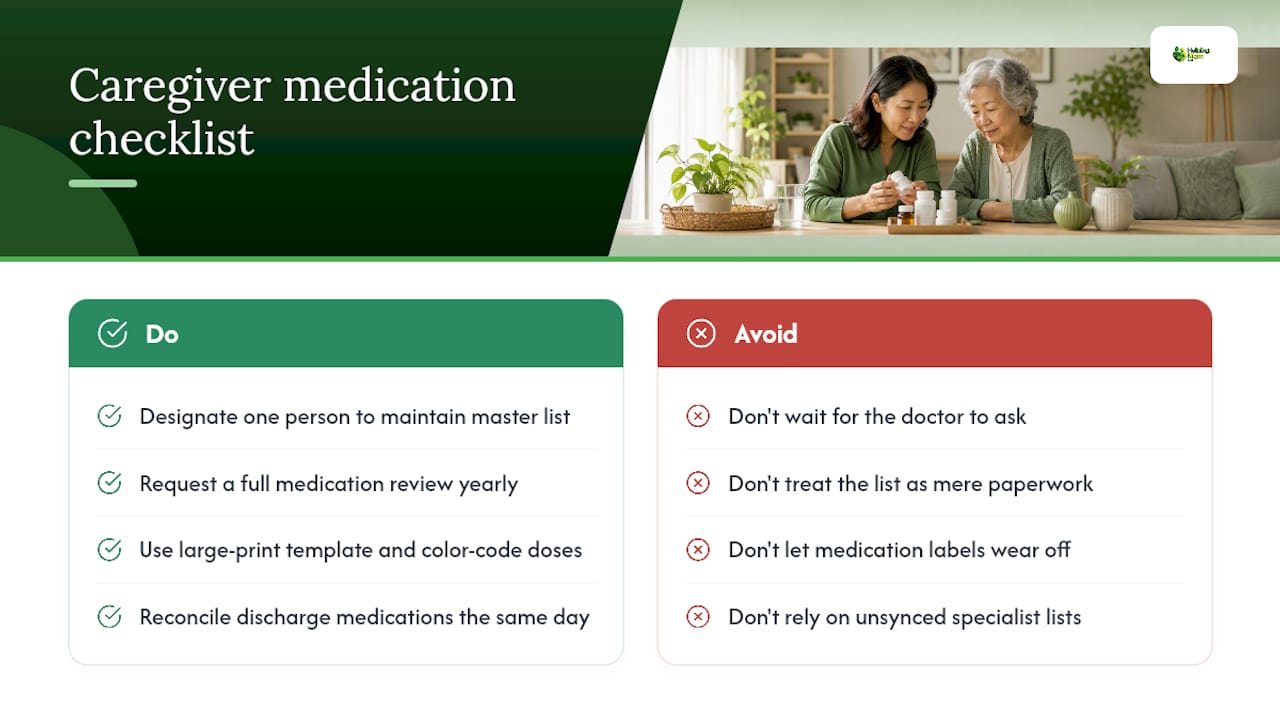
If your parent has trouble reading small print or distinguishing similar-looking pills, a few small adjustments help a lot. Choose a large-print version of the template. Use color-coded stickers or highlighters to separate morning, afternoon, and evening doses. Note the medication's color and shape on the list itself, which matters more than people expect when two bottles get mixed up or a label wears off.
Appointment prep gets easier once the list is your default document. Bring a fresh copy to every visit, and don't wait for the doctor to ask about supplements or OTC medications, volunteer that information up front. The same applies at hospital discharge: ask for the discharge medication summary and reconcile it against your existing list the same day, before anything gets lost in the shuffle of coming home.
Treat the list less like paperwork and more like a translator between your parent's care team and your family. It's often the only document that follows your parent from the primary care office to the emergency room to the pharmacy counter, catching the gaps that fall through when specialists don't talk to each other directly.
For a broader look at organizing medications and spotting the kinds of issues polypharmacy creates, Helping-mom's medication management guide for caregivers covers the topic in more depth.
A Caregiver's Take on Why the List Matters More Than the Format
The first time I watched a family flip through a shoebox of pill bottles trying to answer a nurse's simple question, "what is she currently taking," I understood why agencies push so hard for a written list. It wasn't a fancy system that fixed things. It was one page, filled out honestly, that turned a stressful guessing game into a thirty-second answer.
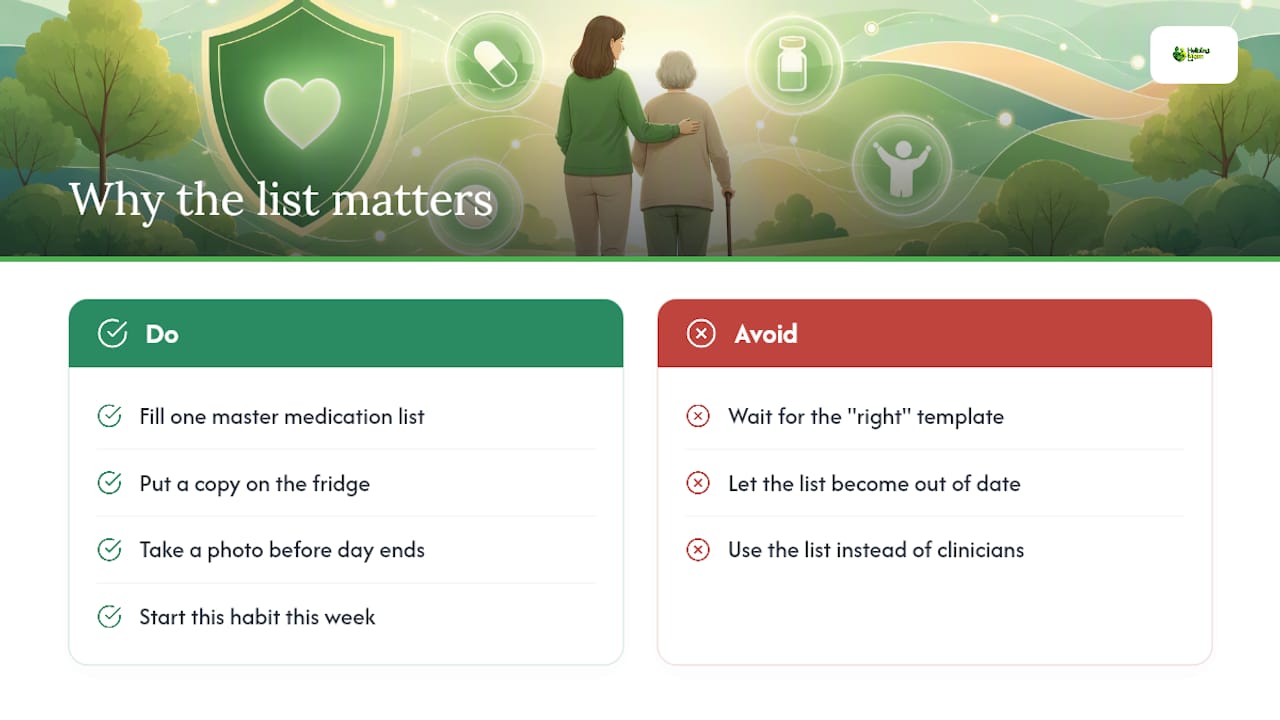
The habit worth starting this week is small: fill out one master list, put a copy on the fridge, and take a photo of it before the day ends. Don't wait for the "right" template or the perfect app. A messy but current list beats a beautiful one that's three months out of date.
One thing worth remembering: the list is a communication tool, not a substitute for your parent's doctor or pharmacist. It helps you ask better questions and helps clinicians see the full picture faster, but the judgment calls still belong with the professionals reading it.
— Mike C.
A Simpler Next Step If You'd Rather Not Start From Scratch
Building a medication list from a blank page takes time most caregivers don't have between work, appointments, and everything else on a given week. A home safety guide includes a printable set built for exactly this kind of caregiving task, a master medication list, a wallet card, and a weekly adherence chart, all formatted the way clinicians expect to see them. If the accuracy tips above felt like a lot to remember, the templates already have those fields built in, so you're filling in blanks instead of designing a system from scratch. Take a look at the practical guide to making a senior's home safer to download the set and see what else it covers for keeping your parent safe at home. If cost tracking is part of what's weighing on you, a pharmacy discount card can also help offset the price of managing multiple prescriptions.
Where to Find the Official Templates
The FDA's medication list guidance outlines the core fields every list needs and offers a straightforward starting template. AHRQ's My Medicines List organizes medicines into daily, occasional, and as-needed sections, which suits caregivers managing several prescriptions at once. The CDC's printable medication list adds a section for discontinued medications and past reactions. For something pocket-sized, the Blue Ridge Poison Center's tracker fits in a wallet for quick emergency reference.
Sources
- Create and Keep a Medication List for Your Health | FDA
- How To Create a My Medicines List | AHRQ
- My Medications List (CDC PDF)
FAQ
How Do I Create a Medication List?
Start with a template that separates daily, occasional, and as-needed medicines, then fill in the name, strength, dose, schedule, and reason for each one. Add emergency contacts and allergies, and update it immediately whenever anything changes.
Is There an App to Create a Medication List?
Yes, several medication tracking apps exist for logging doses and setting reminders, but pair any app with a printed master list since phones can lock, lose battery, or go unanswered in an emergency.
Where Can I Find a Free Printable Medication List Template?
The FDA, AHRQ, and CDC all publish free printable templates, and Helping-mom's medication schedule template offers a caregiver-friendly version with the same core fields already built in.
Where Do I Get a Medication List?
You can download one from a government health agency, print one from a caregiving resource like Helping-mom, or ask your pharmacist for a printed summary of current prescriptions to use as a starting point.