

If your parent served during wartime and now needs help bathing, dressing, or getting around safely, VA Aid and Attendance is worth pursuing right now. It's a tax-free, needs-based boost to VA pension that can help cover in-home care or assisted living. Start today by locating your parent's DD214 and filing an Intent to File while you schedule a physician visit for VA Form 21-2680.
TL;DR:
- Unreimbursed medical expenses, such as caregiver payments, can significantly lower your parent's income calculation, increasing VA aid payments.
- Filing an Intent to File promptly locks in the effective date and maximizes retroactive benefit eligibility, with processing typically taking several months.
- Aid and Attendance pays the higher amount between it and Housebound benefits, and VA only provides one; eligibility also depends on military service, medical need, and income limits.
- Applying requires physician completion of VA Form 21-2680, supporting documents like DD214, income records, and medical expenses, with early, complete submissions preferred.
- Free assistance from accredited veterans service organizations can help avoid scams and speed up the application process while ensuring proper paperwork.
Table of Contents
- What Is Veterans Aid and Attendance, and Who Does It Help?
- 2026 VA Aid and Attendance Rates and How MAPR Works
- Do You Qualify? Service, Medical, and Financial Rules
- How to Apply for Veterans Aid and Attendance, Step by Step
- Aid and Attendance, Housebound Status, and Service-Connected Pay
- Getting Free Help and Avoiding Pension Poachers
- Your 90-Day Action Plan for Filing
- A Note From Helping-mom
- How Helping-mom Supports You While You Wait on VA
- Sources
- FAQ
What Is Veterans Aid and Attendance, and Who Does It Help?
Veterans aid and attendance is an add-on to the VA pension, not a separate benefit. It's designed for wartime veterans and surviving spouses whose age or health makes it hard to manage daily life without help. Think of it as a higher tier layered on top of the standard pension calculation, available once VA confirms the person genuinely needs regular assistance.
This matters because families often confuse it with service-connected disability compensation. They're different programs with different rules. A&A is need-based, tied to income and care requirements rather than an injury connected to military service, and every dollar paid out is tax-free.
In practice, families use these funds for exactly the things that keep a parent safely at home or in a facility: paying a home health aide, covering assisted living or memory care fees, or offsetting nursing home costs. If your mom needs someone to help her shower and manage medications three times a week, this benefit is built for that situation.
2026 VA Aid and Attendance Rates and How MAPR Works
The VA sets maximum monthly rates each year, and the 2026 numbers give you a real sense of what's possible. A surviving spouse can receive up to $1,558 a month. A single veteran can receive up to $2,424. A married veteran can receive up to $2,874. And when both spouses are veterans, the household can receive up to $3,845. These figures are tax-free and adjusted annually for cost of living.
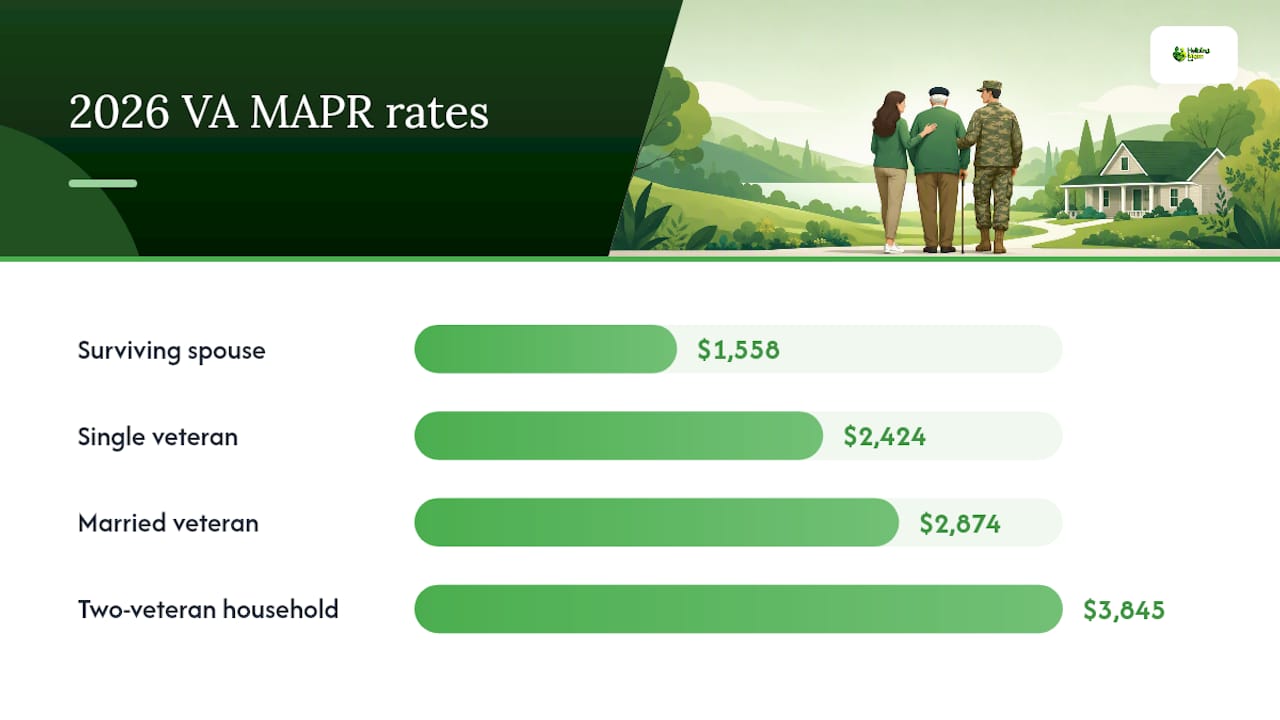
Behind these numbers sits a formula called MAPR, the Maximum Annual Pension Rate. The VA doesn't just hand out the maximum figure to everyone. It subtracts your parent's countable income from the MAPR, and the difference becomes the annual pension, paid out monthly.
Here's where it gets useful: unreimbursed medical expenses reduce countable income, which raises the pension. Say a veteran has $2,500 in monthly income but pays $1,200 out of pocket for an aide. That $1,200 gets deducted, dropping countable income and increasing what VA pays.
Do You Qualify? Service, Medical, and Financial Rules
Three separate boxes need checking before VA approves a claim, and it helps to think of them as three legs of a stool.
Service requirements. Your parent needs qualifying wartime service, generally at least one day during a recognized wartime period along with 90 days total active duty (longer for those who entered after September 1980). Surviving spouses qualify through the veteran's service record and their marriage, provided they haven't remarried.
Medical requirements. This is the heart of the claim. VA looks for a demonstrated need for help with activities of daily living, such as bathing, dressing, eating, or toileting, along with bedridden status or severe visual impairment. The governing standard lives in 38 CFR § 3.352, and the proof comes from VA Form 21-2680, completed by a physician.
Financial requirements. VA reviews countable income and net worth, though your parent's primary residence is exempt from the net worth calculation.
- Countable income includes Social Security, pensions, and most other regular income
- Net worth limits combine income and assets, with annual adjustments
- Unreimbursed medical expenses, including caregiver pay, can lower countable income
- Bank statements and receipts should be organized and current
How to Apply for Veterans Aid and Attendance, Step by Step
Filing feels intimidating until you break it into pieces. Here's the order that actually works.
- File an Intent to File (VA Form 21-0966) immediately. This locks in an effective date, which can mean months of retroactive back pay once your claim is approved.
- Schedule a physician visit for VA Form 21-2680. Any licensed physician can complete this, whether it's your parent's longtime primary care doctor or a facility medical director. The more specific the doctor is about which daily tasks require help, the stronger the claim.
- Complete VA Form 21P-527EZ, the main pension application, alongside the 21-2680.
- Gather supporting documents: DD214, marriage certificate if applying as a surviving spouse, recent bank statements, and a list of unreimbursed medical expenses.
- Choose how to file: online through VA.gov, by mail, or in person at a regional VA office, where staff can help review your paperwork before submission.
Processing generally takes several months from submission to decision, so filing early and completely matters more than filing fast and messy.
Pro Tip: Ask the physician to describe specific tasks your parent can't safely do alone, like "cannot bathe without standby assistance" rather than a vague note about "declining health." Specific language moves claims through faster.
Aid and Attendance, Housebound Status, and Service-Connected Pay
Families frequently ask whether their parent can stack multiple VA benefits, and the honest answer is: not always. Aid and Attendance and Housebound status are mutually exclusive. VA compares the two and pays whichever amount is higher, never both together.
The same logic applies if a veteran already receives service-connected disability compensation. VA pays the higher of the two benefits rather than combining them dollar for dollar, though Special Monthly Compensation can sometimes apply in specific injury or care situations. If your parent's income or living situation changes, tell VA promptly. Overpayments have to be repaid, and nobody wants that surprise showing up in a letter months later.
Getting Free Help and Avoiding Pension Poachers
You don't need to pay anyone to file this claim correctly. Accredited Veterans Service Organizations, including DAV, VFW, and the American Legion, offer free help preparing and submitting A&A claims, and your state veterans affairs office can point you toward local accredited representatives.
Watch for warning signs before you hire anyone claiming to specialize in VA claims:
- Anyone charging a percentage of your parent's benefit or back pay
- Pressure to restructure assets or purchase financial products before filing
- Vague credentials with no VA accreditation number you can verify
Pro Tip: Before signing anything, ask for the person's VA accreditation number and verify it directly with the VA's accredited representative search. A legitimate VSO will never hesitate to share it.
Helping-mom's documentation checklists and guides help you organize medical evidence and care records before you ever sit down with a VSO representative.
Your 90-Day Action Plan for Filing
Breaking this into a timeline keeps it from feeling like one giant task.
- This week: Locate the DD214, Social Security statements, and recent bank statements. Call to schedule a physician visit for VA Form 21-2680.
- Weeks 2 through 4: File the Intent to File. Submit VA Form 21P-527EZ along with the completed 21-2680.
- Weeks 4 through 12: Contact an accredited VSO if you haven't already. Start collecting receipts for unreimbursed medical and caregiving expenses.
- Ongoing: Keep signed caregiver payment agreements and log hours if a family member is paid to help, since well-documented in-home care arrangements can count toward reducing countable income.
| Timeframe | Priority Action |
|---|---|
| This week | Gather DD214, financial records; book physician visit |
| Weeks 2 to 4 | File Intent to File and pension forms |
| Weeks 4 to 12 | Engage a VSO; collect medical expense receipts |
| Ongoing | Log caregiver hours and payment agreements |
A Note From Helping-mom
Filling out VA forms while worrying about your parent's daily safety is a lot to carry at once. That's exactly why Helping-mom exists: to walk alongside you with practical guides on supporting daily living needs and organizing the paperwork that supports a strong claim. If you'd like help pulling your documentation together, we're here for that conversation.
— Mike C.
How Helping-mom Supports You While You Wait on VA
Filing for Aid and Attendance takes months, and your parent's home doesn't get safer on its own during that wait. Helping-mom's Practical Guide to Making Home Safer for Seniors walks you through the exact modifications and documentation that strengthen both your parent's safety and your VA paperwork trail, since a well-documented care need helps your physician write a stronger 21-2680. Our elder care planning guide helps you organize financial records, caregiver agreements, and expense logs in one place instead of scattered across drawers and email threads. And if you want a real conversation instead of another checklist, a paid Zoom consultation with our team lets you talk through your specific situation and leave with a clear next step. Start by exploring the home safety guide and booking a time that works for your family this week.
Sources
- Aid And Attendance Benefits And Housebound Allowance | Veterans Affairs
- Usmilitary
- 38 CFR § 3.352 - Criteria for determining need for aid and attendance and 'permanently bedridden' (Cornell Law)
FAQ
Can a Veteran Receive Aid and Attendance?
Yes, a wartime veteran who meets the service, medical, and financial requirements can receive Aid and Attendance as an increase to their VA pension, provided they need help with daily activities or meet the bedridden or visual impairment criteria under 38 CFR § 3.352.
What Are the VA Aid and Attendance Benefits for 2026?
The maximum monthly rates for 2026 are $1,558 for a surviving spouse, $2,424 for a single veteran, $2,874 for a married veteran, and $3,845 when both spouses are veterans, and all payments are tax-free.
Can You Get VA Disability and Aid and Attendance at the Same Time?
VA pays whichever benefit amount is higher between service-connected compensation and Aid and Attendance rather than paying both in full, though Special Monthly Compensation can apply in certain injury or care circumstances.
Is It Difficult to Get Aid and Attendance From VA?
The process is detailed but manageable when you file an Intent to File early, gather complete documentation, and work with an accredited VSO; most delays come from incomplete forms or vague physician notes rather than the eligibility rules themselves.
What Does Aid and Attendance Cover for a Spouse?
A surviving spouse of a wartime veteran can qualify for their own Aid and Attendance pension if they meet the same medical and financial tests, with a 2026 maximum monthly rate of $1,558, usable for in-home care, assisted living, or nursing home costs.