

The best way to start is small: ask your parent how their days have been going lately, not whether it's time to move. Your only goal in this first talk is to gather information and plant a seed. Expect to revisit the subject several times before anything changes, and treat that as normal, not a sign you're failing.
TL;DR:
- Regularly observe medication management, finances, and mobility issues over time to identify patterns that indicate the need for a conversation.
- Prepare by researching local care options, costs, and support networks, and involve healthcare professionals or trusted friends for Neutral support.
- Approach the talk with curiosity, focusing on listening and framing benefits rather than deficits, and be patient with silences and pauses.
- Use natural events like hospital visits or falls as opportunities to introduce assisted living discussions with less resistance.
- Seek professional help if conversations stall, as external input from a doctor or care manager can shift perceptions and encourage planning.
Table of Contents
- How Do You Prepare for an Assisted Living Conversation?
- What Should You Actually Say?
- What Signs Suggest It's Time to Talk?
- What Happens After the First Talk?
- When Should a Professional Step In?
- A Personal Note on Guilt and Patience
- Getting Guided Help With This Conversation
- Helpful Places to Learn More
- Sources
- FAQ
How Do You Prepare for an Assisted Living Conversation?
Walking in without preparation is how good intentions turn into a defensive standoff. Before you say a word, spend a week paying attention. Notice whether prescription bottles are full when they shouldn't be, whether mail is piling up unopened, or whether the pantry has more expired cans than fresh food. These details matter because a single missed pill is forgettable. A pattern of missed pills is information.
Alongside your observations, do some homework so you're not guessing at answers when questions come up:
- Look into the types of communities near your parent (assisted living, memory care, independent living with add-on services) and what each actually provides.
- Get a rough sense of local cost ranges so you're not caught flat-footed if your parent asks "how much."
- Check proximity to family, current doctors, and transportation options, since isolation is often the real fear underneath the resistance.
- Note which levels of care exist within a community, in case needs change later.
It also helps to know who else can support the conversation. A primary care doctor can sometimes raise safety concerns more neutrally than a son or daughter can. A geriatric care manager, a trusted friend, or clergy your parent respects can also open doors you can't open alone. Johns Hopkins Medicine recommends starting these conversations early and researching options ahead of time, treating the whole thing as a process rather than a single decision point.
Finally, pick your moment. A quiet Sunday afternoon over coffee works better than a rushed conversation after a doctor's appointment or during a holiday gathering.
What Should You Actually Say?
Once you've prepared, the words themselves matter less than the tone behind them. Lead with curiosity, not conclusions. "How have your days been going?" opens a door. "You can't live alone anymore" slams one shut.
Here's a simple sequence that tends to work:
- Open with genuine interest. Ask about daily routines, energy levels, or what's been hard lately, and actually listen to the answer.
- Share an observation gently. "I noticed you mentioned the stairs have been tougher this month" lands softer than "You're going to fall."
- Frame benefits, not deficits. Talk about what your parent could gain, like company at meals or no more yard work, instead of what they'd be giving up.
- Offer to explore together. "Would you be willing to look at a couple of places with me, just to see what's out there?" keeps them in the driver's seat.
Silence is a tool here, not a failure. After you ask a real question, resist the urge to fill the pause with more talking. Let your parent think. If the conversation gets tense, it's fine to pause and say, "Let's think about this and talk again next week." That's not avoidance. It's how the Sanford Health team describes these talks: a series of small conversations rather than one high-stakes meeting.
Pro Tip: Keep a small notebook of what you notice and what your parent says in each conversation. It helps you track patterns over weeks instead of relying on memory, and it keeps you from repeating the same argument twice.

What Signs Suggest It's Time to Talk?
One missed appointment doesn't mean much on its own. A pattern of missed appointments does. That distinction is what separates a productive assisted living conversation from an accusation that puts your parent on the defensive.
Watch for these signs over time, not in isolation:
- Medications that are missed, doubled up, or expired
- Unpaid bills, unopened mail, or confusion about finances
- Falls, even small ones the person brushes off
- Spoiled food in the fridge or weight loss
- Withdrawal from hobbies, friends, or community activities
Certain events also create a natural, low-friction opening for the conversation: a hospital discharge, a fall, or the loss of a spouse. Sanford Health notes that these moments give families a neutral reason to bring up care options, since the conversation feels tied to a real event rather than a judgment about someone's abilities. If you're keeping notes, describe what you observed rather than what you assume it means. "The stove was left on Tuesday" invites a conversation. "You're not safe anymore" invites a fight.
What Happens After the First Talk?
A single conversation rarely changes a mind. A tour usually does more of that work than any argument you could make. Seeing residents chatting over lunch or heading to an art class tends to dismantle assumptions faster than facts and figures ever will.
Consider these next steps once your parent is even slightly open to looking:
- Arrange a casual visit or a shared lunch at a community, with no pressure to decide anything that day.
- Ask about a short try-out stay, which lets your parent experience daily life there before committing.
- On any tour, pay attention to the activity calendar, the quality of meals, and how staff interact with residents, since those details tell you more than a glossy brochure.
- Once there's real interest, ask about wait lists, deposit requirements, and paperwork timelines so you're not scrambling later.
- For cost questions, get pricing directly from communities you're considering, and ask a financial planner about Medicaid eligibility or veterans' benefits if affordability is a concern.
None of this requires a decision on day one. It just moves the conversation from theoretical to real.
When Should a Professional Step In?
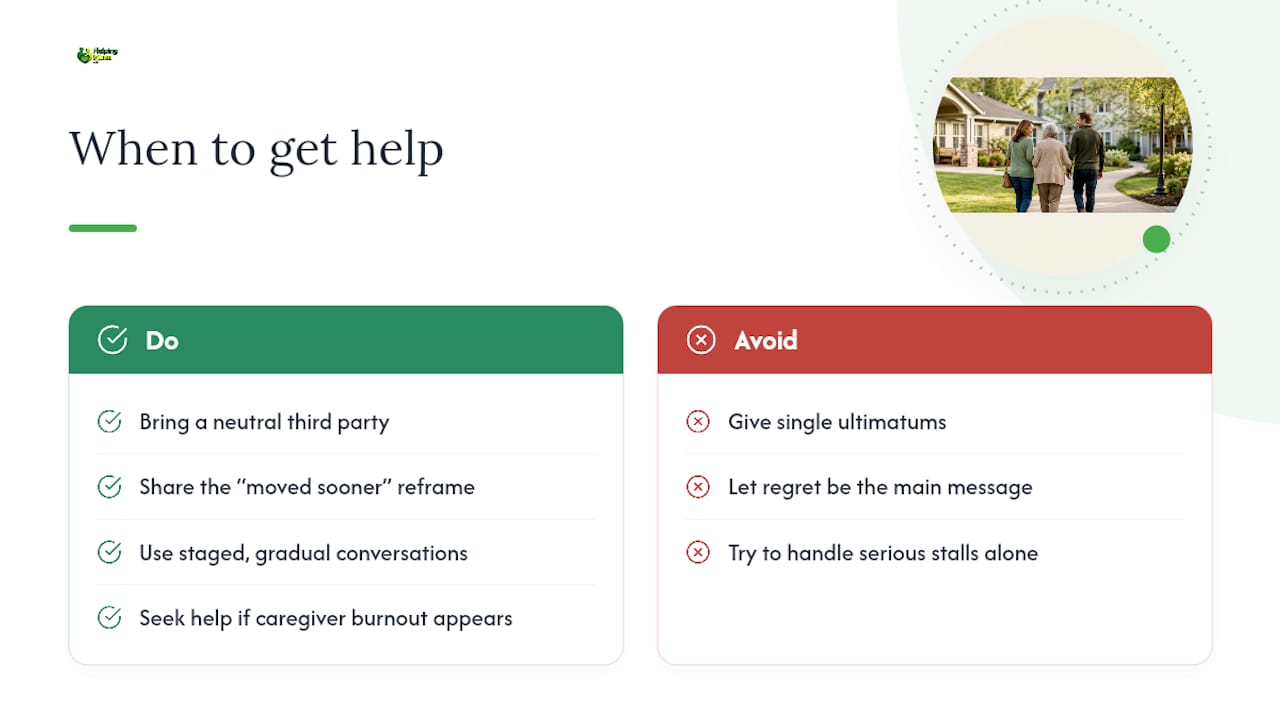
Sometimes the conversation stalls no matter how gently you approach it. That's the moment to bring in a neutral third party. A doctor, counselor, or geriatric care manager can sometimes say the same thing you've said for months and have it finally land, simply because it's coming from someone outside the family dynamic.
It also helps to share a reframe practitioners use often: many residents later admit they wish they'd moved sooner. Sanford Health points to this pattern as a way to soften regret-based resistance, since it shifts the conversation from loss to relief. Research on caregiving communication also supports staged, gradual conversations over single ultimatums, particularly when caregiver burnout is part of the picture, according to a review of caregiving strategies.
A Personal Note on Guilt and Patience
If you feel guilty for even having this conversation, that feeling is common and it doesn't mean you're doing something wrong. Small, repeated conversations are not a failure to "just handle it." They are often the most respectful way through this.
Success here isn't a signed lease. It's a conversation that stays open and a parent who still feels heard. Give yourself the same patience you're offering them.
**
Getting Guided Help With This Conversation
Some conversations go more smoothly with a little structure behind them, and that's exactly where a Caregiving Clarity Session can help. It's a one-on-one session designed to help you walk into the conversation prepared, whether you need help organizing what you've observed, practicing what to say, or figuring out your next move if your parent pushes back. There's no judgment involved, just a calm, practical plan built around your family's actual situation. If your concerns are more about physical safety at home right now, a virtual home safety consultation can help you document specific risks before you even bring up assisted living. Book a session when you're ready to stop rehearsing this conversation alone.
Helpful Places to Learn More
For deeper reading, Johns Hopkins Medicine offers solid guidance on starting hard conversations early. Five Wishes helps families document care preferences in writing, and HealthinAging has practical tools for planning transitions ahead of a crisis.
Sources
- Tough (But Important) Conversations - Johns Hopkins Medicine
- How to begin the talk about assisted living - Sanford Health News
- PMC article relevant to caregiving conversations
- Five Wishes - Aging with Dignity
- Making your wishes known - HealthinAging
FAQ
What Are Good Conversation Topics for Elderly Parents?
Ask about daily routines, favorite memories, or what they're looking forward to that week rather than leading with logistics. Light, curious questions like "How have your days been going?" often open the door to deeper topics naturally, including care and safety.
What Is the 40/70 Rule for Aging and Caregiving?
It's wise to start having honest conversations about future care needs early rather than waiting for a crisis. There's no strict age cutoff, but beginning the talk sooner helps families prepare gradually.
What Should I Do if My Elderly Parent Insists on Living Alone?
Respect the wish while gently introducing smaller steps, like a home safety check or a trial visit to a community, instead of pushing for a full decision. Revisiting the conversation over time, especially after a health event, often works better than a single confrontation.
What Can I Do if My Elderly Parent Refuses Assisted Living?
Try bringing in a neutral third party, such as a doctor or geriatric care manager, since outside voices sometimes carry more weight than family. A low-pressure tour or short try-out stay can also shift the conversation from an argument to a real, lived experience.