

The fastest path forward is a printable, editable template you fill in today, not a blank page you stare at tonight. The CDC's Complete Care Plan is a free, well-organized starting point that covers medical conditions, medications, and emergency contacts in one place. Download it, fill what you know now, and add the rest as you go.
TL;DR:
- The CDC's free Complete Care Plan PDF is suitable for straightforward cases, but more complex situations benefit from editable or online templates for frequent updates.
- A caregiver plan must include personal details, medical information, medication schedules, daily routines, emergency contacts, and personal preferences to be effective.
- Involving the parent in building the plan ensures better adherence and helps identify the most important nonclinical details that preserve dignity.
- A medication table should list drug names, doses, times, specific instructions, and who administers, paired with short daily logs to prevent errors.
- Regular review and proper storage of the care plan, with updates labeled and shared only with necessary caregivers, are crucial to maintaining its usefulness.
Table of Contents
- Where To Find a Reliable Caregiver Care Plan Template
- Core Elements Every Caregiver Care Plan Should Include
- How Do You Build the Plan With Your Parent, Not Just For Them?
- Daily Schedule and Medication Tracking That Prevent Errors
- Keeping the Plan Current: Storage, Sharing, and Review
- Mini-Templates You Can Copy Right Now
- What Helping-mom Brings to Your Care Plan
- Get Your Care Plan Set Up With Expert Support
- Sources
- FAQ
Where To Find a Reliable Caregiver Care Plan Template
You don't need to build one from scratch, and honestly, you shouldn't. Start with what's already tested and free.
The CDC Complete Care Plan PDF is the most complete option available at no cost. It has dedicated sections for medical conditions, medication schedules with special instructions, emergency contacts, and advance care planning documents, all in a format built for people without a medical background. If your mom or dad has a fairly straightforward situation, this single PDF might be all you need.
Editable versions matter more once several people share caregiving duties. A fillable Word document or an online generator lets you update details without reprinting the whole packet every time a dose changes. Some free printable generators build out full daily routines, matching meals, activities, and safety checks to a person's mobility and cognitive status.
Here's how to choose between the two:
- One caregiver, stable situation: print the CDC PDF, fill it by hand, done.
- Multiple caregivers or siblings splitting duties: use an editable file stored where everyone can access and update it.
- Frequent medical changes: a generator or editable template saves you from crossing out and rewriting every week.
Core Elements Every Caregiver Care Plan Should Include
A care plan only works if someone unfamiliar with the situation, a substitute caregiver, a visiting nurse, a sibling flying in for the weekend, can pick it up and understand what to do. That means covering both clinical basics and the small human details that keep your parent's dignity intact.
At minimum, your plan needs:
- Personal details and preferences — full name, birth date, preferred name, and anything that helps a stranger treat your parent like a person, not a case file.
- Medical conditions and provider contacts — diagnoses, primary doctor, specialists, and pharmacy, with phone numbers attached.
- A medication table — drug name, dose, timing, and any special instruction (take with food, avoid dairy, refrigerate).
- Daily routine blocks — morning, midday, evening tasks, in the order they actually happen.
- Emergency contacts, power of attorney, and insurance details — who to call, who can legally decide, and which cards to bring to the ER.
- Nonclinical notes — favorite foods, calming phrases, mobility aids used, things that soothe or agitate.
That last category isn't filler. Practitioner literature on caregiving notes that including personal preferences and daily routines reduces friction and helps preserve dignity, which matters just as much as getting the medication dose right. A plan that only lists diagnoses tells a substitute caregiver what's wrong. A plan that also notes "she likes the radio on low in the morning" tells them how to actually help.
How Do You Build the Plan With Your Parent, Not Just For Them?
The plan works better, and gets followed more consistently, when your parent helps build it instead of receiving it as a finished document. Research on person-centered planning backs this up: care plans shaped around someone's actual preferences and routines get followed more closely and cause less pushback during handoffs.
Here's a simple order of operations:
- Gather the paperwork first. Pull together prescriptions, insurance cards, and notes from the last two or three doctor visits before you sit down to write anything.
- Ask, don't assume. Instead of "What medications do you take?" try "Walk me through your morning, what's the first thing you do after you wake up?" You'll get routines, not just facts.
- Build one single-reference page. This is the page that gets taped inside a cabinet or posted on the fridge, just the essentials: meds, timing, emergency numbers.
- Attach the details behind it. Insurance info, provider notes, and advance directives can live on additional pages that don't need to be memorized daily.
- Assign roles if more than one person is helping. Write down who handles pharmacy pickups, who drives to appointments, who's the emergency contact.
Pro Tip: Ask your parent what they'd want a stranger to know about them in the first thirty seconds. That answer usually reveals the nonclinical detail that matters most, and it's rarely the one you'd have guessed.
Daily Schedule and Medication Tracking That Prevent Errors
Most medication mistakes happen because the instructions were technically written down somewhere, just not somewhere anyone checked in the moment. A clear table fixes that.
Your medication table needs five columns: drug name, dose, time, special instruction, and who administers it. That last column matters more than people expect, especially when a rotating cast of family members or aides is involved.
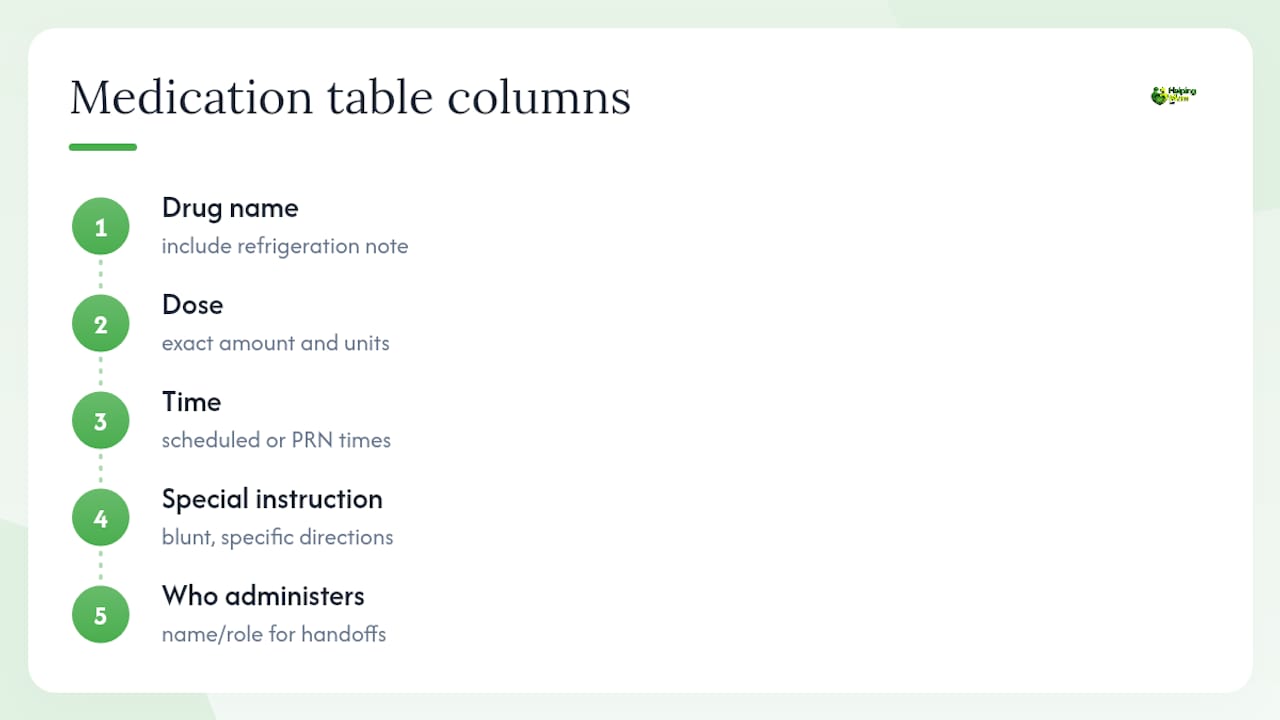
For special instructions, be blunt and specific rather than clinical. "Take with breakfast, not on empty stomach" beats "administer with food." Note refrigeration needs directly next to the drug name so nobody has to guess.
Pair the medication table with a one-page daily log for quick handoffs, mood, food intake, bathroom trips, anything unusual. Short daily logs like this cut down on missed tasks and repeated questions between shifts. Helping-mom's printable caregiver schedule and medication list template are both built around this exact structure, ready to print today.
Keeping the Plan Current: Storage, Sharing, and Review
A care plan that sits in a drawer from January to October has already failed its job. Keep a master copy somewhere permanent, a binder, a labeled folder, and post a quick-reference version somewhere visible, like the fridge or a shared cloud folder everyone in the family can open.
- Label every update with the date and who made the change, so nobody's working from an outdated version by accident.
- Review the whole plan every three to six months, or right after a hospital discharge or medication change, a cadence supported by NIA guidance on advance care planning.
- Share only with people who need it. Aides and substitute caregivers need the daily log and medication table, not necessarily the financial or legal pages.
Pro Tip: Keep a small sticky note on the front of the binder listing the last review date. It takes five seconds to check and saves you from wondering whether the plan in your hand is even current.
Mini-Templates You Can Copy Right Now
Sometimes the fastest way to start is with a short example, not a blank form. Adapt one of these into your full plan.
- Elder care routine: Morning: meds at 8 AM with breakfast, help with dressing. Evening: meds at 7 PM, check mobility aid (walker) is nearby. Emergency contact: daughter, cell number, primary doctor's office number.
- Dementia-friendly note: Orientation cue: "Today is Tuesday, you're at home, I'm your son." Calming step: soft music, avoid correcting mistaken memories directly. Wandering plan: door alarm active, ID bracelet on, neighbor aware to call if seen outside alone. Keep this on its own labeled quick-sheet attached to the main plan, since these cues need to be found fast.
- Post-op plan: Wound check twice daily, note redness or drainage. Activity limit: no stairs unassisted for two weeks. Follow-up appointment: surgeon, ten days out, date written on the calendar.
Start with whichever mini-template matches your situation, then grow it by adding the medication table, emergency contacts, and personal preference notes from the sections above.
What Helping-mom Brings to Your Care Plan
Helping-mom builds its printable daily and weekly logs, medication tracking templates, and emergency contact templates around the same checklist covered here, so nothing in your plan is guesswork. This piece is written by Mike C., drawing on real caregiving situations rather than clinical theory. The goal has always been calm, practical guidance, no jargon, no alarm bells, just what actually helps.
— Mike C.
Get Your Care Plan Set Up With Expert Support
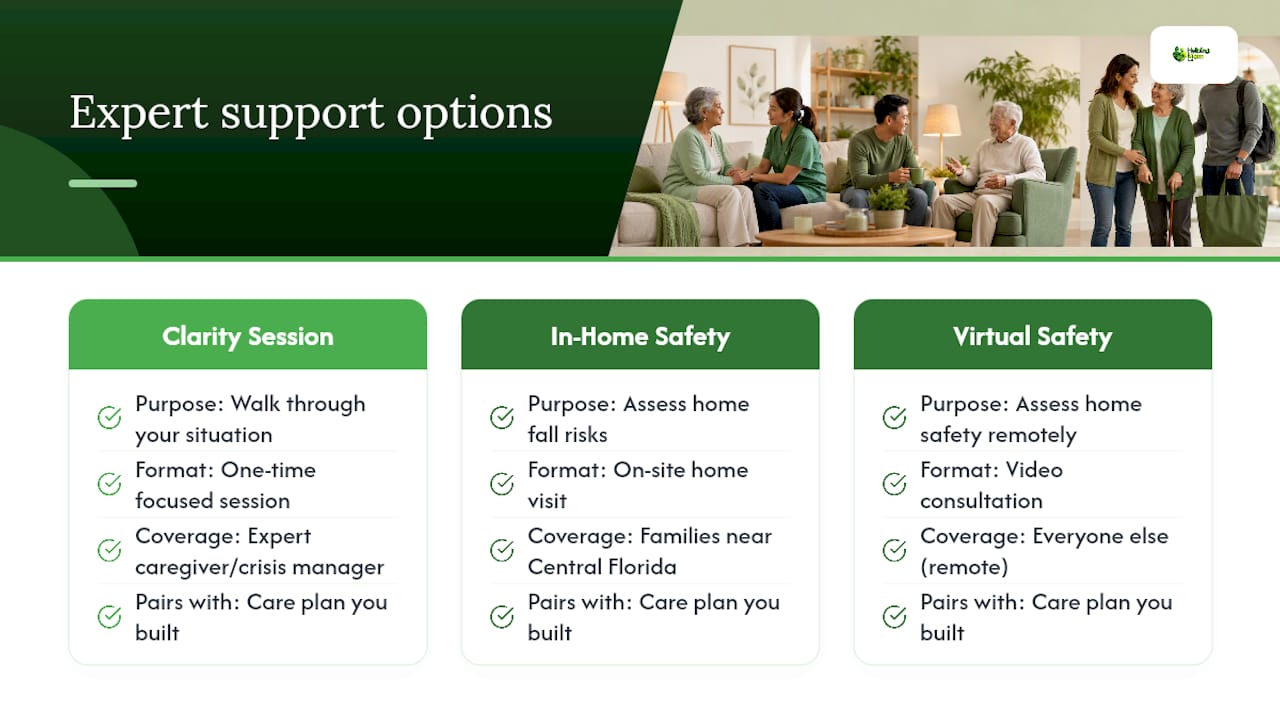
A template gets you most of the way there, but some situations, a recent hospital discharge, a medication list that keeps changing, or a caregiver running on fumes, call for another set of eyes. That's what the Caregiving Clarity Session is for: a focused, one-time session where you walk through your specific situation with someone who's spent years in caregiving and crisis management, not a call center script.
If home safety is part of the puzzle too, grab bars, lighting, fall risks, Helping-mom also offers in-home safety assessments for families near Central Florida, and virtual home safety consultations for everyone else. Either option pairs naturally with the care plan you just built, since a safer home means fewer emergencies that plan needs to cover in the first place.
If you're feeling stuck on where to even start the conversation with your parent, book a Caregiving Clarity Session and bring your half-finished template. Most families leave that call with a clear plan they didn't have an hour before.
Sources
- Steps for Creating and Maintaining a Care Plan | Caregiving
- Advance care planning and advance directives | NIA
- Practitioner literature on nonclinical caregiving factors
FAQ
How do I make a caregiver care plan?
Start with a free template like the CDC Complete Care Plan, fill in medical conditions, medications, and emergency contacts, then add daily routine and personal preference notes with input from the person receiving care.
What are the main components of a care plan?
A usable plan needs personal details, medical conditions and provider contacts, a medication table, daily routine blocks, and emergency contacts along with legal and insurance information.
Is there a template for a home care plan?
Yes. The CDC Complete Care Plan PDF works well for home care, and Helping-mom's printable daily and medication log templates cover the day-to-day tracking side.
Can you give examples of care plans for elderly parents?
A simple elder care example lists morning and evening medication times, mobility aid notes, and emergency contacts; a dementia-friendly version adds orientation cues and a wandering plan on a separate quick-sheet.
How often should a caregiver care plan be updated?
Review the plan every three to six months, or immediately after a hospital discharge, new diagnosis, or medication change, per NIA guidance on advance care planning.