
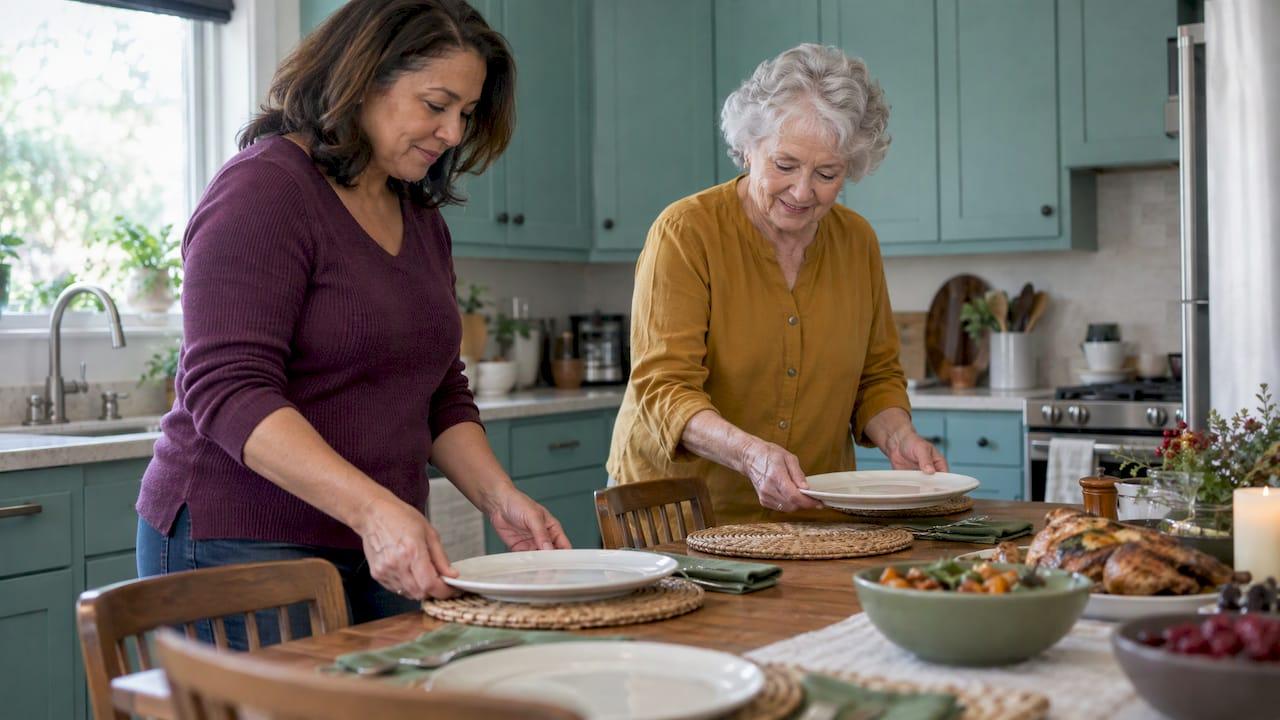
If the holidays feel heavier this year because you are caring for a parent, nothing is wrong with you. The season asks for extra cooking, travel, cheer and togetherness. Caregiving already uses most of your energy. The way through is not to do everything well. It is to decide what matters, tell your family what is realistic, and build in small pieces of rest before the busiest days arrive.
This guide walks through that in order: why the season weighs so much, how to plan around your parent's comfort, how to talk with relatives, and how to keep a little time for yourself. It is written for adult children in the middle of it, not for a perfect holiday.
TL;DR
- Choose a short "must do" list and a longer "only if I feel like it" list, and let the second one go without guilt.
- Plan gatherings around your parent's best time of day: small guest list, a quiet room, a familiar place, one or two activities.
- Talk with relatives early, by phone, video or email, and name specific tasks they can take.
- Say your limits plainly and kindly. Your situation is different now, and your family can adjust.
- Schedule real breaks before the holiday week, not after it.
Table of Contents
- Why the holidays feel heavier when you are a caregiver
- Start with two lists
- Plan the day around your parent
- Get the home ready for guests and for the season
- Talk with your family early about what is realistic
- Set boundaries without the guilt
- Protect small pieces of rest
- A sample holiday week, simplified
- Perspective: what we have learned about caregiving at the holidays
- If you want support planning your holiday season
- FAQ
- Sources
Why the holidays feel heavier when you are a caregiver
The holidays are built on memory. We expect the same table, the same recipes, the same person at the head of it. When a parent has changed, every tradition quietly shows you what is different.
The Alzheimer's Association notes that the season can bring stress, disappointment or sadness for a person living with dementia, and that caregivers can feel overwhelmed trying to keep traditions going while also providing care and following safety precautions. Even when your parent does not have dementia, the same pull is there: you are trying to protect the day for everyone, including them.
You are also far from alone. The National Alliance for Caregiving reports that the number of family caregivers in the U.S. grew from 43 million to 63 million between 2015 and 2025, and that about two-thirds of them report moderate to high emotional stress, with one in four feeling isolated. If your December to-do list feels like a second job on top of the first, that is a very common experience.
A few situations tend to bring the stress to the surface:
- Seeing a change. You may notice at the holiday table that Mom is more tired, more forgetful or less steady than last year. That can bring sadness, worry, even a strange mix of grief and relief.
- Hosting in a new place. If the family home is no longer practical, celebrating somewhere new can feel like losing something. Our guide on when Mom can't host Thanksgiving is for exactly this moment.
- Resentment and guilt together. You may feel frustrated with siblings who show up for one afternoon, then guilty for feeling frustrated. Both feelings are normal.
The Family Caregiver Alliance puts it simply: it is not your fault that your parent's health has declined or that caregiving takes your time and energy, and your feelings about it are valid.
Start with two lists
Before you say yes to anything, take ten quiet minutes with a piece of paper and make two lists.
Must do. The three or four things that would make the season feel like the season to you and your parent. Maybe it is a Christmas Eve dinner, lighting candles, or a drive to look at lights.
Only if I feel like it. Everything else: the cards, the elaborate decorations, the cookie exchange, the extra party across town.
The idea is to spend your limited energy where it counts. When an invitation arrives, ask which list it belongs on. Most of the time the answer is obvious, and the second list gets quietly shorter.
The American Academy of Family Physicians offers the same permission in a few words: it is okay to say no to things that feel too hard or tiring, to keep some fun traditions and change others, and to enjoy simple moments like sharing a snack or listening to music together.
Trade a big tradition for a smaller version
Smaller does not mean sadder. A few examples of swaps families make:
- A full holiday dinner becomes a midday meal with a few dishes, or a potluck where each guest brings one item.
- Hosting at your parent's house moves to your house, or the reverse, depending on which is easier for them to be comfortable in.
- A big family photo becomes a few relaxed snapshots while everyone is already together.
- Gift exchanges become one shared outing or a drawing of names.
If a tradition is truly no longer doable, the Family Caregiver Alliance suggests naming it honestly and inviting others in: something like, "I regret our holiday traditions are no longer doable. Let's find new ones to try." That turns a loss into a small project the whole family can share.
Plan the day around your parent
Once you know what you are keeping, shape it around how your parent actually does best. This matters whether your parent has memory loss, limited stamina, hearing trouble or just gets tired earlier than they used to.
The Alzheimer's Association suggests thinking about what will be most comfortable and enjoyable for the person, keeping their normal routine as much as possible, and letting go of activities that seem overwhelming. Dementia Friendly America's holiday toolkit adds practical details: schedule the gathering around the person's rhythms, keep the guest list small, and plan a meal and one or two activities.
A simple checklist for a gathering:
- Pick the right hour. If your parent is sharpest at lunchtime, hold the meal then, not at 7 p.m.
- Keep the group small. A few familiar faces are easier than a crowded room.
- Lower the volume. The National Institute on Aging suggests avoiding noise, loud conversations, loud music and lighting that is too bright or too dark, along with too much rich food or drink.
- Make a quiet space. A bedroom or den with a comfortable chair where your parent can rest without feeling they have left the party.
- Choose familiar places. Strange places and changes in routine can confuse or frustrate a person with Alzheimer's, according to the same NIA guidance.
- Recruit a spotter. Ask one or two guests to help watch for signs of stress or fatigue, and stay flexible, since your parent may need to arrive late or leave early. This is a suggestion from the Dementia Friendly America toolkit.
Give your parent a role
Being included feels better than being managed. The Alzheimer's Association recommends involving your parent in safe, manageable preparation they enjoy, such as helping with food, wrapping packages, decorating or setting the table. It also cautions against decorations like candies or artificial fruit, because some people with dementia may mistake them for real food.

Every person is different, and symptoms change over time. So hold your plan loosely: keep what works, adjust what does not, and run it past someone who knows your parent well.
If you are also noticing new changes in memory or thinking, our calm guide to the early signs of dementia in aging parents can help you sort out what you are seeing. A parent's doctor is the right person for any health questions.
Visits and video calls
The NIA encourages friends and family to visit when health and safety allow, even if it feels like effort, while limiting how many people come at once and choosing times when your parent is usually at their best. It also notes that video and phone calls are a good way to connect. That gives distant relatives a way to take part without adding a crowd to the living room.
Get the home ready for guests and for the season
Holidays change a house. Extension cords for lights, rugs moved for tables, extra chairs, suitcases in hallways, candles, and more people moving around can all create small hazards for an older adult who is steady on an ordinary day.
A quick walk-through before guests arrive can take away a lot of worry:
- Keep pathways wide and clear, especially from the bedroom to the bathroom.
- Tape down or tuck away cords for lights and decorations.
- Check that rugs lie flat and chairs are sturdy with arms where possible.
- Make sure night lighting is on for guests and for your parent.
- Keep medications in their usual place, away from visitors' bags and children.
If you would like a fuller walk-through, start with our home safety for aging parents guide, or the aging in place and home safety guide. If your parent has memory loss and visitors will be coming and going, our dementia wandering prevention plan covers doors, routines and what to prepare ahead of time.
Talk with your family early about what is realistic
Most holiday resentment begins with silence. You assume your siblings know how much you are carrying. They assume you have it handled. By December everyone is tense.
The Alzheimer's Association recommends setting up a group discussion by phone, video call or email well ahead of the holidays and sharing realistic expectations about what you can and cannot do. The Family Caregiver Alliance suggests inviting family to meet by phone or online to create a caregiving schedule and learn what others can contribute, which may include covering travel and lodging.
What to say
Keep it short, specific and free of blame. A few openings you can adapt:
- "I'm in a difficult situation, and sometimes I have to make difficult decisions." (Adapted from the Family Caregiver Alliance's suggested wording.)
- "Here is what I can do this year: Thanksgiving lunch at my house, two hours, small group. Here is what I can't."
- "Can you take Dad from noon to three on Saturday so I can go to the party?"
- "Would you be willing to handle the grocery order and the pharmacy pickup the week before?"
The American Academy of Family Physicians points out that sharing exactly what you need gives others a chance to do something meaningful. A clear request is a gift to a sibling who has been wondering how to help. And asking is not weakness: the AAFP calls it a sign of strength.
For more on how these conversations go, see our guide to talking with aging parents about care.
Ideas for dividing the work
| Task | Who could take it |
|---|---|
| Hosting or main meal | A sibling, or a potluck shared by everyone |
| Sitting with your parent so you can attend an event | A friend, cousin or neighbor |
| Grocery, pharmacy and errands | A relative who lives nearby, or a delivery order |
| Travel and lodging costs for long-distance siblings | The family as a group, as part of the schedule |
| Video call hour for faraway relatives | Whoever is least able to visit in person |
| Cleanup | Every guest, with a short list on the fridge |
The NIA also suggests asking a friend or family member to spend time with your parent while you attend an event. The Family Caregiver Alliance adds that you can look into respite care, so that you can attend a gathering knowing your parents are well cared for at home.
Set boundaries without the guilt
Boundaries are not walls. They are the way you stay able to keep showing up. The NIA advises caregivers to set their own limits and be clear about them, noting that you do not need to live up to the expectations of friends and relatives because your situation is different now.
The Family Caregiver Alliance suggests asking your family for what you need firmly but gently, whether that means joining in, responding to unrealistic requests or choosing not to attend, and leaving guilt and anger out of the conversation.
Some boundaries that families find workable:
- A time limit. "We'll be there from 1 to 3."
- A host limit. "We can come, but we can't host this year."
- A visitor limit. "Mom does best with four or five people at a time."
- A help limit. "I can handle Mom's care, but I can't also cook for twelve."
- A no. "We're staying home this year, and we'd love a video call."
If boundary talks tend to stall with certain relatives, our practical guide to caregiver boundaries with parents offers more language and examples.
Protect small pieces of rest
Caregiver stress does not pause for the holidays. An AARP study, as summarized by the American Academy of Family Physicians, found that more than half of family caregivers say it is hard to look after their own mental health, and about two in five feel lonely. The holidays can make that loneliness louder, especially when everyone else seems to be gathered and cheerful.
Rest does not need to be dramatic. It helps to put it on the calendar the same way you would a doctor's appointment:
- A twenty-minute walk or a cup of coffee alone, scheduled before the big day.
- A relative or friend covering one afternoon so you can see a friend, nap or sit in a quiet room.
- Water, regular meals and a decent night's sleep in the week before a gathering.
- One phone call with someone who listens and does not try to fix anything.
The AAFP is clear that taking care of yourself is not selfish. It is necessary. If you want more ideas, our pages on caregiver well-being and emotional support and how to reduce caregiver stress as an adult child go deeper. If you ever feel hopeless or unable to cope, please talk with your own doctor or a mental health professional.
A sample holiday week, simplified
Here is an example of what "realistic" can look like. It is an illustration, not a prescription, so adjust it to your parent and your family.
Imagine you care for your mother, who tires by late afternoon, and you have two siblings, one nearby and one three states away.
- Two weeks before: you hold a 30-minute family video call. You share your two lists, ask your nearby sibling to host a midday meal, and ask your faraway sibling to cover the groceries and join by video.
- One week before: you walk through your mother's home, clear the hallways, tape down light cords, and set up a quiet room with her favorite chair.
- Holiday day: guests arrive at noon. A cousin keeps an eye on Mom's energy. Dinner is done by 2. Mom rests at 3. Anyone who wants more time visits quietly in the evening or calls on video.
- Day after: you do nothing on purpose. A friend takes Mom for a drive, and you take a walk.
Nothing about that week is dramatic. It is simply planned, shared and kind to everyone, including you.
Perspective: what we have learned about caregiving at the holidays
We hear the same sentence from many families: "I just want one good holiday." Our answer is that a good holiday is not the same as a perfect one. It is a day your parent feels safe and included, and you feel like a person and not only a caregiver.
We believe the biggest relief usually comes from two things: a calm plan made early, and a home that supports your parent without extra worry. Many holiday scares are not medical at all. They are a loose rug, a crowded hallway, a late dinner, or a parent who is overtired and out of routine. Small changes in those areas can lift a surprising amount of tension.
At Helping Mom, our guidance comes from real family caregiving experience, and our home safety work carries Age Safe® America certification. That is why we focus on simple, non-medical steps: observing how your parent moves through the house, making the space easier, and having honest conversations with family before stress piles up. This journey is not about taking control. It is about walking alongside your parents, and giving yourself the same patience you give them.
Mike C.
If you want support planning your holiday season
Sometimes it helps to talk the plan through with someone who has been there. Our Caregiving Clarity Session is a one-time 1:1 session, $97, to help you sort out priorities, family roles and next steps in a calm, practical way.
If the home is the part that worries you most, you can learn about our virtual home safety consultations, or our in-home Age-Safe assessments for families in Central Florida. If you would like to browse first, the Caregiving Resource Library is free.
FAQ
How do I handle caregiver stress during the holidays without feeling guilty?
Start by accepting that guilt and sadness often come with change, and they do not mean you are failing. Choose a short list of must-do items, let the rest go, and tell family what you can realistically do. The Family Caregiver Alliance reminds caregivers that their feelings about caregiving are valid.
What if my siblings don't help?
Try a specific, blame-free request instead of a general plea. Offer a few concrete options, such as a grocery run, two hours with Mom, or hosting one meal, and let each person pick. A group call before the season starts, with a simple schedule, often works better than a conversation in the middle of the holiday rush.
Should I include my parent with memory loss in every gathering?
Not necessarily. Many families find that smaller gatherings in familiar surroundings work better than large events. Plan around your parent's best time of day, keep a quiet room available, and stay flexible if they need to leave early. Their doctor can answer questions about how your parent is doing.
Is it okay to skip holiday events?
Yes. The American Academy of Family Physicians says it is okay to say no to things that feel too hard or tiring. You might attend part of an event, join by video, or skip it entirely and plan a quiet day at home.
How can I make time for myself when I'm the main caregiver?
Schedule it before the busy days begin. Ask a friend or relative to cover a block of time, explore respite care options, and protect basics like water, meals and sleep. Small, planned breaks help more than a big one you never get to take.
Sources
- The Holidays and Alzheimer's, Alzheimer's Association
- Holiday Hints for Alzheimer's Caregivers, National Institute on Aging
- Dementia-Friendly Holiday Guide, Dementia Friendly America
- Smart Caregiving by FCA: Holiday Caregiving, Family Caregiver Alliance
- The best self-care tips for caregivers, Family Doctor (AAFP)
- 2025 Caregiving in the US key messages and data, National Alliance for Caregiving