
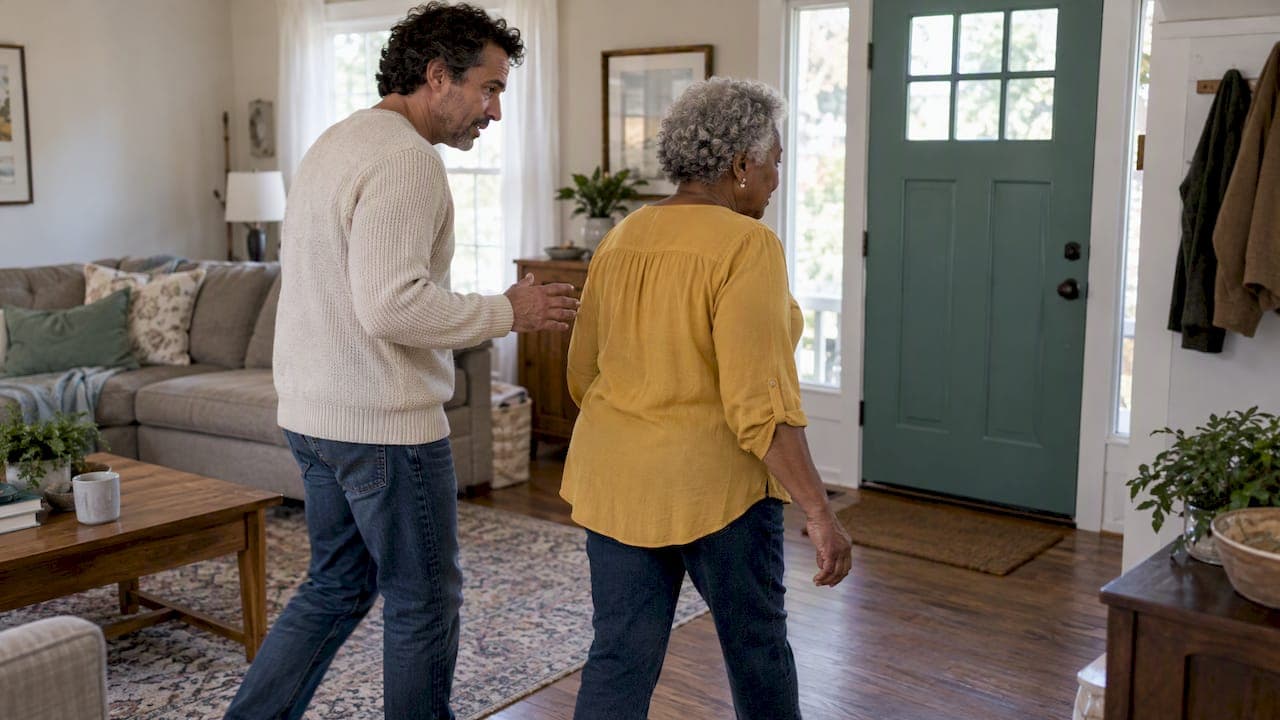
If your parent has started pacing, trying doors or talking about going home, you are probably worried about the day they walk out and you can't find them. That worry is reasonable, and there is a lot you can do about it. Wandering prevention is mostly a mix of understanding why your parent walks, making the home quietly harder to leave unnoticed, keeping the day meaningful, and having a plan ready just in case. No plan is perfect, but a calm, layered one makes a real difference.
TL;DR
- Wandering often has a purpose. It can be a response to an unmet need such as hunger, thirst, pain, needing the toilet, or a noisy, confusing space.
- Layer your safeguards: door alarms or bells, deadbolts out of the line of sight, night lights and a routine that fills the day with meaningful activity.
- Prevention lowers the risk but cannot guarantee your parent will never wander, so prepare ID, a recent photo and a plan for the worst moment.
- If your parent goes missing, start searching right away and call 911 if they are not found within 15 minutes.
- Talk to your parent's doctor about any sudden change in behavior. We offer non-medical, safety-focused guidance only.
Table of Contents
- Why a parent with dementia wanders
- How common it is, and when it tends to start
- Spend a week simply observing
- Make the home quietly safer
- Handling nighttime restlessness
- Keep the day full of meaningful things to do
- When your parent says "I want to go home"
- Plan ahead for outings and for the worst moment
- If your parent goes missing
- Our perspective: protecting without taking over
- Want a second set of eyes on your parent's home?
- Looking after the person doing the watching
- FAQ
- Sources
Why a parent with dementia wanders
It helps to start with the person, not the problem. From the outside, wandering can look aimless. Federal guidance on wandering and exit-seeking notes that it often has a purpose, and that it can be a response to unmet needs such as human contact, hunger, thirst, pain or needing the toilet, or to a noisy or confusing environment.
Other professional sources add more possible reasons: memory loss, searching for someone or something from the past, boredom, excess energy, agitation and discomfort, according to Dementia Australia. A neurologist at Cleveland Clinic describes wandering as an umbrella term covering elopement, repetitive pacing and becoming lost, and explains that changes in sequential planning and perception can make it hard to know where you are and what to do next.
You may recognize a few of these in your own parent:
- Your dad gets up at 4 p.m. every day and heads for the door because, in his mind, it is time to pick up the kids from school.
- Your mom walks the hallway back and forth after dinner, and it settles when you sit with her and put on music.
- Your parent tries the front door only when the television is loud and the house feels chaotic.
None of these is "bad behavior." Each is a clue. Caregivers are encouraged to trust their instincts and use what they know about the person to work out why they are walking. You know your parent's old job, old routines and old worries better than any checklist does.
How common it is, and when it tends to start
Wandering is common. The Alzheimer's Association reports that six in 10 people living with dementia will wander at least once. If it is happening in your family, you are not doing anything wrong.
A frequent question is what stage of dementia wandering starts in. Cleveland Clinic says wandering tends to occur in the moderate to advanced stages of Alzheimer's disease. A 2001 longitudinal study suggests increased walking may begin at a moderate level of impairment, last several years, and eventually decline as people become less active. That is one study, and every person's path differs, so treat it as a rough picture rather than a timetable.
The practical takeaway: you do not have to wait for the first scare. If your parent is showing early memory changes, our guide to early signs of dementia in aging parents can help you think about what to set up now, while things are calm.
Spend a week simply observing
Before you buy anything, take a few days to watch and jot down notes. This is not a clinical exercise. It is the kind of observation a close family member does naturally, just written down.
Note:
- When your parent heads for the door or starts pacing (time of day, after meals, after visitors leave).
- What was happening just before (noise, a missed meal, a full bladder, a quiet afternoon with nothing to do).
- What they say they are doing. "Going to work" or "going home" tells you what the need is underneath.
- What helped them settle (a snack, a walk with you, a call from a grandchild).
Most families find a pattern within a week. Maybe late afternoon is the hard hour, or maybe it is the first twenty minutes after waking. Once you see it, you can put your effort at that hour. Bring the notes to your parent's doctor too, especially if anything changes suddenly, because pain, infection or a medication change are medical questions that belong with their care team, not with us.
Make the home quietly safer
The goal is to make leaving unnoticed difficult without making the house feel like a locked ward. Your parent should still feel at home. The Alzheimer's Association suggests families place deadbolts out of sight, use door warning bells or monitoring devices, and camouflage doors. The National Institute on Aging lists simple ideas such as keeping doors locked and using signs like STOP or CLOSED, plus a smart doorbell or alarm that alerts you when a door opens.
Here is how that looks in practice:
| Layer | What it looks like | Why it helps |
|---|---|---|
| Alert | Chime, door alarm or smart doorbell on exterior doors | You know the moment a door opens |
| Barrier | Deadbolt placed high or low, out of the usual line of sight | A lock your parent doesn't notice is less likely to become a target |
| Disguise | A door painted like the wall, a cloth cover over the knob, a simple STOP or CLOSED sign | Less visual invitation to leave |
| Triggers | Keys, coats and purses stored out of sight | Removes cues that say "time to go" |
| Light | Night lights from bedroom to bathroom | Less confusion and disorientation in the dark |
The Alzheimer's Association also suggests removing items that trigger the idea of leaving, such as keys. Think about your parent's own cues. If a coat by the door means "going out," move it to a closet.
A few honest cautions from our experience with home safety:
- Keep exits usable in an emergency. Anything you add should still let a caregiver or first responder open the door quickly. Talk through fire safety with your local fire department if you are unsure.
- Don't rely on one tool. Alarms fail, batteries die and doors get left open by visitors.
- Check the whole house, not just the front door. Garage doors, back patios and sliding doors count, as does a pool gate if you have one.
If you want to see what is available, our practical guide to home safety devices for aging parents walks through the common options, and our elderly home safety checklist lets you check each room one by one.
Handling nighttime restlessness
Many families find that nights are the hardest. Everyone is tired, the house is dark and a parent who wakes confused may head for the door. The Alzheimer's Association suggests a few simple steps: use night lights, place a pressure-sensitive mat at the bedside, and consider reducing, but not eliminating, liquids up to two hours before bedtime. It also notes that early-evening activities and exercise may help ease the anxiety, agitation and restlessness of sundowning.
Some ways to build that into an ordinary evening:
- Keep dinner, a short walk or easy chore, and bedtime at roughly the same times each day.
- Dim the lights and turn off the television an hour before bed. A quiet radio or favorite music is gentler.
- Make the path to the bathroom obvious with lights, so a middle-of-the-night trip doesn't turn into a wander.
- Put a bedside mat or a sensor where a footstep will alert you, and place it where you won't trip on it yourself.
If your parent's sleep suddenly worsens, mention it to their doctor. Medication, pain and other health issues can play a part, and that is outside what we can advise on.
Keep the day full of meaningful things to do
Boredom and extra energy are among the reasons listed above for walking about, so a day with a rhythm can help. The Alzheimer's Association recommends involving your parent in structured, meaningful activities. Meaningful is the key word. A task that connects to who they were works better than busywork.
Ideas that families tell us work:
- A former teacher sorts and stacks books or sorts "homework" into folders.
- A retired mechanic sorts a box of nuts and bolts.
- A former homemaker folds towels fresh from the dryer or sets the table.
- A gardener waters plants on the patio with you beside them.
We have a whole guide of calm and practical memory care activities if you want more ideas.
Movement matters, too. A daily walk with you, in the safe direction, can use up restless energy and improve sleep. If your parent's balance is a concern, gentle balance training for seniors can make walking steadier, and it is worth asking their doctor which exercises suit them. Our guide to walker and cane safety covers the equipment side.

When your parent says "I want to go home"
This one is hard to hear, especially when they are standing in the house they have lived in for forty years. Usually, "home" means safety, comfort or a time when things made sense, not a particular address. Arguing the facts tends to raise the temperature.
The Alzheimer's Association advises you to reassure the person if they feel lost, abandoned or disoriented. In practice that can sound like:
- "You're safe here with me. Let's have a cup of tea first."
- "Tell me about your house. What was your favorite room?"
- A short walk around the block together, then back in for a snack.
Notice the feeling first, and then redirect. Our communication toolkit for adult children offers wording that fits different stages, so you are not searching for the right sentence in the middle of a hard moment.
Plan ahead for outings and for the worst moment
There is a line worth saying plainly: prevention strategies can help reduce wandering, but they cannot guarantee a person with dementia will not wander. So the second half of prevention is preparation. It is also where families feel the most relief once it's done.
Do these once, then keep them current:
- Identification. The National Institute on Aging says a person who wanders should carry identification or wear a medical bracelet with their name and address and the caregiver's phone number.
- A recent photo. Keep a clear, close-up photograph, or a short video, saved on your phone and printed in a folder. Police will ask for it.
- Neighbors and local police. The NIA recommends telling both that your parent tends to wander. A neighbor who knows to call you is one of the best "devices" there is.
- A wandering response service. The Alzheimer's Association suggests considering enrolling your parent in one.
- GPS. If your parent can still drive safely, a GPS device may help if they get lost.
On outings: avoid busy places that may cause disorientation, and do not leave your parent unsupervised in new surroundings if they could become confused, disoriented or agitated, as the Alzheimer's Association advises. Keep a hand close at the bathroom door and stand near exits in public.
For the bigger picture of making the whole house work for your parent, see our guide to making home safer for an elderly parent.
If your parent goes missing
Having this written down in advance helps you think clearly when your heart is pounding. According to the Alzheimer's Association:
- Start searching right away. Many people who wander are found within 1.5 miles of where they disappeared.
- Check familiar places your parent has visited before, such as an old workplace, a church, a favorite park or a former home.
- Call 911 if they are not found within 15 minutes, and tell the dispatcher that your parent has dementia.
Have a second person stay at the house in case your parent returns, and hand police the photo you already prepared. You can read the full guidance from the Alzheimer's Association and keep a printed copy with your emergency contacts.
Our perspective: protecting without taking over
We come at wandering from two places: personal caregiving experience and professional crisis management, and we are Age Safe® America certified. What we see again and again is that families swing between two extremes. Some do nothing until the first scary night. Others lock everything down and feel they have taken away their parent's dignity.
We think the better path sits in the middle. Safety work does not have to feel like surveillance. A well-placed chime, a coat moved to a closet, a 4 p.m. walk together and a photo saved on your phone are small, respectful steps. They say, "I'm walking alongside you," not "I'm watching you."
We also believe the plan should be written down, shared with siblings, and revisited every few months, because needs shift. And please be kind to yourself. Wandering is not a failure of attention. It is a symptom of a disease, and no caregiver can watch every second.
— Mike C.
Want a second set of eyes on your parent's home?
Sometimes it is hard to see your own front door through a stranger's eyes. If you'd like help, we offer several options:
- A Caregiving Clarity Session for $97, a one-on-one conversation to sort out your next steps.
- Virtual home safety consultations by video, where we walk through the home with you.
- In-home Age-Safe assessments for families in Central Florida.
Prices for the consultations and assessments are not published, so please check each page for details. Our guidance is non-medical and focused on safety and planning.
Looking after the person doing the watching
Prevention takes energy, and the person with the most to give is often the one with the least left. Broken sleep, constant alertness and worry add up. Ask a sibling to take the late shift. Ask a neighbor to be your call. Consider outside help for a few hours a week. Our pages on caregiver well-being and types of caregiver support can help you work out what kind fits your family.
FAQ
What stage of dementia does wandering start?
Wandering tends to occur in the moderate to advanced stages of Alzheimer's disease, according to Cleveland Clinic. It does not follow a strict schedule, though, and some people begin pacing or exit-seeking earlier or later. If you are noticing early signs, it makes sense to set up simple safeguards now.
Can wandering be completely prevented?
No. The Alzheimer's Association states that prevention strategies can reduce the chance of wandering but cannot guarantee it will never happen. That is why we pair home changes and routines with ID, a current photo and a plan for what to do if your parent goes missing.
How long should I wait before calling 911?
The Alzheimer's Association says to begin searching immediately, and if your parent is not found within 15 minutes, call 911 and tell them your parent has dementia. If you feel something is wrong sooner, trust that feeling and call.
What should I say when my parent insists on going home?
Start by acknowledging the feeling instead of correcting the facts. Reassure them they are safe, ask them about home, then gently offer a snack, walk or activity. If they are often distressed in this way, describe the pattern to their doctor.
Sources
- Wandering | Alzheimer's Association
- Coping With Alzheimer's Behaviors: Wandering and Getting Lost | National Institute on Aging
- Responding to the Wandering and Exit-seeking Behaviors of People Living with Dementia | Administration for Community Living
- When Someone With Alzheimer's Disease Wanders | Cleveland Clinic
- Wandering in Dementia: A Longitudinal Study | International Psychogeriatrics
- Wandering | Dementia Australia
- Why a person with dementia might be walking about | Alzheimer's Society