
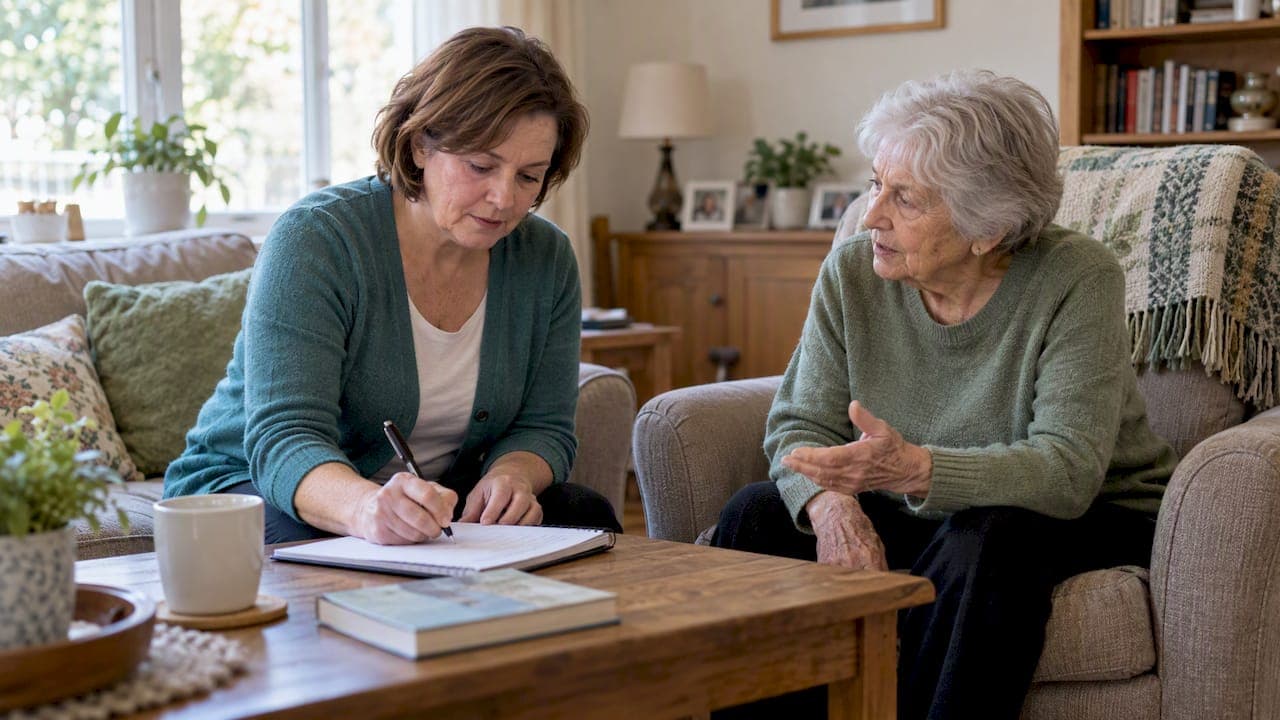
Before any caregiver home visit, prepare four things: clear, safe walking paths, an up-to-date medication and contacts sheet, a simple visit log, and a short notes packet with emergency and legal information. Resources like the National Institute on Aging's caregiver worksheets and the CDC's fall-prevention guidance can help you build this out. The sections below walk through each piece, room by room.
TL;DR:
- Confirm safety improvements such as securing rugs and improving lighting ahead of the visit, especially in stairs and hallways.
- Keep a current medication list, emergency summary, and detailed contact and responsibilities sheet easily accessible near the main entry.
- Conduct a thorough room-by-room safety review to identify hazards like loose rugs or clutter, prioritizing bathroom and stairs for quick fixes.
- Record visit details such as medication administration, tasks performed, mood, and incidents in a shared log that family members review regularly.
- Consider professional evaluations if there have been falls, ongoing mobility issues, or unsafe conditions persist despite household modifications.
Table of Contents
- Your pre-visit checklist: what to do in the days before and the morning of
- What documents to prepare and where to keep them
- The room-by-room safety walkthrough caregivers rely on
- What to expect during the visit and how to communicate well
- Keeping records and dividing responsibilities between visits
- When to bring in a professional home safety evaluator
- How to gently check in on physical and mental well-being
- Respecting privacy and dignity throughout every visit
- How this checklist came together
- How Helping Mom can support your next steps
- Worksheets and checklists worth printing today
- Sources
- FAQ
Your pre-visit checklist: what to do in the days before and the morning of
A little preparation in the days before a caregiver visit saves everyone time and worry once they walk through the door. Think of it less as a chore list and more as a way to hand someone a clear picture of your parent's daily life.
Three days ahead, confirm the logistics. Call or text to confirm the arrival window, and let the caregiver know how to get in. Some families leave a key with a neighbor, others use a lockbox, and some simply prefer the caregiver to knock and wait. Mention pets by name, note where to park, and flag anything unusual about the entryway, like a sticky door or a step that is easy to miss.
The day before, walk through the home with safety in mind. The CDC's Check for Safety checklist recommends removing objects from stairways, securing loose rugs and cords, and improving lighting in hallways and entryways. These small fixes take minutes but prevent the kind of fall that turns a routine visit into an emergency room trip.
The morning of the visit, pull together what the caregiver will actually need:
- A written summary of your parent's daily routine, including meal times, toileting help, and mobility needs.
- A current medication list with dosages and times, plus any recent changes.
- Contact information for the pharmacy and primary doctor, in case something looks off.
- A one-page emergency summary with advance directive location and health care proxy contact.
- Notes on preferred routines, like a favorite chair or a particular way your mom likes her coffee.
If a medication looks different from what is on the list, such as a new pill shape or an unfamiliar name, do not assume it is a mistake or let it slide either way. A quick call to the pharmacy clears up more confusion than guessing ever does.
Pro Tip: Keep a laminated index card by the front door with emergency numbers and entry instructions. It takes the guesswork out of a first visit, even if you are not there to greet the caregiver yourself.
What documents to prepare and where to keep them
A caregiver visit runs smoother when the paperwork is already organized, not scrambled together while someone waits at the door. Three documents matter most: a medication list, a contacts and roles page, and a visit log.
Your medication list should include the drug name, dose, time of day, reason it is prescribed, and the pharmacy that fills it. Note anything taken only as needed, often labeled PRN, and flag any change made in the last month. The NIA's medication worksheets are a useful starting point if you have never built one of these before, and our own guide to medication management walks through handling discrepancies in more depth.
A contacts and roles page prevents the common assumption that one family member handles everything. NIA research on sharing caregiving responsibilities notes that a single person holding all the information creates confusion the moment needs change. List who manages appointments, who handles finances, who provides transportation, and who is the first call for the caregiver if something seems wrong.

For storage, a paper envelope taped near the refrigerator works well because every caregiver knows to look there, though it only helps whoever is physically present. A shared digital file, such as a password-protected folder, lets far-away siblings stay current but requires everyone to actually check it.
Your visit log can be as simple as a notebook with these fields:
- Date and time in, time out.
- Tasks completed during the visit.
- Medications given or missed.
- Any notes or concerns observed.
- Follow-up needed before the next visit.
One page, consistently filled out, tells you more about your parent's week than a dozen phone calls ever could.
The room-by-room safety walkthrough caregivers rely on
A thorough walkthrough catches the hazards that are easy to miss when you see the same rooms every day. The CDC's STEADI program built its Check for Safety checklist around exactly this kind of room-by-room review, and it pairs naturally with a caregiver's first visit.
- Entry and stairs. Clear away shoes, boxes, or anything stacked near the door. Make sure handrails are sturdy on both sides where possible, fix any loose or uneven steps, and add a light near the top and bottom of the staircase.
- Living areas. Clear walking paths of furniture and cords. Remove throw rugs, or secure them firmly with non-slip backing, since loose rugs are one of the easiest fixes with the biggest payoff.
- Bedroom. Keep a lamp and phone within easy reach of the bed. A small night-light along the path to the bathroom helps far more than it costs.
- Bathroom. Add non-slip strips or a mat inside the tub, install grab bars near the toilet and shower, and consider a shower seat or raised toilet seat if standing or sitting is becoming difficult.
- Kitchen. Keep everyday items at waist height so there is no reason to reach or climb. Clear floor clutter, secure any rugs, and replace a wobbly step stool with a sturdy one that has a handrail.
- Outdoor pathways. Check porch steps and railings, add lighting near entry points, and clear leaves, hoses, or anything that could catch a foot after dark.
The Administration for Community Living frames this kind of walkthrough as the right first step for fall prevention, with a referral to an occupational therapist when hazards or functional concerns remain after the obvious fixes are made.
Pro Tip: Fix one room at a time instead of trying to overhaul the whole house in a weekend. The bathroom and stairs give you the most safety for the least effort, so start there.
What to expect during the visit and how to communicate well
A first caregiver visit usually follows a predictable shape, and knowing it ahead of time takes a lot of the nervousness out of the morning.
- Introductions. The caregiver meets your parent, and ideally you, to build initial rapport and ask about daily preferences.
- A brief safety review. The caregiver walks through the home, often confirming the same hazards you already addressed.
- Medication check. They review the current list against what is actually in the cabinet.
- Scheduled tasks. This is when the actual help, whether it is meal prep, bathing assistance, or light housekeeping, begins.
- Wrap-up. The caregiver confirms the next visit and notes anything that needs follow-up.
First visits tend to run longer than routine ones, since that extra time goes toward getting acquainted and working through the safety review together. Keep your own introduction simple and concrete: "Mom takes her blood pressure pill at 8 AM with breakfast, and she likes her shower before lunch, not after." Specific statements like this are more useful than general background.
Give the caregiver room to work. Step out of the room during personal care tasks, offer quiet oversight rather than hovering, and ask for their observations once the visit wraps up. A good caregiver will often notice small changes you have stopped seeing because you are there every day.
Keeping records and dividing responsibilities between visits
A consistent visit log turns scattered impressions into a real record of how your parent is doing. Note the arrival and departure time, tasks completed, medications given or missed, any incidents, your parent's general mood, and anything that needs follow-up before the next visit.
A shared record works better than one person's private notes. Some families keep a notebook in a central spot, like the kitchen counter, while others use a shared calendar or a simple cloud document that every sibling can open. Our printable caregiver schedule gives you a ready-made template if you would rather not build one from scratch.
Assign roles clearly: one person as the primary point of contact for the caregiver, another who updates the doctor, another who handles bills. Our guide on coordinating care for an aging parent breaks this down further.
Certain signs deserve a prompt conversation, not a wait-and-see approach:
- A new fall, or a repeated one.
- Confusion that seems worse than last visit.
- Medications that were missed or given incorrectly.
- Bruising or marks with no clear explanation.
Pro Tip: Review the visit log together as a family once a month. Patterns show up in writing that are easy to miss in scattered phone updates.
When to bring in a professional home safety evaluator
Some situations call for more than a family walkthrough. If your parent has fallen recently, is having a harder time with daily tasks like dressing or bathing, or if your home fixes have not resolved a hazard, it is worth asking about a professional evaluation.
Public health guidance supports this step directly.
A home walk-through is an appropriate first step for fall prevention, and if hazards or functional concerns remain, families can ask a qualified occupational therapist about a home safety evaluation.
The Administration for Community Living frames the decision this way, and it lines up with how the CDC's STEADI program approaches fall risk: start with the obvious fixes, then bring in a professional when something more is needed.
To take that next step, ask your parent's doctor for a referral to an occupational therapist, or look into a local home safety assessment service. Some basics to cover first:
- A bathroom with no grab bars and a parent who is unsteady.
- Stairs that remain a problem even after adding rails and lighting.
- Any sign that daily tasks, like cooking or dressing, have become genuinely difficult.
Whatever changes you recommend, loop your parent into the decision. A grab bar installed without buy-in often goes unused, while one chosen together tends to actually get used.
How to gently check in on physical and mental well-being
A caregiver visit is also a quiet opportunity to notice how your parent is really doing, without turning it into an interrogation. Simple observation tells you a lot: is your parent moving around the house steadily, or holding onto furniture more than before? Are they eating normally, or does the fridge look untouched since the last visit?
Conversation works better than a checklist here. Ask open questions like "How did you sleep this week?" or "What have you been up to?" rather than yes-or-no questions that shut a conversation down. Watch for repeated stories, trouble finding words, or a flat mood that was not there last time. None of this is a diagnosis, and it should never be treated as one. It is simply information worth sharing with the caregiver and, when it adds up, with your parent's doctor.
Caregivers are often well positioned to notice these shifts because they see your parent with fresh eyes each visit, while family members adjust gradually without realizing how much has changed. That is part of why the visit log matters: a single odd afternoon is not a pattern, but three logged instances of confusion in two weeks is worth a phone call.
Respecting privacy and dignity throughout every visit
Good caregiving never comes at the cost of your parent's dignity, and it is worth saying that out loud to the caregiver and to yourself. Knock before entering a room, even one your parent has lived in for forty years. Keep the bathroom door closed during personal care, and ask before moving or touching personal belongings.
Talk with the caregiver outside your parent's earshot when discussing sensitive topics like finances or memory changes, unless your parent wants to be part of that conversation, which is often the better default. Let your parent answer questions directed at them, even if it takes longer or the answer wanders. Speaking for them out of habit sends a quiet message that their voice matters less now, which is rarely the message any family intends.
Small gestures carry weight: asking "Would you like help with that, or would you rather do it yourself?" instead of just stepping in. This is not about following a script. It is about walking alongside your parent, not taking over their life one task at a time.
How this checklist came together
I have spent enough time inside family caregiving situations to know that confusion usually comes from missing information, not missing effort. A checklist like this one grew out of watching families repeat the same scramble before every new caregiver visit: hunting for the pharmacy's number, guessing at what Mom ate yesterday, forgetting who was supposed to call the doctor back.
One family I worked with cut their first-visit stress in half simply by taping a one-page routine sheet to the inside of a kitchen cabinet. The caregiver read it in two minutes and skipped the usual round of guessing questions. Helping Mom's printables and consultations exist for exactly that kind of small, practical fix.
— Mike C.
How Helping Mom can support your next steps
You do not have to build all of this alone, and most families do better with a little outside structure. The Caregiving Clarity Session is a one-on-one session designed to help you sort out roles, priorities, and next steps when everything feels tangled together.
If you want eyes on the home itself, Virtual Home Safety Consultations offer a remote walkthrough and a prioritized list of fixes, while In-Home Age-Safe Home Safety Assessments provide an in-home evaluation for a hands-on review. Families typically come away from these sessions with greater clarity on roles, a focused list of safety priorities, and a usable visit log template to share with a caregiver.
If you are ready for a clearer plan, book a Caregiving Clarity Session and start from a place of structure instead of guesswork.
Worksheets and checklists worth printing today
- NIA caregiver worksheets: covers responsibilities, safety, and medications.
- CDC Check for Safety: room-by-room fall prevention.
- ACL caregiver worksheet: clarifies who handles what.
- Helping Mom's printable caregiver schedule: ready-made visit log.
Sources
- Caregiver Worksheets | National Institute on Aging - NIH
- Check for Safety A Home Fall Prevention Checklist for Older Adults (CDC)
- Avoiding a fall (Administration for Community Living)
FAQ
What should be recorded in a caregiver checklist?
A caregiver checklist should record arrival and departure times, tasks completed, medications given or missed, your parent's mood, any incidents, and follow-up items for the next visit. The NIA's caregiver worksheets cover responsibilities, safety, medications, and important documents as the core categories worth tracking.
How do you prepare for a caregiver home assessment?
Prepare by clearing walking paths, securing rugs and cords, and improving lighting in hallways, stairs, and the bathroom, following the approach in the CDC's Check for Safety checklist. Have a current medication list, emergency contacts, and a brief routine summary ready so the caregiver or assessor can get oriented quickly.
What are red flags in a caregiver interview?
Watch for vagueness about training or experience, reluctance to provide references, and inconsistent answers about availability or responsibilities. A caregiver who seems uncomfortable discussing emergency procedures or who dismisses your questions about daily routines is worth reconsidering.
What do caregivers need most during a home visit?
Caregivers need clear, current information: a medication list, a daily routine summary, emergency contacts, and a sense of who in the family to call with questions. The NIA's guidance on sharing responsibilities notes that confusion often comes from one person holding all the details instead of writing them down for others.
When should a family bring in a professional home safety evaluator?
Bring in a professional when falls have occurred, mobility or daily tasks have become noticeably harder, or home fixes have not resolved an obvious hazard. The Administration for Community Living recommends a walkthrough first, followed by a referral to an occupational therapist when concerns remain.