

A family caregiver agreement is a written contract that pays a relative for hands-on caregiving while spelling out duties, hours, and pay so everyone stays protected. It gives families clarity, legitimizes compensation, and creates the paper trail Medicaid reviewers expect to see. If your family is heading in this direction, the next step is simple: sit down together, talk through what care actually looks like, and set a start date that begins today, not months ago.
TL;DR:
- Signing a caregiver agreement after care has already started can lead to Medicaid penalties through retroactive payments, so start payments only after signing.
- Local market rates for nonmedical care should guide compensation to ensure pay is considered reasonable by Medicaid and tax authorities.
- Family members acting as caregivers are generally classified as employees if they are under direct control, which involves tax withholding responsibilities and potential benefits.
- The agreement must clearly specify duties, hours, pay structure, and notice, with consistent documentation and recordkeeping to prevent legal or Medicaid issues.
- A family meeting and open communication are critical to ensure all siblings agree on the terms to prevent conflicts or agreement failure later.
Table of Contents
- What a Family Caregiver Agreement Is (And When Families Use One)
- The Core Components Every Caregiver Agreement Should Include
- Medicaid Rules, Look-Back Periods, and Setting Reasonable Pay
- Employment Status and Tax Basics for Family Caregivers
- How to Write the Agreement: A Step-by-Step Checklist
- Common Mistakes and Red Flags to Avoid
- When to Bring in a Lawyer
- Helping Mom's Perspective: Tools That Make Agreements Workable
- A Closer Look: Why Most Family Caregiver Agreements Fail Before They Start
- Sources
- FAQ
What a Family Caregiver Agreement Is (And When Families Use One)
You'll see this document called a few different things: a family caregiver agreement, a personal care agreement, or an elder care contract. The wording matters less than the substance, but Medicaid caseworkers and tax professionals tend to recognize "personal care agreement" more readily, so it's worth using that phrase in the document itself even if you think of it casually as "the caregiving deal with Mom."
Families usually reach for one of these agreements in a handful of situations. Maybe your sister has been driving over three times a week for a year, unpaid, and everyone agrees that needs to change. Maybe a sibling is about to leave a job to provide full-time care and needs a real income to make that sustainable. Or maybe your parent is doing private-pay long-term care planning and wants to compensate the child who's doing the heaviest lifting, while keeping things fair with siblings who aren't as involved.
Here's when families most often draft one:
- Ongoing nonmedical care has become routine rather than occasional (meal prep, bathing help, medication reminders, transportation).
- A family member is reducing work hours or leaving a job to provide care and needs formal, documented pay.
- The family is doing private-pay planning and wants a record that protects the paying parent's finances and the caregiver's time.
- Medicaid planning is on the horizon and the family wants documentation in place well before it's needed.
Who can actually sign it isn't always obvious. Ideally, the care recipient signs for themselves. If your parent no longer has the mental capacity to understand and sign a contract, the person holding power of attorney or acting as legal guardian can sign on their behalf, but that comes with real responsibility. A personal care agreement sample from the Caregiver Incentive Project notes that a POA or guardian signing for someone else is acting under fiduciary duty and should document the decision carefully. If that's your situation, loop in an attorney before anyone signs anything.
Formalizing this relationship in writing does more than satisfy Medicaid or the IRS. According to Family Caregiver Alliance, putting the arrangement on paper gives both the caregiver and the care recipient clarity, and it tends to reduce the kind of family conflict that flares up when one sibling feels another is either overpaid or under-thanked.
The Core Components Every Caregiver Agreement Should Include
Think of this as your audit checklist, whether you're drafting from scratch or reviewing something a family member already wrote. Skip any of these and you're leaving room for confusion, or worse, a Medicaid denial down the road.
- Start date and term. Always a future date, never retroactive. State whether the agreement runs indefinitely or for a set period, and how it renews.
- Termination and notice language. Spell out how either party can end the agreement and how much notice is required, typically 30 days unless circumstances change suddenly.
- Duties and expected hours. List specific tasks, not vague phrases like "help around the house." Include activities of daily living (bathing, dressing, toileting, mobility assistance) and instrumental activities of daily living (grocery shopping, meal prep, medication management, transportation to appointments).
- Compensation structure. State the hourly or flat rate, payment frequency (weekly, biweekly, monthly), and how overtime is handled if hours run long some weeks.
- Room and board terms, if the caregiver lives with the care recipient, including how that value is calculated against pay.
- Reimbursement rules for out-of-pocket expenses like groceries, gas, or medical supplies, and how receipts should be submitted.
- Recordkeeping requirements, including timesheets and expense logs.
- Backup care plan for illness, vacation, or emergencies.
- Amendment clause describing how the agreement can be updated as needs change.
- Signatures, witnesses, and governing state law.
The American Bar Association's guidance on caregiver payment agreements recommends reviewing the whole document annually, since care needs rarely stay static for long.
Pro Tip: Keep a printable weekly schedule attached to the agreement rather than folded into the contract text itself. It's much easier to update a schedule than to amend a legal document every time Dad's physical therapy days change.
Medicaid Rules, Look-Back Periods, and Setting Reasonable Pay
If Medicaid is anywhere in your family's future, this section matters more than any other. A written personal care agreement can genuinely help you document that payments to a family caregiver were legitimate care expenses, not disguised gifts meant to shelter assets. But it only works if you do it right.
The biggest risk is retroactive payment. Medicaid has a look-back period, typically five years, during which caseworkers examine financial transfers to determine whether assets were given away to qualify for benefits earlier than they should have. According to Medicaid Planning Assistance, payments made for care that happened before the agreement was signed are frequently treated as gifts, which can trigger a penalty period that delays eligibility. The fix is straightforward: sign the agreement, then start paying. Never the reverse.
"Reasonable" compensation is the other pressure point. Caseworkers want to see that pay reflects the actual market value of the work, not an inflated number designed to move money out of an estate. To establish that:
- Call two or three local home care agencies and ask their hourly rates for nonmedical care.
- Match your caregiver's pay to those local rates rather than picking a round number that feels fair.
- Keep screenshots or printed quotes from those calls as evidence, since a caseworker may ask how the rate was chosen down the road.
Helping-mom's Medicaid look-back guide walks through state-specific timing in more detail, since look-back rules and penalty calculations vary by state.
Employment Status and Tax Basics for Family Caregivers
This is the part families skip most often, and it's the part that causes the most trouble later. Once money changes hands regularly for care, the IRS generally considers your family member an employee, not an independent contractor, if the care recipient (or their family) controls when, where, and how the work gets done. That's the case for most in-home caregiving arrangements.
Getting this classification wrong has real consequences. Misclassifying a household employee as a 1099 contractor can trigger back taxes, penalties, and interest if the IRS or state labor department catches it, according to HomeWork Solutions. Watch for these red flags:
- The family sets the caregiver's schedule and supervises the work directly (a strong sign of employee status, not contractor status).
- The caregiver works exclusively for one family rather than offering services to multiple clients.
- No separate business entity, invoicing, or liability insurance exists on the caregiver's end.
If your family member is classified as a household employee, the paying parent (as employer) generally needs to withhold Social Security and Medicare taxes and may owe federal unemployment tax, depending on total wages paid. IRS Publication 926 lays out these household employer obligations in detail, including wage thresholds that trigger reporting requirements. If the caregiver operates independently across multiple clients, self-employment tax rules apply instead.
There's an upside worth mentioning: documented, taxed caregiver pay counts toward Social Security earnings history. A caregiver who's been working unpaid for years and starts receiving reported wages is building toward future Social Security credits, something that matters more the closer that caregiver gets to retirement age.
A payroll service or a tax professional familiar with household employment can handle withholding and filing for a modest monthly fee, and it's usually money well spent compared to sorting out a penalty notice two years later.
How to Write the Agreement: A Step-by-Step Checklist
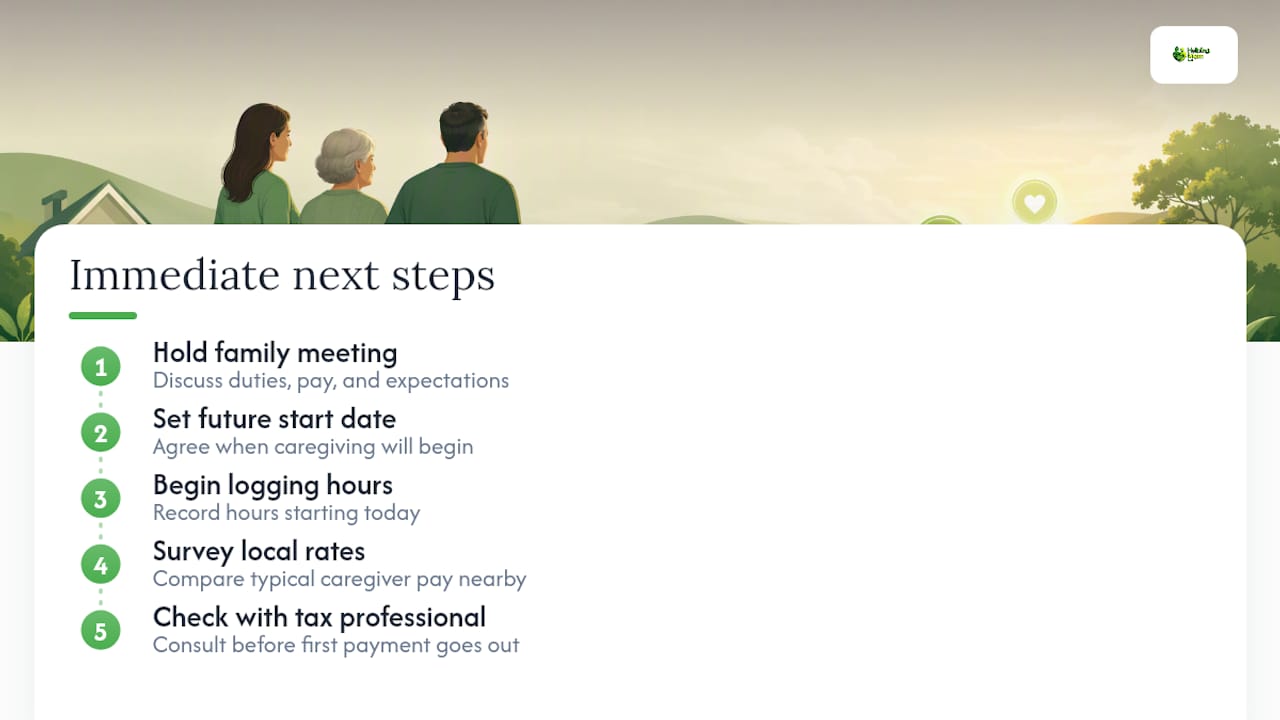
Before you draft a single word, hold a family meeting to talk through duties, hours, and pay openly. Skipping this step is the single most common reason agreements fall apart later.
- List every duty the caregiver actually performs or will perform, then estimate weekly hours honestly.
- Survey local agency rates to anchor your pay figure in something defensible.
- Fill in the template fields: names of both parties, effective date, specific duties, weekly hours, hourly or flat rate, reimbursement terms, termination notice period, and signature lines.
- Attach supporting documents: a timesheet template, an expense reimbursement form, and a backup caregiver contact list.
- Set a review date, ideally 12 months out or sooner if a health change occurs.
Helping-mom's printable caregiver schedule works well as the timesheet attachment mentioned in step four.
Common Mistakes and Red Flags to Avoid
Most caregiver agreement problems trace back to one of three habits. Watch for retroactive payments (paying for care that happened before signing), vague duty descriptions ("help as needed" instead of specific tasks), and pay that's noticeably higher than local market rates without documentation explaining why.
- Never backdate payments, even informally.
- Keep timesheets and receipts as you go, not reconstructed from memory months later.
- Write clear termination language and name a backup caregiver before you need one.
When to Bring in a Lawyer
Consider an elder-law attorney if Medicaid planning is likely within the next five years, if you're structuring a lump-sum payment instead of ongoing wages, or if there's any question about your parent's capacity to sign. Otherwise, your immediate next steps are: hold the family meeting, set a future start date, begin logging hours today, survey local rates, and check in with a tax professional before the first payment goes out.
Helping Mom's Perspective: Tools That Make Agreements Workable
A caregiver agreement only works if the family behind it stays organized. Our family meeting guide helps you run that first conversation without it turning into a debate about who does more. Our printable caregiver schedule keeps hours documented from day one, and our financial planning roadmap connects the agreement to your parent's larger financial picture. Revisit the agreement every year, and don't forget the caregiver's own well-being in that review. Our caregiver wellness resources exist because burnout is common among family caregivers, paid or not.
If your family is also thinking about home safety as part of this care plan, our practical guide to making a home safer for seniors is a natural next stop once the agreement is signed.
A Closer Look: Why Most Family Caregiver Agreements Fail Before They Start
Most families don't fail at the paperwork. They fail before they ever open a template, because nobody wants to be the one who brings up money first. I've watched this play out the same way over and over: one adult child quietly absorbs years of caregiving, resentment builds, and by the time someone finally suggests formal pay, the conversation feels less like planning and more like a referendum on who's been carrying the family.
That's the real reason so many agreements skip the family meeting step. It's not that people don't know they should talk it through. It's that the conversation feels harder than the contract. But an agreement drafted in isolation, without every sibling's buy-in, tends to unravel exactly when it matters most, during a Medicaid application, a hospital stay, or a dispute over an estate.
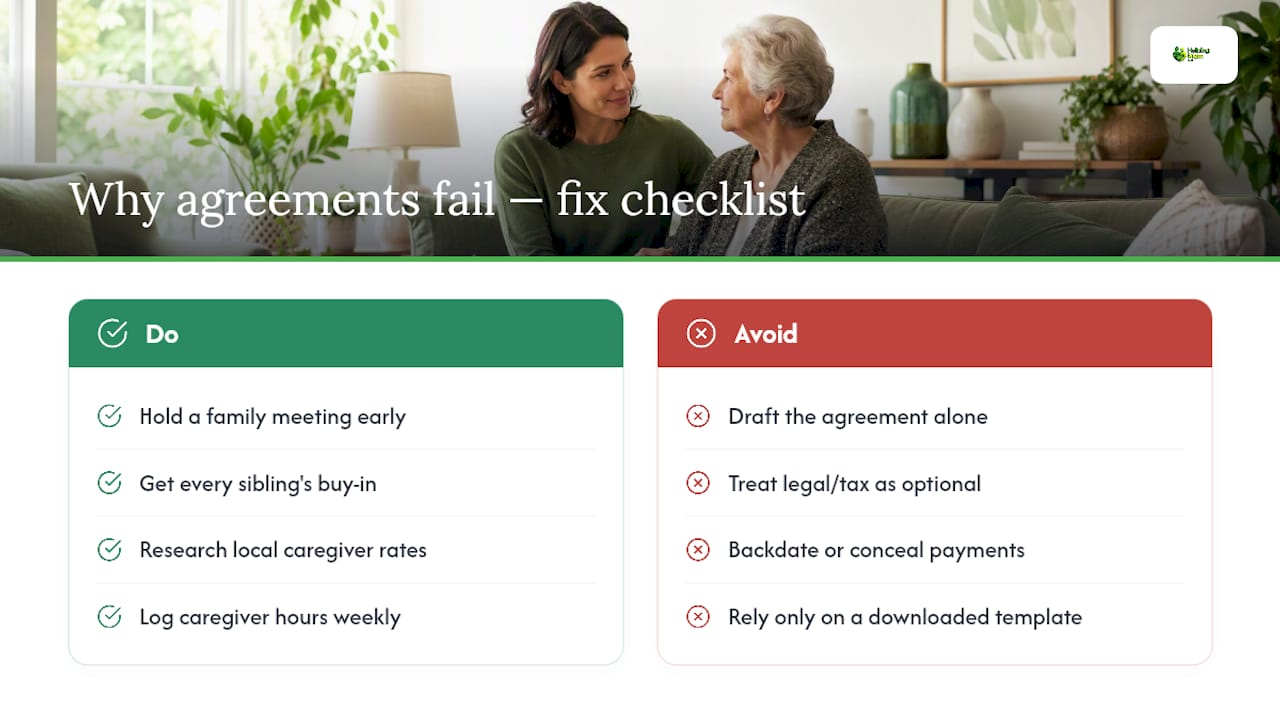
The other pattern worth naming: families treat the legal and tax pieces as optional extras rather than the backbone of the whole arrangement. A beautifully specific duties list means very little if the payments were backdated or the caregiver was misclassified. The IRS and Medicaid caseworkers aren't looking for perfect prose. They're looking for consistency between what the document says and what the bank records show. That's the gap that trips up otherwise well-intentioned families.
If there's one piece of conventional wisdom I'd push back on, it's the idea that a downloaded template is "close enough" for most situations. A template gets you the structure. It does not get you the family conversation, the local rate research, or the discipline to log hours weekly instead of reconstructing them from memory in March. The document is the easy 20 percent. The habits around it are the other 80.
— Mike C.
This article is general information, not a substitute for advice from a qualified financial advisor. Consult a qualified financial professional about your own circumstances before acting on anything here.
Sources
- Creating Effective Agreements for Payment of Family Caregivers — American Bar Association
- Personal Care Agreements — Family Caregiver Alliance
- Family Caregiver Contracts / Personal Care Agreements — Medicaid Planning Assistance
- Publication 926 — Household Employers Tax Guide (IRS)
- Family caretaker agreement (sample) — Caregiver Incentive Project
FAQ
Can I get paid to be a family caregiver in the U.S.?
Yes. Family members can be paid for caregiving through a written personal care agreement, private-pay arrangements, or in some cases state Medicaid programs that allow consumer-directed care. Payment must be documented, reasonable, and, for Medicaid purposes, tied to a future-dated written agreement.
What states pay family caregivers the most?
Pay rates vary widely by state and program, largely because Medicaid consumer-directed care rates and local home care agency wages differ by region and cost of living. Rather than chasing a single "best" state, check your state's Medicaid agency for its specific consumer-directed care program and compare local agency rates directly, since that's the figure caseworkers use to judge reasonableness.
What states pay you to take care of a family member?
Many states offer Medicaid-funded consumer-directed care or self-directed care programs that allow eligible recipients to hire and pay a family member as their caregiver, though program names and rules differ state to state. Medicaid is the starting point for finding your state's specific program and application process.
Does a caregiver agreement have to be notarized?
Notarization isn't universally required, but it strengthens the document's credibility if Medicaid or the IRS ever questions the arrangement. Many elder-law attorneys recommend notarizing the signature page and having a witness present, especially when a power of attorney is signing on behalf of the care recipient.